
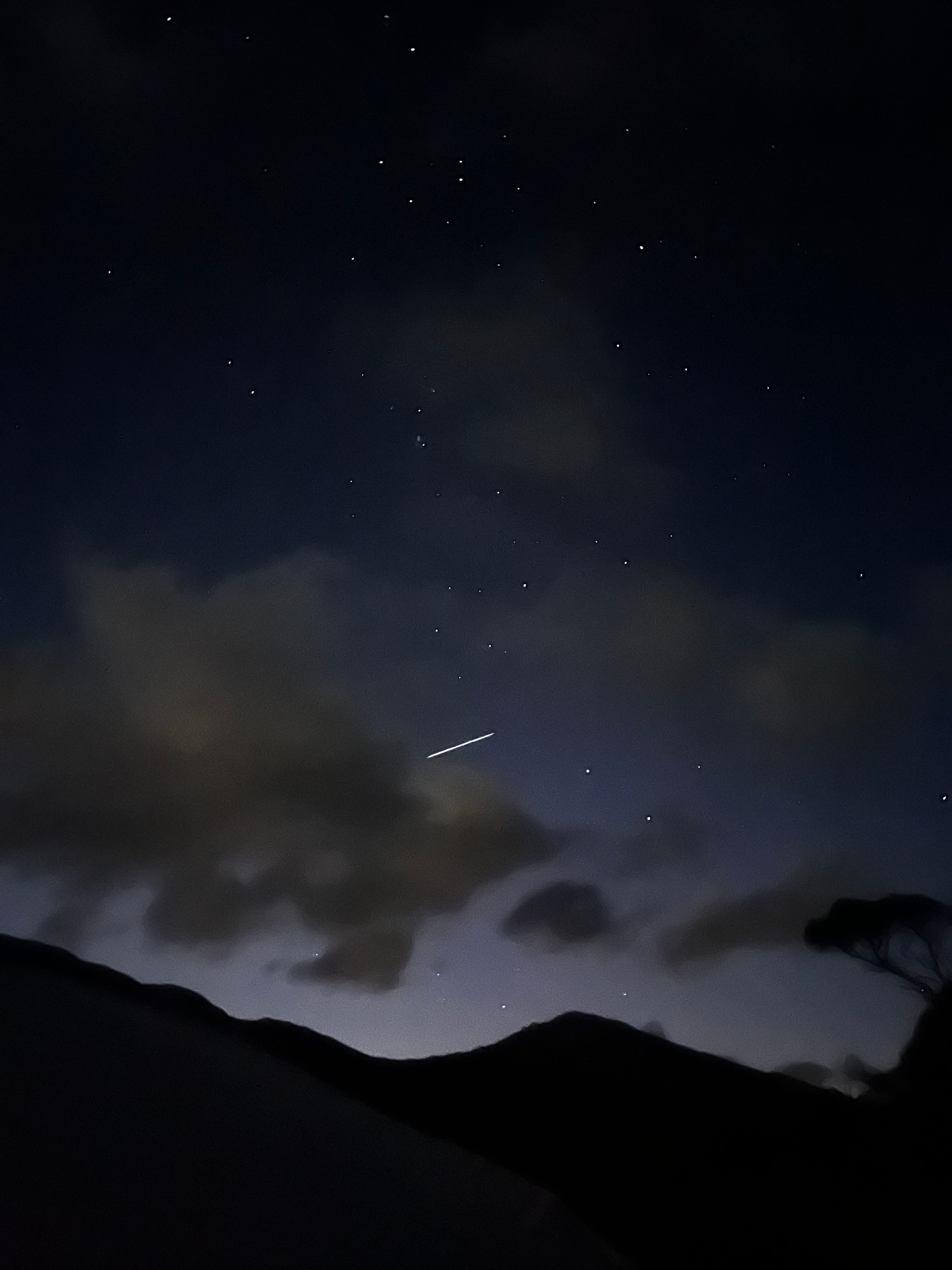
A few years ago I woke in the middle of the night while camping at the Prom, on the southernmost tip of Victoria, Australia. I climbed out of the tent - the sky was dark and clear aside from a few loose clouds floating close to nearby hills. It’s easy to feel small under a Prom sky; a type of calming insignificance I like to try to conjure later when I’m back in suburbia. I was scanning the nightscape enjoying this feeling when a long stripe of linked lights caught my eye. One light at the end of the chain would flick off, as a light at the front of the chain flicked on, and so on, as it moved across the sky. To my eyes this was a giant flying saucer, making way to land. Scrambling back into the tent for my phone and waiting for a tube of white light to descend to the earth (any minute now) I tried to shake my husband awake: there’s a huge string of lights darting across the sky! He grumbled and rolled over. I took a series of photographs from the tent opening and got back into bed, wondering what one is meant to do during an impending alien invasion. I landed on: google (isn’t it ironic). The search revealed almost immediately that this was not an alien invasion after all, but potentially an even more sinister event - depending on your viewpoint of course - starting with S and ending with K: it was Elon Musk’s Starlink, consisting of over 10,000 satellites low-orbiting our planet.
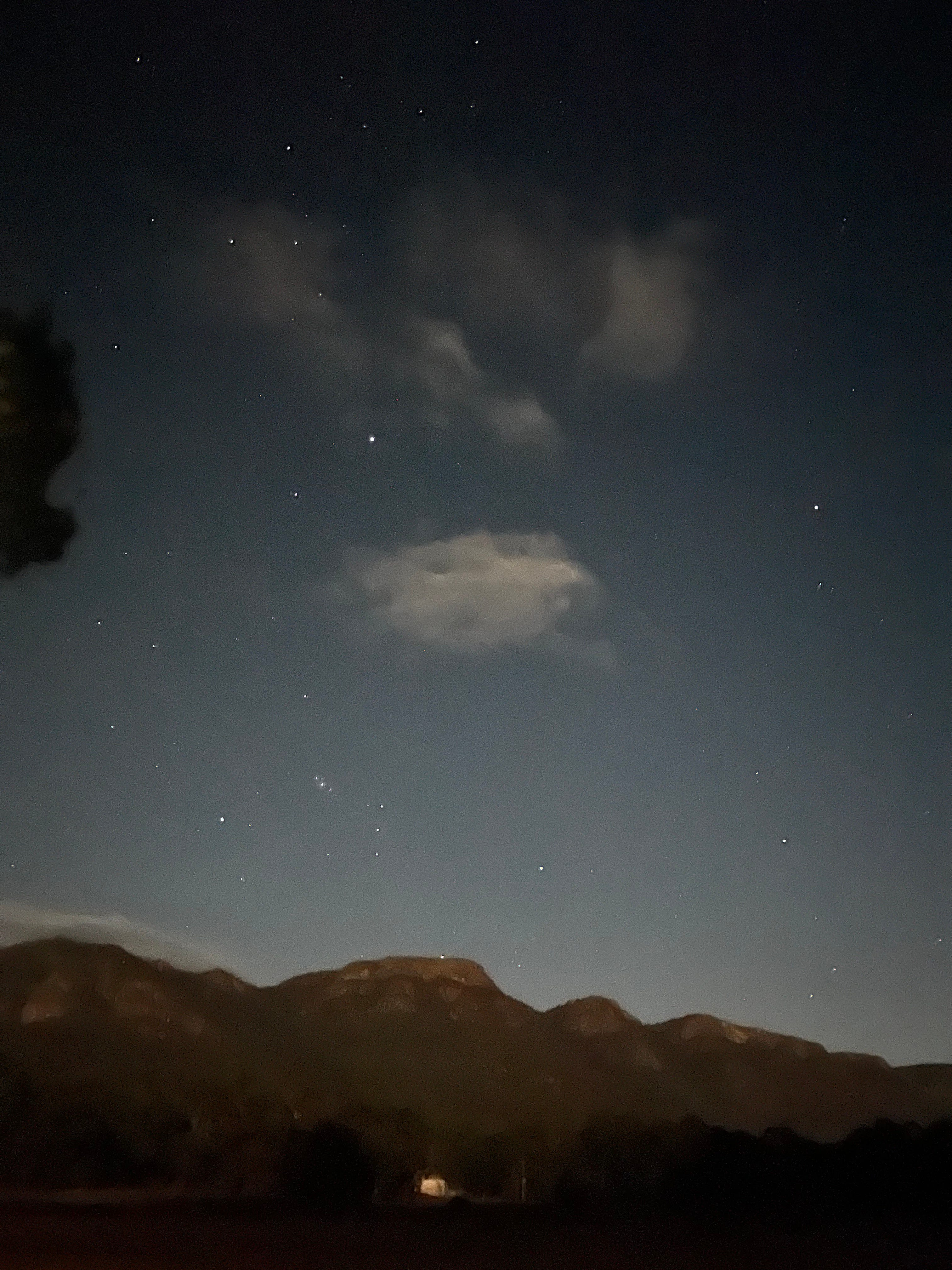
Last weekend the moon was on the cusp of full when I stepped away from the warmth of my house at around 11pm. It had been raining that evening and as my eyes adjusted I noticed the moon’s soft, sifted light filtering through water droplets held delicately by the tips of gum leaves, rendering the tall trees in my yard as though lit with a thousand fairy lights. I could hear the hushed tinkling of raindrops being released from the leaves, tiny orbs of light showering down to the ground. Captivated, I returned again the next night at the same time, but the light sat differently and I could only see the dark silhouettes of trees and neighbouring houses.
Starlink accounts for around 65% of active satellites orbiting earth, with many more satellites being imagined into future skies. Studies show that globally our night skies are lightening by 10% per year, and through a combination of satellites in orbit and human-made artificial lights on earth, we are changing the ecology of darkness. Astronomy, nocturnal patterns and habitats, migratory birds, our circadian rhythms, to name but a few, are all being disturbed and disrupted by these ever-increasing lightscapes.
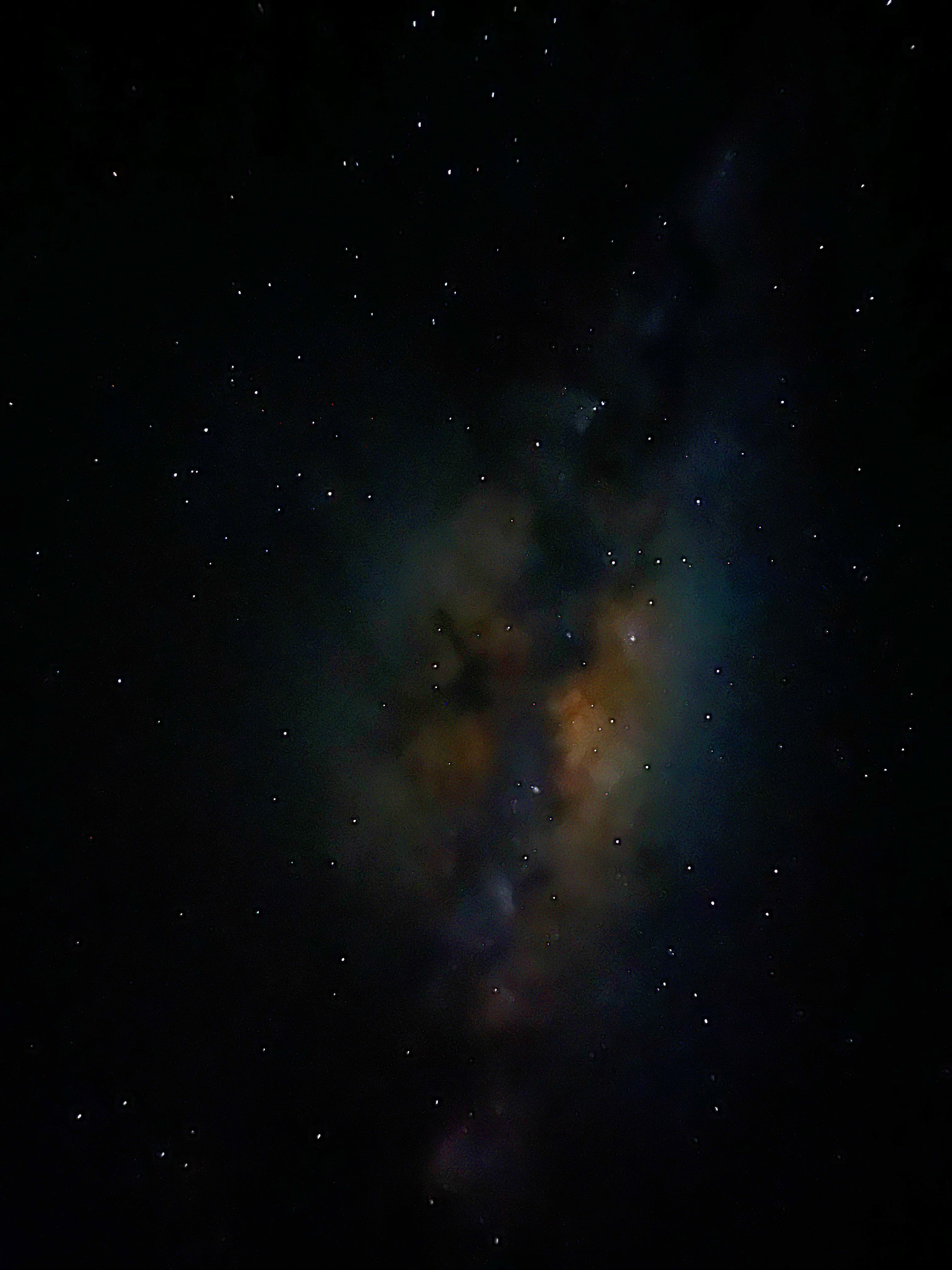
In my writing life outside of this platform in recent years, I have been researching and writing about the Bogong moth and learnt that it uses the stars as a navigation tool, a cosmic compass if you will. It relies on a combination of the earth’s magnetic field and maps in the stars for its lengthy nocturnal migrations, which I find astounding. As we go about our daily lives it’s easy to think of our homes and towns as human-centric places and forget the other beings who live right here alongside us, many of whom rely on the darkness of night to navigate, to breed, to eat. The Bogong moth is one of many beings who depend on the darkness of night to survive.
Humans have adapted to our well-lit environments - or have we? Artificial light, particularly of the cold, blue variety, has been shown to disrupt our circadian rhythms and melatonin production leading to a number of health concerns. Our entire lives are now easily disconnected from the environments we live in. We rarely need to worry about what season it is, or whether or not it’s night or day to manage our daily comings and goings. We are, for the most part, no longer guided by these natural rhythms and if we feel any sense of them, we tend to push them aside. In culture, films, sayings, we depict darkness as something to fear, but do we wish to go so far as to imagine a night without stars? For many, this is fast becoming a reality.
I was completely struck by this gallery of nighttime images (one of them features what appears to be Starlink in a much more defined way than my iphone image - can you spot it?). It was late at night when I was scrolling slowly through these photographs and reading the accompanying essay, and perhaps I was tired, but the enormity they capture - both of our galaxy and our world - had the salt pricking at the corners of my eyes.
“Given the myriad ways in which we humans have all but severed our connection to the natural world, perhaps none will prove to be as profound as the loss of the night sky and of our connection to the dark.” Dark Skies by Bear Guerra
If you enjoyed this piece and you want to delve further into this topic, try this and this and this.
I take the dog outside one night before going to bed and look up at the sky. It has been raining again, and the air is cold and completely still. The sky is overcast. I stare up at it for a while as the dog wanders around, trying to decide what colour it is. I land on beige-blue. It’s glowing dimly: glow worm, cryptonite. Rain drips from the trees. A neighbour arrives home. I take the dog inside and turn out the lights.
And that’s quite enough for now.
Until next time, travel light1 x
P.S. If you enjoyed this edition of Suburban Dreaming, a quick tap on the heart goes a long way, and sharing it helps these words find their people. Thank you, thank you.
Lucinda Bain is a contemporary Australian writer based in Melbourne, whose work explores motherhood, place, memory, suburban life and the natural world. Lucinda is mother to three daughters – a role that deeply informs much of her writing. She is currently studying librarianship at the master’s level, which complements her identity as a reader, writer, researcher and observer of how stories locate themselves in both home and landscape.
(My regular sign off seems to have unintended meaning this fortnight.)
Comments
Nothing yet. Say the first thing.
Sign in to join the conversation.