
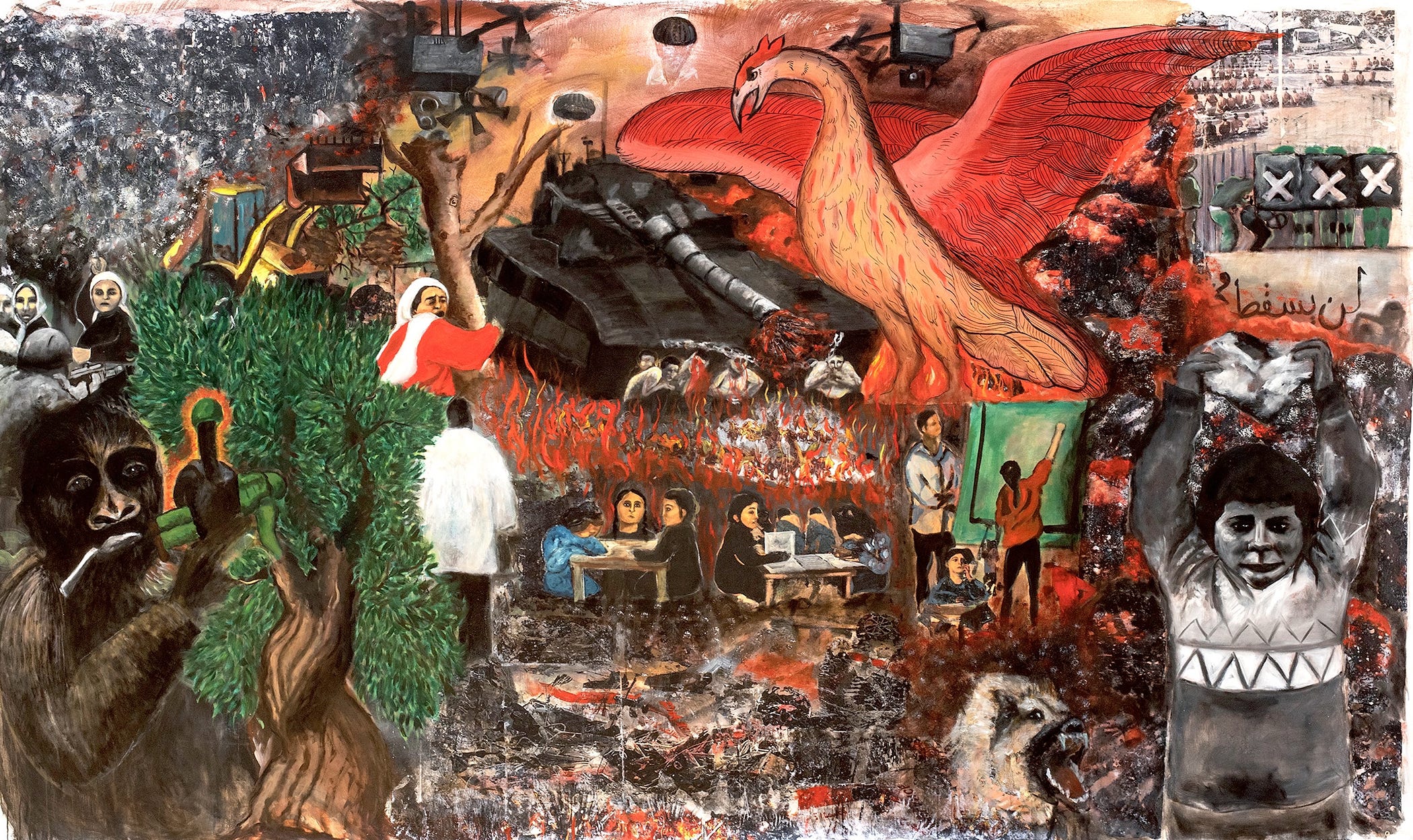
Malak Mattar, Gaza is a Phoenix, 2025.
I. Please make it stop.
There is no need to argue the case that there is an Israeli-US genocide ongoing in Gaza, now not as fierce as in the months of late 2023 but no less destructive to Palestinian society and life. The most recent newsletter from Tricontinental: Institute for Social Research reflects on why the world is silent on Gaza as the genocide grinds on. The intensities and forms of execution vary, but the genocide indisputably continues. To entertain doubts about the status of this ferocity as a ‘genocide’ is to fall into an argument with Zionism that is a distraction from the more fundamental issue: how to stop this genocide and how to assist Palestinian politics to end the occupation?
Across the world, from Malaysia to the United States, ordinary people are heartsick about the catastrophe against the Palestinians but take refuge in the immense fortitude of the Palestinian people to resist the occupation and war. Wherever I go, I see people trying to indicate their solidarity (the ubiquitous kufiya and the stickers and posters) as well as trying to find ways to assist the Palestinian struggle (raising money for relief and building campaigns to release political prisoners). An 8-year-old child comes to an event I did in Jakarta (Indonesia) and hands me a note that says she is doing everything that she can to end the genocide; in Johannesburg, an elderly man tells me that he has decided to dedicate the rest of his life to ending the war against the Palestinians: these are two of the thousands of interactions that I have had since 2023, when the sense of anxiousness and anger for the Palestinians has increased manyfold amongst ordinary people across the world, but particularly in the Global South.
Corporate media systems, however, fail this public sentiment, unable or unwilling to report the genocide with honesty and courage. They are held back by an international campaign that seeks to demonise the Palestinian struggle and to dehumanise Palestinians, while making the false argument that any criticism of Israel is tantamount to anti-Semitism. When corporate journalists make some noises for the truth, they find themselves on the street (the New York Times forced the resignation of Jazmine Hughes, Australian Broadcasting Corporation removed Antoinette Lattouf, MSNBC removed Mehdi Hasan, and the BBC sidelined six Arab journalists, including Nada Abdel Samad, Sally Nabil, and Mahmoud Shalib). In fact, the BBC explicitly told its journalists not to use the word ‘genocide’ in its coverage of the Israeli violence in Gaza. Corporate media around the world rely upon these outfits for news coverage from West Asia because they do not have their own reporters on the ground, and therefore this genocidal bias carried into the narrative of media in Africa, Asia, and Latin America.
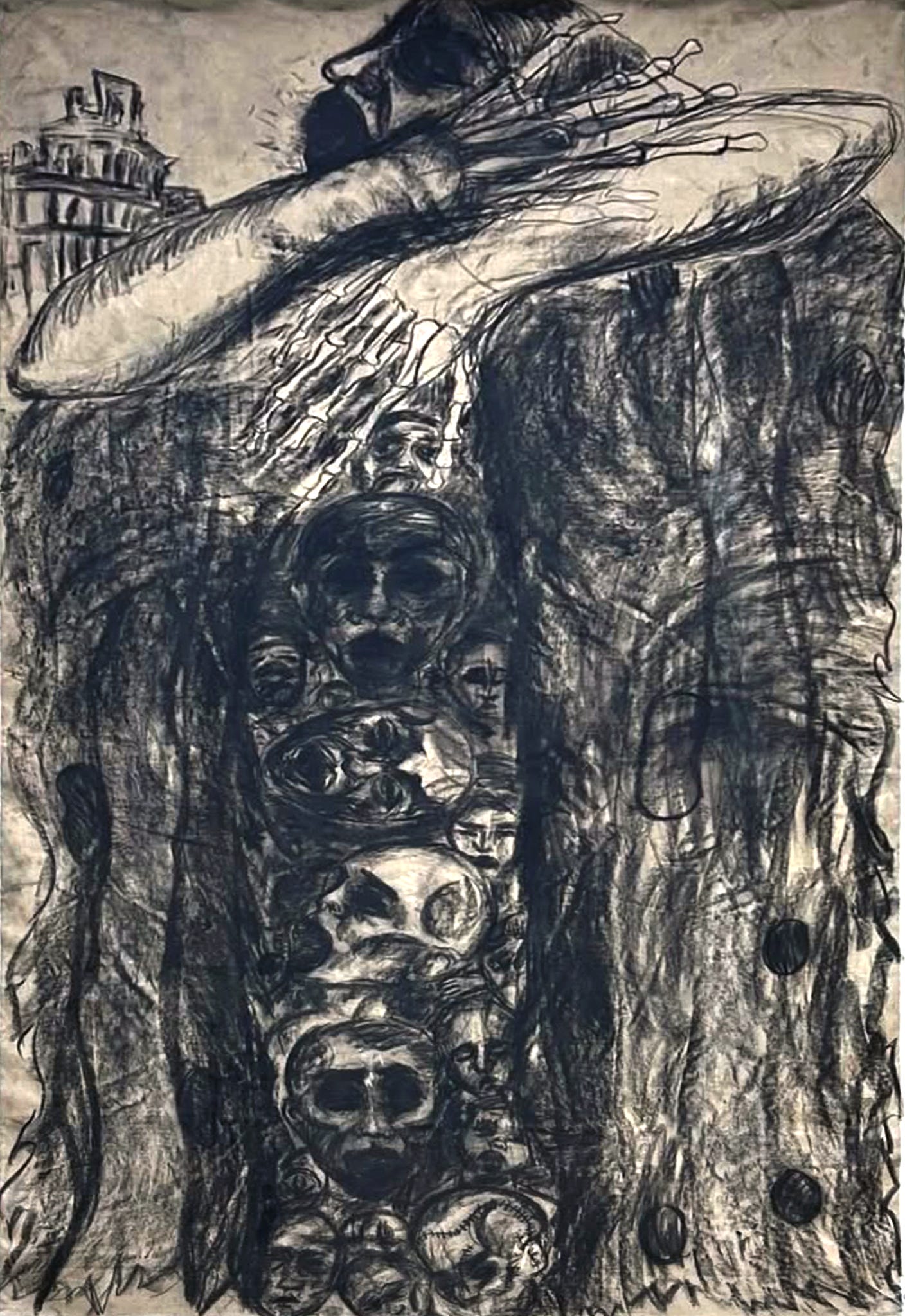
Malak Mattar, To Lose a Mother, To Lose a Child, 2025.
II. Blockade on the Truth
I am anti-Zionist. I don’t believe [Jews] have the right, after 3,000 years, to reclaim the land with western bombs and guns on biblical injunction. When I was in Israel it was as though I was in the middle of The Fire Next Time.
James Baldwin to Ida Lewis, Essence, 1970.
James Baldwin said those words in Turkey. He was attacked for them but insulated by distance. These were brave words for a US citizen in 1970. Baldwin references his 1963 book The Fire Next Time, which has two strong essays on the centrality of a racist structure in the United States that acts with violence against people of African descent. The way people of African descent are treated in the United States, Baldwin suggested, mirrored the way that the Palestinians are treated by the Zionist project.
Not sure that these words could easily be said by a writer of his eminence in our time. At least, no writer of his celebrity based in the West (apart from the Irish writer Sally Rooney) has been as vocal during the genocide in our time. Other writers in the West have said this or that, but mostly only after they have condemned the Palestinians for violence, even though international law permits those under occupation to use any and every means to fight for their emancipation. The demonisation of the Palestinians using the word ‘Hamas’ – now made into a myth rather than a genuine political movement and a military phalanx – is central to these writers, who believe that making that gesture immunises them from criticism. By doing this, they walk directly into Zionist ideology to affirm their own humanity and to condemn the Palestinians to the grave.
The impact of social media posts, however, undid the blockade on the truth. Palestinian journalists – whether working for Arabic language media outlets or working for small Palestinian media or for just posting content using their professional judgment – did get stories before the global public of the awful tragedies. It was thanks to this reporting by brave Palestinians that we got to have documented evidence that Israel had wiped out over 2700 family bloodlines in Gaza and had – in many of its strikes on civilian homes – killed four generations of a family in one sweep. Israel began to target these Palestinian journalists because they began to have a major impact on world opinion. On 10 October 2023, the Palestinian Press Union announced that Israel had killed four journalists. If there was any doubt about the targeting of journalists, this was dispelled by November 2023, when Israeli forces began to attack the homes of journalists and kill them and their families. Reporters without Borders filed their first complaint with the International Criminal Court on 1 November 2023. Since then, the Israel targeting of Palestinian journalists escalated with about 270 Palestinian journalists killed by Israel between October 2023 and May 2026. This was precisely to silence the voices of the Palestinians and to strengthen the embargo of news from Gaza (no foreign journalist has been permitted into the occupied territory, in contravention of the custom of modern war).
Large rallies flooded the streets of the Global North, with sizable sections of young people on the streets newly radicalised not only into the agenda of peace or of solidarity with the Palestinians but with an escalated understanding of the nature of imperialism. These rallies were huge, and they terrified the ruling classes of their countries – who began a crackdown against those who opposed the genocide. In the North Atlantic states, the countries began to forbid criticism of Israel through anti-terrorism laws (such as the UK’s Terrorism Act of 2006), anti-BDS laws (such as the Texas House Bill no. 89 of 2017), anti-hate speech laws (such as Chapter 7, Paragraph 130 of the German penal code of 1871 – amended in 1960 – that forbids volksverhetzung or incitement to hatred), and other employer and public order rules. Arrests of anyone posting things on social media critical of Israel and use of the immigration laws to threaten people had a mild chilling effect, although it did not silence the dissent. Establishment institutions such as museums and universities began to target curators and faculty members who spoke out against the genocide, and against the complicity of their governments in the genocide. The accusation of anti-Semitism was wielded freely, trying to chill any amplification of the terrorism inflicted by Israel on the Palestinians. In many cases, administrators known to have pro-Palestinians ideas faced pseudo-accusations of corruption and incompetence. Lobby groups and the local media highlight these accusations, which then went to the large media groups to pillory people and force resignations. This chills the entire environment for dissent of any kind. It became difficult for people who had some information from Gaza to even report this on social media, because their posts began to be screened either manually or through artificial intelligence. Careers sat on the line. Silences began to come into effect.
Academics in the North Atlantic states faced cancelled talks, investigations, suspensions, harassment campaigns, tenure threats – much of it due to donor pressure and political interference. There was mention of ‘institutional chilling’, ‘disciplinary pressure’, ‘soft censorship’, and less frequently outright expurgation of any free speech. Brave intellectuals, often with student and community support, fought these restrictions, but the question of employment loss hung in the air and began to squelch public criticism of Israel. It was acceptable to publish articles in minor academic journals with language relatively impenetrable to the vast masses – but much less safe to stand up in a public meeting and directly call Israel a genocidal country. The few who did that faced severe consequences. The rest had to satisfy their frustration with esoterica.
In many parts of the Global South, with some exceptions (such as Argentina and India), open criticism of Israel was not controlled by the governments (many of whom had supported the South African claim to the International Court of Justice in one way or another). But here, the intellectual climate had already been damaged by privatisation of colleges and universities, by a culture of overwork for underpaid teachers in public institutions, and by the destruction of the apparatus of intellectual culture (including of academic and intellectual journals, public spaces for discussion and debate, and the relationship between academic intellectuals and the media). Intellectuals in large parts of the Global South expressed their frustration on social media, in their own letters to the editor, and in whatever webinars they could hold for relatively small audiences. The public square in the Global South had already been shrunk into a neoliberal commodity.
But in many parts of the Global South, there is considerable space to openly speak and write about the outrage of the genocide. There is no army of compliant mercenary bureaucrats, as there are in the culture industries in the Global North. During my travels in Indonesia, Kenya, Burkina Faso, Ghana, and South Africa – over the course of the past two months – I was struck by the acceptable space created to speak with bluntness of the outrages against the Palestinians. There was no hammer that hung over the head of people, no police at the door, no anti-Semitism laws at the edge of the room, no eyebrows rising when you say basic factual things (such as that Gaza has the largest number of child amputees in the world). In the ruins of the neoliberal public space, there are new libraries and reading rooms opening that hold these discussions – from Pelagia Bookstore (Bandung, Indonesia) to the Ukombozi Library (Nairobi, Kenya) – where hundreds of people come to events, some wearing kufiyas, others with radical t-shirts, middle class and working class, anti-fascist football clubs and anti-imperialist reading groups. It is here that we can sniff the bold breaking of the blockade on the truth.
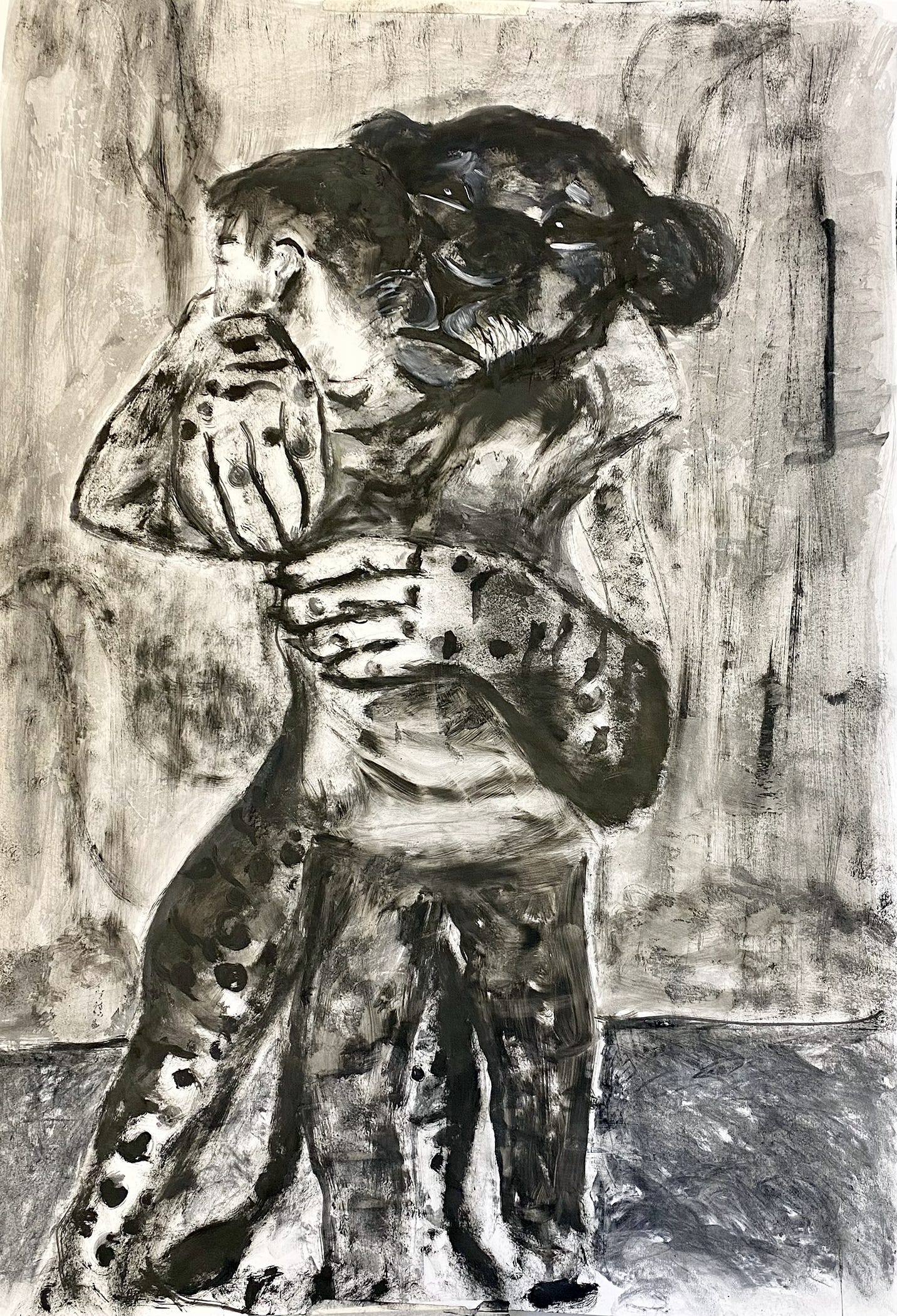
Malak Mattar, Seeking Peace, Wanting Freedom, 2025.
III. Breaking the Blockade on the Truth.
You, standing at the doorsteps, come in
And drink with us our Arabic coffee
For you may feel that you are human like us.Mahmoud Darwish, A State of Siege, 2002.
But these restrictions of one kind or another produced immense frustration amongst people who had begun to accumulate information about the devastation but found it difficult to amplify the genocide for reasons of employment or reputation or lack of an outlet. What compelled them to want to speak despite the limitations of ideology and the repressive atmosphere inflicted by US-Israeli power on the global stage was their humanity and their frustration at their own inability to speak with clarity. It would be impossible to disagree with the formulation that intellectuals have a moral responsibility to speak loudly during moments of human suffering. After the Holocaust and during the age of decolonisation, many intellectuals concluded that silence in the face of atrocity was itself a form of complicity. The founding charter of the UN Educational, Scientific, and Cultural Organisation (UNESCO) in 1945 captured this postwar reckoning with the statement, ‘Since wars begin in the minds of men, it is in the minds of men that the defences of peace must be constructed’. The idea was that fascism, genocide, and colonial violence had been enabled not only by armies, but also by propaganda, racism, obedient institutions, and the failure of intellectual resistance.
In 1947, Jean Paul Sartre published What is Literature in which he distinguished between the bourgeois idea of the ‘freedom’ of the writer and the ‘commitment’ of the writer; the former idea suggested licence and irresponsibility, while the latter enforced a moral obligation on writers. ‘The function of the writer’, Sartre wrote, ‘is to act in such a way that nobody can be ignorant of the world and that nobody may say that he is innocent of what it’s all about’. Three years later, in his Discourse on Colonialism (1950), Aimé Césaire argued that colonial violence and fascist violence had emerged out of European civilisation, and, in a challenge to European intellectuals, he wrote, ‘a civilisation that proves incapable of solving the problems it creates is a decadent civilisation’. These postwar debates helped establish a modern expectation that scholars, writers, and journalists have a duty to speak clearly about mass violence. For many contemporary intellectuals, therefore, the genocide in Gaza has become a test of whether those lessons still carry moral force today.
There are millions of scholars, writers, and journalists who have been active in a range of ways to highlight the genocide – but their efforts have been minuscule and many of them have become demoralised. What is the point of articulating in detail the moments of mass human suffering in Gaza – by major multilateral agencies (including the United Nations) and by intellectuals in the smallest of outlets – if these statements of documented outrage have come to nothing? It is not only the institutions that have tried to silence scholars, writers, and journalists who have created this failure, but it is the entire set of industries that have deformed culture and that have created a sensibility of indifference in the modern population – creating doubt about the genocide itself, creating a sense of futility about the violence, and creating a normality that allows everyday life to continue in its habitual incarnation while the brutality continues.
What this reveals is not the futility of intellectual work or the courage of the intellectuals themselves, but the depth of the structures against which intellectual work and intellectuals struggle. The issue is not merely that governments ignore evidence or that media corporations distort reality. It is that contemporary capitalism has produced an entire architecture of distraction, exhaustion, spectacle, and managed feeling that absorbs even the most horrifying images into the ordinary circulation of daily life. Atrocity is transformed into content. Outrage becomes episodic. Suffering appears briefly before disappearing into the endless stream of commodities, entertainment, and anxious survival that structures modern existence. In such a condition, the responsibility of intellectuals cannot simply be to provide more information, since information itself is no longer sufficient to generate moral action. The task becomes larger and more difficult: to break the habits of indifference, to restore the human meaning of suffering, to defend historical truth against organised falsification, and to insist that Palestinian life cannot be treated as disposable within the moral order of the world. Is this easier said than done? Not really. We stay informed through serious journalism, historical scholarship, eyewitness testimony, literature, and human rights documentation rather than relying on the sensational coverage of the corporate media. This requires us to build institutions that transmit people-centred journalism, not only about people but for people (which means media done in languages understandable by people). It is important to remember that our media must be captivating and transformative of consciousnesses not only a transmission of information. This is what we see in media such as Breakthrough News, Pan-African TV, Brasil de Fato, and others. We resist indifference by refusing to treat Palestinian suffering as routine, distant, or inevitable. We restore the human meaning of suffering by focusing on lived experience, including the destruction of ordinary life and the fight for existence. Our media for each other must not reduce people to statistics, symbols, or geopolitical abstractions. Even when these interventions appear ineffective in the immediate sense, they remain essential because they preserve the possibility that humanity itself might still resist normalisation of barbarism. We must break the blockade on reality.
To break this blockade on reality requires more than the circulation of facts. It requires forms of political and cultural work capable of overcoming isolation, fragmentation, and learned helplessness. Solidarity with Palestine remains a mere gesture unless it is directly linked with domestic struggles of the local working classes. Solidarity is not a one-way street, where the privileged express solidarity with those seen to be without power. Solidarity with Palestine must be seen as critical to the success of domestic struggles. Can we use solidarity with Palestine as a weapon to hurt our ruling classes? The immense task before us is to reconnect suffering to structures of power, to transform private horror into collective consciousness, and to rebuild institutions that can sustain moral attention beyond brief cycles of spectacle. Intellectuals, artists, educators, and movements must therefore struggle not only against censorship, but against the habits of passivity that allow atrocity to appear distant, inevitable, or unreal. The defence of truth becomes inseparable from the defence of human collectiveness itself.
The modern order isolates people into competitive and anxious individual existence while dissolving the capacities required for collective moral and political action. Against this decomposition, the project of rescuing collective life means rebuilding popular organisations, public culture, trade unions, peasant movements, study circles, and political education capable of restoring a shared commitment to human dignity. It is only through such collective structures that societies can resist the normalisation of cruelty and overcome the paralysis produced by spectacle and despair. In this sense, solidarity with Palestine is not merely an act of sympathy with distant suffering; it is part of a broader struggle to defend the very possibility of a humane and collective future.
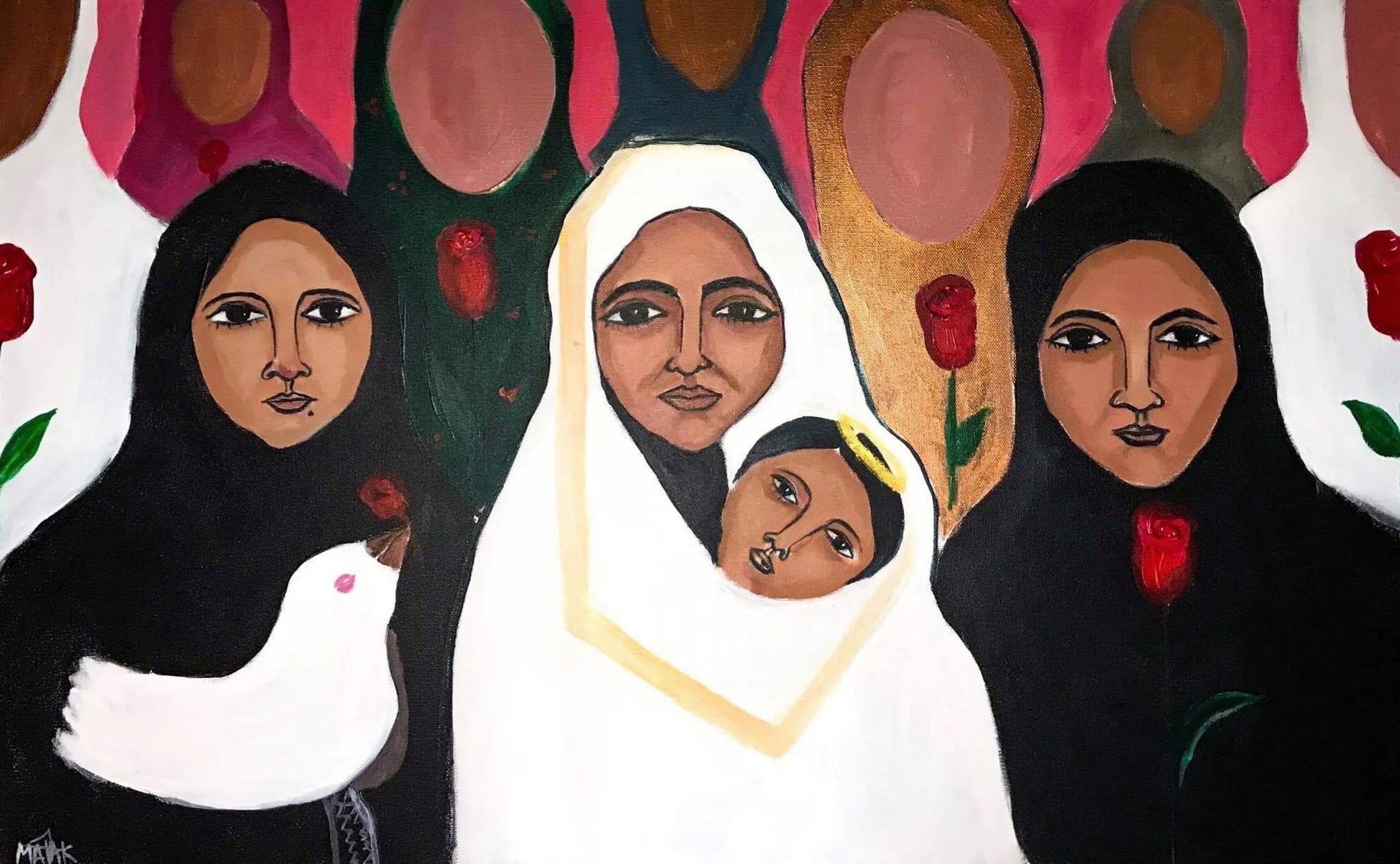
Malak Mattar, The Mother and Child, 2019.
(Thanks to dear Malak Mattar for the use of the images - please visit her website. Support her work by buying a copy of No Words…(For Gaza), in which I have an essay on her work, and get the new book by Wesam Afifa called Survivors of the Darkness, for which she did the cover).
No posts
Comments
Nothing yet. Say the first thing.
Sign in to join the conversation.