
Welcome back to Lucid, and hello to all new subscribers. I hope you are enjoying the summer and making some time to relax away from the news. I am trying to spend time in nature and listen to music more.
This essay is a bit long but once I delved into the subject of personal lawyers of authoritarian leaders it was hard to stop. Many autocrats, Putin and Xi among them, don’t have designated personal lawyers, or ones that are known publicly, in any case. But those who do offer some interesting context for Todd Blanche and his likely dereliction of duty as Attorney General.
___________________
The appointment of President Donald Trump’s personal criminal lawyer, Todd Blanche, as Attorney General, is the latest sign that America is experiencing a form of personalist rule. This is a form of autocracy which organizes governance around the self-preservation of a leader whose private interests prevail over national ones in shaping domestic and foreign policy.
While it is more common in established regimes, personalist rule can emerge in degraded democracies, such as Italy under Silvio Berlusconi, and in countries in transition from democracy to autocracy, which is the case with today’s America.
Personalist leaders have no interest in public welfare or serving the people. Holding public office is a vehicle of private enrichment for them, their families, and their allies, and a means of finally solving their abundant legal, financial, and other problems once and for all.
Having the right custodian of justice, who real job is freeing the autocrat from the obligations and burden of obeying the law, is key to success.
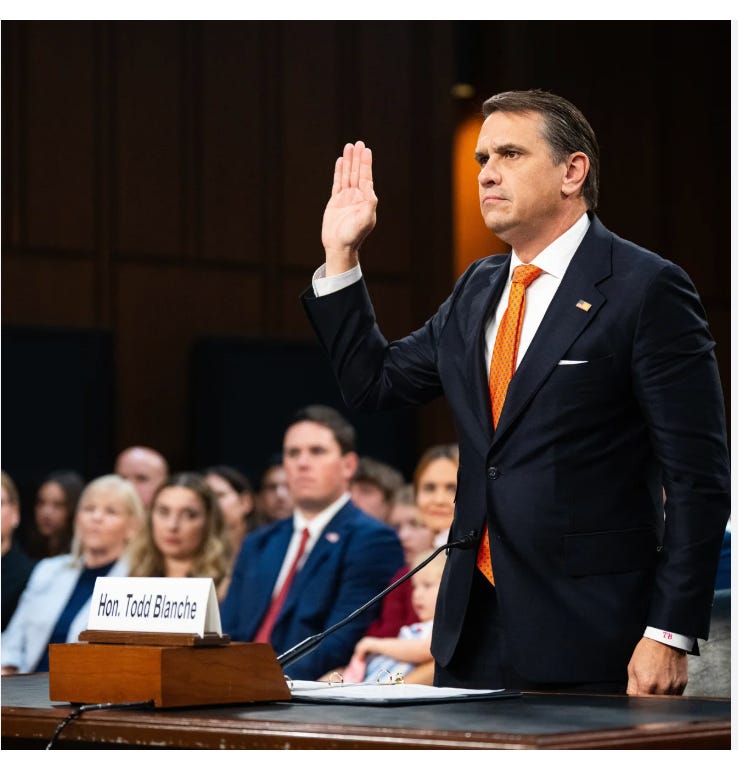
This essay places Blanche’s appointment in comparative perspective, looking at the fates and roles of other personal lawyers of autocrats. As we’ll see, the proprietary view personalist rulers have of their jobs means that quaint notions such as conflicts of interest, or the separation of public and private, do not apply.
Government institutions are “hollowed out” under autocracy, meaning that the civil service must lose its professional ethics and impartiality and do what the leader asks. Yet government institutions are also retooled and infused with new missions and priorities. Number One is: always defend the leader from prosecution, including by targeting anyone who tries to expose his wrongdoing, such as journalists, opposition politicians, lawyers, and judges who stand up for canons of judicial impartiality and rule of law.
In personalist states, government-allied media, politicians from the leader’s party, and government institutions, the judiciary included, devote time and resources to satisfying the leader’s personal vendettas and obsessions, as sycophants and toadies who serve as officials compete for his approval by translating his will into policy.
Historian Ian Kershaw described this situation in Nazi Germany as “working toward the Führer,” and the Third Reich provides one of the most extreme examples of the personalization of rule and justice. The Führerprinzip, or Leader Principle, decreed that Adolf Hitler’s will was superior to any written law.
Hitler’s Personal Lawyer
Hans Frank, an architect of the Leader Principle, served as Hitler’s personal lawyer starting in the Weimar Republic. Frank participated in the Munich Beer Hall Putsch as a stormtrooper, and attended the 1924 trial. He passed the bar in 1926 and started working for Hitler in 1927, representing the future Führer and other prominent Nazis in hundreds of trials. In 1931 he also became the Nazi Party’s legal advisor, a job he retained for over a decade.
Once Hitler came to power he appointed Frank to important posts: the Bavarian region Minister of Justice, Reich Minister without Portfolio (so he could fix Hitler’s messes under the radar), and the head of the Academy of German law and the National Socialist Jurists Association. Hitler’s legal needs were now taken care of by the state apparatus, but Frank parlayed his status as Hitler’s former personal counsel into positions that determined the norms of Nazi jurisprudence –including the idea that Hitler’s personal will was a source of authority beyond all law.
Frank is infamous for his role in Nazi atrocities as Governor-General of Poland from 1939 on, which accounted for his presence at the Nuremberg Trials and his war criminal conviction. At his 1946 trial, he testified that he only met with Hitler in person six times during the Third Reich. This seems unlikely, given their long history, and a statement by Frank quoted in Gerry O’Connor’s book, The Butcher of Poland, sums up the exhilaration that came with feeling needed by a man who seemed like a God.
I know why Hitler loves me…I so appeal to Hitler’s vanity. But there is a further reason. It is my secret, and it is Hitler’s too. I cannot describe the ecstasy I feel, the rapture, the high peak of my emotions.
Berlusconi’s Personal Lawyers and Personalized Laws
Berlusconi, a billionaire, was one of the most corrupt leaders ever to govern a democracy, with a range of crimes that rivals Trump’s in number: he and Trump both have Wikipedia pages devoted to their thousands of litigations. Throughout his terms as Prime Minister (1994, 2001-2006, 2008-2011) personal lawyers helped Berlusconi to destroy the legal system as it had existed and arrange for new laws that benefited his personal circumstances.
Italian Parliament passed dozens of ad personam measures that made it easier for him to disobey the law without consequences. A series of laws from 2003 onward granted Berlusconi and other high state authorities immunity from prosecution while they served in office. Did I mention that Berlusconi was then on trial for his involvement in bribing judges?
Here we arrive at a key duty of the autocrat’s personal lawyer: to take the fall for him, even if that means going to prison (Michael Cohen may come to mind). That was the fate of Cesare Previti, who was convicted of bribing judges on Berlusconi’s behalf when he was Il Cavaliere’s personal attorney in the 1990s. Back then, Berlusconi tried to make Previti Minister of Justice –the equivalent of Attorney General—but that move was vetoed by the Italian President, so he made Previti Minister of Defense instead.
Once Previti was out of the picture due to his conviction, other personal lawyers perfected the arts of harassing judges and running out the clock, taking advantage of Italy’s famously slow court system. Berlusconi also tried a new strategy: he appointed two personal lawyers, Niccolò Ghedini and Piero Longo, who were members of the Chamber of Deputies and the Senate, respectively, both of them representing Berlusconi’s party, Forza Italia. This means that their salaries were paid by taxpayers while they helped Berlusconi to evade justice.
Recep Tayyip Erdogan and Viktor Orban also saw the wisdom of appointing personal lawyers who were members of Parliament, so the lawyers could be voting on laws that would help the leaders’ personal situations. Ali Ozkaya, Erdogan’s personal attorney, represents Erdogan’s AKP party, and is heavily involved with policing his boss’s image: he has been an architect of the “insult suit” strategy to sue Turks at scale (over 160,000 and counting) for criticism of the leader.
István Bajkai, Orban’s personal lawyer until his death in 2023, was a co-founder of Fidesz, represented the party in parliament, and had a similar function to Ozkaya: he was a board member of the massive pro-government media conglomerate (the Central European Press and Media Foundation) that funded about 80% of Hungarian media under Orban and shut out criticism and news about corruption.
The priorities, fears and fantasies of autocrats can be gleaned by who they hire for this sensitive role and what they ask their personal lawyers to focus on.
Blanche: Chief Epstein Coverup Official
And so we come to Blanche, who journalist Nina Burleigh calls “Trump’s Chief Epstein Coverup Officer.” Here she describes the credentials that likely got him the job:
Blanche has already proven his eagerness not merely to preside over the Epstein Files Coverup, but to personally engineer it – from executing an apparently illegal quid pro quo with sex monster Ghislaine Maxwell, to overseeing the redaction of names of rich predators in the files, to publicly promising to flout the Epstein Files Transparency Act entirely and withhold millions more pages of evidence that Congress has demanded be released.
Enabling the Epstein coverup is only part of the calamity of this appointment, which lawyer and civil rights advocate Sherrilyn Ifill sees as the collapse of rule of law in America. As she writes, Blanche affirmed at his confirmation hearing “what he believes is the right of the President to fully control every apparatus of the federal government, including federal prosecutions.”
In other words, Blanche sold himself to GOP politicians as the perfect tool of a personalist state vision of justice, and as the servant of a man who, in his reading, is bound by no checks and balances, who has immunity for official acts and the right to control prosecutions. With Blanche, Trump has found the perfect partner to complete his reengineering of the judicial system to make himself feel safe and beyond the reach of the law no matter what he does.
Luckily, we are not Orban’s Hungary, with an 80% media capture. We can continue to speak out and educate others about the conversion of justice into a system that allows the powerful to get away with crime. And the robust legal pushback against the Trump administration, which now has hundreds of successes in court, is another difference.
As Trump becomes ever more unpopular, he and Blanche will lose legitimacy. Personalist leaders have a much higher rate of involuntary exits than other kinds of authoritarians: there are only so many people to take the fall for you before it is your turn to be held accountable.
No posts
Comments
Nothing yet. Say the first thing.
Sign in to join the conversation.