
“The Russia-Ukraine war is, in many ways, an open laboratory providing insights into what war and large-scale, multidomain combat operations may look like in the decades ahead,” observed U.S. Army Colonel, Dr. Todd A Schmidt, in 2024. “Multidomain” refers to operations that include air, land, sea, space, and cyberspace, each with a physical human and informational dimension.
Since then, the dramatic pace, variety, and import of technological change, from the centrality of drones (now used in 80-85% of frontline targets in Ukraine) have led analysts to argue that we are living through a revolution in military affairs. An RMA happens when bundles of new technologies drive the development of new operational doctrines, bringing about shifts in strategy, priorities, and thinking about armed conflict.
The two world wars are obvious cases, but regional conflicts can spark RMAs or serve as testing grounds for technologies that will be scaled up in future significant conflicts.
This is the case in Ukraine, where the Kremlin’s quest to annihilate Ukraine has instead seen Ukrainians increase their status and geopolitical footprint, becoming leaders of a new mode of war “increasingly shaped by operators, engineers, and algorithms,” as Kateryna Odarchenko writes.
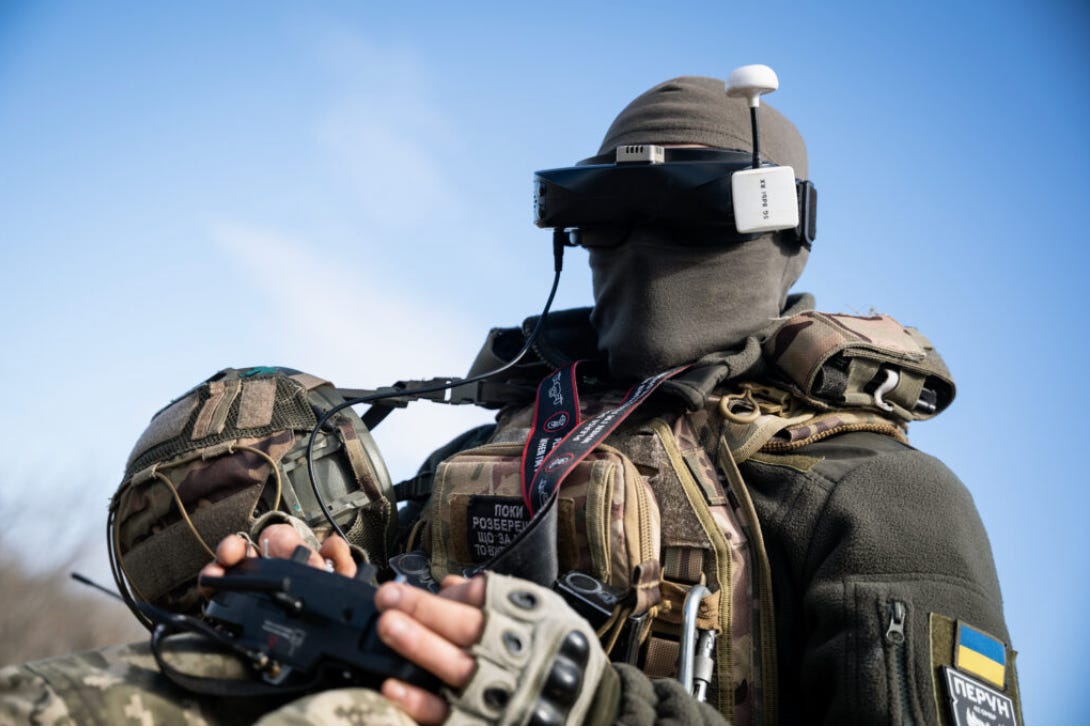
Ukraine has engaged in “drone diplomacy,” assisting Gulf states with drone and counter-drone technologies (several hundred Ukrainian experts are deployed to the UAE and Qatar) in return for financial support, fuel supplies, and more. Ukraine also has defense agreements with many European countries. The greater transparency of the 2020s battlefield allows many foreign militaries to learn about unmanned aerial vehicles, while Go-Pro-equipped Ukrainian soldier-filmmakers on the front are documenting the war “from the inside.”
These technological teachings by a country that is under siege make the failure of most countries to provide Ukraine with sufficient weapons to defend itself against Russian ballistic and cruise missiles more ignominious. As Anne Applebaum and I observed in our recent conversation, the stakes of the war are existential for Ukraine and for democracy in Europe. If Russia stops fighting, the war will be over. If Ukraine stops fighting, Ukraine will be over –it will cease to exist as a sovereign entity and culture and Russia and its allies will feel empowered to move on their next democratic targets.
The United States under the Donald Trump administration is in a class by itself in terms of this hypocrisy. While US companies such as Anduril test their drones in Ukraine, as a Modern War Institute report detailed in January 2025. Trump has refused to give Ukraine Patriot missiles. He cites depleted U.S. inventory, but has approved the sale of missiles to Saudi Arabia. Trump’s slavish relationship with Putin means that America will never seriously compromise Russian military capability or act in ways that would significantly boost Ukrainian success.
Ukraine: Ground-Up, Flexible Infrastructure and Motivated Citizen Mobilization
In 2022, virtually everyone underestimated Ukraine’s military capabilities, despite the country having massively reformed its military after the Russian annexation of Crimea. Ukraine may have been motivated to invest in drones due to the lack of a large modern air force. Yet as Andriy Zagorodnyuk observes, Ukraine is not using drones to compensate for a lack by the metrics of conventional thinking, but rather changing the whole operating system of war.
What Applebaum calls a “ground-up” national culture has made that innovation possible. Ukraine has a distributed, bottom-up innovation model with hundreds of firms and volunteer groups developing technology as well as combat formations being part of the research and development process. Zagorodnyuk has written about a shift toward brigade-centric innovation, “with individual units increasingly acting as focal points for experimentation, adaptation, and capability development.”
Russia: Centralization, Combatants as “Meat Grinders”
In contrast, here is the Russian military as described by Col. Schmidt: “Archaic, costly, and overly political, protective, and bureaucratic processes and decision-making frameworks are self-defeating encumbrances.” Russia’s assault on Ukraine in 2022 immediately exposed the toll of Kremlin corruption on the military and how Russian fighting capabilities had been overestimated. Russia’s centralized, statist approach to war means changing operational and production systems is not easy.
Yet Putin does not seem to care what happens to Russian soldiers: he shares the autocrat’s use-and-discard view of people, including in war.
Russia has sustained devastating losses at every rank and in almost every unit, including elite corps such as the 331st Guards Parachute Regiment. An astounding number of generals died in the first year: they were at the front to impose discipline on unmotivated and badly trained soldiers saddled with inferior equipment and rancid rations. As of 2024, nearly 20 percent of Russian casualties were highly trained officers.
“This isn’t war. It’s the destruction of the Russian people by their own commanders,” said Mikhail, a Russian soldier wounded in Ukraine, in December 2022, referring to the Kremlin’s callous treatment of Russian troops. Then and later, hundreds of thousands of young men fled Russia to escape being killed in “meat grinder” offensives that bring home Mikhail’s observation.
CIA director John Ratcliffe recently disclosed a shocking statistic: the average Russian recruit on the front lines in Ukraine survives only 20 or 30 minutes before being killed or wounded, in part due to the proliferation of AI-powered drones as “low-cost killing machines.”
This enormous loss of life is one reason why the Russians are using foreign soldiers in Ukraine. “Putin had to dial 1-800-NorthKorea to scrounge for aid for his ravaged army in Ukraine,” Thomas Friedman observed in October 2023, and this is even truer today. Almost 15,000 North Korean soldiers have fought for Russia in Ukraine, absorbing lessons in 21st century combat, and North Korea is now deploying a ballistic missile unit against Ukraine.
Robots May Fight, But People Still Die
War may be changing, but the idea that drone use can reduce casualty numbers should be received with some caution, because several factors could cause a rise in losses for societies. Autocrats routinely create cultures in which war crimes become normalized, and wars of ethnic cleansing and cultural annihilation (as in Ukraine and Gaza) mean that more losses inflicted, including on civilians, is considered a win. By this measure, every day that the Russians stay in the war, killing Ukrainians, is a victory for Putin.
The revival of urban warfare in this conflict, and cities as major theaters of 21st century war, also means increased casualties. “The idea that we used to have sacred territory of civilian and critical infrastructure — these targets are now all in play, and that really changes the nature of how war is fought,” commented Jenny Town, senior fellow at the Stimson Center and director of 38 North.
In the rush to fund war by robot, and by letting Putin’s war continue, we are setting the stage for a heightened geopolitical volatility and a dangerous situation in which autocrats feel further empowered to enter and wage wars without regard for international law. Robots may do the fighting in the future, but people could die in increasing numbers, as war becomes even more dehumanized.
No posts
Comments
Nothing yet. Say the first thing.
Sign in to join the conversation.