
Last week I interviewed Nobel Prize-winning economist Daron Acemoglu. He is the author of the New York Times bestseller Why Nations Fail, and Institute Professor at MIT. The prompt for our conversation was his just-published book, What Happened to Liberal Democracy? I recommend it to anyone interested in how to restore faith in democracy and make it a viable alternative to authoritarianism.
Professor Acemoglu’s findings about the importance of community and giving people more voice in politics dovetail in part with a December 2025 Lucid essay on how large-scale, multi-national surveys have found that people want more democracy, not less:
Here is the video of our conversation. It is also posted on the Lucid home page and is available to everyone. A transcript is below. It has been edited for clarity.
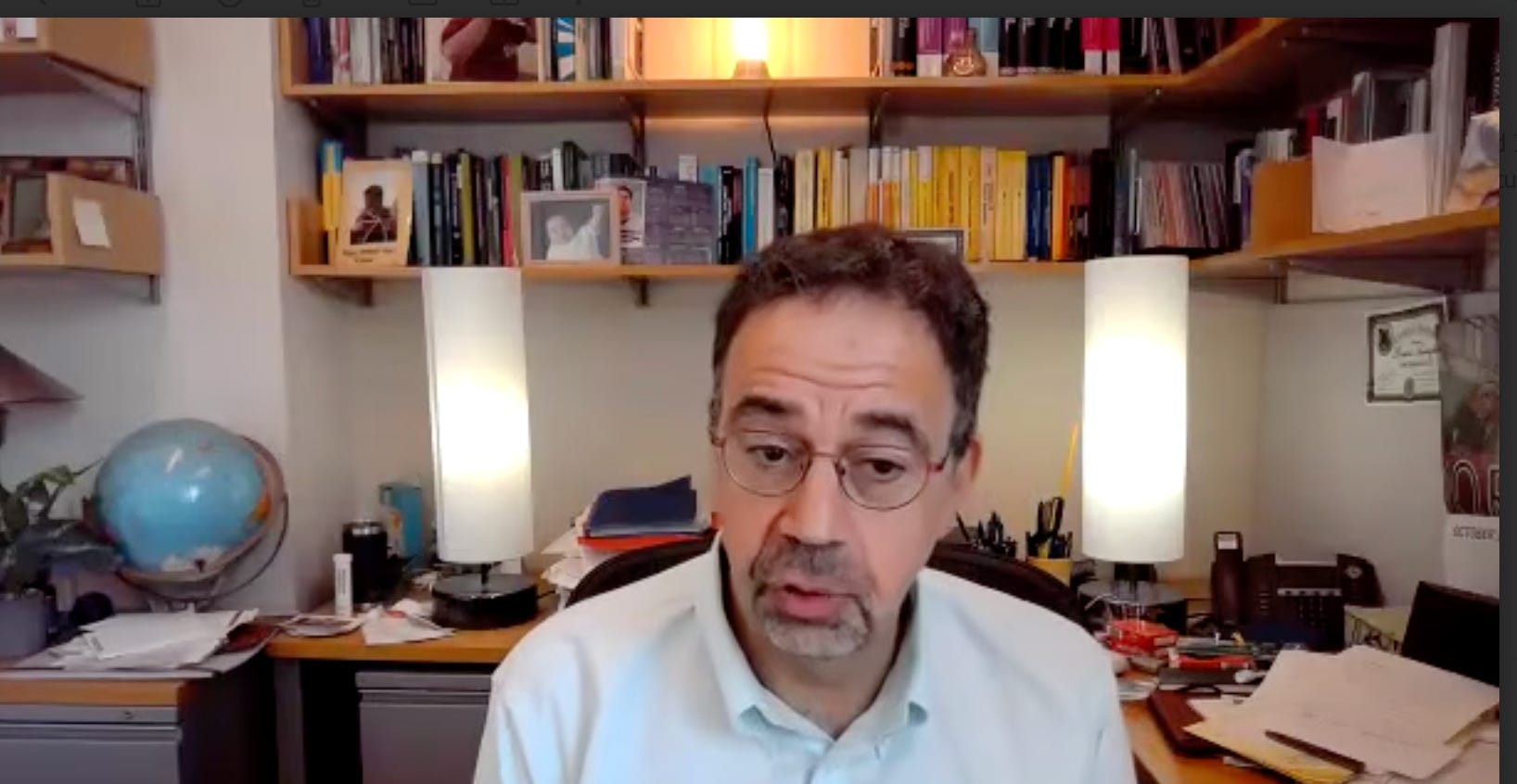
Ruth Ben-Ghiat (RBG): Welcome, Daron. Congratulations on this new book, which offers recommendations on how to restore faith in democracy, including by embracing a “working-class liberalism” marked by policies that aim at shared prosperity, more value given to community, expanded public services, and more voice and self-government for people. Can you talk about these central ideas of the book?
Daron Acemoglu (DA): Let me take a step back and say I’m writing this as a believer in liberal ideas and in democracy. So part of the book is devoted to explaining why they are the best framework for our future, and why they’ve succeeded in the past. But the book also comes out of a belief that liberal democracy is in crisis: there is no sugarcoating it.
My proposals are around dealing with those problems at a time when technology, the nature of polarization, and the way we communicate are very different than in the past. But I believe the founding pledges of liberal democracy are still the same.
Shared prosperity, which means economic growth from which all segments of society will benefit, high quality widely available public services, that are so important and have always been sought by people throughout the last 200 years, and self-government, not just talk about how people are sovereign, etc., but real participation by people shaping their lives [through citizens assemblies, town halls, etc].
Community is so important, because it’s the nexus of all of these things. Local politics is where self-government takes clearest shape and where liberal ideas can spread.
RBG: I was pleasantly surprised to see that the book’s final chapter is entitled “Working Class Liberalism.” That should certainly be a priority right now, as we live through the most accelerated process of oligarchic concentration of power and subtraction of benefits that people depend on.
DA: It’s very important to go back to stating what might seem obvious: that rights are part of a contract and a compact of what can be a working class liberalism which is oriented not to elites, but to regular people, like back to basics.
RBG: The book also addresses the challenge posed to liberalism in an age of algorithms and AI. I really liked your discussion of the promise of what you call pro-worker AI.
DA: Let’s go back for one second to the diagnosis of the book. It starts with the rise of post-industrial society. And it has two aspects. One is the collapse of shared prosperity. And the way that I analyze that as an economist is the emphasis on automation. In the 1920s, 30s, 50s, 60s, there was an industrial formula for shared prosperity. Businesses would expand, they would innovate, but then they needed more labor. And within a democratic society, the way you get more labor is by paying higher wages.
You create jobs and you pay higher wages, and that’s a powerful pathway from business expansion to shared prosperity. Digital technologies, especially digital technologies used for automation, severed that link. Now you can grow and at the same time lay off workers because you can get robots to do those jobs.
And AI, at least as currently conceived as a technology which will do better than humans in everything, then is the apex of that automation agenda. And if it goes down that path, I think shared prosperity would become just a fantasy. And according to my diagnosis, liberal democracy would as well.
Are we doomed? No. I argue that AI can do many things. And in fact, it’s a technology that can provide information to everybody, including workers in many different sectors, to become more expert, to do new things, to develop new capabilities.
And that type of pro-worker AI is very consistent with shared prosperity. But that’s not where we’re heading, and that’s why it’s very important to think of AI’s future within a framework that’s informed by the future of liberal democracy.
The second aspect of algorithms is their role in our communication, which social media defines very clearly, but of course AI is going to play an important role there as well.
I am a free speech absolutist when it comes to people. I do not think that free speech should be restricted for people in any way, even when they are saying intolerant things, bigoted things, and even wrong things.
But free speech doesn’t apply to algorithms. We should not then say, oh well, then Facebook, Twitter, TikTok should be able to amplify the most incorrect messages in a way that creates more polarization. That’s not the same as free speech.
So we have to regulate what algorithms do to our free speech in order to protect the meaning of free speech, and also in order to protect information. You cannot hope that democracy will survive unless you provide people with accurate information.
RBG: My last question is about class, given that you discuss “working class liberalism” and “pro-worker AI.” Are you feeling as an economist that we need to bring class, understood in a non-Marxist way, back into our discussions?
DA: I do believe the emphasis on workers is very important. I do believe class broadly construed in non-Marxist term exactly like you said, as economic situation emphasizing the value of skills, et cetera, has to be brought back.
Capital-labor distinction is very important for policy, as I discuss in the last chapter, But I think the Marxist notion of class doesn’t fit the current environment. The industrial working class, the blue collar workers, they are a smaller and smaller fraction of the workforce. The industrial sector is still critical, but it’s not the future in the same way that many other occupations are. And we know that businesses will use the ample automation tools that AI and tech companies provide them with, and eliminate more jobs.
So that’s why labor organizations and workers themselves have to find the right compromise about how technology should be used, how workplaces should be organized in ways that benefit workers. That’s critical for shared prosperity and for democracy.
RBG: We have been talking with Daron Acemoglu, the recipient of the Nobel Prize in Economic Sciences, a professor at MIT, and author of the new book What Happened to Liberal Democracy? Thank you so much, Daron.
DA: Thank you, Ruth. This was a true pleasure. Thanks for your very kind words and for spending the time with me.
No posts
Comments
Nothing yet. Say the first thing.
Sign in to join the conversation.