
This is my fourth Substack article on the subject of intelligence from an integrative design-oriented perspective. It aims to provide an IDO definition of intelligence that is sufficiently concise without sacrificing explanatory depth. As with my previous articles, instead of merely saying that AI is or is not intelligent (binary view), or that it is more or less intelligent on one or more dimensions as IQ entails (scalar and multi-dimensional views), we can ask whether an agent has the mechanisms listed below and how they are organized.
This does not replace the notion of intelligence as IQ (which is extremely useful), but complements it. IQ is not fully predictive of performance and achievement. The conception below could inform revisions of IQ measures.
Why a fourth article? My other posts (listed at the end of this one) set the context but they didn’t succinctly define intelligence. This time I cut to the chase.
To a first approximation, human-intelligence involves the capacity of an autonomous agent to generate and pursue multiple manifold sources of motivation in real-time with limited temporal and other resources. That is also how I have long defined autonomous agency. Human-like intelligence evinces the following mechanisms and abilities. This is not the full definition however. The following is part of my definition (qua specification) of human-like intelligence.
Perception, pattern recognition and perception-based action in the world
Ours is more than perceiving the spatiotemporal world, based on a modular system. In contrast AI perceptual systems are typically modular as far as I know (which makes it easier to design). Much mammalian perception, for instance in squirrels, involves a labyrinthine system with parts that have multiple relationships to other parts of the system, as described in Aaron Sloman (1989) “On designing a visual system”.
These sensory-motor mechanisms can
react to the world in real-time
generate alarms and motivators
operate in parallel with management functions
In humans, these mechanisms are more or less under management control as described below. Since my thesis, I have proposed that executive functions are divided in management and meta-management layers.
(Not to be confused with the typical Type-1 (automatic) and Type-2 (controlled) distinction in cognitive psychology).
use a rich internal generalized language or languages
comprehend, reason, plan, prioritize, solve problems and innovate
handle ambiguity
improvise
These are also sources of learning (e.g., persisting fragments of plans for future use; decisions about priorities can be persisted for future use; etc.).
inhibit action
self-explain
make decisions of whether, when, and how to do something (e.g., turn plans into possibly conditional decisions)
enact/execute decisions and control action
observe management processing
deliberate about management processing, assess and criticize thinking
decide, interrupt, schedule and control management processing (guide attention, etc.)
evince cognitive flexibility
self regulate in many other ways
Human intelligence cannot be separated from the mechanisms that enable social and emotional competence with which it co-evolved. This involves mechanisms to
use public language(s) to communicate.
perceive and regulate moods and “emotions”
engage in social signaling and use hierometers
trade commitments and other resources
cooperate, divide labor, negotiate and compete
act (in the theatrical sense)
The mechanisms described above are subject to manifold learning and development. Some psychologists draw a sharp line between development and learning. However, from an information-processing perspective, much architectural development is possible throughout the lifespan. Other primates and some modern AI systems can learn in several ways. However as it stands, human learning is more manifold and complex. Humans can
develop cognitive and motor skills (proceduralization)
learn to recognize new perceptual and higher-order patterns
retain information in various forms of memory (short-term memory, associative memory, semantic memory, episodic memory, long-term working memory, etc.)
form new concepts, symbols and other representations, engaging in Piagetian accommodation (to a first approximation this is purely cognitive, but in a deeper analysis it includes motivational learning)
build new public knowledge
develop an understanding of knowledge (which involves developing relationships to knowledge, which overlaps with Piagetian accommodation)
develop new motivators, new motivator generators and activators
develop new priorities amongst motivators
develop new motivator filters and suppressors
extend their internal generalized languages and learn new public languages
develop new models, narratives and analogies
Human learning happens on different time scales. their learning however is often remarkably rapid and sample-efficient (contrast The data black hole at the center of AI - by Dwarkesh Patel)
“Defining” from an integrative design-oriented perspective is different from other forms of defining (such as genus-species definitions, or operationally as in IQ). Design-oriented definitions specify key mechanisms, their functions and organization.
With this in mind, the next time someone tells you AI is or is not intelligent, ask them which of the above mechanisms and abilities they are talking about.
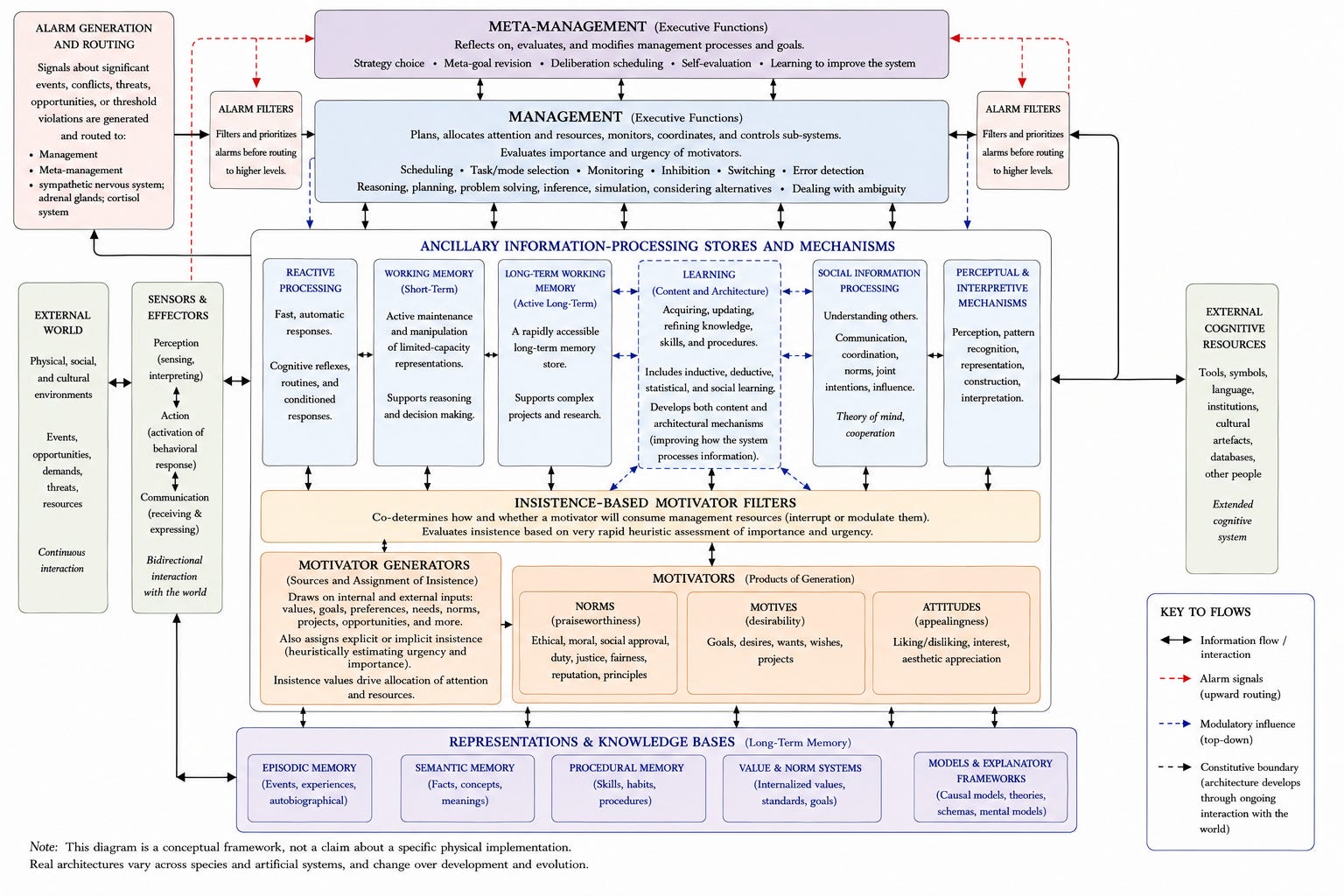
Here is a sketch of an architecture for human-like intelligence reprised from my previous article. While it is an oversimplification, it does suggest more complexity than typical models of mind (e.g., Freud’s tripartite model of mind or dual process theories which are so common in cognitive psychology).
Like discussions of intelligence, discussions of consciousness tend to be binary (claiming a type of agent has consciousness or does not) or quantitative (claiming a type of agent has a certain amount of consciousness). In my view consciousness is like intelligence in that it is a polymorphic concept to be interpreted in terms of an information-processing architecture. There is a discontinuousspace of possible minds with different forms of consciousness based on their information processing architectures. I consider “p-consciousness” (“phenomenal consciousness”) to be largely irrelevant. To me it is obvious that different information processing architectures support different forms of p-consciousness.
See for example
Merlin Donald’s A Mind So Rare: The Evolution of Human Consciousness
Sloman (2010) Phenomenal and Access Consciousness and the “Hard” Problem: A View from the Designer Stance in The International Journal of Machine Consciousness who wrote:
The diversity of the phenomena related to the concept “consciousness” as ordinarily used makes it a polymorphic concept, partly analogous to concepts like “efficient”, “sensitive”, and “impediment” all of which need extra information to be provided before they can be applied to anything, and then the criteria of applicability differ. As a result there cannot be one explanation of consciousness, one set of neural associates of consciousness, one explanation for the evolution of consciousness, nor one machine model of consciousness. We need many of each. I present a way of making progress based on what McCarthy called “the designer stance”, using facts about running virtual machines, without which current computers obviously could not work. I suggest the same is true of biological minds, because biological evolution long ago “discovered” a need for something like virtual machinery for selfmonitoring and self-extending information processing systems, and produced far more sophisticated versions than human engineers have so far achieved.
Many of the mechanisms entailed above are elaborated in my thesis and in Sloman (2008) The Cognition and Affect Project: Architectures, Architecture-Schemas, And The New Science of Mind..
Beyond “Is AI Intelligent?”: Intelligence as Architecture. This distinguishes four conceptions of intelligence. The first conception is binary (system is said to be intelligent or not intelligent). The second puts intelligence on a one-dimensional continuum. The third views intelligence as values in a multidimensional space. The fourth is architectural, which subsumes but extends the third. Each has its place. I focus on the fourth.
If Intelligence Isn’t Binary, What Is It? This article summarizes an architectural view of intelligence and characterizes human-like intelligence, but it did not actually define it. (I rewrote this one from scratch).
Beyond “Is AI Intelligent?”: Intelligence as Architecture This one took a deeper stab at defining intelligence in a comparative fashion, providing a couple of helpful tables one of which is pretty long.
I owe SharpBrains an article on repetitive thought which I’ll publish here.
I will update the Manifesto for an Integrative Design-oriented Approach to Understanding Humans as Autonomous Agents – CogZest here
I will comment on the similarities and differences between Agnes Moor’s Goal Directed theory of “emotion” and my own. See for instance her July 2026 “Emotions as High-Impact Decisions: A Goal-Directed Theory”.I am a big fan of her work. We both agree that a goal-directed “eliminativist” view of emotion is required, and we both emphasize goal-directedness (should be obvious from the title of my 1994 thesis, Goal Processing in Autonomous Agents
I will eventually write an article on consciousness in AI, humans and other primates
My new book Discontinuities: Love, Art, Mind is 95% done and on sale. I have two books in my pipeline but I’m undecided re what my next book should be.
The Art and Science of Falling Asleep: Understanding Sleep Onset, Insomnolence, and Mental Perturbance
Comparing Minds: Intelligence and Consciousness in Humans, Animals, and AI
Please let me know in the comments your thoughts about this article and what should come next.
No posts
Comments
Nothing yet. Say the first thing.
Sign in to join the conversation.