
Abstract
The concept of epistemic agency has become increasingly influential in educational psychology, the learning sciences, and AI-in-education research. Existing conceptions emphasize important epistemic practices, including knowledge building, collaborative inquiry, evidence evaluation, self-regulated learning, and responsible engagement with generative artificial intelligence. This article argues that these perspectives, while making substantial contributions, generally describe epistemic practices more fully than they explain the nature of the autonomous agent who performs them. I propose that epistemic agency should be understood as one manifestation of a broader phenomenon: Cognitive Productivity, defined as the effective use of knowledge resources to solve problems, develop products, and improve ourselves. Drawing on an integrative design-oriented perspective and the H-CogAff model of autonomous agency, I argue that epistemic agency presupposes a theory of autonomous agents organized around motivators (projects and goals, norms, preferences, and needs), management and meta-management processes, and architecture-based effectance—the motivation to improve oneself that emerges from an autonomous cognitive architecture. Building on this foundation, I introduce meta-effectiveness, the capacity to improve one’s own methods of becoming effective, and argue that education should aim not merely to build knowledge but to transform learners by developing their knowledge, skills, habits, motivators, motive generators, and other forms of mindware. The article reviews major conceptions of epistemic agency, relates them to research on self-regulated learning, and presents the seven principles of Cognitive Productivity as a theoretical and practical framework for developing epistemic agency across formal education, professional knowledge work, and lifelong learning. The result is a broader conception of epistemic agency that integrates educational psychology, self-regulated learning, autonomous-agent research, and theories of knowledge work within a common theory of Cognitive Productivity, providing a foundation for future research on learning, AI, professional knowledge work, and lifelong human development.
This article is an initial attempt to improve and generalize the concept of epistemic agency by bringing it into contact with integrative design-oriented approach to autonomous agency and my work on Cognitive Productivity. It is intended as a precursor to a peer-reviewed conceptual article. I hope readers will provide feedback in the comments (or email me), which may help shape the forthcoming paper.
This article goes into too much detail for many readers, including in particular the Surf Strategically principle. It’s partly that it consolidates over 30 years of my work You can skip parts of the article if you prefer. I hope you’ll at least tune into the intro and conclusion and read here and there. You can also ask AI to summarize it for you. I trust you will apply your epistemic agency 😊.
Introduction
Conceptions of epistemic agency in the educational literature
Epistemic agency presupposes autonomous agency
Learning should transform the agent
Effectance as architecture-based motivation
New concepts for learning and epistemic agency
Meta-effectiveness: improving the ability to improve onself
Cognitive Productivity
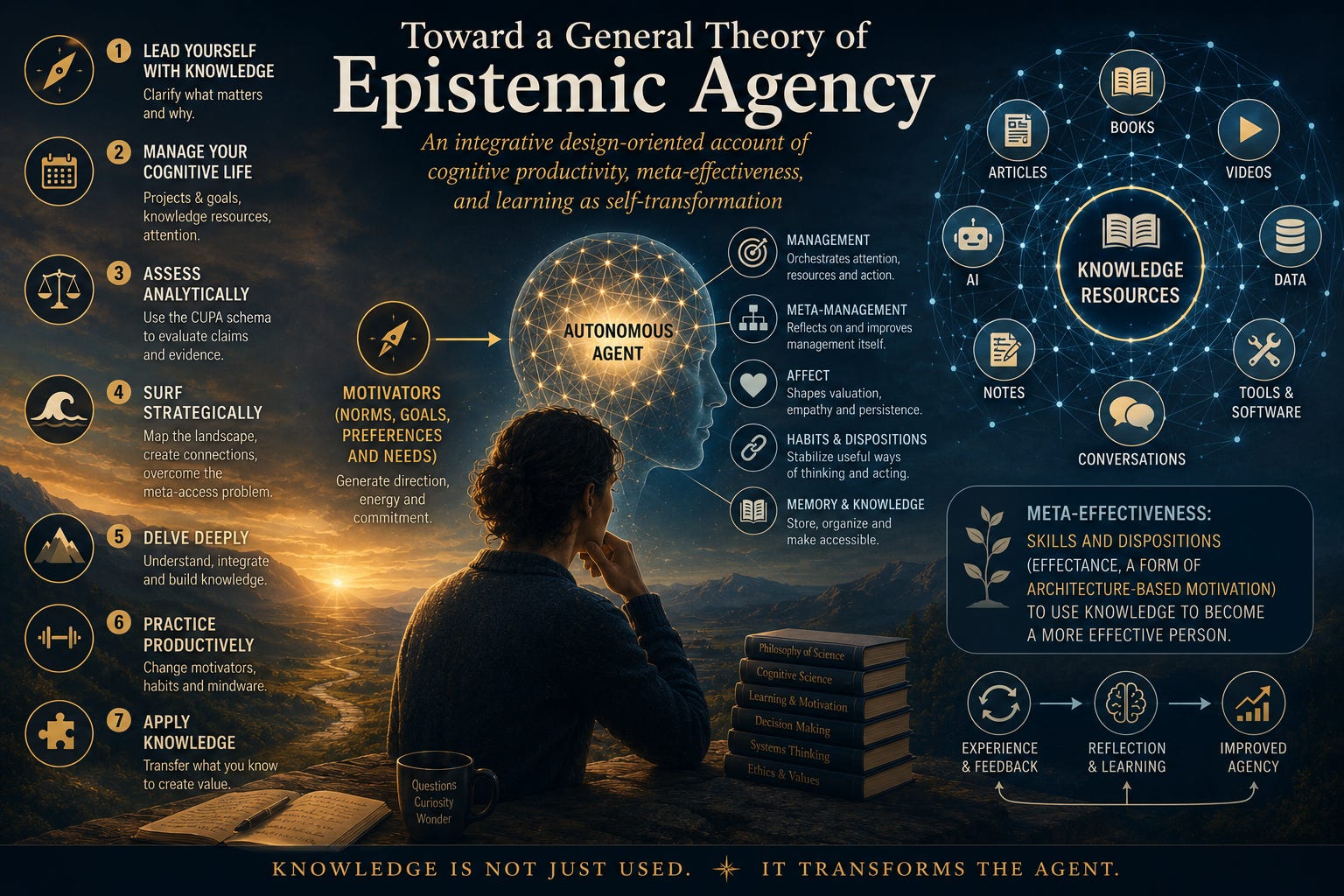
The seven principles as a framework for epistemic agency
Principle 1. Lead Yourself with Knowledge
Principle 2. Manage Your Cognitive Life
Principle 3. Assess Analytically
Principle 4. Surf Strategically
The meta-access problem
Contextual retrieval and consciousness
Surfing as epistemic control
Principle 5. Delve Deeply
Principle 6. Practice Productively
Principle 7. Apply Knowledge
Individual and shared epistemic agency
Relation to research on self-regulated
Human-Al relations reconsidered
A proposed general conception of
Conclusion
Colophon
The term epistemic agency is gaining traction in educational psychology, the learning sciences, science education, educational technology, and research on generative AI. The phrase is compelling. It suggests that learners should not merely receive information or comply with instructions; they should take responsibility for knowing. They should formulate questions, assess claims, seek and interpret evidence, contribute ideas, regulate inquiry, and participate in the advancement of knowledge.
These are important aims. Yet the concept remains theoretically unsettled, as argued in a recent Ph.D. thesis by Diana Meek. Different researchers use epistemic agency to refer to overlapping but significantly different phenomena. It may mean taking responsibility for one’s own learning, contributing to a community’s knowledge, directing collaborative inquiry, participating in disciplinary practices, evaluating evidence, or maintaining human judgment when interacting with artificial intelligence. The literature has produced many valuable descriptions of epistemic practices but has not yet supplied a sufficiently general model of the agent who performs them.
I will argue that epistemic agency presupposes autonomous agency. More specifically, it needs an integrative design-orientedmodel of the learner and knowledge worker as autonomous agents. Such an account should explain how agents agents generate and manage motivators, how they select and process knowledge resources, how learning transforms them, and how they improve the very mechanisms through which they learn and act.
My interest includes not only students. It extends to professional knowledge workers and lifelong learners — people who continually use knowledge resources to understand situations, make decisions, solve problems, develop products, improve themselves, and help others.
Nor is AI the defining context of epistemic agency. Generative AI has made the issue urgent because it can produce plausible answers, explanations, arguments, and designs without ensuring that its users understand or can justify them. But AI is one class of knowledge resource among many. Books, articles, conversations, teachers, colleagues, notes, diagrams, databases, search engines, reference managers, software tools, and one’s own prior writings also mediate cognition. A theory that explains agency only in relation to AI is therefore not a general theory of epistemic agency.
The broader framework I propose is developed in my books Cognitive Productivity: Using Knowledge to Become Profoundly Effective and Cognitive Productivity with macOS: 7 Principles for Getting Smarter with Knowledge. The first develops a theory of meta-effectiveness, meaning the knowledge-based development of competence as further defined below. The second expresses that theory through seven practical principles which it illustrates extensively (including over 60 videos of how to use software for them). The principles, elaborated below are:
Lead yourself with knowledge
Manage your cognitive life mindfully
Assess analytically
Surf strategically
Delve deeply
Practice productively and
Apply knowledge.
These are not merely tips for managing information on a Mac. Taken together, they constitute a theoretical and practical framework for individual epistemic agency. The books’ structures themselves reflect this progression: self-governance, productive information processing, and mastery culminating in application.
The educational idea of epistemic agency is rooted in the knowledge building tradition initiated by Carl Bereiter and Marlene Scardamalia – most elaborately in Bereiter’s 2002 masterpiece, Education and Mind in the Knowledge Age. Their work shifted attention from students merely learning to students assuming collective cognitive responsibility for advancing ideas, and generalized it to professional knowledge workers. Students should not simply complete activities selected by teachers. They should help identify problems, propose explanations, improve theories, make use of authoritative sources constructively, and contribute to knowledge that matters to their community.
This was a major conceptual advance. It located agency not only in choosing how to study but in participating in knowledge creation in communities of knowledge builders. It also challenged the assumption that the teacher must retain nearly all cognitive authority. Students could become legitimate contributors to a community’s knowledge rather than remaining consumers of curricular content.
Crina Damşa and colleagues developed this tradition in their seminal 2010 article, “Shared epistemic agency: an empirical study of an emergent construct.” They define shared epistemic agency as a group’s capacity to undertake deliberate, sustained, knowledge-driven collaboration aimed at producing shared knowledge objects. The knowledge object may be an instructional design, report, model, or other tangible product in which the group’s developing ideas become materialized. Their analysis distinguishes an epistemic dimension—searching for information, sharing and structuring ideas, generating new ideas, and developing the knowledge object—from a regulative dimension concerned with goals, planning, coordination, monitoring, negotiation, and management of the collaborative process.
The Damşa et al. paper is especially valuable because it does not treat agency as an invisible trait inferred from successful performance. They seek observable indicators in the group’s activity. Shared epistemic agency emerges when members establish a common understanding, propose and compare alternatives, integrate contributions, regulate their work, and translate emerging knowledge into their common object. It is not automatically present whenever people are assigned to a group. It is recursive, gradual, and dependent on patterns of interaction.
Lai and Campbell’s 2018 study of a secondary-school art-history class places epistemic agency within a knowledge building community supported by Bereiter’s & Scardamalia’s Knowledge Forum software. They define it as the active process of choosing when, what, and where one learns, how one knows, and how one participates in creating knowledge within a community. Students exercised agency by identifying gaps in their knowledge, sharing information, developing ideas, building on the contributions of others, and creating communal knowledge. Their account also highlights familiar knowledge building principles: collective responsibility, improvable ideas, idea diversity, constructive use of authoritative sources, and assessment embedded within the knowledge-building process.
The concept of epistemic agency has also become prominent in science education, where it is often framed as participation in the practices through which scientific knowledge is proposed, evaluated, communicated, and legitimized. Vasconcelos and colleagues describe students as epistemic agents when they conduct self-directed inquiry, generate propositions, formulate and test hypotheses, evaluate evidence against theories, produce explanations, refine inquiry practices, and connect their knowledge to the standards and activities of a scientific community. Their study of preservice teachers’ robotics-enhanced lessons is especially instructive because the technology itself did not guarantee agency. The robots were often used to transmit content or stage activities rather than to support student-driven inquiry. A technologically rich lesson can remain epistemically poor.
Nam-Hwa Kang’s perspective on physics education similarly characterizes epistemic agents as students who assume accountability for their learning, set goals, regulate their processes, and share cognitive authority with instructors. This resembles the concept of self-regulated learning, discussed below. Students must learn not only the content of physics but its standards, methods, and forms of reasoning. They should regard themselves as members of a community who bear some responsibility for what they and their peers believe. Digital technologies can support this transition, but only when they are used to enable authentic inquiry rather than simply to modernize information delivery.
Recent work on generative AI extends these concerns. Wu and colleagues (2025) define epistemic agency as the capacity of individuals or groups to shape the knowledge and practices of a community. They propose a human–AI form of shared epistemic agency while insisting that the human must remain its fundamental initiator and driver. Users should actively acquire, question, verify, interpret, and modify AI-generated content rather than receive it passively. They also connect epistemic agency to epistemic stances: absolutist, multiplist, and evaluativist orientations toward knowledge and justification. Evaluativist learners, who recognize that claims can be compared using evidence and domain-relevant standards, are better positioned to benefit from AI without surrendering judgment to it.
The 2025 editorial by Yan and colleagues situates epistemic agency alongside cognition, metacognition, self-regulation, and the socio-emotional consequences of sustained AI use. It warns that educational attention to efficiency and performance can obscure deeper questions about superficial processing, overreliance, epistemic vigilance, and the changing relation between learners and knowledge. Their synthesis points toward an education in which learners do not merely use AI effectively but critically and ethically co-author an AI-mediated future.
Rachel Horst’s funded Insight Development Grant research proposal, developed with colleagues at UBC, advances a particularly explicit sociotechnical conception. In that proposal, epistemic agency is the situated exercise of judgment, ethical deliberation, verification, and responsible refusal in AI-mediated knowledge work. It concerns deciding when AI outputs require checking, how deeply they should be interrogated, and when delegating a cognitive task would itself be epistemically inappropriate. Crucially, this is not treated as a fixed disposition residing wholly inside an individual. It is enacted through interactions among learners, instructors, assignments, institutional policies, pedagogical protocols, and course-embedded AI systems.
Across these accounts, epistemic agency is associated with ownership, responsibility, inquiry, evaluation, justification, knowledge creation, regulation, participation in disciplinary practices, and increasingly the maintenance of human judgment in interactions with AI. These are substantial contributions. Collectively, however, the literature tends to define epistemic agency in terms of participation in epistemic practices with a particular emphasis on evaluative processes (a more general conception of which is conveyed by my “Assess Analytically” principle and its CUPA evaluative schema, summarized below.) It tells us something about what epistemically agentic learners and groups do. It says less about the general architecture of an autonomous agent capable of doing these things. My concern is partly with the information-processing architecture that makes those practices possible.
That is the opening for an integrative design-oriented account of human or human-like autonomous agents.
Agency is not merely activity. A thermostat acts causally upon its environment, but we do not normally treat it as an autonomous agent. Autonomous agency involves internally generated and managed motivators. An autonomous agent must be able to generate or acquire motivators (bottom-up and top-down), detect relevant opportunities and problems, deliberate among alternatives, regulate competing demands, learn from consequences, and alter its future behaviour.
Autonomous agency was the subject of my 1994 Ph.D. thesis, Goal Processing in Autonomous Agents, which I believe remains relevant today, and can help ground the concept of epistemic agency.
Epistemic agency is a specialization of this more general capacity. It concerns the agent’s relations to knowledge: how knowledge resources are selected, interpreted, assessed, mastered, transformed, and applied in the service of what the agent values.
Existing educational accounts often presuppose these capacities. A student is expected to “take responsibility,” “set inquiry goals,” “evaluate evidence,” “decide when verification is warranted,” or “refuse delegation.” But each of those descriptions raises important largely unanswered questions about the agent’s information-processing architecture. How are candidate goals or concerns generated? What makes one of them salient? How does it gain priority over competitors? What enables an agent to interrupt an ongoing activity, reflect upon it, and change course? How does a concern with evidence become sufficiently entrenched that it influences future thinking without requiring a teacher’s immediate prompt? How do principles learned declaratively become operative dispositions and habits? What kinds of processes manage (deliberate over) the agent’s motivators? How are management or deliberative processes themselves regulated through what I call meta-management and others call reflective processes? (Management and meta-management processes are executive processes.)
An integrative design-oriented approach asks such questions directly. Instead of treating cognition, motivation, emotion, attention, learning, and executive control as separate topics, it asks what interacting mechanisms an autonomous information processing architecture requires. Alan Newell’s seminal 1990 book, Unified Theories of Cognition popularized information processing architectures, however unlike my work with Aaron Sloman, who was my Ph.D. thesis advisor, it only dealt with “dry” cognition, not motivation and affect.
The approach is design-oriented because it takes the design stance elaborated by David Marr, Daniel Dennett, Aaron Sloman of the university of Birmingham and others. (On this subject, I recommend Aaron Sloman’s Prospects for ai as the general science of intelligence). That is to say that one way to expose the incompleteness of a verbal theory is to ask what would be required to design an agent that exhibited the competence in question.
The approach is integrative because a plausible autonomous agent cannot be built from an isolated theory of memory, motivation, reasoning, emotion, or learning. These functions and others constrain and partly constitute one another.
The H-CogAff account belongs to this tradition. It distinguishes reactive processes, deliberative or management processes, and reflective or meta-management processes, while also incorporating motivator generators, attention and interrupt mechanisms, working memory, long-term memory, and forms of affective control. This is a general architecture-schema rather than a model only of students—or even only of humans. It can guide theories of natural and artificial autonomous agents.
H-CogAff is also fundamentally goal-directed. In that respect it is compatible with Agnes Moors’s Goal-Directed Theory, in which much emotional and non-emotional behaviour is explained through interacting goal-directed cycles rather than special-purpose emotion mechanisms. Moors’s theory is focused on humans and the phenomena commonly called emotions; ours ( H-CogAff, etc.) is more general in scope and explicitly integrative design-oriented, encompassing human and artificial agents. A fuller comparison belongs in a separate article. For present purposes, the relevant point is that epistemic agency cannot be detached from the goal-directed organization of the agent as a whole. Moors herself notes that epistemic goals, including the goal to obtain information, can support many other goals and can acquire intrinsic value.
The H-CogAff architecture is updated, in integrative design-oriented terms, in my 2020 paper with Sylwia Hyniewska and Monica Pudlo: Mental perturbance: An integrative design-oriented concept for understanding repetitive thought emotions and related phenomena involving a loss of control of executive. (See also part 2 of my first Cognitive Productivity book.)
The literature on epistemic agency rightly emphasizes knowledge building. Bereiter is explicit that knowledge building is not learning. It deals with Popper’s third world of objective artifacts. But knowledge building is not the only aim of education. Learning itself is also an aim, and true learning should transform the agent.
An integrative design-oriented account does not identify learning solely with acquiring declarative propositions or procedural knowledge. Learning may produce objective knowledge in a community, but within the learner it changes what David Perkins (in Outsmarting IQ: The Emerging Science of Learnable Intelligence and Keith Stanovich (in What Intelligence Tests Miss: The Psychology of Rational Thought) called mindware. It is the “mental stuff” of knowledge, now in the sense of Popper’s World 2 (as opposed to World 3): _ skills, procedures, monitors, habits, motivators, motive generators, and other dispositions that affect future cognition and action. In other words, it transforms the agent’s information processing architecture by adding new structures and mechanisms, and modifying them.
This aligns with Marvin Minsky’s seminal 1985 book, The Society of Mind. In this integrative design-oriented account, Minsky emphasized that learning could involve adding new If-Do-Then rules, change low-level connections, make new subgoals for goals, choosing better search techniques, changing high-level descriptions and narratives, making suppressors and censors (to prevent errors), linking older fragments of knowledge, making new kinds of analogies, making new models, virtual worlds, and other types of mental representations. Making sense of this requires an information processing architecture well beyond the simple distinctions between sensory memory, short-term and long-term memory.
Chapter 2 of Cognitive Productivity distinguishes several contributors to effectiveness, including mastery of objective knowledge, development of implicit understanding, skills, norms, attitudes, propensities, habits, and other dispositions. The book then situates these changes within adult mental development and the pursuit of greater meta-effectiveness.
Suppose a student learns a norm against manipulating evidence. The outcome is not adequate if the student can merely recite the norm on an exam. The learning becomes consequential when the norm acquires motivational force (which Sloman and I refer to as intensity and insistence) —when it helps detect questionable conduct, generates concern, interrupts expedient behaviour, and influences decisions even in the absence of external surveillance.
Similarly, learning about the importance of considering alternative explanations should not terminate in a declarative belief that alternatives matter. It should help develop a monitor that notices when an attractive explanation is being accepted too quickly and generates a motive to search for competitors. In the terminology of my autonomous-agent work, learning may create or refine motive generators: mechanisms that detect relevant conditions and generate motivators in response.
The same is true of preferences. Education can cultivate a preference for depth over superficial fluency, for well-structured explanations over jargon, for evidence over tribal reassurance, and for cognitively potent resources over seductive but unhelpful content. It can also change habits: whether a person checks a source, records an insight, revisits an important concept, tests their recall, compares theories, or applies a principle outside the context in which it was taught.
Learning should therefore generate not only knowledge but new motivators, motive generators, and habits. A learner who has acquired a durable concern for explanatory adequacy, a habit of checking assumptions, and a preference for intellectually honest disagreement has not merely added content to memory. The learner has become a different kind of agent.
The meta-effectiveness component of epistemic agency involves become better at using knowledge resources (AI or static) for such self-transformation. One can become more effective at becoming more effective. Effectiveness is the core measure of agency.
This account raises a question that epistemic agency research rarely addresses directly: why should an agent be motivated to improve itself?
Robert White’s influential 1959 paper introduced effectance as motivation for competence. The proposal helped challenge theories that reduced motivation to the satisfaction of primary biological drives.
My use of the concept is both indebted to White and theoretically revisionary. I recast effectance using Aaron Sloman’s revolutionary concept of architecture-based motivation, in this case architecture-based motivation to improve oneself. This is not merely a terminological update. It is an architectural extension, meaning it interprets the motivation of effectance in terms of information processing architecture.
An autonomous architecture must continue functioning in environments that are variable, partly unknown, and populated by opportunities and threats the agent has not encountered before. Fixed competences cannot be sufficient. An architecture capable of detecting limitations, monitoring outcomes, representing possible improvements, and generating motivators to learn will be more adaptive than one restricted to a static repertoire.
Effectance, on this account, must not be represented as a single standing goal such as “become more competent” from which more specific self-improvement goals are derived (through means-end reasoning). A child playing with lego is simply motivated to play, he is not deliberately then motivated to become more effective. However, this architecture-based, intrinsic, motivation to play as a consequence helps the child become more effective. Effectance can thus emerge from the architecture’s organization. Deficiencies, prediction failures, blocked projects, admired exemplars, unexplained phenomena, and encounters with potent knowledge resources can generate motives the pursuit of which incidentally, but importantly, help the agent to develop. Architecture-based motivation was instilled by evolution, not by means-ends analysis. The architecture supplies a basis for self-improvement across many domains. Curiosity, an aspect of effectance, can similarly be interpreted in terms of architecture-based motivation.
This provides a motivational foundation for epistemic agency. An agent does not only seek answers to current questions. It can implicitly pursue motives that as a side-effect make them become a better questioner, reasoner, learner, designer, collaborator, or user of knowledge. The agent can seek resources that alter their future capacities, not merely resources that solve the immediate problem.
Having said that, architecture-based motivation for effectance is not sufficient. Learners need to be deliberate about their learning. That is, after all, why I published Cognitive Productivity books.
This may be a good point to pause for a moment and acknowledge that this paper introduces much terminology , which while not historically original, is new to most of my readers. We are not just introducing new words, but new concepts. My argument is that epistemic agency cannot be understood without these improvements beyond rudimentary cognitive psychology and folk psychology. Next, I continue to introduce concepts new to most readers.
The concept of effectance leads to meta-effectiveness, the central construct of my Cognitive Productivity books. I define meta-effectiveness as the skills, dispositions, and underlying information-processing mechanisms—mindware—that enable and drive people to improve themselves. The motivation component of meta-effectiveness is effectance as described above (as architecture-based motivation).
Effectiveness concerns achieving valuable outcomes. It is the core concept of Albert Bandura’s concept of perceived self-efficacy, which itself is explicitly part of his theory of agency. (See his contribution to the canon of psychology, his book Self-Efficacy: The Exercise of Control .) Meta-effectiveness concerns improving one’s capacity to achieve valuable outcomes in the future. It is therefore recursive. A person may learn a fact, acquire a skill, or solve a problem; a meta-effective person also improves the processes by which facts are selected and retained, skills are developed, and problems are represented and solved.
This is not reducible to metacognition, although metacognition is part of it. Monitoring whether one understands a passage is metacognitive. Creating a better method for selecting what to read, assessing its potential value, delving into it, extracting knowledge gems, practising them, developing relevant habits, and applying them across contexts is a broader meta-effectiveness project.
Nor is meta-effectiveness reducible to self-regulated learning, as usually studied and discussed below. Self-regulated learning often focuses on learners’ planning, monitoring, and strategy use within educational tasks. Meta-effectiveness extends across adult development and professional life. It includes choosing cognitively potent tools, redesigning workflows, developing standards and habits, resisting illusions of comprehension and future recall, building external cognitive systems, and learning how to make knowledge usable when circumstances require it.
Epistemic agency without meta-effectiveness can become static. An agent may possess some effective epistemic practices while lacking the disposition and mechanisms required to revise them. A researcher may evaluate evidence carefully but manage sources poorly. A student may know that retrieval practice is effective yet never develop a routine for using it. A professional may be skilled in a familiar domain but avoid knowledge that would challenge established methods.
A general theory of epistemic agency should therefore include not only the exercise of epistemic competence but the implicitly sought and deliberate development of that competence.
Another concept is required…
Cognitive productivity is the effective use of knowledge resources to solve problems, develop products, and improve ourselves. It links knowledge to valued outcomes.
The term productivity can evoke quantity, speed, or economic output. That is not my intended meaning. For cognitive productivity is not just about efficiency, though efficiency is part of it. Cognitive productivity concerns productiveness, the production of objective knowledge (knowledge building), the solution of problems, self-improvement, and effectance. The concept of cognitive productivity is indicated by the subtitle of my first book: Using Knowledge to Become Profoundly Effective.
A person may consume enormous quantities of information while becoming no more capable of understanding a problem, improving a relationship, developing a theory, making a decision, or changing a harmful habit. Such a person is informationally busy but cognitively unproductive.
Cognitive Productivity provides a broader setting for epistemic agency than has previously been recognized because it encompasses the full trajectory from self-governance to action. Evaluation, covered by the Assess Analytically principle 3 below, is essential but insufficient. A well-assessed idea that cannot be remembered or accessed when relevant will not guide behaviour. A deeply understood theory that remains inert will not improve practice. A useful norm that never becomes a motivator or habit will not regulate conduct.
This is why the seven principles are best interpreted as a process model of epistemic agency.
Here is a summary of the seven principles of Cognitive Productivity which I proposed in Cognitive Productivity with macOS: 7 Principles for Getting Smarter with Knowledge. I elaborate on them here because they are effectively principles required for full epistemic agency. Whereas this book illustrated the principles with macOS and iPhone technology, the ideas in that book, of course, apply to other platforms. (The book is not just theoretical, it contains very specific guidance, including over 60 videos. The more theoretical chapters are contained in Part 2 of my first book, Cognitive Productivity: Using Knowledge to Become Profoundly Effective.)
The first principle in Cognitive Productivity with macOS is Lead Yourself with Knowledge. This is not a motivational slogan attached to a book about software. It is an autonomous-agency claim.
To lead oneself is to govern one’s activities through an evolving understanding of what matters. Knowledge is not simply accumulated. It is recruited to interpret situations, choose directions, revise commitments, avoid foreseeable mistakes, and coordinate action across time. Epistemic agency therefore begins before formal evidence assessment. It begins when an agent aims to use knowledge to shape its own conduct, and does so.
To lead oneself entails pursuing a valued direction. This calls for a theoretical framework. The account of value I use draws from Ortony, Clore, and Collins’s 1988 cognitive theory of emotion updated in the 2022 revision of their highly influential book The Cognitive Structure of Emotions. It distinguishes three broad kinds of value. Projects and goals determine the desirability or usefulness of events. Norms provide standards for evaluating actions, including whether an action is praiseworthy or blameworthy.Preferences, or attitudes, determine attraction and aversion toward objects, people, ideas, experiences, and situations. They vary in appealingness. I refer to all information processing forms of value — projects and goals, norms, preferences, and needs — collectively as motivators. See Chapter 3 of my thesis..
This taxonomy matters because autonomous agency cannot be reduced to reflexive behavior. A researcher may be guided by a norm of intellectual honesty, a long-term project of understanding a problem, and a preference for elegant explanations. A physician may pursue the goal of identifying a treatment, act under professional norms governing consent and evidence, and develop preferences for methods that reduce avoidable burden on patients. A student may want a high grade while also accepting norms against plagiarism and gradually acquiring a genuine preference for deep understanding over superficial completion.
Motivators of the same and/or different types may cooperate or conflict. Knowledge helps agents understand those conflicts, predict their implications, and decide which commitments should govern action. It can also alter the motivators themselves. A person may learn that a cherished project is harmful, that a norm was poorly justified, or that a preference was manufactured by repeated exposure rather than reflective endorsement. Leading oneself with knowledge thus includes using knowledge to revise the motivational organization through which future knowledge will be processed.
This is one reason typical definitions of epistemic agency are too narrow when they centre primarily on knowledge claims. Agency requires not merely asking, “Is this claim true?” but also, “Why does this matter?”, “Which project does it serve?”, “Which norms govern my use of it?”, “What preferences are influencing my judgment?”, and “What kind of person or agent will I become by repeatedly acting this way?”
AI makes these questions visible in new, more dynamic and perhaps more urgent ways, but does not create them. A student deciding whether to delegate an essay to an AI system is negotiating projects, norms, and preferences. The project may be to finish the assignment, learn the subject, earn a credential, or avoid embarrassment. Norms may concern academic integrity, responsibility, disclosure, and fairness. Preferences may include convenience, intellectual challenge, originality, or admiration for technical novelty. Responsible refusal, emphasized in Horst’s proposal, is therefore not simply an epistemic judgment about AI reliability. It is an agentic resolution of competing motivators. (The section below on Assessing Analytically deals with a subset of epistemic agency dealing with evaluating knowledge resources – from AI or other).
To be clear: autonomous agency, including epistemic agency, requires self-leadership, which is what this principle is about.
The second principle concerns stewardship of cognitive conditions. Projects, knowledge resources, attention, time, tools, and interruptions must be managed in ways that reflect the agent’s values rather than the contingencies of the moment.
This principle is divided into 3 concerns:
Managing Your goals and projects (e.g., with task management software such as OmniFocus), goal management being foundational to all forms of agency, including epistemic agency.
Manage Your knowledge resources (e.g., with Finder, tagging software and information managers such as DEVONthink,
Manage your attention (your information processing time) with time tracking software like Timing.app and my free mySelfQuantifier spreadsheet — attention and time being the most precious resources in knowledge work.
An agent may possess good intentions and valuable knowledge yet remain ineffective because attention is fragmented, commitments are poorly managed, relevant resources are inaccessible, or immediate demands repeatedly displace more important projects. Epistemic agency requires control not only over conclusions but over the conditions under which conclusions are reached.
Managing a cognitive life mindfully includes designing external systems and internal policies that make sustained, responsible knowledge work more likely. Epistemic agency without adequate cognitive management, as detailed in my books, is unproductive.
Much of the current literature on epistemic agency concentrates on (a small subset) of the territory of Principle 3. It focuses on evaluating evidence, assessing sources, verifying AI outputs, and determining whether claims are warranted. My principle Assess Analytically encompasses these matters but is considerably broader, and based on cognitive science.
It asks whether a knowledge resource is helpful and analyzes that helpfulness through the “CUPA” framework for assessing information resources.. This goes far beyond the traditional “CRAAP” test. The dimensions of CUPA are caliber, utility, potency, and appeal. Caliber concerns epistemic quality: accuracy, justification, argumentation, evidence, coherence, the adequacy of explanatory theories, etc. Utility concerns relevance to the agent’s projects and other motivators (discussed in the previous principle). Potency concerns the resource’s capacity to contribute to mental development—to generate concepts, skills, motivators, motive generators, habits, and other mindware. Appeal concerns the agent’s affective response and the need to interpret rather than blindly trust that response. Appeal is a potential red herring: not all truths are beautiful; not every proposition that is beautiful is true. Not every seductively appealing bit of information is high caliber: often alluring information, including from AI, is misleading.
You may have noticed that the forms of value of “CUPA” map onto the forms of value of Principle 1 (norms, goals and preferences), but are epistemically oriented —thus highly relevant to epistemic agency.
My book’s CUPA assessment framework includes general epistemic criteria, argument assessment, conceptual analysis, and explicit criteria for evaluating explanatory theories. It therefore goes beyond asking whether a source is credible. It asks whether an explanation has sufficient scope, depth, coherence, precision, plausibility, and power; whether it advances understanding; and whether rival accounts have been treated fairly. The fuller CUP’A framework is summarized here.
The CUPA framework has direct implications for AI literacy. Checking whether an AI has fabricated a citation is necessary but elementary. A sophisticated epistemic agent must assess the caliber, utility, potency and appeal of the AI output.
I examine this principle in unusual depth because it illustrates how a simple type of software (contextual information retrieval softwares) can apply cognitive science to support epistemic agency. Having said that, contextual information retrieval concerns only a fraction of what is required to “surf strategically”, and discussed in that principle. Every Cognitive Productivity principle is similarly grounded in cognitive science.
The fourth principle, Surf Strategically, addresses forms of interaction with knowledge resources that may appear superficial but are often indispensable. Knowledge workers do not—and should not—process every potentially relevant book, paper, message, webpage, dataset, or AI response in depth. Before deciding what deserves sustained attention, they must survey a field, inspect documents, skim passages, scan tables of contents, examine references, compare search results, classify resources, create links, file materials, and move rapidly among related items. These activities are shallow in the descriptive sense that they do not ordinarily produce deep comprehension. They are not intellectually trivial.
Surfing is a distinct phase of cognitive work with its own purposes and standards. It allows an agent to identify promising knowledge resources, estimate their potential CUPA (caliber, utility, potency, and appeal) before a more detailed assessment can be made, locate relevant passages, detect relationships among resources, and decide where scarce attention should be invested. Strategic surfing therefore requires judgment. One must know why one is surveying an informational space, what signals of value to look for, when a resource merits deeper processing, and when continued searching is unlikely to justify its cognitive cost. A person who delves deeply into everything is not more epistemically responsible than a person who skims intelligently. Indiscriminate depth can be as unproductive as indiscriminate superficiality.
This distinction matters because words such as skimming and browsing often carry a pejorative connotation. They can suggest impatience, distraction, or intellectual laziness. Yet sophisticated research depends on rapid, selective interactions with large bodies of information. A scholar reviewing a new literature may first inspect hundreds of titles and abstracts, follow citation trails, scan diagrams, search within documents, and compare competing terminologies before choosing a small number of works for careful study. A lawyer may rapidly inspect cases to determine which warrant full analysis. A physician may survey guidelines and abstracts before examining the most pertinent evidence. In each instance, superficially processed information guides the allocation of deeper cognitive effort.
Surfing (which in the Cognitive Productivity framework is not just “surfing the net”) also includes apparently mundane actions such as naming, tagging, filing, bookmarking, linking, and recording why a resource may matter. These actions are easily dismissed as clerical information management rather than epistemic activity. That would be a mistake. They shape the agent’s future access to knowledge and therefore influence what can later enter reasoning, deliberation, learning, and application. In an environment of informational abundance, deciding what should remain accessible—and constructing reliable routes back to it—is part of epistemic agency.
Surfing strategically can, and should, be supported by technology, such as using search engines. Such technology is reviewed in my book. In what follows we focus on a particular neglected aspect of strategic surfing: contextual information retrieval which is supported by our Hookmark app. (COI disclosure: I am CEO of CogSci Apps Corp. which develops the app.) But first we must consider the deep problem solved by contextual information retrieval.
This leads to what I call the meta-access problem. Epistemically agentic knowledge workers do not merely need access to individual resources. They need rapid access to the other resources that are relevant to whatever they are currently doing. While drafting a paper, for example, a researcher may need its project plan, outline, source PDFs, notes, correspondence, figures, task list, conceptual diagrams, bibliographic records, and relevant webpages. These resources are commonly scattered across the file system, the web and multiple applications. The challenge is therefore not simply to find a document in isolation. It is to access a changing constellation of contextually relevant resources without disrupting the cognitive work that made them relevant.
Traditional search remains essential, but it places a series of ancillary demands on cognition. The user must suspend the superordinate task, formulate a query, remember identifying details, invoke a search interface, inspect results, distinguish the intended item from plausible alternatives, open it, and then reconstruct the cognitive context that was interrupted. Each step consumes time and mental resources. The problem is especially severe because working memory is severely limited and the activation of information in working memory declines rapidly. When the agent knows that a relevant resource exists but cannot readily recall where it is stored, what it was called, or which application contains it, their productivity suffers — not just their efficiency but their productiveness.
I coined the expression contextual information retrieval to describe access in which the current informational context helps determine what resources are presented or made immediately reachable. Unlike ordinary (random-access) retrieval, which begins primarily with a query, contextual information retrieval starts from the item or activity already occupying the foreground of cognition. In computer science, this is known as content addressable memory rather than a random access memory. The question becomes not merely “Where is the information?” but “What information is relevant here (to this document), and how can I reach it with minimal cognitive disruption?” I discuss the concept and the meta-access problem more fully in “Contextual information retrieval: The missing link in knowledge work”.
This is where Hookmark becomes theoretically relevant rather than merely convenient. Hookmark enables knowledge workers (students or professionals) to create and use robust links among resources in different applications. A draft can be linked bidirectionally to its outline, source documents, notes, relevant email, task list, diagrams, bibliographic record, and other resources. When Hookmark is invoked in the context of the draft, it presents links associated with that context; when invoked on one of the linked resources, it can provide a route back. A 2023 paper of mine illustrates this with both a PDF surrounded by related notes, tasks, diagrams, emails, ebooks, and practice materials, and a Word draft connected to the resources required to develop it.
Hookmark is therefore not simply a bookmark manager (though it is also the world’s first contextual bookmark manager). It implements a form of user-controlled associative (non-random) memory. The user deliberately or implicitly records relationships among conceptual artifacts, creating multiple retrieval routes that remain available when the context changes. This complements random-access search. Search is indispensable when the retrieval target is unknown or when the user needs to explore a large corpus. Contextual retrieval is especially valuable when relationships among resources have already been recognized and should remain available for future cognition. (Hookmark also contains a growing recommendation system where, soon with AI, the software guesses what information the user might need next.)
Hookmark’s ability to create deep links to particular segment of a PDF or Word document takes this capability even further. A global link to a fifty-page PDF is useful; a link to the exact passage under consideration is even more useful. Deep links reduce the need to reopen a document, reconstruct the original location, search within it, and visually scan for the relevant material. Similar principles apply to locations in ebooks, videos and webpages and other structured resources. These forms of access help preserve the agent’s orientation toward the superordinate project rather than forcing repeated detours through the mechanics of retrieval.
It should be clear that every principle of the meta-effectiveness framework grounds epistemic agency and is informed by cognitive science. Here I discuss how contextual information retrieval relates to research on consciousness and long-term working memory (a key cognitive feature of expertise).
The significance of contextual information retrieval becomes clearer when considered in relation to Merlin Donald’s account of consciousness in A Mind So Rare: The Evolution of Human Consciousness (2001). Donald rejects the idea that consciousness can be understood solely as a momentary biological phenomenon confined to a brief working-memory interval. Human consciousness depends on the integration of information across multiple neural systems, other people, and external symbolic resources. It operates not only over the immediate present but across what Donald describes as intermediate and long-term temporal ranges.
External symbolic technologies are central to this expanded form of consciousness. Writing, diagrams, books, computer displays, and other conceptual artifacts allow information to be stabilized outside the brain and repeatedly reintroduced into conscious processing. As Donald later observed, a computer screen can function as a temporary external working-memory field: the user enters an interactive loop with the display while thinking, writing, and creating. Contextual information retrieval tightens this loop by reducing the friction involved in bringing relevant external representations back into consciousness.
I have therefore argued that software such as Hookmark can extend intermediate and long-term consciousness. This does not mean that the software is itself conscious or that a link becomes part of the biological mind. The claim is functional. Contextual links enable an agent to reconstitute, across hours, days, months, or years, configurations of information that had previously supported a cognitive project. They help restore not just a file but a working intellectual context.
Consider a researcher returning to a manuscript after several weeks. Without contextual retrieval, the manuscript may be available while the surrounding cognitive system has largely disappeared. The researcher must remember or rediscover which email contained an important objection, which PDF supported a claim, where the outline was stored, which diagram represented the argument, and what tasks remained unresolved. Hookmark can make these resources immediately available from the manuscript itself. In doing so, it helps the researcher reconstruct an extended episode of knowledge work and resume it with less loss of orientation.
This is an extension of intermediate consciousness because it supports integration over the minutes and hours required to work across multiple artifacts during an active session. It is an extension of long-term consciousness because deliberately constructed relationships can persist and become available much later, after the corresponding contents have faded from biological working memory and can no longer be reliably recalled unaided.
The point is not simply that retrieval becomes faster (as is characteristic of long-term working memory). Speed matters because every additional retrieval step competes with the contents and control states that must be maintained during demanding knowledge work. But contextual retrieval also affects what kinds of cognitive projects are feasible. If it is difficult to reconnect a source with separate notes, diagrams, tasks, correspondence, and practice materials, knowledge workers may avoid producing those artifacts in the first place. They may keep inadequate notes, forgo conceptual diagrams, or abandon useful connections because they anticipate difficulty retrieving them later. The meta-access problem can therefore constrain knowledge building and learning before any explicit search failure occurs.
By lowering this barrier, contextual information retrieval can support a richer cognitive ecology. It becomes more practical to take persistent notes in the app of one’s choice, link them to the source, associate a paper with the projects it informs, connect a claim to evidence and criticism, and attach productive-practice challenges to the knowledge they are meant to develop. The result is not merely a more orderly information system. It is an environment in which conceptual artifacts can more readily participate in ongoing cognition.
Contextual information retrieval software calls for all software to be link-friendly. It needs to be possible to form links not only to web pages, but emails, task lists, PDFs, diagrams, and more. I have led an effort involving more than 20 cognitive scientists and software developers to ensure software is link-friendly. That is the Manifesto for Ubiquitous Linking. It is structurally modeled on the famous and influential Agile Manifesto for software development. Its rationale section details its grounding in cognitive science in highly accessible terms.
Surfing strategically should therefore be understood as a cognitive science-informed form of epistemic control. It governs the transitions among informational breadth, selective access, and depth. It includes deciding where to look, what to sample, what to preserve, what to connect, what to retrieve, and what deserves delving. The epistemically agentic researcher does not treat all superficial processing as suspect. Rather, the researcher distinguishes superficiality caused by distraction or avoidance from deliberate shallow processing that serves a larger cognitive strategy.
This principle also qualifies familiar concerns about digital reading. Digital environments can certainly encourage fragmented attention and compulsive switching. But switching among resources is not inherently a cognitive failure. Complex knowledge work often requires the integration of heterogeneous materials. The relevant question is whether those transitions are controlled by the agent’s projects, motivators and priorities or by the attention-capturing (superficially appealing) designs of applications, feeds, and platforms. Contextual information retrieval supports the former by allowing the agent to construct and preserve personally meaningful routes through an informational environment.
For epistemic agency, then, access is not a secondary convenience that comes after inquiry, evaluation, and knowledge construction. It is one of their enabling conditions. Agents can assess, integrate, practise, and apply only the knowledge resources they can bring into an appropriate cognitive context. A general theory of epistemic agency must therefore encompass not merely the appraisal of accessible claims but the design and management of access itself.
Delving is my general term for deeply processing a knowledge resource, whether one reads a paper, listens to a lecture, studies a diagram, watches a video, explores software, participates in a demanding conversation, or interacts with AI. English has many medium-specific verbs (reading, watching, etc.) but lacked a satisfactory generic term for this essential cognitive activity.
Delving involves much more than surfing. It includes identifying the structure of a resource, clarifying concepts, reconstructing arguments, connecting the material with prior knowledge, generating questions, recording insights, determining what deserves further mastery or application, etc.
This principle corrects an important weakness in discussions of access to information. Easy access does not imply understanding. Generative AI can compress, summarize, and explain, but it can also allow users to move quickly past the cognitive work through which concepts become integrated into mindware. Epistemic agency includes deciding when convenience is appropriate and when deep engagement is indispensable.
My Cognitive Productivity with macOS book demonstrates with many videos, in detail, how to delve deeply into material, such as with the most power PDF reader, Skim which has amazing inline annotation features, and by creating meta-docs. Meta-docs are documents about knowledge resource, such as textual notes and diagrammatic notes. One can use Hookmark to bidirectionally link a central resource (PDF, web page, video, AI chat, etc.) to one’s meta-docs. (In fact, one can simultaneously create a meta-doc, in the app of one’s choice, and hook it [meaning bidirectionally link, it] in a single command, called Hook to New. This illustrates the interrelatedness of the seven principles, in this case surfing and delving.)
Productive practice is deliberate practice and retrieval-based learning directed toward the development of mindware. It is not limited to memorizing declarative facts. It can be used to develop concepts, skills, norms, attitudes, motivators, motive generators, monitors, propensities, and habits.
This is where the transformative conception of learning becomes practical. Suppose a learner encounters a knowledge gem: an idea with the potential to improve judgment or action. Simply highlighting it or agreeing with it is unlikely to produce durable change. The learner may need to retrieve it repeatedly, discriminate the conditions in which it applies, practise generating it from meaningful cues, use it in examples, and reflect upon failures to apply it.
Productive practice is therefore designed not just for rote learning but for architectural change. It can cultivate a norm by rehearsing its implications, a motive generator by practising detection of relevant situations, or a habit by repeatedly coupling a cue to a suitable response. It can help turn declarative knowledge into a propensity to act.
Productive practice taps into a deep heuristic the brain uses to determine what to learn, which I call the heuristic relevance-signaling hypothesis. During sleep, the brain decides to learn information (e.g., to make easy to retrieve) information which the cortex has tried to retrieve. Retrieval practice is a cue for what to learn. This idea comes from J.R. Anderson in his seminal 1990 book, The Adaptive Character of Thought. I elaborate this in chapter 7 of my first Cognitive Productivity book.
Most good students know they need to practice, often with flashcards. But knowledge workers tend to fall short. Productive practice is especially important for professional knowledge workers, who often continue reading and attending conferences long after they have stopped practising. They may possess sophisticated explicit knowledge while failing to transform the monitors, habits, and dispositions that govern work under pressure.
The concept and specification of practicing productively explicitly draws on literature from cognitive science literature in different areas: test-enhanced learning, memory testing effects, retrieval practice, spaced learning, distributed practice. The literature is expounded on in chapters 7 of my first book Cognitive Productivity: Using Knowledge to Become Profoundly Effective. Because my second book is more applied. Having said that chapters 13 and 14 of my first book describe the applied concept.
My Cognitive Productivity books explain in great depth, with many videos, how the world’s most powerful flashcard app, Anki, can be used for productive practice. Remnote is also a contender productive practice app, though not described yet in my books.
The final principle of Cognitive Productivity with macOS is Apply Knowledge. Its position is deliberate.
Application is sometimes treated as a relatively low level in taxonomies of cognition. Bloom’s original and revised taxonomies have often encouraged educators to regard remembering and application as lower than evaluation and creation. After all, they figure in low levels of the taxonomies. My framework rejects the implication that application is merely a routine operation.
Productive application of knowledge calls for the crown jewel of learning, transfer of learning beyond the original context in which the information was acquired. Transfer of learning is discussed in cognitive science-based fashion in detail in Cognitive Productivity: Using Knowledge to Become Profoundly Effective. I recommend the interested reader search for “transfer” in that book.
Application is the culmination of cognitive productivity. Knowledge is cognitively productive (not inert) when it helps solve problems, develop products, improve theories, make decisions, transform practices, help others, and improve the agent. Applyingsophisticated knowledge to a novel, ambiguous, value-laden situation can require every other capacity in the framework: self-leadership, mindful management, analytical assessment, strategic search, deep understanding, and productive mastery.
As Mark McDaniel remarked “The primary gauge of expertise is transfer performance. […] How to train to promote transfer is the most fundamental challenge of education.” Transfer of learning is the ability to use knowledge in contexts different from when it was learned. See amongst many other sources on this subject, Haskell’s (2000). Transfer of learning: Cognition and instructionbook.
The ultimate test of much World 2 knowledge (as mindware) is whether it can inform intelligent action. That does not imply a crude instrumentalism in which every idea must generate an immediate practical payoff. The application may be to improve an explanation, refine a preference, acquire a norm, reinterpret an experience, understand another person, or prepare for future learning. But cognition does not reach its culmination merely when an artifact has been created or a proposition has been accepted. It culminates when knowledge becomes available to the autonomous agent in ways that can make a difference.
The account developed here is intentionally centred on the individual autonomous agent. That is a choice of theoretical level, not a denial of social cognition.
The knowledge building tradition and Damşa et al.’s theory of shared epistemic agency illuminate collective processes that my framework does not attempt to explain fully. Groups can generate structures, practices, norms, and products that cannot be reduced to the isolated behaviour of their members. Shared epistemic agency is therefore a legitimate and important research topic in its own right.
Nevertheless, collective agency depends partly on the internal capabilities of individual participating agents. Groups need members who can assess resources, represent goals, detect knowledge gaps, manage attention, understand others’ contributions, revise commitments, and apply ideas. Even a well-designed knowledge-building environment cannot substitute completely for undeveloped individual epistemic capability.
The relation should therefore be treated as complementary. Knowledge building explains how communities take collective responsibility for advancing ideas as public, “third world” objects. Cognitive Productivity explains how individual agents use knowledge resources to lead themselves, develop, and contribute effectively. A later, more comprehensive theory could examine how individual and collective epistemic agency recursively shape one another. The present article deliberately does not cast that wider net.
Research on self-regulated learning has, in my view, made some of the most important contributions to understanding epistemic agency, even though its researchers rarely use that term. Among the most influential researchers in this tradition are Philip Winne of Simon Fraser University where I am an adjunct professor of Education, and Allyson Hadwin. Although Winne does not to my knowledge use the phrase epistemic agency, his work arguably provides one of its richest information-processing accounts. Their excellent chapter, Studying as Self-Regulated Learning, models studying as four recursively connected phases: defining the task, setting goals and planning, enacting tactics and strategies, and adapting future learning. Their COPES framework—conditions, operations, products, evaluations, and standards—shows how learners actively interpret tasks, monitor discrepancies, exercise control, and revise the cognitive structures that guide subsequent learning. They expounded on COPES in their influential paper, Self-Regulated Learning Viewed from Models of Information Processing. Although they do not use the phrase epistemic agency, their learner is unmistakably an autonomous, self-directing epistemic agent rather than a passive recipient of instruction.
Winne’s equally important chapter, Self-Regulated Learning Viewed from Models of Information Processing, develops this account in greater architectural detail. His SMART processes—searching, monitoring, assembling, rehearsing, and translating—together with explicit models of tactics, strategies, motivation, monitoring, and feedback, provides one of the most sophisticated information-processing theories of learner agency in the educational psychology literature. He explicitly interprets information-processing control theories as theories of agency: learners represent goals, compare alternatives, monitor progress, and regulate their own cognition.
Winne’s work and H-CogAff share an important common foundation: both model humans as autonomous, goal-directed agents who actively regulate their own cognition through monitoring, feedback, strategy selection, and adaptation. The Cognitive Productivity framework builds directly on this agentic tradition. Where it differs is primarily in scope. Winne and Hadwin focus on how students regulate learning and studying. Cognitive Productivity asks how autonomous agents regulate their entire relationship with knowledge across formal education, informal and lifelong learning, professional knowledge work, research, design, decision-making, and self-improvement. It also places self-regulated learning within a broader integrative design-oriented architecture that explicitly incorporates motivators, motive generators, habits, architecture-based effectance, meta-management, and meta-effectiveness.
Thus, self-regulated learning is not an alternative to epistemic agency but one of its most important foundations, while Cognitive Productivity seeks to provide a broader theory of epistemic agency itself.
I believe the foregoing account changes how we should think about AI and epistemic agency. (Incidentally, production of this account is an instance of knowledge building).
The core issue is not simply whether AI possesses agency or whether responsibility should be “shared” between humans and systems. A more immediate question is how interaction with AI affects the architecture and development of the human agent. Does it improve or weaken analytical assessment? Does it create habits of verification or passive acceptance? Does it stimulate deeper questions or truncate inquiry? Does it help users develop concepts, motivators, and motive generators, or merely provide satisfactory-looking outputs? Does it increase meta-effectiveness, or does it conceal deficiencies that the learner might otherwise detect?
However, more important than how AI currently does affect the agent is how agents could use AI for cognitive productivity: to build knowledge, solve problems and improve themselves. This I believe is the objective of Rachel Horst’s recent IDG grant-funded research project at the University of British Columbia.
AI can support every principle of Cognitive Productivity. It can help articulate motivators, plan projects, inspect cognitive routines, assess arguments, survey literatures, clarify difficult texts, generate practice challenges, and explore applications. It can also undermine every principle by displacing self-leadership, fragmenting attention, flattering weak reasoning, encouraging shallow processing, simulating mastery, and completing tasks that users needed to practise.
The appropriate stance is therefore neither rejection nor unconditional partnership. AI should be assessed as a knowledge resource and cognitive tool in relation to its caliber, utility, potency, and appeal. Its role should be selected according to the projects, norms, preferences, capabilities, and developmental needs of the agent. Sometimes extensive use will be justified. Normally, verification will be required. Sometimes, as Horst’s proposal emphasizes, refusal to delegate will be epistemically necessary.
But refusal is only one element of a general theory. A person may refuse AI assistance and remain a poor epistemic agent. Conversely, a person may use AI extensively while exercising sophisticated self-leadership, assessment, learning, and application. The relevant question is not simply whether AI was used but what kind of cognitive process and personal development its use supported.
The existing literature has illuminated important aspects of epistemic agency. Knowledge building has shown how learners and communities can take responsibility for advancing ideas. Research on shared epistemic agency has explained how groups regulate sustained work on common knowledge objects. Science-education research has connected agency to authentic disciplinary practices. Assessment research has foregrounded judgment and responsibility. AI-related work has made verification, epistemic vigilance, and refusal newly urgent.
In sum, my proposal is not to replace these contributions but to provide them with a broader, deeper integrative design-orientedtheoretical foundation supported by practical recommendations for using knowledge and technology in a cognitively productive manner in pursuit of valued motivators, while developing their own capabilities.
On this account:
Epistemic agency is the capacity of an autonomous agent to direct and improve its interactions with knowledge resources in the service of its projects and goals, norms (standards), and attitudes (preferences). This includes managing its processing of knowledge resources: surfing strategically (selecting, skimming, retrieving, etc), assessing analytically, delving deeply, practicing productively, and applying the knowledge (solving problems, building new knowledge and improve themselves). The agent’s self-improvement ideally involves developing the motivators, motive generators, habits, and other mindware through which future knowing and acting occur.
Cognitive Productivity names the effective exercise of this capacity. Meta-effectiveness names the agent’s capacity to recursively improve it. Architecture-based effectance helps explain why agents are motivated, sometimes implicitly sometimes explicitly, to do so. The seven principles provide an organized practical framework through which epistemic agency can be developed and expressed.
Epistemic agency has become an important idea because contemporary learners and knowledge workers confront an unprecedented abundance of information, increasingly powerful cognitive tools, and growing pressure to delegate thinking. But the concept will remain fragmented unless it is connected to a theory of autonomous agency.
An integrative design-oriented account starts with the agent as a whole. The agent is not merely a holder of beliefs, of long-term memory and procedural knowledge, or a participant in classroom discourse. The agent is a motivational, affective, cognitive, self-regulating, developing system. The agent pursues projects and goals, responds to norms, develops preferences, forms habits, generates new motivators, and can sometimes reflect upon and redesign its own methods.
From that perspective, learning should not merely transmit knowledge or even build knowledge. It should transform agents. It should help them develop the concepts, skills, standards, preferences, motivators, motive generators, habits, and reflective capabilities required to continue improving after formal education has ended.
That is why epistemic agency needs concepts of Cognitive Productivity and meta-effectiveness. And it is why the seven principles begin with leading oneself through knowledge and end not with passive possession, nor even with creation alone, but with applying knowledge to become more effective and to make valuable differences in the world.
To summarize this paper:
Epistemic agency presupposes autonomous agency.
Learning should transform the architecture of the agent.
Cognitive Productivity provides a broader practical framework than existing epistemic agency accounts.
Thanks for reading. Please stay tuned for a journal article on this topic! Please contribute to the discussion ↓ and share this article with others.
No posts
Comments
Nothing yet. Say the first thing.
Sign in to join the conversation.