
Much of today’s discussion about artificial intelligence revolves around a deceptively simple question: Is AI intelligent? Some people answer yes. Others answer no. Some say there are (merely) quantitative differences between the two. The debate can become surprisingly heated, with each side convinced that the other has fundamentally misunderstood intelligence. I believe the debate is largely asking the wrong question. In Why You Can’t Say AI Is—or Is Not—Intelligent, I argued that it makes little sense to treat intelligence as an all-or-none property. Contemporary AI clearly performs many tasks that we naturally associate with intelligence. At the same time, it lacks many capabilities that humans possess. Simply declaring that AI either is or is not intelligent obscures far more than it reveals.
Rejecting the binary question, however, leaves a more interesting one: If intelligence isn’t binary, then what is it? My answer is that intelligence is best understood not as a label, not as a score, and not even primarily as a profile of abilities. More fundamentally, intelligence is a property of information-processing architectures.
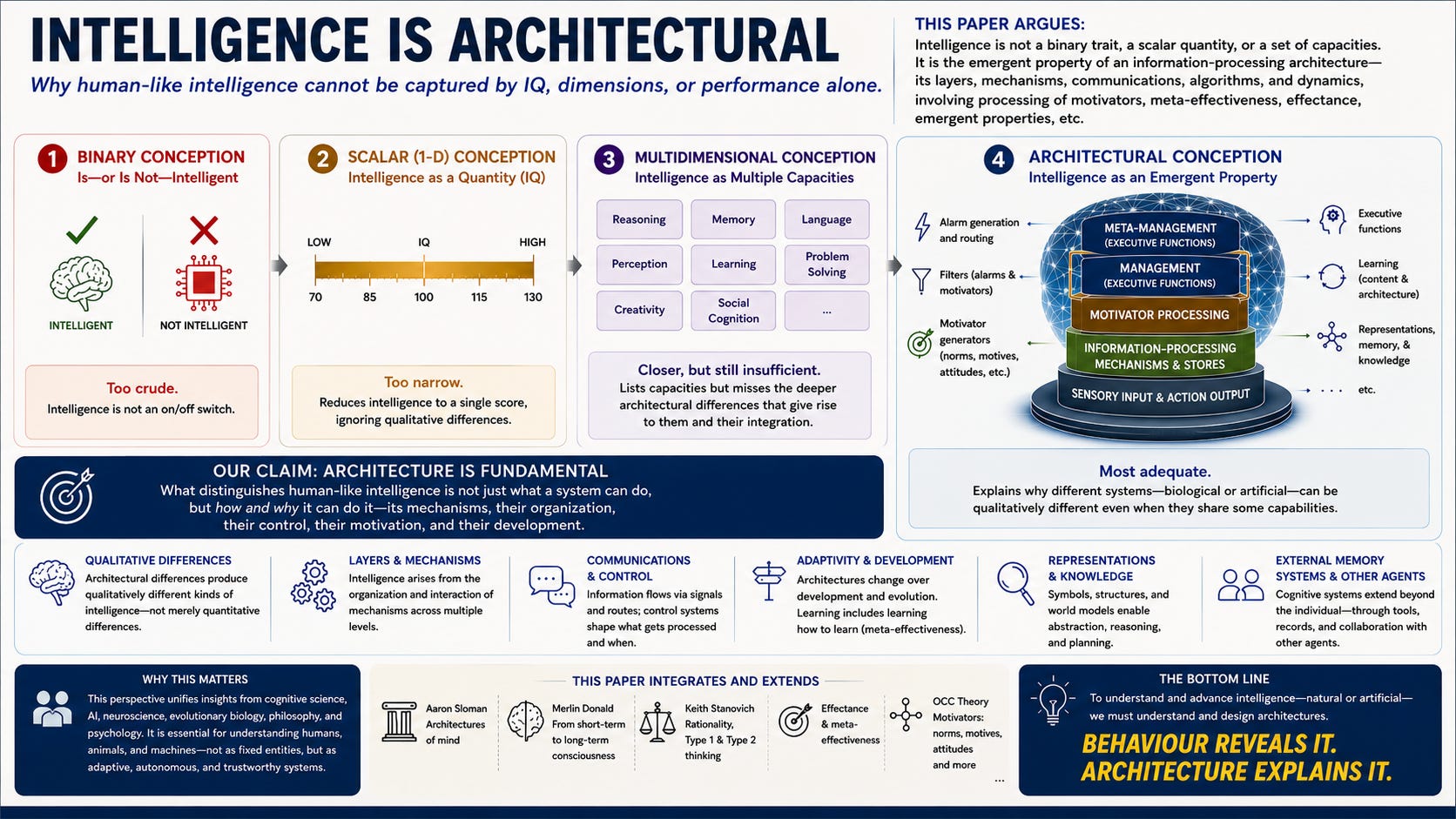
Figure generated by AI based on my specification
Psychology has traditionally described intelligence in two familiar ways. The first is scalar. Intelligence tests ask how intelligent someone is, producing measures such as IQ. The second is multidimensional. Rather than reducing intelligence to one number, many researchers distinguish language, memory, reasoning, creativity, social understanding, executive function, and many other abilities. These approaches have taught us a great deal and remain extremely valuable. But they remain largely descriptive.
Suppose two systems perform equally well on a planning task. One constructs explicit plans, monitors progress, interrupts itself when circumstances change, and deliberately revises its strategy. The other arrives at similar answers using entirely different internal mechanisms. From the standpoint of behaviour, they may look alike. From the standpoint of explanation, they may be profoundly different. Performance provides evidence about intelligence. It is not intelligence itself.
To explain intelligence we need to ask what kind of information-processing organization gives rise to intelligent behaviour. The architectural perspective has a long history in artificial intelligence and cognitive science. I think Aaron Sloman was the first to emphasize the importance of information-processing architectures in AI. Search for “architecture” in his still relevant 1978 book, The Computer Revolution in Philosophy: Philosophy, Science and Models of Mind, and you will find many hits. Allen Newell later argued that cognitive science should seek unified theories capable of explaining memory, reasoning, learning, problem solving, and language within one integrated system rather than as isolated modules.
The present essay belongs to that tradition.
An information-processing architecture is much more than a list of abilities. It includes the mechanisms through which an agent generates goals, allocates attention, stores and retrieves information, learns, plans, evaluates alternatives, interrupts itself, governs its own thinking, and adapts over time. It also includes the communication pathways linking these mechanisms together. Two systems can exhibit similar behaviour while possessing very different architectures, just as birds and airplanes both fly despite relying on radically different mechanisms.
Human intelligence, from this perspective, is not explained by any single faculty. It emerges from the interaction of many architectural mechanisms.
Some of these mechanisms operate reactively, responding quickly to opportunities and dangers. Others support deliberation, planning, scheduling, and decision making. Higher-level management processes coordinate ongoing activities, while meta-management processes monitor and regulate the management processes themselves. Human intelligence also depends on systems for generating and evaluating motivations, detecting important changes through alarm mechanisms, governing behaviour across long periods of time, constructing explanations, learning from criticism, and continually reorganizing itself through experience.
These mechanisms are not independent. They continually interact. Memory supports planning. Planning guides learning. Learning changes motivation. Motivation directs attention. Meta-management evaluates whether current strategies are working. The intelligence of the whole arises from the organization of the parts rather than from any one component.
Evolution provides another perspective on this organization. Building on Merlin Donald’s work, I suggest that uniquely human intelligence emerged through successive architectural innovations rather than through one major breakthrough. Memesis enabled the following development of mythic consciousness. Language enabled narrative thought and shared culture. Writing and other external symbol systems transformed memory and reasoning by allowing knowledge to accumulate outside the brain. Today, books, diagrams, search systems, note-taking tools, contextual information retrieval, and AI continue extending human cognitive architectures. Mature human intelligence is therefore partly biological, partly social, and partly technological.
Learning itself also looks different from an architectural perspective. Rather than viewing learning simply as storing information or developing procedural knowledge, we can think of it as changing the architecture. Learning may alter knowledge, habits, motivational systems, evaluative processes, strategies, executive control, or even the mechanisms through which future learning occurs. One can develop new motive generators and mechanisms for generating alarms. Humans are especially remarkable because they can deliberately participate in this process. Through explanation, criticism, productive practice, and reflection, they can redesign aspects of their own information-processing architecture.
This leads naturally to what I have elsewhere called meta-effectiveness: the capacity and disposition to become increasingly effective. Perhaps the highest expression of intelligence is not simply solving today’s problems but improving the architecture that will solve tomorrow’s.
The architectural perspective also provides a richer framework for comparing humans, other animals, and artificial intelligence. Instead of asking whether one system is more intelligent than another, we can ask which architectural mechanisms they possess, how those mechanisms are organized, how they interact, and how they develop over time. Humans, great apes, and contemporary AI share important continuities while also exhibiting significant architectural differences. These comparisons become far more informative than attempting to place every mind on a single intelligence scale.
None of this diminishes the value of IQ tests, psychometric research, or AI benchmarks. On the contrary, they become even more useful because they provide evidence from which we can infer underlying architectural properties. The mistake is treating those measurements as intelligence itself rather than as clues about the organization that produces intelligent behaviour.
I therefore propose adding a fourth conception of intelligence to the familiar binary, scalar, and multidimensional conceptions. Intelligence should also be understood architecturally.
Viewed this way, the central scientific challenge changes. Instead of asking whether a system is intelligent, we ask what kind of information-processing architecture it possesses, how that architecture developed, how it learns, how it governs itself, and how it supports the remarkable variety of behaviours we associate with intelligence.
Behaviour provides the evidence for intelligence. Architecture provides the explanation.
No posts
Comments
Nothing yet. Say the first thing.
Sign in to join the conversation.