
Here follows another chapter on creativity from my book Discontinuities: Love, Art, Mind on which I’ve been working on-and-off since… 2012! (See my First [2012] chapter.) Now, I’m delighted to finally complete a chapter that consolidates many of the psychological criteria underlying judgments of creativity that have occupied my mind for years, based on reading several very potent books on the subject.
Margaret Boden’s The Creative Mind: Myths and Mechanisms remains the most insightful book I’ve read on creativity. Rather than treating creativity as an inexplicable gift possessed by a fortunate few, Boden analyzes it as a phenomenon that can be understood scientifically. She argues that genuinely creative products possess three defining characteristics: they are surprising, important, and novel. I remember these three properties with the acronym SIN. It is an elegant characterization. Creative products are not merely different from what came before; they also matter, and they violate our expectations in interesting ways.
Boden is certainly not alone in emphasizing usefulness or importance as an essential component of creativity. Keith Simonton, for example, has long argued that creativity cannot be reduced to originality alone: ideas must also prove valuable or useful within their domain. See, for example, Keith Simonton’s Creativity in Science: Chance, Logic, Genius, and Zeitgeist. Throughout her book, Boden further argues that creativity is constrained rather than random: it arises through the exploration or transformation of conceptual spaces rather than through arbitrary originality.
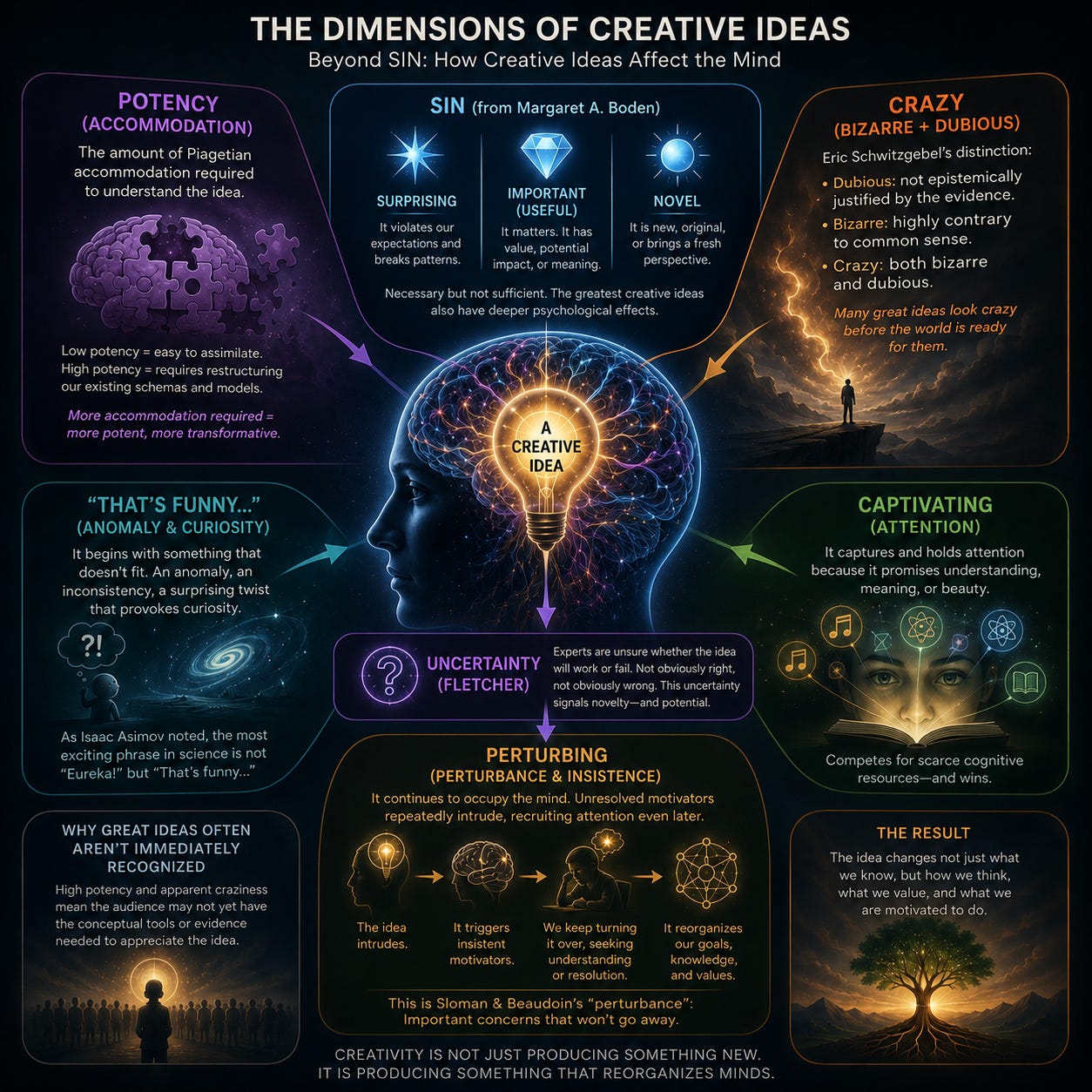
Image courtesy of ChatGPT.
I believe, however, that SIN captures only one important aspect of what makes the greatest creative works memorable. Boden’s criteria characterize the creativity of products. I would like to complement this perspective by focusing on the relationship between the product and the cognitive architecture encountering it. Creativity is not simply a property of an idea, theory, painting, novel, or scientific discovery. It is also a property of what that artifact does to the mind that encounters it. The greatest creative works do more than surprise us. They reorganize our conceptual structures, challenge our assumptions, alter our motivations, recruit and sustain our attention, and continue occupying our thoughts long after the initial encounter. They can even leave us uncertain about what to believe or how to proceed, precisely because they stretch beyond our existing conceptual frameworks. In short, creativity is not merely about producing something new. It is also about producing something capable of changing another mind.
Thus, the first additional property I would add is potency. I discussed this at length in my two Cognitive Productivity books and elsewhere in this book. (Just search for “potency” in this book.) By potency I mean the degree of Piagetian accommodation required before the observer can genuinely understand the work. Some new ideas can be assimilated (in Piaget’s sense) into existing conceptual structures with little effort. We simply add another fact to what we already know. But highly creative works resist assimilation. They require accommodation. We must reorganize our existing mental models before the work itself becomes intelligible. Einstein’s theory of relativity, Darwin’s theory of evolution by natural selection, cubism, atonal music, Joyce’s Ulysses, and Gödel’s incompleteness theorem are all potent in this sense. Their creativity lies not merely in their novelty but in the conceptual restructuring they demand of the audience. Potency therefore measures something different from novelty: it measures how profoundly an artifact transforms the conceptual organization of the observer.
A second characteristic of many creative works is what philosopher Eric Schwitzgebel calls craziness. In a fascinating discussion on the Rationally Speaking podcast, Schwitzgebel carefully distinguishes between three related dimensions of ideas: dubiety, bizarreness, and craziness. A claim is dubious when the available evidence does not epistemically justify believing it. A claim is bizarre when it is highly contrary to common sense. Finally, a claim is crazy when it is both bizarre and dubious—that is, when it is highly contrary to common sense and we are not yet epistemically compelled to accept it. This distinction is extremely useful because it reminds us that apparent craziness is not the same as falsehood. Many of history’s greatest scientific and artistic innovations initially appeared crazy precisely because they challenged deeply entrenched conceptual frameworks before sufficient evidence had accumulated. Continental drift, heliocentrism, the theory of relativity, the theory of evolution, and germ theory all looked crazy long before they became accepted science.
Closely related is what might be called the “That’s funny…” phenomenon. In Inside Jokes: Using Humor to Reverse-Engineer the Mind, Matthew Hurley, Daniel Dennett, and Reginald Adams argue that humor often arises when the mind suddenly abandons one interpretation in favour of another after detecting an inconsistency in its current mental space. Drawing on Gilles Fauconnier’s theory of mental spaces, they describe a mental space as a temporary conceptual structure constructed during comprehension that organizes currently relevant concepts, percepts, assumptions, and inferences. Mental spaces are continually constructed, revised, and sometimes abandoned as new information arrives. Humor arises when an inconsistency is detected within the current mental space, prompting the rapid construction of a superior interpretation. Scientific creativity frequently begins in much the same way. Isaac Asimov famously observed that the most exciting phrase in science is not “Eureka!” but “That’s funny….” Whether or not Asimov actually coined the quotation, it captures something profound about discovery. Creative breakthroughs often begin with anomalies—observations that stubbornly refuse to fit our existing understanding. Before there is explanation, there is puzzlement. Before there is theory, there is the nagging feeling that something is wrong with our current mental space. The inconsistency need not be between two conscious beliefs. Rather, new information often conflicts with assumptions or expectations that remain outside conscious awareness. Humans appear to be exquisitely designed to detect such inconsistencies, and the pleasurable experience of humor arises when a richer mental space suddenly replaces the old one. (I highly recommend Inside Jokes.)
Brian Boyd approaches creativity from a complementary perspective. In On the Origin of Stories: Evolution, Cognition, and Fiction, discussed elsewhere in this book, discussed elsewhere in this book, he argues that propensity to create artistic work evolved under selective pressures to capture, direct, and reward attention. Stories, paintings, music, and other works of art compete for our limited cognitive resources, and those that better engage our attention are more likely to be appreciated, remembered, and transmitted culturally.
I would extend Boyd’s account one step further using an architectural theory of mind based on Sloman’s H-CogAff but which I significantly expanded. The greatest creative works do not merely capture our attention while we are experiencing them. They continue occupying our attention afterwards. They generate what Sloman and I have called perturbance: an information processing state in which unresolved motivators repeatedly compete for attention because they have acquired high insistence. We replay scenes from a novel days later. We continue turning over a philosophical argument while driving home. We awaken during the night thinking about a scientific puzzle or an unresolved piece of music. The artifact has become motivationally active within our cognitive architecture. It repeatedly interrupts ongoing cognition because unresolved concerns continue recruiting management and meta-management processes. In this sense, great creativity is not merely attention-grabbing; it is perturbance-inducing. It generates insistent motivators that remain cognitively active until they are integrated, resolved, or abandoned. See the very accessible paper I coauthored with Sylwia Hyniewska and Monica Pudlo.
This perspective also helps explain why immediate popularity is often a poor measure of creativity. Boyd is surely right that creative works must ultimately earn attention if they are to survive culturally. But the most potent works are frequently misunderstood when they first appear because they require more accommodation than contemporary audiences are prepared to undertake. Einstein’s 1905 papers did not immediately revolutionize physics. Van Gogh sold almost none of his paintings during his lifetime. Joyce bewildered many early readers. Their creativity did not consist in immediate popularity but in their remarkable capacity to reorganize the minds of those willing to engage with them deeply enough.
Keith Simonton argues that chance plays a fundamental—but often misunderstood—role in scientific creativity. Creative breakthroughs rarely emerge from straightforward logical deduction alone. Instead, scientists generate many tentative combinations of ideas, analogies, methods, and observations, only a few of which prove fruitful. Chance enters because no one can reliably predict in advance which combinations will lead to major discoveries. Yet this is not blind randomness: logic, expertise, and historical context guide the generation, evaluation, and refinement of ideas. Creativity thus depends on a disciplined search in which serendipitous combinations are recognized, developed, and ultimately integrated into scientific knowledge. I believe this also applies in other domains of human creativity.
Angus Fletcher (author of Wonderworks) offers a complementary perspective by arguing that creativity is closely tied to uncertainty rather than originality alone. Because it is notoriously difficult for experts to judge whether a new idea is genuinely creative, Fletcher proposes asking a different question: How uncertain are you that this solution will work? A highly creative idea is one that experts cannot confidently classify as either correct or incorrect because they have not encountered anything quite like it before. If they are uncertain, the idea likely contains genuine novelty; if they are also unwilling to dismiss it, it has creative potential. Rather than treating uncertainty as a flaw, Fletcher suggests that it is often a hallmark of innovation and a signal that exploration should continue rather than cease. This perspective aligns well with Simonton’s emphasis on chance: creativity often involves venturing into regions where outcomes cannot be predicted in advance. This idea is not in his book. Instead, Fletcher discusses this idea in The Uniting Power of Story (YouTube, Episode 205)., where he also connects uncertainty to the distinctive power of stories to help us navigate an unpredictable world.
Another characteristic of many great creative works is what might be called ingenuity. We recognize that some creative artifacts could not have been produced by an ordinary person. They bear unmistakable evidence of extraordinary intelligence, expertise, imagination, or technical mastery. The audience is left wondering, How could anyone have thought of that? or How could anyone possibly have created that? This reaction differs from mere surprise. We are not simply surprised by the product; we are astonished by the remarkable cognitive achievement that must have been required to produce it.
This is especially evident in music. The compositions of J. S. Bach, the late string quartets of Beethoven, the orchestral works of Stravinsky, or the improvisations of Charlie Parker all convey an extraordinary degree of ingenuity. Even listeners with little formal musical training often recognize that these works embody a level of craftsmanship far beyond ordinary competence. Part of their creative power lies in the audience’s appreciation of the exceptional cognitive abilities required to conceive and execute them.
A striking contemporary example is the Quebec experimental music collective Angine de Poitrine. Their performances are simultaneously bewildering, captivating, technically astonishing, and emotionally compelling. Watching both the performances and the many reaction videos posted online, one repeatedly encounters comments expressing not merely surprise but amazement at the performers’ apparent abilities. Viewers frequently remark that the music seems almost impossible to reproduce, that the performers must possess extraordinary musical intelligence, and that the work repeatedly draws them back for further listening despite—or perhaps because of—its initial difficulty. The live performance at the Electric Ballroom in London provides an excellent illustration. The work does not simply command attention during performance; it often continues recruiting thought afterwards as listeners attempt to understand how such music could have been conceived and performed.
Through their costumes, stage presence, and deliberately uncanny performance style, Angine de Poitrine also satisfy the funny criterion. Their visual presentation continually encourages the audience to reconstruct its mental spaces in response to unexpected juxtapositions, making the performance psychologically as inventive as the music itself.
Boden’s SIN framework remains an outstanding foundation for understanding creativity. I would simply augment it with a more explicitly architectural perspective. The greatest creative works are not merely surprising, important, and novel. They are also potent enough to require accommodation, crazy enough to challenge prevailing assumptions before the evidence becomes compelling, funny enough to begin with anomalies that provoke curiosity, and perturbing enough to generate insistent motivators that continue to occupy the mind long after the initial encounter. It may leave us uncertain about the utility of the idea. Chance co-determines the significance of creations. Truly creative work also are also perceived as the result of tremendous ingenuity. Creativity, on this view, is not merely about producing something new. It is about producing something that changes the organization of another mind—and keeps changing it until a new equilibrium is reached.
You may notice a pattern in my writing. Neuroscientist Luiz Pessoa on the Brain Science Podcast (c. 2013), when interviewed about his book The Cognitive-Emotional Brain, said neuroscientists should “embrace complexity”. I believe the same goes for cognitive science, hence my integrative design-oriented approach to humans as autonomous agents. I have always resisted simplistic definitions of intelligence, conscious, creativity, emotion etc. (See my articles on intelligence and my upcoming article on consciousness). By the way, the Discontinuities book is already for sale on Leanpub —it’s 95% complete — I estimate it will be complete before October. But as a Leanpub book, I will be able to update it based on reader feedback. My next book will either be on sleep onset and insomnolence (compare this) or comparative integrative design-oriented understanding of consciousness and intelligence (AI vs. human vs. other animals).
No posts
Comments
Nothing yet. Say the first thing.
Sign in to join the conversation.