
Part of my summer professional learning is spent building my content knowledge. Traditionally, I would build my content knowledge specific to the content I teach for my grade level. For example, when I taught second grade, I focused on building my knowledge of Ancient Greece, Ancient China, Ancient India. When I moved to teaching third grade, I read texts about Ancient Rome and the Vikings.
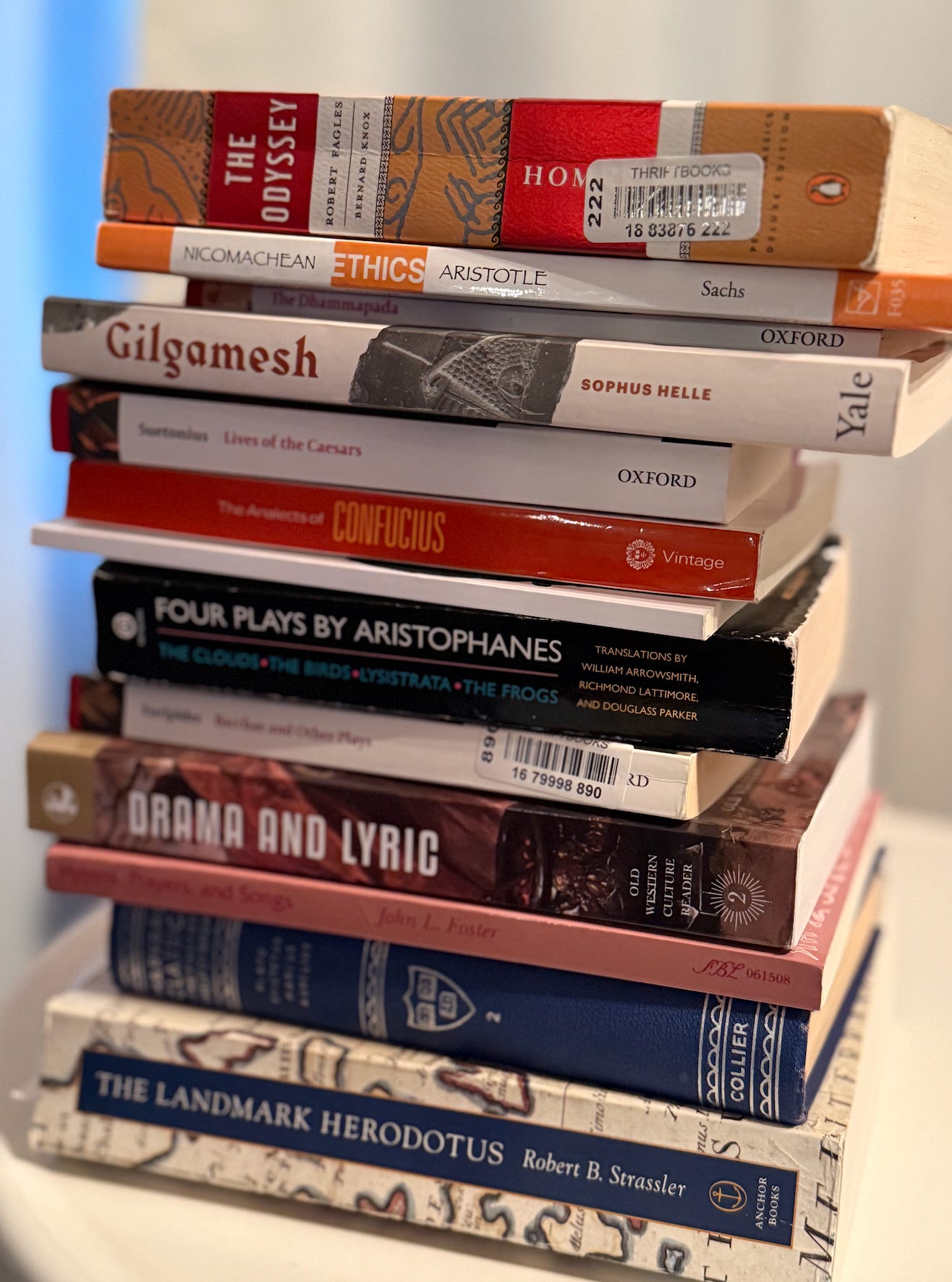
But this year, I was really interested in attempting Ted Gioia’s 12-week humanities course to expand my overall knowledge, not just what was specific to the content I teach. But there was a surprising correlation between that humanities course and Ausubel’s meaningful learning.
Gioia has the course set up to read 250 pages a week and engage with a selection of related music and art. The reading selections were mostly a variety of texts from the ancient world, including ancient Greece, Egypt, Rome, India, Mesopotamia, and the Middle East.
So how does this relate to meaningful learning? While I wasn’t looking to focus specifically on my grade-level content, the humanities course turned out to be an in-depth review of all the content I had learned related to second and third grade content. It also developed my knowledge of the content students at my school learn in first grade. It took that knowledge I had acquired over several years, which had been somewhat isolated bits of knowledge, and connected it all into one schema. It made that knowledge stronger and deeper, and gave me a better picture of the ancient world as a whole. I also better understand the interplay of those civilizations with each other and their influence on modern civilizations and events.
More importantly, though, it made me aware of how important this is not just for my own learning but also for my students’ learning, and that I need to make similar connections for my students. Through my own summer learning experience, I realized that I need to intentionally design my lessons to build and strengthen connections between knowledge my students learned in earlier grades and what they will learn this year.
My students will be coming to me having been taught about the ancient civilizations of Mesopotamia, Egypt, China, India, and Greece. Ideally, they will have a basic understanding of these civilizations, but my concerns are:
Their retention of knowledge learned in earlier grades.
Their ability to learn new knowledge in third grade depends on what they have learned and remembered in previous grades.
Their knowledge of each civilization is isolated, and they are unaware of the connections across the content. This also increases the likelihood they will forget what they have learned.
To address these concerns, I am considering these guidelines as I develop my lessons.
Intentionally review content they have learned in earlier grades.
Explicitly connect third grade content to content learned in earlier grades.
Design learning experiences that advance students towards the generalization and adaptation phases of the instructional hierarchy so they can build connections across content.
In upcoming posts, I will go more in depth on what this looks like in my lesson design.
No posts
Comments
Nothing yet. Say the first thing.
Sign in to join the conversation.