
Sarah Cottinghatt explains meaningful learning simply in this quote:
Ausubel says that meaningful learning happens when some relevant existing knowledge connects to the new information that you’re teaching and a new meaning is born.
Before I understood meaningful learning principles, I had instinctively thought it was important that knowledge should be cumulative and connected, but I had never intentionally designed my instruction to include explicit connections to previous learning. Meaningful learning now underpins all my instructional design and delivery.
I’ve organized this post by the practical application categories outlined in Ausubel’s Meaningful Learning in Action by Sarah Cottingham. All quotes are Sarah’s taken from her book or from her webinar Kickstart Meaningful Learning with Sarah Cottinghatt.
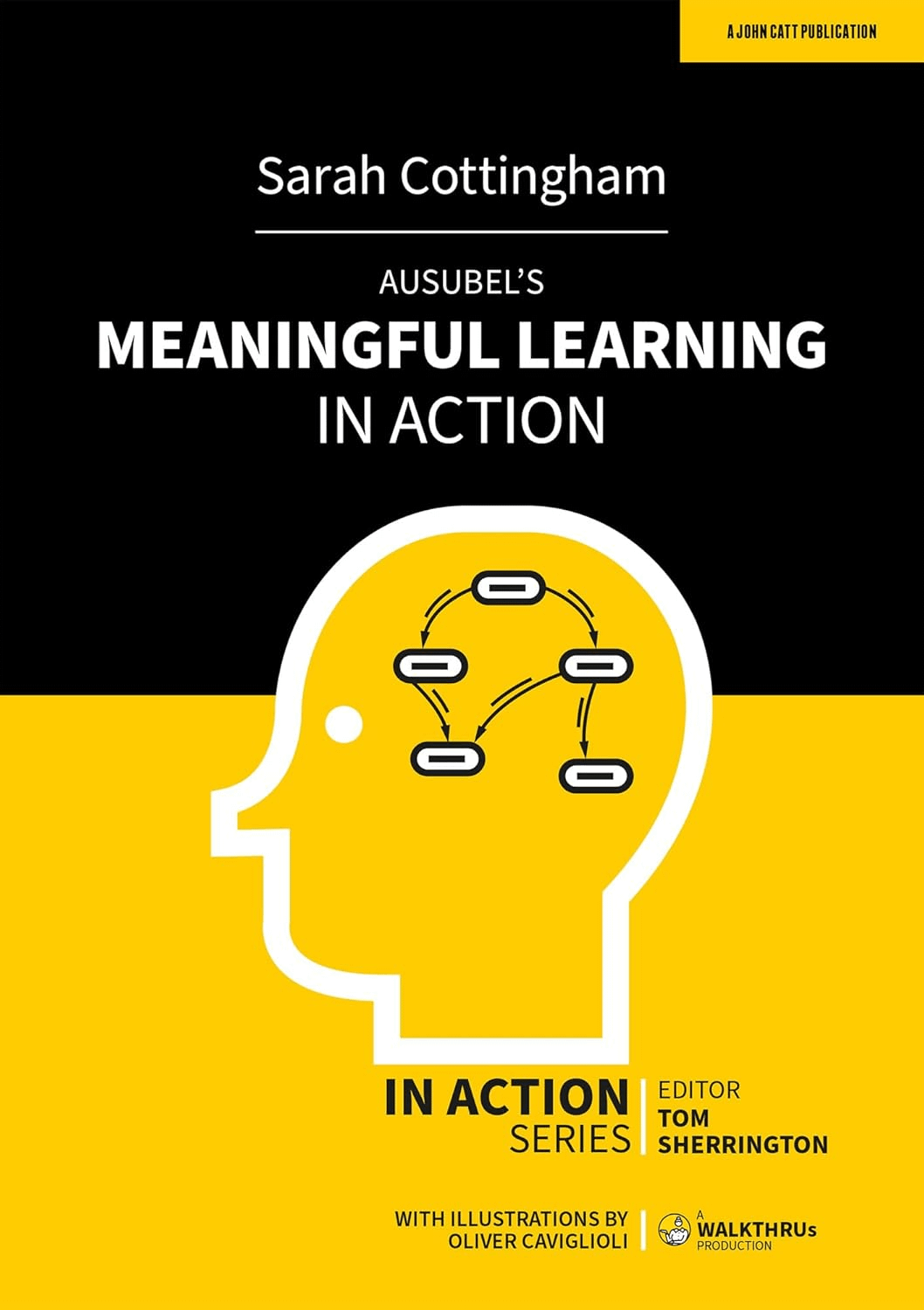
Ausubel’s Meaningful Learning in Action by Sarah Cottingham
Sarah’s book is an excellent distillation of Ausubel’s work on meaningful learning. It is the perfect blend of theory and practical application. (You can also find an excellent book summary by Helen Reynolds here.)
Kickstart Meaningful Learning with Sarah Cottinghatt
This webinar combined with her book is the perfect way to learn about and get started with meaningful learning.
Visually map out the curriculum and the links between ideas.
Be explicit about which concepts are being prioritized.
Teach Fast: Focused Adaptable Structured Teaching by Gene Tavernetti
Teach FAST is an excellent resource for designing instruction around meaningful learning. Every stage of the FAST framework addresses each principle of meaningful learning.
Organise Ideas: Thinking by Hand, Extending the Mind by Oliver Caviglioli
This is a helpful book for creating a visual map of the subsumers and ideas to focus on in the content.
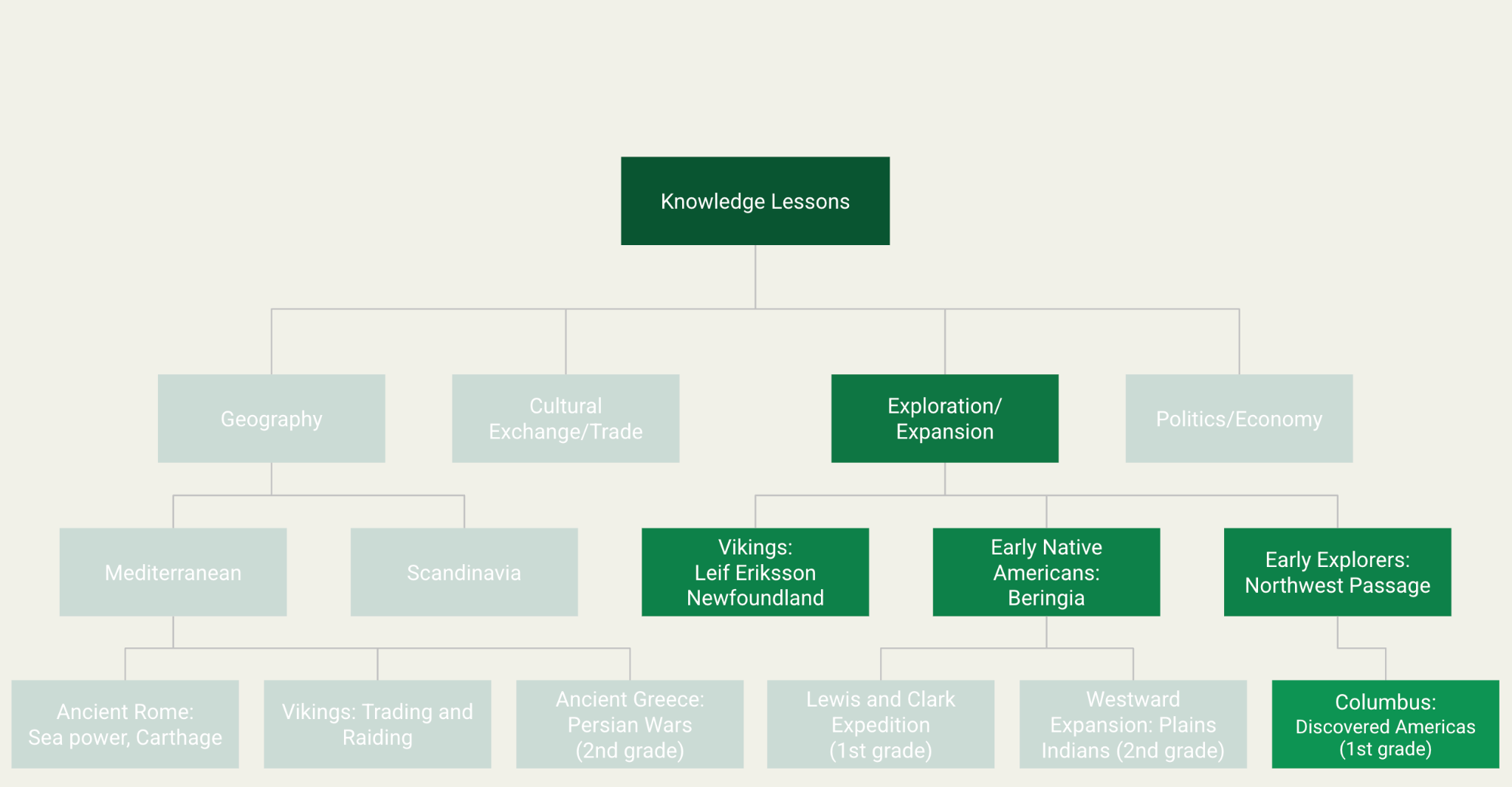
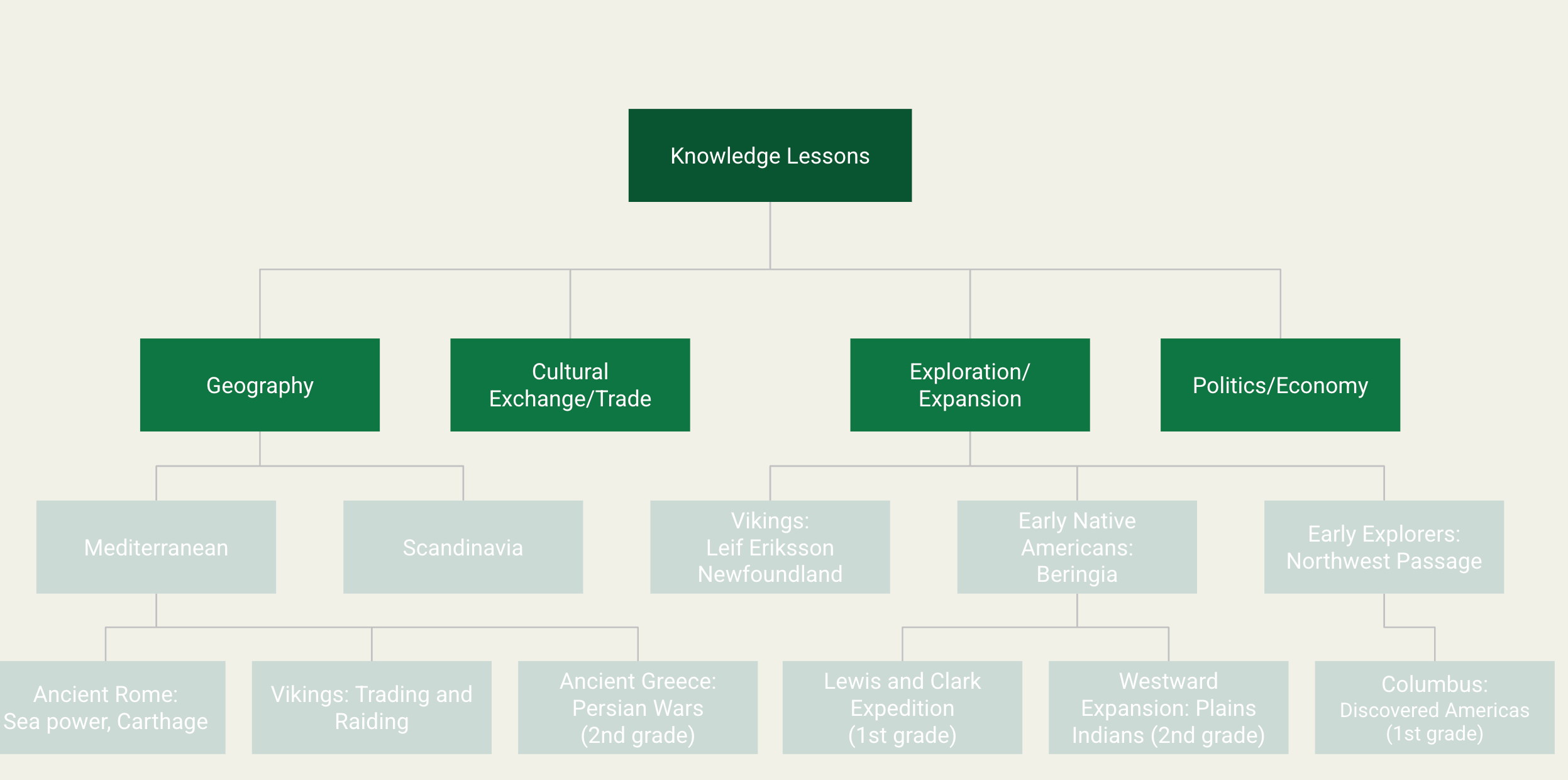
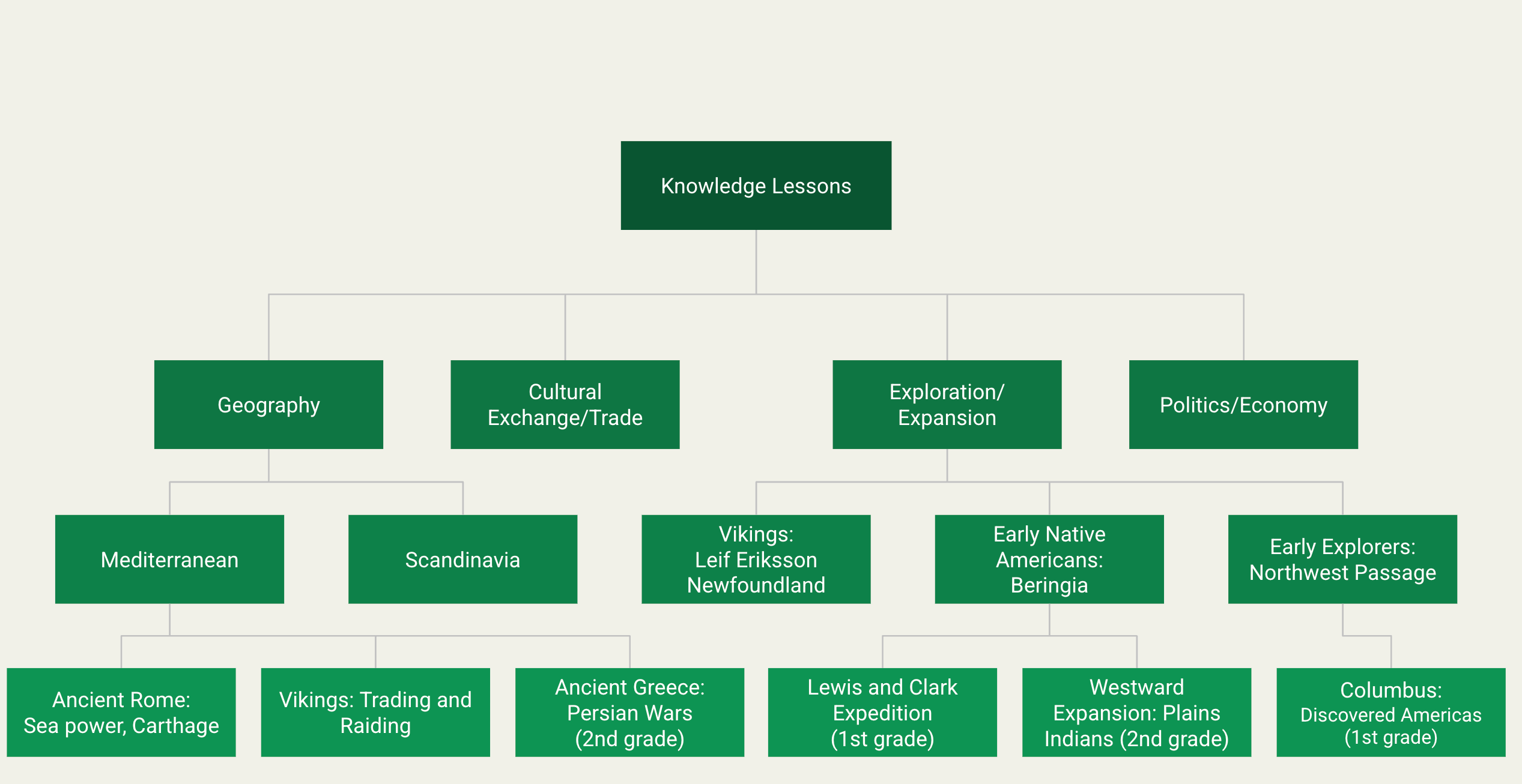
Here is an example of how I have mapped out these ideas. I first extracted the key ideas from each of my units. I then identified the common connections between them to develop my subsumers. Finally, I filled in the details from each unit. I also included relevant learning from previous grades. This is a sample of some of those connections.
We need to prepare students’ cognitive structures so they are ready to learn the new ideas in our lessons
The advance organizer acts as a bridge between existing knowledge and the new idea.
The use of advance organizers in the learning and retention of meaningful verbal material. by David P. Ausubel
This paper is also discussed in Chapter 11: “What You Know Determines What You Learn” in How Learning Happens by Paul A. Kirschner and Carl Hendrick.
The prior knowledge paradox: what to do with what they know by Sarah Cottinghatt
Sarah has a useful explanation of the purpose of advance organizers and examples of how to use them.
Advance Organizers for Deeper Learning – TCEA TechNotes Blog
This had some useful resources. Caution: Some of these resources could lead to lethal mutations, so be careful to understand their purpose and how best to design them.
Make connections to students’ relevant, existing knowledge in the moment.
It matters what knowledge you link it to.
Here is an example from one of my own lessons of how I will make connections to relevant, existing knowledge in the moment:
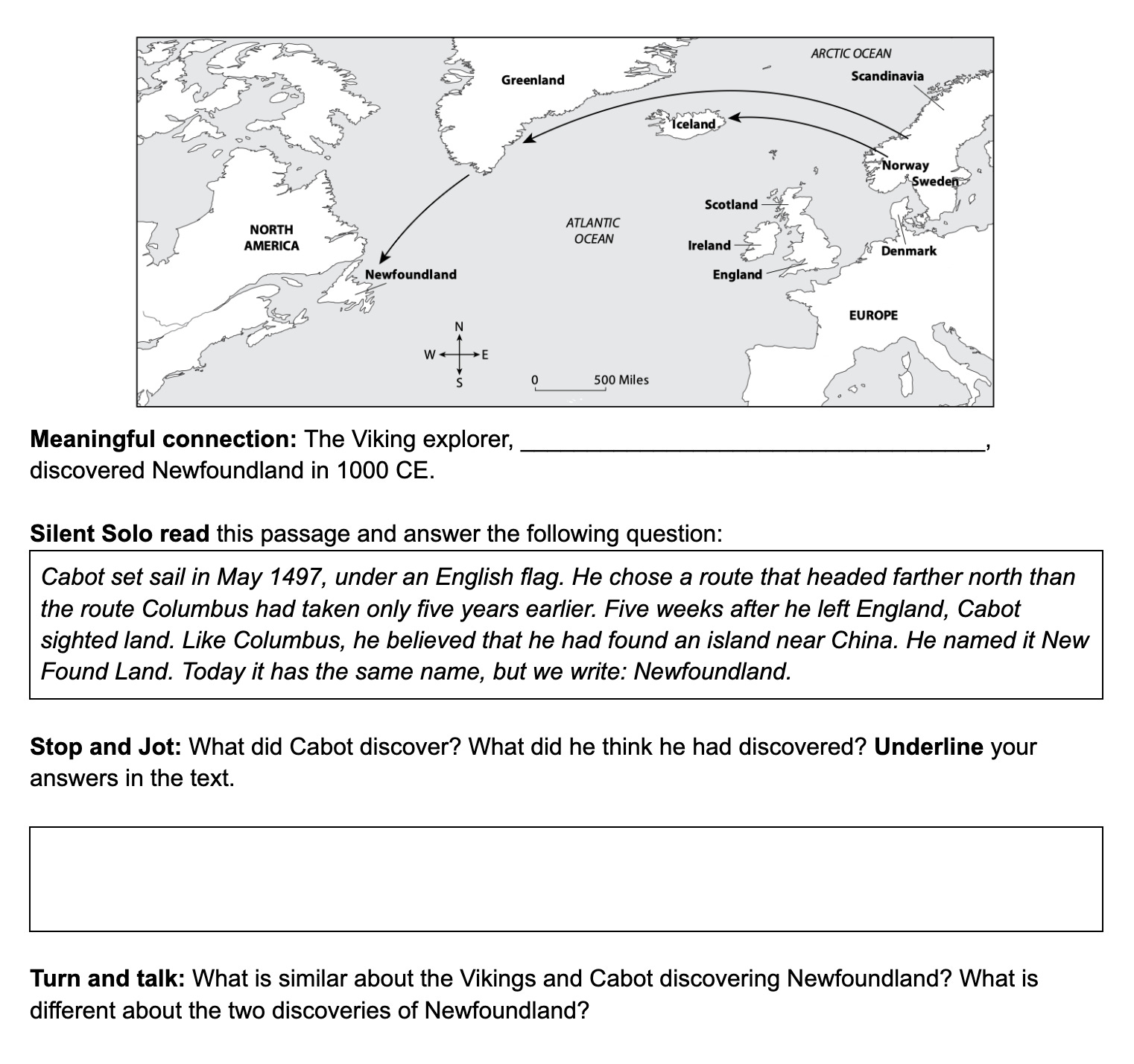
Students had learned about Lief Erikson discovering Newfoundland in a previous unit on the Vikings. I had originally included this review in the Do Now. But Sarah points out that these connections need to be made in the moment so that the relevant knowledge is in the forefront of their minds when new information is introduced.
The Power of Examples and Non-Examples - by Carl Hendrick
Sarah talks about how examples and non-examples are really helpful for understanding ideas that can easily be confused. The seminal work on this is Engelmann’s and Carnine’s Theory of Instruction: Principles and Applications: Engelmann, but Carl’s explanation does a nice job of making this concept more accessible.
Meaning is made in the mind of the learner, not the words of the teacher.
Children must make the connection for themselves.
Strengthening the Student Toolbox by John Dunlosky
Sarah particularly brings up the importance of self-explanation for students to explain what they already know and how it connects to the new learning.
(Original paper: Improving Students’ Learning With Effective Learning Techniques: Promising Directions From Cognitive and Educational Psychology https://doi.org/10.1177/1529100612453266. The paper is also discussed in Chapter 26: “Learning Techniques That Really Work” in How Learning Happens by Paul A. Kirschner and Carl Hendrick)
How and Why to Use Concept Maps | Cult of Pedagogy with Dr. Kripa Sundar and Dr. Pooja Agarwal
Concept Maps: A Tool for Strengthening Background Knowledge and Boosting Comprehension - Scientists in the Making) by Marcie Samayoa
Concept Mapping A Powerful Tool for Learning by Dr. Kripa Sundar
Concept Maps by Reading Rockets
Checking for meaning is different from checking for understanding.
Ask questions that require the student to show if they can relate the new idea to existing knowledge.
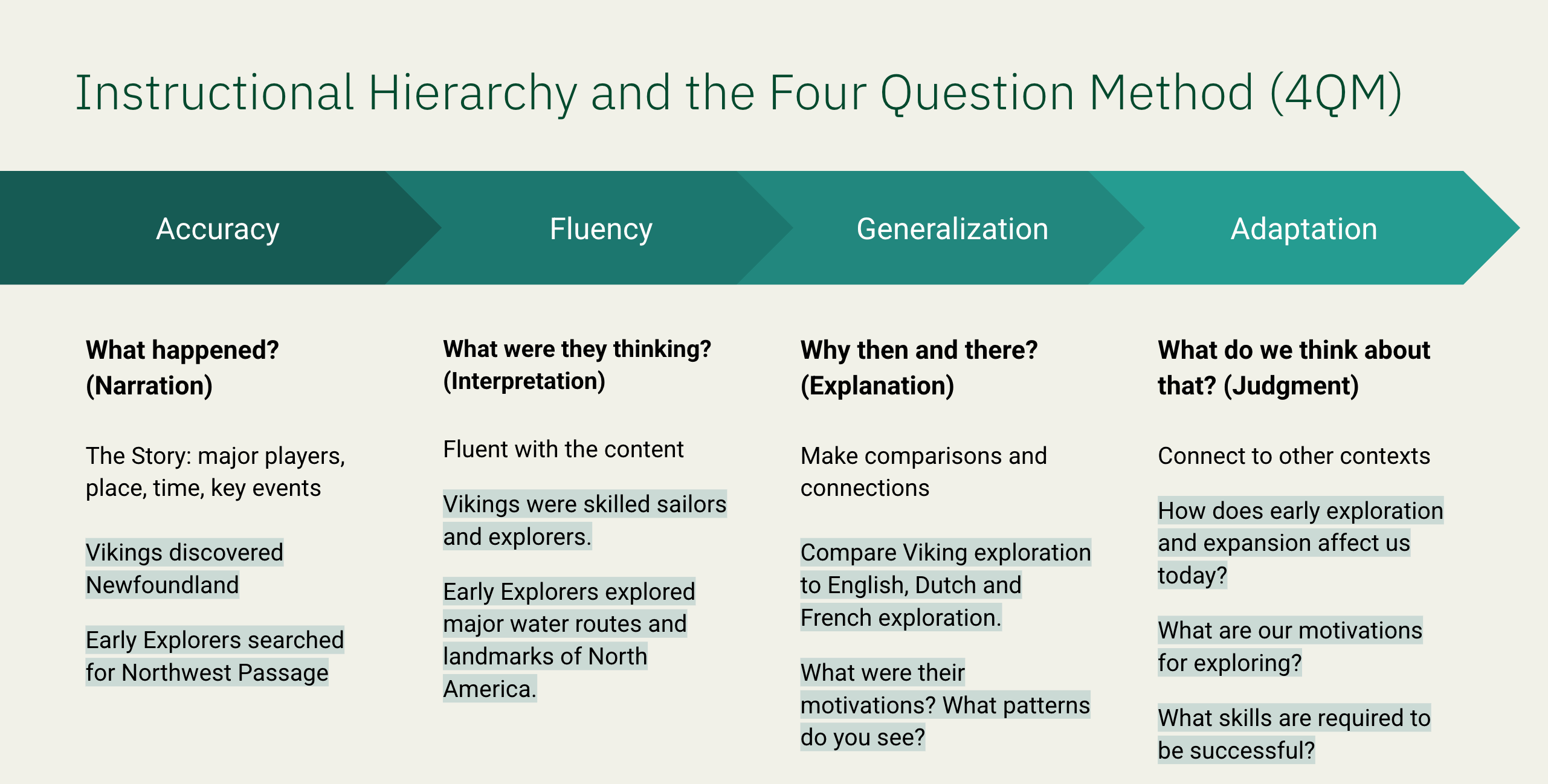
Instructional Hierarchy infographic by MTSS Center
This is a useful infographic to understand where a student may fall in their understanding of the instruction. Meaningful learning is also very useful in advancing students into the generalization and adaptation phases.
Designed specifically for history content, questions 2-4 are excellent for checking if students are connecting new ideas to what they already know.
Here is an example of how I’ve connected the Instructional Hierarchy and 4QM:
Hinge Questions: Identify and Respond to Common Misconceptions by Jamie Clark
From Jamie Clark’s DistillED, this is a short guide to developing targeted questions at key points in the lesson that aid in responsive teaching and knowing if students are relating new ideas to existing knowledge.
Robust Comprehension Instruction with Questioning the Author: 15 Years Smarter by Isabel L. Beck, Margaret G. McKeown, Cheryl A. Sandora
This is a must-have reference for designing well-crafted questions that probe students’ connections to existing knowledge.
Keeping meaning alive is about counteracting forgetting and preventing new learning from regressing into existing knowledge.
The Hidden Lives of Learners by Graham Nuthall
What Helen Reynold’s calls the “Rule of three,” Nuthall found that if a learner has three exposures to a concept, he could predict with 80% accuracy that learner would have successfully learned the content. The beauty of meaningful learning is it makes those three exposures almost seamless.
Nuthall’s Hidden Lives of Learners in Action by Bennie Kara
Another excellent in Action book on how to interpret and integrate Nuthall’s work into your instruction.
An Annotated Forgetting Curve | Teach Like a Champion
TLAC has created a helpful visual with annotations to understand the forgetting curve.
Students must understand and embrace their role in the meaningful learning process.
The ‘Knowledge, Belief, Commitment, Planning’ Framework may be a helpful tool.
KBCP - Knowledge, Belief, Commitment and Planning Framework from InnerDrive
Dr. Claire Badger has written an excellent article explaining KBCP and has included examples and sample resources for implementation.
This is a video interview with Mark McDaniel who developed the KBCT framework with his colleague Gil Einstein. (Mark McDaniel is also a coauthor of Make it Stick.)
How Do We Learn?: A Scientific Approach to Learning and Teaching (Evidence-Based Education) by Hector Ruiz Martin
Hector has an entire section dedicated to motivation that he explains theoretically and practically. I recommend the whole book, and I love that it includes motivation, something that is often overlooked in books on learning.
No posts
Comments
Nothing yet. Say the first thing.
Sign in to join the conversation.