
In just a few months, David and I plan to set sail from Queensland, Australia, bound across the Tasman Sea to New Zealand. This will be my 9th passage across this often-boisterous body of water. Unlike with most ocean passages, I am facing this one with a bit of trepidation. The reason? Only one of my previous Tasman crossings has been what could be called “pleasurable.” The others ranged from okay to terrible.
My first Tasman crossing was definitely the most taxing. In 1988, Larry and I were in New Zealand and had been invited to meet up with several cruising friends to attend the Festival of the South Pacific in Townsville, Australia. Before we could set sail, we were obligated to finish the manuscript for Larry’s book, Details of Classic Boat Construction. This meant foregoing the best weather window months, and waiting until July when the southern winter had truly set in.
The following story, written soon after the event, will show you why I am not too excited about this upcoming voyage.
_ _ _ _ _ _ _ _ _
I was furious. The jib had wrapped itself around the headstay, not once, but two times. The boat was rolling, the 20-foot-long whisker pole was banging against the stay, and I couldn’t keep the flashlight directed on the twist to help me figure which way the sail had wrapped. It had been a lousy watch from the beginning. The wind had been fluky when Larry went below to sleep. Each time the sails slatted, Larry’s eyes fluttered open. I tried adjusting the wind vane, putting shock cords on the tiller, sheeting in the sails far tighter than normal, hand steering – anything to keep the boat quiet so he could get some sleep. I really didn’t want to be working on deck. I’d discovered a new author and would have preferred being below, book in hand, coming out to check on deck and scan the horizon every 10 minutes. But Larry needed sleep, and nothing bothers him quite so much as slatting, banging sails.
The wind veered to that impossible spot, 35 degrees aft of the beam. As the boat surged off each wave, the damned jib would blanket just for a second, then BAMM, it would fill, clunking against the fairleads. Through the open hatch, I’d see Larry’s eyes flutter.
“I’ll set the g--d--- pole and run off for a while. If the wind backs any more, we’ll need the pole anyway. If not, we can reach up in the morning,” I mumbled to myself as I planned a super-quiet pole raising. I set the vane to run off dead downwind. I eased the jib to give me lots of sheet so I could pull the pole down its track on the mast. I went forward on the rolling deck and clipped the weather sheet into the pole end, then grabbed the pole downhaul line. Nothing much happened. Back to the cockpit for a flashlight. Ease the leeward jibsheet some more so the sail is almost flying free. Back to the pole downhaul – pole up, head for the cockpit. Boat lurches – sail flogs – before I reach for the sheet and get some tension on it, it’s twice around the headstay. I try winching the sheet, then loosening it. I try running by the lee. Finally, I wake Larry and, while he pulls on some clothes, I tie a halyard tail around my waist and go out to the end of the bowsprit. Then I jerk the sail free, guided by the light Larry is now shining on the jib. He hauls in the sheet as soon as the sail is unwound, and a minute later, we are running wing-and-wing over a much smoother-feeling sea, the vane perfectly in control, the breeze fresh and fair. Larry is chuckling, “You looked cute out there fighting that sail. But aren’t you cold without any pants on?” I didn’t particularly care about looking cute. I just wanted him asleep, and now I knew – to be fair – I owed him another half hour in the bunk before I got to climb in.
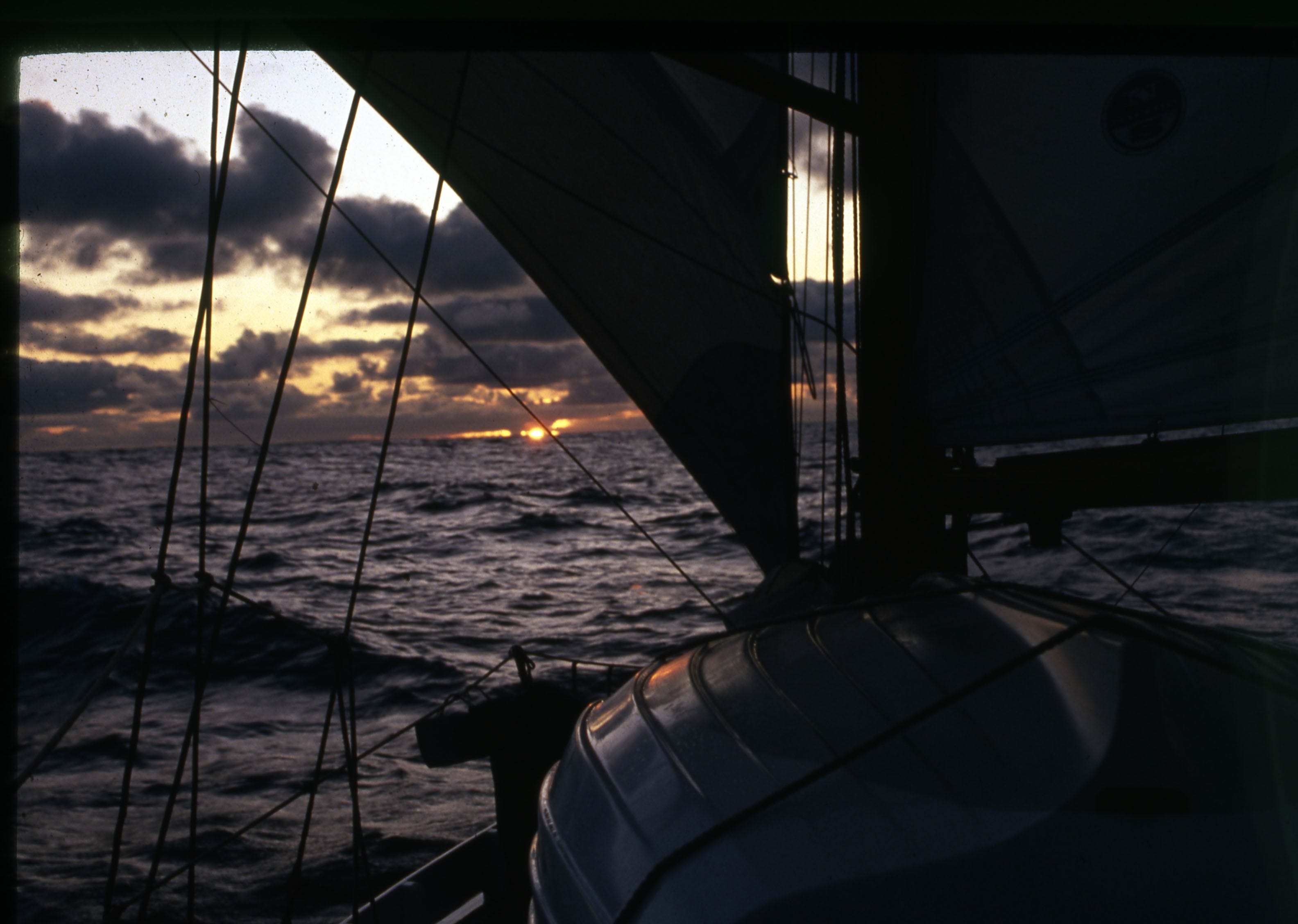
As I fine-tuned the vane, coiled the lines, and calmed down, I considered ways I could have avoided the snarl. I could have run a bit higher as I put up the pole, worked a bit faster. Then I thought back to the far less solvable problem I’d faced over the past two weeks, and tonight’s glitch came more into perspective. At least it had been something physical, curse-able, easily fixed and soon to be forgotten.
Two weeks earlier, our alarm had gone off early so we could catch the morning offshore forecast. “Strong wind warning,” entoned the broadcaster. “SW to W, 20 to 25 knots, some gusts to 35.” That was less than perfect for our planned voyage from New Zealand, across the Tasman Sea to Australia. But first we had to get 60 miles north from our island home base to Whangarei, where we could clear customs and immigration. To reach Whangerei we had to sail 60 miles northeast. With the forecast winds, we would be on a beam reach. Even better, we would always be in the lee of the land. So, we decided to go for it. I cleaned up below as Larry hanked our reefing jib onto the headstay. “We’ll reef it down when the wind freshens; right now we’ll need it,” he called to me. I flaked the chain into its locker as he cranked it in, then went on deck to help trim the sails. As soon as the sails were settled, and a bit of anchor mud washed off the foredeck, I went below to record our departure time in the log. The morning chill caught at my fingers as I pulled off my sailing mittens. The pen on the chart table rolled away from my grasp as I turned to the correct page in the logbook. I got a strange dizzy feeling as I started to write, “June 25th, 0800 set sail....” I sat down on the settee, my head against a cushion, and cursed, “You can’t be seasick yet, there’s hardly any waves.” I poked my head out of the companionway to get some fresh air. The wind was already fresher and we were running at close to 6 knots. My head began to throb, and I could feel the clamminess of growing seasickness – or was it fear? This was the first passage of a midwinter voyage across a sea notorious for boisterous winds and sudden gales. This was my first voyage outside the Hauraki Gulf and into open ocean in two and a half years. Almost every day for the previous five weeks, there had been reports of storm-force winds within miles of us.
A short while later, I helped Larry jibe the boat, and just before we left the lee of Kawau Island, 25-knot gusts convinced us to drop the jib and reef it to its working-jib configuration. Once we were in more open water, a cross swell set the boat dancing a bit as she reached quickly to the north. “I’m going to put my head down for a minute,” I told Larry as I climbed below.
“Your first-day-at-sea stomach,” Larry commented, “You’ll soon be over it.”
But I lay there feeling horrid, slowly accepting that it might be fear, not motion, at the bottom of my problem. But fear of what? I thought back over our previous month of preparations. I’d inspected every inch of the boat inside and out before we’d loaded the cruising gear on board, after two years of local racing and gunkholing. The boat was well proven, well outfitted – in fact in some ways, almost over-outfitted. Besides the storm trysail that was now hanked onto the base of its own track, we carried a brand-new spare mainsail and staysail, our lockers were full, we had lots of warm clothes, and, luxury of luxury, we had two complete sets of foul weather gear. But – I then began thinking of the preparations that are a vital part of prudent offshore voyaging. Inspect and repack the abandon-ship kit. Inspect and oil the flare pistol. Refurbish the emergency medical kit. Check the EPIRB signal and make sure the batteries are good. New batteries for the man-overboard strobes, lock-downs to keep the cabin floorboards and bilge contents from getting loose in a knockdown – nearly everything reminded me of potential dangers. Even the purchase of spare mittens was a reminder that this could be a rough and cold passage. What a contrast to preparing for more normal modes of travel toward sunny climes and skin-diving locales. Every bit of preparation for those trips was positive – pack the sunglasses, suntan lotion, lots of good books. I’d done the final preparations for a few dozen ocean crossings. I’d checked all of the emergency gear then. I’d never experienced this feeling of fear. “Why this time?” I questioned myself.
The wind began increasing, and Taleisin roared through seas that were now reaching 5 feet (1.5m) in height only a mile and a half offshore. Then, as we came clear of the high cliffs and began reaching across the 30-mile-wide bay toward Whangarei, the water ahead became streaked with blown spume. Larry opened the hatch a few inches and called down, “I’m going to drop the jib. I’ll lash it down on the bowsprit; probably sail out of the wind as soon as we pass the next headland.” For 10 minutes, I lay and listened to him working on the foredeck, then moving back to the cockpit to sheet in the staysail. Taleisin still reached along at full speed under the reduced canvas. Two hours later, Larry slid open the hatch and called down, “Better put on your foul weather gear and help me get the jib off the bowsprit.”
Your tips are really appreciated
I struggled into boots, jacket, foulies, and stocking cap and scrambled up on deck, feeling woozy and horribly clumsy as the boat lurched and bucked. Thirty-five-knot gusts heeled us as the seas grew across the three miles of fetch to reach almost 9 feet (2.8m) in the current-swept shallow water. We didn’t want to lose ground by running off to make it easier to take the jib off the bowsprit, so constant sheets of spray flew across us as Larry unhanked it and I pulled the unruly, soaking mass inboard. I helped Larry set a reef in the staysail, along with the two in the mainsail, and then we started working inshore toward smoother water. I sat in the cockpit, ducking spray, while Larry adjusted the self-steering vane. He was grumbling when he sat down next to me. “Should have known better. Should have taken that jib right off the bowsprit while we were in calm water. Guess I’m a bit rusty after all this gulf cruising.” But as he settled in and watched the boat bash through the waves, I could see that the whole wild scene seemed to excite him. “Look at how she’s moving; she’s great, isn’t she?” he called in my ear as we sat side by side. “I think we can get a better angle on these seas if we tack. Then we can work in toward smoother water. Check the chart and see if there are any dangers near the beach. If this keeps up, we can anchor in the lee of the land somewhere for the night.”
I went below, pulled off my gear, and tuned the radio. “Gale warnings for all exposed areas. Gusts to 50 knots.” My seasickness/fear was still there. Even four hours later, when we lay anchored 300 yards off the beach in surprisingly calm conditions, I still didn’t feel much better.
By morning, the wind was down to 25 knots, and we had an amazing sail along the shore toward Whangarei, escorted by a pod of 8-foot-long dolphins. We anchored in a secluded, soothing bay seven miles from the city and hitchhiked in to buy our final provisions and visit the duty-free store where we could stock up on wine and rum at discount prices.. Each evening for five days, I rowed to a little pub a mile away. There I’d check the weather map and track a huge high-pressure system that was slowly moving along the south of Australia toward the Tasman Sea. And each day my mind explored my fear. I finally began to talk about it with Larry. “What is different this time?” I asked. “I’ve been out in some pretty bad storms. We’ve sailed across the North Sea in winter, down through the gales of the Red Sea and the storms of the Bay of Bengal – why now?”
“We’re both a bit rusty at passagemaking,” he reminded me. “Besides, the Pilot Charts do show a pretty negative view. They predict a 7 percent chance of gale-force winds for the first 400 miles. They show wave heights above 12 feet for over 20 percent of the time all along our route. The pilot books predict even higher storm percentages.”
Larry was right. We’d encountered our share of blows on other passages, but never before had we set out knowing the odds were against us. And what was worrying me? I knew the boat and Larry could take it. But I also knew that I’d be seasick for at least a couple of days. It often hit me in heavy weather. I knew I wouldn’t be able to hold up what I felt was my fair share of the work of running the boat. I’d be dependent on Larry and, in a way, reminded daily of my small size and lack of physical strength as basic necessary chores became endlessly energy-consuming.
The high-pressure system moved toward New Zealand. The associated frontal troughs swept across us, and after five days, we realized we could be stuck for a month or more waiting for perfect weather. If we wanted to get to Australia before the hurricane season, we’d have to calculate our risks and take our lumps. So we set off with three days’ worth of meals ready to be heated and served, Taleisin as ready as she’d ever be.
Less than 12 hours out, we hit gale-force winds. The storm trysail came out of its bag and a simple change of the main halyard had it pulling us along on a close reach, its short luff cutting the heeling pressure of the growing wind. Eighteen hours out, we dropped the staysail and lay hove-to in storm-force winds; the trysail with its short hoist and long foot kept the sail area low and well aft and held Taleisin’s bow up, so she lay quietly.
Those first few days at sea were uncomfortable and cold, but I’d had my minor triumphs. Despite a few visits to the lee rail, I’d stood my watches, hand steering and feathering the boat into the wind through the heaviest gusts at the front of each squall, then letting the wind vane steer until the next black squall cloud overtook us as we close-reached away from the land to gain a good offing. I’d heated and served Larry’s meals, though I hadn’t shared them. I’d recorded changes and barometer readings in the log and advanced our DR on the chart. When it became necessary to heave to through heavier bouts of wind, I’d helped Larry adjust the boat so she lay properly.
Gradually, my fear eroded as I felt the boat lying securely, lifting surely to each sea that rolled toward us. I was able to sleep despite the storm that roared outside. Then, as the winds abated enough so we could again set sail, my confidence grew. I felt Taleisin battle westward without a creak or groan, stiff and dry under her staysail and trysail. As each day passed and I slowly grew more attuned to the heavy motion, the words of the well-loved English voyager Peter Pye came to mind, “If you want to be a sailor, you have got to go to sea.”
How right he was. It is fine to begin a sailing career by avoiding strong winds. It is okay to gain experience with gales gradually, as we did in Seraffyn. But to truly trust myself, to have complete confidence in the boat on which I sailed, I had to make my winter passage. I had to go to sea.
Note – That first 1,350-mile Tasman Sea passage took 11½ days, during which we were hove-to three separate times for a total of 17 hours. (Larry, ever comfortable whatever the wind strength, used this time to do some experimenting, which we later wrote about in our Storm Tactics Handbook.) We reached and/or ran with Force 7 and Force 8 winds for eight days, and had Force 4 to Force 6 winds the rest of the time. The only real mishaps of the trip were a sail bag washed overboard (we had not stowed it where it belonged) and a plate of stew overturned on the velour settee upholstery, and yes, I did lose some weight.
This original story appears in our book, Cost Conscious Cruiser, available from Google books, Apple Books, and Amazon.com.
No posts
Comments
Nothing yet. Say the first thing.
Sign in to join the conversation.