
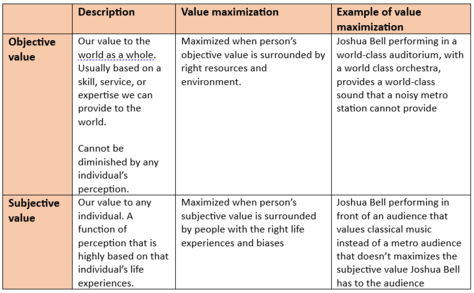
I came across this post the other day about a violinist named Joshua Bell who back in 2007 decided to do a little social experiment that got me thinking a lot about how we assign value in our society and the heavy biases we rely on when doing so.
For those who don’t know much about the classical music world—including myself—apparently Joshua Bell is a world class violinist who performs as a soloist in auditoriums in which people pay anywhere from $53-$200+ (verified through a quick google search) to see him perform on a Stradivarius violin made in 1713 that apparently is worth somewhere around $14 million (he bought it for $4 million).
While I don’t know much about classical music, I do know that if you were able to afford a $4 million violin that was paid for by your ability to play the violin then you must be a pretty damn good violinist.
So this world class violinist decided one day that he wanted to see what would happen if he took his very expensive violin and his world class abilities and just started playing in a Washington DC metro station in front of random people who didn’t know who he was or the quality of the violin he was performing with.
Would they appreciate it? Would they even stop and listen?
He clearly wanted to find out.
So in the middle of people’s morning rush to work on a Friday at 7:51 am Joshua Bell played his violin for 43 minutes as 1,097 people passed by him just inside L’Enfant Plaza Metro entrance in Washington D.C.
27 people gave $52.17. And that included 1 person who recognized him and gave him $20. So if we subtract that $20, in total he collected an average of $1.24 from each person who gave money and didn’t recognize him.
And most of these people didn’t even stop to listen. They just heard him and dropped some money because they enjoyed what they heard as they were passing.
7 people stopped for as little as a couple seconds to as long as nine minutes.
Objective vs Subjective Value:
Perhaps the easiest takeaway from the Joshua Bell experiment is that value, like beauty, is subject to the eye of the beholder on an individual level.
In Joshua Bell’s case, he was worth an average of $1.24 to the Washington D.C. metro riders, but $53-$200 to the classical music devotees who watch him perform in large auditoriums.
Any individual gets to determine what value another person or object has to them. I talked about the subjectivity of value in our previous post about speculating versus investing in future outcomes.
However, while value is subjective on an individual level, there is also an objective measure of value on a collective level that cannot be diminished by any individual.
In the case of Joshua Bell, his ability to play the violin is world class. Very few people in the world can play the violin better than Joshua Bell. Just because the metro riders by and large don’t value it, doesn’t mean he doesn’t have this value to the world to begin with. He just doesn’t have this level of value to them.
But they can’t diminish his ability to play the violin at a world class level by their lack of appreciation for him either.
There are a number of takeaways we can expound on here.
1) In order for objective value to be maximized, it has to be surrounded by the right resources and environment
When I speak of objective value, I speak of our objective value to the world. This value is usually based on a skill, service, or expertise we can provide to the world. For example, Joshua Bell’s ability to play the violin at a world class level is an objective value that he provides to the world.
This value cannot be diminished by another person’s perception of his value.
For example, just because the metro riders are not in awe with his violin playing, does not negate the fact that he is a world class violinist. Regardless of how they feel about him, this is the objective truth. They do not have the ability to take this away from him simply because they don’t like the sound of him playing.
In order for Joshua Bell’s objective value to be maximized, he has to be surrounded by the right resources and environment that enhance his skillset. This includes things like a world class violin, an orchestra, and an auditorium that helps him produce a world class sound.
Joshua Bell is still a world class violinist without these things. But the objective value of the sound he can produce is enhanced by having these things.
Comparing Objective vs Subjective Value
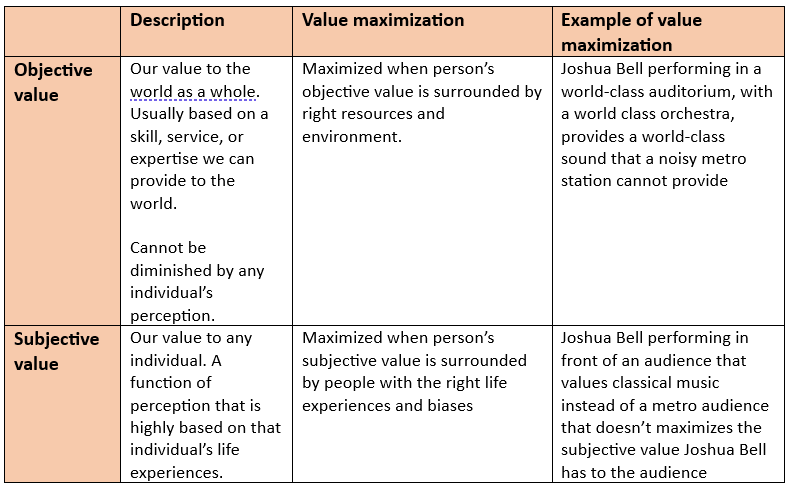
Subjective value, in contrast, is largely dependent on the perception of whoever is receiving the value. This perception often has more to do with the biases and life experience of the receiver of the value than it is of the giver of the value.
There is of course a correlation between objective value and subjective value. The lower the objective value of the product being offered, the lower the probability that the product will have subjective value to any given individual—and vice versa.
In other words, although Joshua Bell only earned $52.17 during his stint in the metro station, if he had less objective value (i.e. was a less talented musician), he would have likely received even less than this.
But ultimately, it is subjective value that determines the price a given individual will pay for a product. The more that individual loves a product, the more he or she is willing to pay for it—independent of the objective value the product has.
In order for a product to maximize its subjective value, it has to be delivered to an audience that has a bias towards that product. For Joshua Bell that means performing in front of classical music afficionados instead of random people at the metro station.
2) Not everyone is capable of valuing what we have to offer
This takeaway is the one most proffered by the viral Facebook posts on the Joshua Bell experiment.
While I agree with the message here, the overall connotation of the Facebook memes here are that somehow the general audience is at fault for not being able to spot value when it’s in front of them. I’m not sure I would go that far because that implies that everyone has an obligation to value things that don’t benefit their lives.
For example, if I’m in a metro on my way to work and I see someone of Joshua Bell’s caliber playing on an expensive violin I’d probably say “oh cool” and then walk on right by. But that’s only because I can’t tell the difference between a regular violinist and someone of Joshua Bell’s caliber. I’m incapable of appreciating the difference in quality between the two; they both sound the same to me. However, for someone who has an ear for these things, I’m sure there is a significant audible separation.
So we’re placing too much emphasis on the “not seeing value” and not enough on the “not capable” part. It’s almost like critiquing someone for not being able to see a red wreath on a green Christmas tree. If we did that, only to learn that the person was colorblind after the fact, we’d realize the lack of context we took into consideration here.
The reason why this is important is because often we interpret certain people’s inability to see our potential as indicative that we lack value to anyone and that can be demoralizing to our own sense of worth. And/or we resent these people for not being able to see it. Doing either of these things (or both) prevents us from engaging productively with the rest of society. I think this can apply to our work lives as well as our personal friendships and romantic relationships.
2) Our bias may prevent us from properly appreciating others’ objective value
What often gets lost in this discussion of value is the huge impact that bias plays on our perception of value.
I don’t know if any of you have ever had to ride a metro or subway to work, but having done that in New York City for a number of years I’d like to share my experience to afford some context. There are approximately 9 million people in New York City. And around 8 million of those people are trying to take the L train into Manhattan every morning.
Or at least that’s the way it felt to me.
I would be dressed in a suit entering a subway station that invariably smelled like urine, only to enter a subway train that was packed like sardines and would have to stand for 45 minutes on the trip from Bushwick to 14th Street/Union Square.
14th Street/Union Square is a fairly popular subway station for street performers. But at the time I get off the L train, I’m not in the emotional state to appreciate what they have to offer. I’m simply trying to find the quickest way to move past people in a crowded station so I can catch the transfer to the 6 train so I can get to work.
Also, keep in mind that we tend to associate value with its surroundings. So for example, if I’m at a garage sale and see a bunch of broken trinkets and mundane Pablo Picasso reprints, I’m already predisposed to believe that there is nothing of value here. So if by chance one of the Picasso paintings is an original, I’m not likely to be taken aback by its imagery. I’m going to see it and assume it’s nothing special.
But if I saw that same painting in the Louvre in France, my reaction and appreciation for it would be different—if for no other reason than I’m taken aback by the ambiance the surroundings helped create.
Our emotional state and the environment we observe people in heavily biases the value we perceive them to have.
This applies to Joshua Bell, the metro riders who were largely unwilling to compensate him for his talent, and the classical concert attendees who were willing to pay $53-$200 a ticket to hear him perform.
If the subway riders had encountered Joshua Bell when they were relaxed on a date night with their spouses on the weekend in an auditorium with a full orchestra behind him, their ability to receive value from his performance would have been entirely different than when they are stressed on their way to work in a crowded subway station that might not be as clean as they would like it to be.
The role of subjective and objective value in the concept of meritocracy
Ultimately this little social experiment allows us a deeper reflection into the concept of meritocracy.
Joshua Bell is clearly a world class violinist. But if he were to languish in the metro station every morning, he wouldn’t be world famous, because the world would never know who he was.
He'd just be another performer in the metro.
What does that say about the world we live in, if there is world class talent in our midst and the world is unable to benefit from it because we are simply incapable of surrounding that talent with the right resources and environments that allow human potential to be realized and benefit the world at large?
Where does the blame for this failing belong?
On the individual performer’s own sense of ambition for not pursuing avenues that could help him realize his or her potential?
Or on the barriers of entry that prevent that ambition from becoming a reality?
More than likely it’s some combination of both.
A person may have great will, but also large barriers of entry, and so he or she fails.
Another person may have little ambition, but also small barriers to entry and so he or she succeeds.
We should be able to distinguish between the two, instead of only seeing the end result and conveying our sense of value based solely on the outcome.
Unfortunately, that’s not how we as humans work.
How we value people, experiences, and accomplishments on an individual level in our lives has very little to do with the objective value they have and everything to do with our subjective interpretation of their worth based on our past experiences, biases, and value systems.
How we feel about the world around us matters more than what’s objectively true about the world we live in.
On a macro level this is deeply troubling as it allows for the society we live in to be inefficient, unequal, and limit human progress due to our flaws as humans in distinguishing reality from perception.
It allows us to award jobs, recognition, and praise to those who make us feel better about ourselves and our lives than those who are actually objectively more qualified and could provide more objective value to the world around us.
It allows us to believe in ideas that data and science objectively refute while simultaneously believing that both opinions are equally worthy of merit.
Our desire to impose our subjective value system on the world around us—instead of rewarding objective value—ultimately slows the progress and innovation of society for the better.
Joshua Bell’s talent is worthy of being in world class auditoriums. The lives of the people who come to listen to him are at the very least $53-$200 better for having listened to him in that venue. If their lives weren’t better by listening to him, they wouldn’t continue to pay that price to see him perform.
Sure, some of that value people derive from seeing him is due to their own subjective value preferences.
But the value they received would be lessened if they came to see someone with less objective value than Joshua talent possesses.
So the world is a better place by Joshua Bell performing in world class auditoriums for people who are able to fully appreciate his value than in metro stations where almost no one is.
But how many people with exceptional talent do we pass by everyday whose objective value we ignore simply because of the environment we see them in and our own bias?
What could these people become if we simply surrounded them with the right opportunities, resources, and environment?
I think this applies to street performers as much as it does to those who are forced to live on the street without adequate housing.
We’re assessing both parties’ value to society solely based on the environment we see them in and not on the objective contributions they could provide to society.
What’s more, how many people do we revere and put on a pedestal simply because of our own bias and the subjective value we assign them instead of the objective value they have?
These individuals we put on a pedestal are taking up space from those who have more objective talent and could use that pedestal in more effective and efficient ways.
What would the world look like if society rewarded a person’s objective value to the world instead of each of us valuing someone based solely on their subjective value to us as individuals?
I hope this post gets you to question your own value assessments of people, objects, and experiences and rethink whether you are making these assessments on their objective value to the world or simply the subjective value to yourself and assuming because they have the latter, they also have the former.
And if you find yourself in your current life being the equivalent of a street performer busting your ass everyday in underground metro stations trying to show your worth to people who keep on passing you by, I hope you deeply consider the following idea:
Just because others aren’t properly valuing you, doesn’t mean you don’t have objective worth. It just means you don’t have subjective value to the people you’re surrounded by. Perhaps all you really need is a change of environment and the right resources and support system to bring your objective worth from being trapped underground in the dark, to light.
Did you enjoy this essay? If so I hope you consider subscribing by clicking the button below or sharing this with your friends who might get value from it.
No posts
Comments
Nothing yet. Say the first thing.
Sign in to join the conversation.