
In our last post we talked about how we can improve the quality of our lives and those around us by finding people who we can invest in—and who can correspondingly invest in us—in ways that make our lives better together than they could be if we were apart.
Doing so enhances the subjective value that we get from our lives and that we have to others.
In this post, I want to talk about how important it is to walk away from those who we have a low subjective value to in order so that we may create the space to find those who we have a high subjective value to. Doing this allows us to find people whose lives we enrich—and who reciprocally enrich our lives.
It also allows us to leave environments where there is an unequal exchange of value—where we give more than others reciprocate back, where we expect more than others are capable of giving, or simply where others expect us to be something we do not want to be.
While our departure may be painful in the short-term for those we walk away from, in the long-run it creates the space for someone who is a better fit to fill the role that we were unhappy playing in their lives.
So us leaving situations and people that are not for us helps make the world around us better for both the people we leave and the people we find who are a better fit.
I’ll also be talking about how not leaving environments in which we have a low subjective value breeds resentment and ultimately limits human potential.
The Software Engineer and The Picker and The Packager
So in my last post I used the concept of comparative advantage to show how 2 farmers can utilize their expertise in picking and packaging strawberries to work together instead of independently to improve each other’s lives.
One was better at picking strawberries and the other was better at packaging strawberries.
The farmer who was better at picking strawberries was known as “The Picker” and the farmer who was better at packaging strawberries was known as “The Packager”.
In that post I showed how the farmers could double their production by focusing on the task they were better at and working together, instead of each farmer trying to work independently and trying to do both tasks themselves.
I used that example to emphasize the importance of each of us finding people in life who complement us and make us better—and who we in turn make them better.
In this post, I want to focus on how it’s equally important to leave people and environments that don’t help us realize our human potential and who we don’t have much subjective value to.
I’m going to do that by continuing the tale of The Picker and The Packager, by adding to it with another allegory.
And this tale is of The Software Engineer.
The Software Engineer lives in the next town over from the Picker and the Packager. His town doesn’t have a basketball gym so he heads over to the Picker and Packager’s town to play basketball. Sometimes during pickup games he gets on the same team as the Picker and the Packager, but they don’t really pass him the ball and instead just pass it back and forth to each other. He tries to tell them that he’s got a really good 3-point shot, but they tell him just to rebound the ball when they miss and pass it back out to them.
One day after the game, the Software Engineer overhears the Picker and the Packager talking about work and realizes that he could reduce the time that they spend picking and packaging strawberries by another 50% if he built an automated machine to do both jobs. So he decides to bring it up to both the Picker and the Packager.
Software Engineer: “Hey guys, I could decrease the time the both of you spend on picking and packaging strawberries by another 50% simply by building a machine to do it”
The Picker: “How would you build that?”
Software Engineer: “I would just need to team up with a Hardware Engineer to build it.”
The Packager: “That sounds way to complicated. We already halved the time it takes by working together. We don’t need to halve it again. Why don’t you just stick to getting us rebounds and leave the business stuff to us?”
Dejected, the Software Engineer walks away.
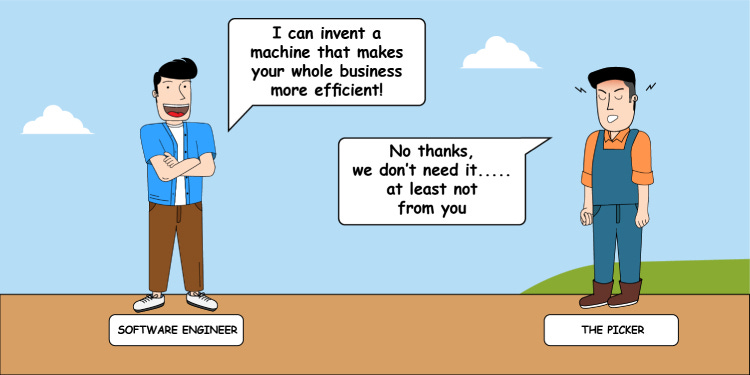
He finds himself resenting The Picker and The Packager every time he’s on the same team with them.
A couple months later the Software Engineer is playing pickup basketball in the same gym but with different teammates. After the game he starts talking to his teammates and realizes that one of them is a Hardware Engineer. The Software Engineer tells the Hardware Engineer about his idea about making a machine that picks and packages strawberries and the Hardware Engineer gets excited and they both agree to start working on it.
The Software Engineer and the Hardware Engineer spend the next 3 months building, testing, and improving their product. In the course of spending so much time in close quarters, the Software Engineer and the Hardware Engineer learn a lot about each other, what the other person likes and dislikes and how to work best with each others strengths and weaknesses.
This level of closeness and camaraderie carries over to the basketball court where the two go to relieve stress from the intense work schedules the two have created in the midst of their excitement over the product.
In the process of doing so, the Hardware Engineer realizes that the Software Engineer has a great 3 point shot and the Software Engineer realizes that the Hardware Engineer is a great big man with post moves. So when the two play together they run plays that allow both of their abilities to shine; pick and rolls, down screen and slip screen action, etc.
After 3 months, the Software Engineer and the Hardware Engineer complete the finished product called the “Strawberry Automator” and get “Farmers Home Depot” to feature it in their large brand store.
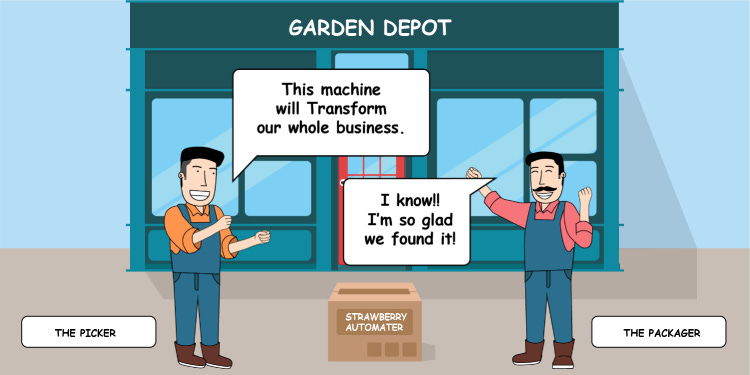
One Saturday afternoon the Picker and the Packager are in Farmers Home Depot looking for supplies for their Strawberry business and see the “Strawberry Automator” in the aisle.
The Picker: “Hey, Packager check this out. This Strawberry Automator says it can halve the time it takes us to pick and package strawberries! We need this product!
The Packager: “You’re right! This is going to change our business completely!”
The Picker and the Packager buy the “Strawberry Automator” and it transforms their business in the same way that working together did.
Subjective Value, Resentment, Bias, and the Effect of Environments on Realizing Human Potential.
Okay, so now we’ve finally gotten to how all this connects to subjective value, resentment, and the effect of environments on both creating bias and limiting or enhancing human potential.
Much like the case of Joshua Bell and the metro riders in a previous post, the Software Engineer has limited subjective value to the Picker and the Packager.
In the case of the Software Engineer, the Picker and Packager only saw him as a third-wheel rebounder in their pickup basketball game. But to the Hardware Engineer, he was both a partner in a revolutionary Strawberry Automation business and an essential teammate/partner in his favorite after-work activity.
There are a couple of takeaways I want to talk about here.
1) Not everyone is the best fit for appreciating our value
Sometimes people, like the Picker and the Packager, have the capacity to see our value, but just aren’t willing to. This is a strong indication of a poor fit. We’re trying to sell something (either ourselves or our vision) to people who don’t want to spend their time, energy, or money on us. There’s a valuable discussion to be had on what other people are obligated to do for us—and we’ll engage in that later on in this essay—but for now I want to purely focus on fit.
If something isn’t the right fit for us, the logical step is to either see if we can make the poor fit work for us or if it’s time to just give up and find a better fit. Unfortunately, I think our frustration often comes about because we spend too much time and energy trying to make a poor fit work than realizing when it’s time to move on and find a better one. Again, I think this applies to both professional and personal situations.
2) The impact of bias on our ability to perceive value
As we saw in the case of Joshua Bell and the metro riders/classical concert attendees, our own human bias often prevents us from appreciating the objective value that another person may have both to us and to the world.
The Picker and the Packager are quick to dismiss the “Strawberry Automation” idea offered by the Software Engineer after their pickup basketball game, but quick to purchase it when they see it for sale at Garden Depot.
How much of their dismissal of the Software Engineer is due to the fact that he is not a farmer like the Picker and the Packager, he is not from their town, they aren’t comfortable with computers, and they already have an expectation of the Software Engineer that his worth is limited to his ability to get rebounds for them on the basketball court?
When the Picker and the Packager finally do realize that the “Strawberry Automator” is a brilliant invention for their business, how much of their perception of that value is based on the credibility that comes from the Garden Depot they saw it in and not from someone selling it on the side of the road on their way to work (which they probably would have passed by without buying)?
3) Resentment based on the expectation of others to invest in us
The resentment of the Software Engineer is due to the expectation that others are obligated to invest their time, money, or energy on him.
This is flawed on multiple levels and deserves a post on its own, but I’ll touch on a few high level points.
The first point I’ll make is that just because someone has a service or product that can benefit the life of another does not mean that the other person is obligated to see it or utilize it.
If someone has a car that is leaking gas and keeps complaining to me about how little gas mileage he’s getting and I offer to fix it because I’m a mechanic, he’s under no obligation to take me up on my offer.
My desire to help him fix it is due to some combination of the fact that I care about his wellbeing and/or the fact that I have a skill that can benefit him and feel there is purpose in seeing my skillset benefiting those around me.
Any resentment I feel towards him for not taking me up on my offer has everything to do with my desire to control the situation or my belief on how things should be. This perspective denies the agency of the other person to do whatever they want with their life—even if it continues to hurt them. They are allowed to make that choice. I have no control over it—nor should I.
That being said, I’m also under no obligation to continue to listen to this person complain about a problem I could fix while he expects me to just sit there and nod my head. That’s an infringement on my peace that I am under no obligation to afford him.
4) Resentment based on an expectation of others to reciprocate
Another form of resentment that builds here is often due to our belief that someone else is obligated to reciprocate that which we have given or would give to them freely.
If I’m the Software Engineer and I’m feeling upset that the Picker and the Packager won’t listen to my ideas because I would do that if I was in their position, then this also has everything to do with what I feel others are obligated to reciprocate back to me when I have given, or would give, to them freely under those same pretenses.
It is entirely acceptable to make gifts or investments of ourselves to other people that come with conditions. Our society does not operate without these basic tenets at the foundation of our interaction with one another.
However to do so while failing to make clear the fine print attached with that investment is a failure of full disclosure that is only used by the less scrupulous members of society to trap others into a social contract that they would not willingly sign otherwise.
On the other hand, if I’ve made these conditions clear and they violate those terms, I’m within my rights to void the contract.
Sometimes The World Is Made Better By Us Leaving
What I’m trying to get at here with all of these examples and allegories is that sometimes the best thing we can do for ourselves, for other people, and for the world as a whole is for us to leave an environment that we are not a great fit for in hopes that we find one that is better fit for us.
If the Picker never finds the Packager he never finds a partner that improves his business life as well as his personal life on the basketball court.
Same goes for the Software Engineer and the Hardware Engineer.
In order for the Software Engineer to maximize the value his life can bring to the Picker and the Packager, he has to stop trying to convince them about the validity of his idea and capabilities.
Instead, he has to find the Hardware Engineer and together they have to create a product that improves the Picker and Packager’s life more than the Software Engineer ever could have by simply getting rebounds for the Picker and the Packager in their pickup basketball games.
Sometimes we think that we are doing right by other people by staying in their lives, when in reality it’s the opposite.
If the Software Engineer were to stay in the Picker and the Packager’s life out of a sense of obligation or guilt, it would only breed resentment on all sides.
The Software Engineer would resent the Picker and the Packager for not seeing his potential, and the Picker and the Packager would resent the Software Engineer for trying to sell them on an idea they didn’t see the value of (or at least not when it was presented to them by the Software Engineer instead of Garden Depot) instead of just playing the role of rebounder that they wanted him to play.
By leaving, the Software Engineer does two things:
1) He opens up the possibility of finding the Hardware Engineer and combining their talents together to improve the lives of those around them—including the Picker and the Packager. If he never leaves, he removes this possibility all together.
2) He opens up the possibility for the Picker and the Packager to find another pickup basketball teammate who just wants to rebound for them and not do anything else. This is ultimately the best alignment of interests for the Picker and the Packager. It aligns what they are looking for from a pickup basketball teammate with what another individual is willing to happily provide. This is a much better scenario than one in which the Software Engineer stays and everyone continues to play together but with embedded resentment.
On learning who to leave behind, who to invest more in, and how to love more freely
The world is made better through productive investment in ideas and the right people. In order to find these right investments and the right people, we need to both learn how to leave environments that are not for us and cultivate the ones that are.
Not doing so creates a worse world for everyone.
We live in a culture that glorifies pursuit: The pursuit of dreams, goals, accomplishments, etc.
But no one ever teaches us how to know when it’s time to walk away.
As a result, we hold on to wrong pursuits and people long after we should have let them go.
And by the time life forces us to let them go—instead of us actively choosing to—we’re left with scars that can take decades to heal—if they ever do.
Which leaves us with the question I hope all of you are pondering right now:
Of all the people in your life and communities you’re a part of, which ones are actively making your life better and which ones are the ones you need to learn to let go of?
I wish I had the answer for you, but in reality it’s a question each individual has to evaluate by themselves.
But I hope this post encourages you to explore the question more and ponder all the people—including yourself—that you are potentially harming by not exploring it.
Is there the equivalent of “The Software Engineer” in your presence whose potential you are willfully or subconsciously ignoring? If so, is this an active decision you’ve made? Or are your biases alone dictating your behavior with regards to them?
Why do we choose to believe in the potential and invest in the Pickers and the Packagers amongst us who make us comfortable because they look like us, talk like us, and come from the same communities as us, but not the Software Engineers who make us uncomfortable with their presence simply because they think, act, feel, and look different from how we do?
Why do we try so hard to get those who are different from us to conform to the way we live our lives?
How is this behavior harming everyone around us?
Finally, I think it’s worth noting that act of loving someone is also an active investment in the wellbeing and life of another person.
I’d argue that this is perhaps the greatest investment most of us will ever make in another person.
Love is an investment of our time, energy, heart, and money that in its purest form is all encompassing.
What does it say about our ability to love if we have Software Engineers in our family or community that we profess to love, but fail to listen to, see, understand, support, and ultimately invest in in the ways that they need?
Love is an ongoing active exercise in participation on an emotion we feel.
It requires action and ongoing introspection. Without this active engagement in the practice of love, we passively let our biases dictate the people in our life and then passively care for them.
I don’t view this as love.
In fact, it bears a greater resemblance to apathy than it does to love.
And this is ultimately the greatest loss we experience by holding on to environments and people that we should have let go; the disappointment and hurt it leaves behind traumatizes us in a way that prevents us from loving and investing deeply in others going forward. We resort to apathy as a defense mechanism to lessen the disappointment and pain from future encounters.
We each only have so much capacity to invest in and love those around us.
We can’t love everyone.
By learning how to let go of the people and communities we are not meant to be a part of, we free them up to find people who reinvigorate a more active and deeper investment in love within them instead of allowing them to settle for a more passive, apathetic role in our lives.
And more importantly, it frees up space in our hearts to find people who we are more willing to invest in deeply because we recognize that we are capable of holding a larger importance in their lives so there is less of a need for us to love with safeguards.
No posts
Comments
Nothing yet. Say the first thing.
Sign in to join the conversation.