
We often use the words and pretty and beautiful interchangeably.
But there’s a fundamental difference between the part of our lives that we find pretty versus the parts of our lives that actually make it beautiful.
Pretty is purely an aesthetic.
It’s a perception that immediately appeals to our senses—regardless of context.
Beauty, on the other hand, explicitly requires context.
Let’s take an example as a case study.
Imagine Arjun and Annika are married, it’s Valentine’s day and Arjun is in a flower shop looking for the perfect flowers for his wife.
In that flower shop there are orchids, lilies, and roses—all perfectly maintained.
They’re all pretty; they all smell nice.
If you think about it, they were all perfectly curated to be that way.
Somewhere out in the world there are floriculturists who spend a huge portion of their lives thinking about how to grow flowers simply so that they come out looking and smelling the best.
So when Arjun is in that shop looking for the perfect flowers for Annika, it can be an incredibly difficult decision simply because they’re all perfect; they’re all pretty.
How is anyone supposed to choose the prettiest flowers from a whole selection of flowers that were all perfectly designed to be pretty?
As I’m hoping most people who have gone to a flower shop trying to find the perfect flowers when they have no idea what they’re doing (myself included) have come to realize over time, the answer doesn’t lie in which flower is the prettiest.
If Arjun thinks the orchids look the prettiest, or the florist in the shop tells him that roses are the best, the answer isn’t to pick that one.
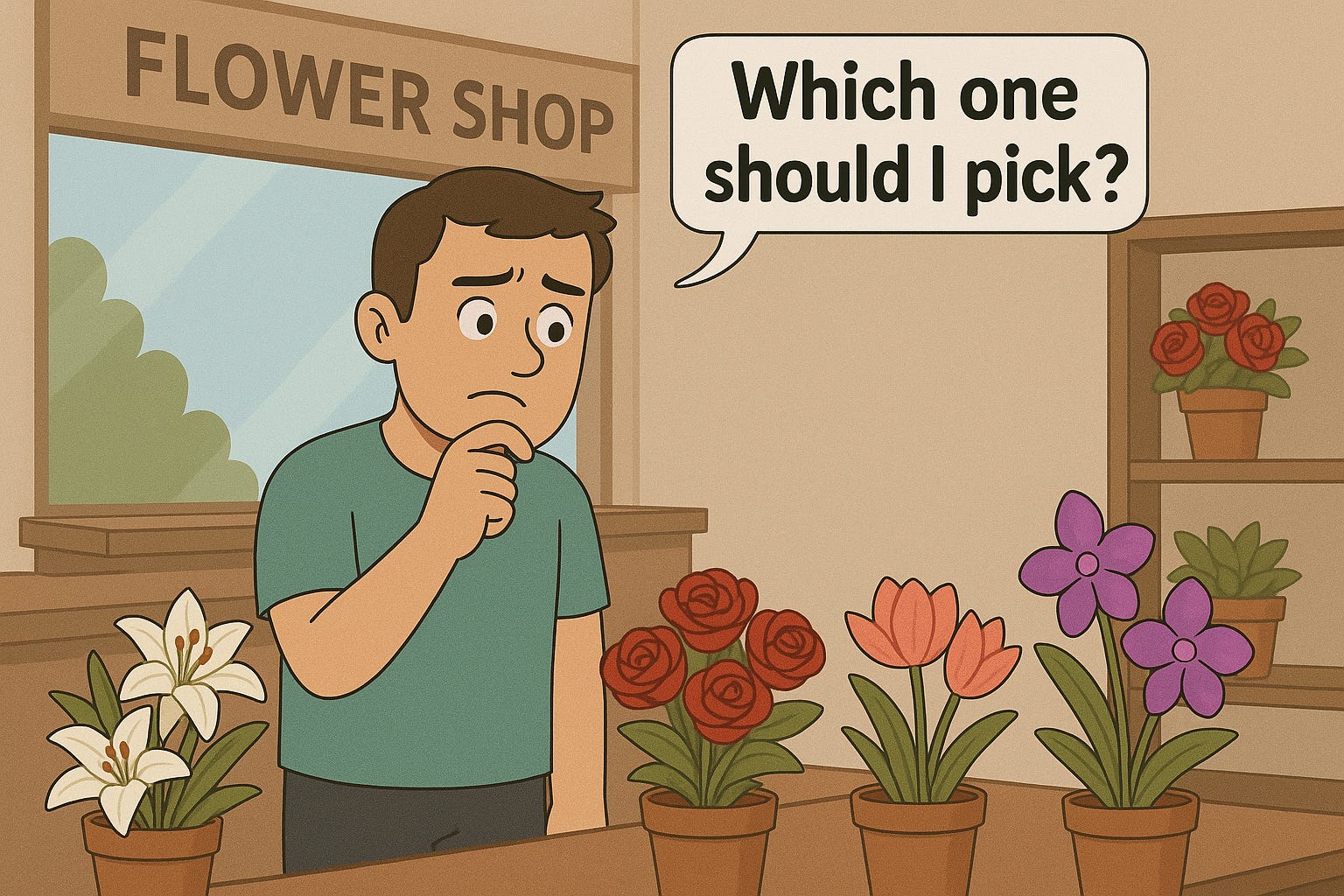
The answer lies in trying to figure out which flowers Annika is going to enjoy the most but in a way that feels authentic to him.
If he only focuses on the former, then the action risks becoming one of obligation instead of care. And doing things for too long only out of obligation inevitably leads to resentment.
If he only focuses on the latter, he risks alienating her by not including her feelings more in his decision making process.
It’s a difficult balancing act between obligation, affection, and authenticity that one must juggle here.
But it’s the juggling that makes the action beautiful—not the appearance of the flowers.
It’s the context of Arjun remembering what Annika loves and then acting on that knowledge in a way that feels genuine to him—regardless of what he may think of Valentine’s Day as a legitimate holiday or not.
In the absence of this, those flowers are just pretty.
So why is this important?
Well because often we forsake context for the simpleness of pretty answers and in the process of doing so we both deny reality and cause suffering for people on the opposite side of the transaction.
Let’s run our Valentine’s Day Example back.
Let’s assume Annika really loves lilies. She’s told Arjun this numerous times over the course of their marriage.
Now it’s Valentine’s Day and he’s forgotten to pick up flowers for her. He’s been stressed out at work, his manager’s been on his back for things outside of his control, and he’s deeply worried about losing his job.
It’s the end of the day, he’s tired, preoccupied and on his way home he suddenly remembers that it’s Valentines Day.
All the flower shops are closed at this time of day.
So he stops in the first grocery store and picks up whatever flowers are still available after all the early Valentine’s Day shoppers have had their pick.
In this case, it happens to be roses.
As Arjun enters the door of his home, Annika eagerly approaches the door with eager anticipation.
As he reaches out to hand her the roses, proud of himself for remembering Valentine’s Day in spite of all he’s been going through at work and taking the time to stop by the store, he quickly sees the disappointment in her face and the tears starting to accumulate in her eyes.
Seeing her begrudgingly take the flowers causes his shoulders to slump instinctively as he sighs in frustration.
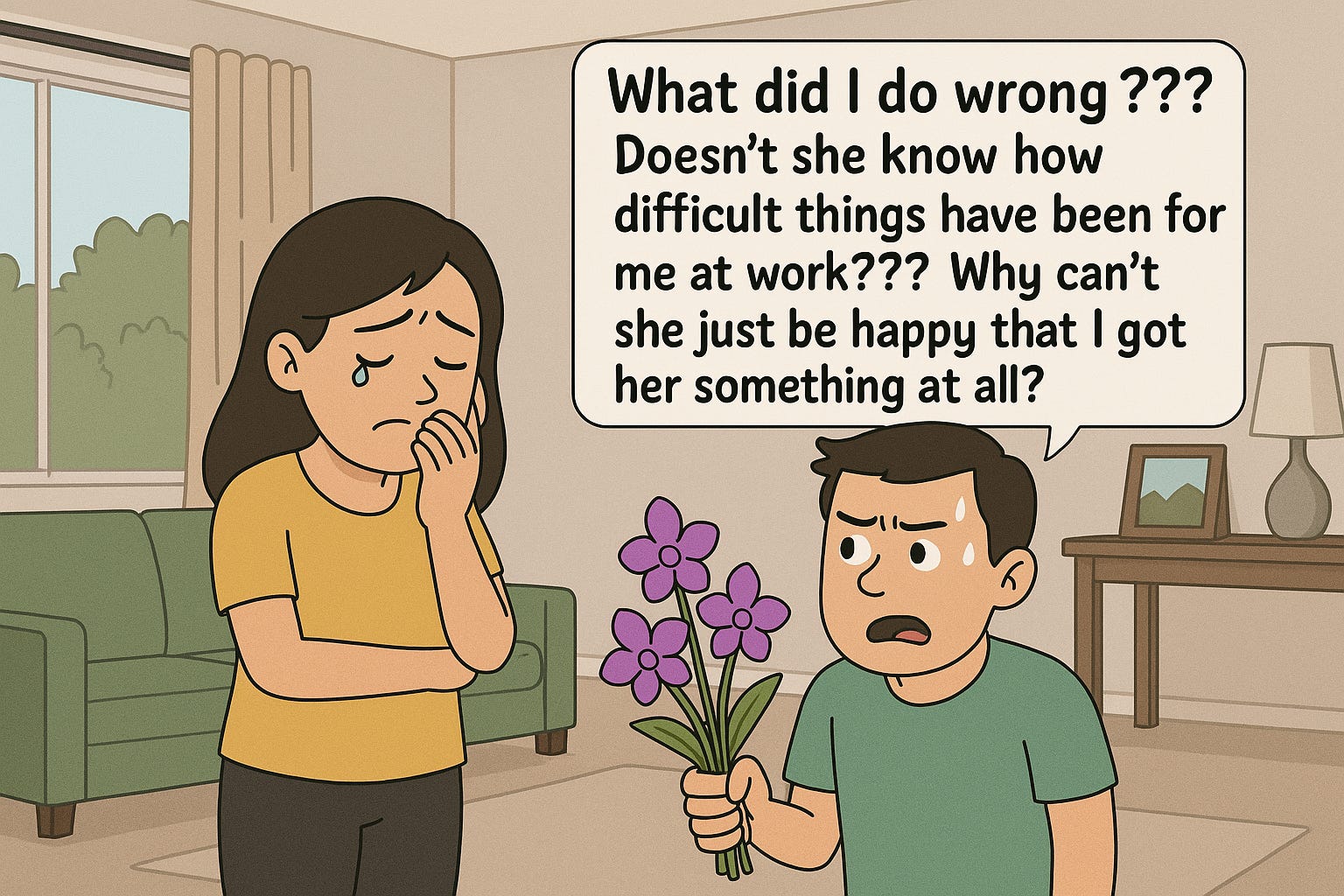
If we take a bird’s eye view of the situation and look at the interaction from both of our perspectives, we can quickly identify how each party is viscerally thinking:
From Annika’s perspective, her husband didn’t love her enough to remember that she loved lilies and to take the time to actually get them for her on the one day she was expecting flowers from Arjun.
From Arjun’s perspective, his wife didn’t appreciate how grueling life has been for him of late and how difficult it was for him to even stop by the store when all he wanted to do was come home and lie down.
Those are both the simple, “pretty” answers that deny the context behind what the other’s person’s legitimate experience and rationale were.
The reason both parties instinctively resort to this rationale is that it paints us as the martyr and the other as the villain responsible for causing our suffering which allows us the ability to deny any accountability for our role in the situation.
You’re probably wondering what the beauty in the situation was.
Well the beauty lies in understanding the context behind each of our emotional responses here and what it says about our desire for connection with one another.
The reason Annika is so hurt is because she wants to feel loved and valued by her husband and what Arjun’s action represents to her—whether it’s based in reality or not—is that he doesn’t love her as much as she thought he did.
And the reason why Arjun is so frustrated is that he wants the pain he’s going through at work to be understood and acknowledged by Annika and her reaction symbolizes to him that she doesn’t—whether that statement is accurate or not doesn’t matter nearly as much as how her reaction made him feel.
So the beauty here is that a wife wants to be loved and valued specifically by her husband and a husband wants his pain to feel understood and acknowledged specifically by the woman he loves.
They both deeply want to feel loved and appreciated specifically by the other and not some replacement individual.
They just want that love to look different than it currently does.
So the individual suffering in this situation is due to our instinctive emotional reactions that don’t consider context in our analysis.
And that’s because context is complicated and it’s just easier to settle for the simplistic, pretty answer that places us and our worldview as the hero and the other party as the villain.
I’m going to prove this to you in a second.
I want you to relook at the scenario I just described and think of who was in the wrong here between Arjun and Annika.
So who do you think was right?
The husband or the wife?
Should Arjun have been more considerate of his wife’s preferences?
Or should Annika have just been more understanding of how difficult things have been for Arjun of late?
Have an answer?
Well my guess is that whoever you thought was right, was based on your worldview and life experience.
If you’re a husband, you’re more likely to relate to the husband’s perspective because that is similar to an experience you’ve had in your own life where you wished your wife would have had more understanding for what you were going through.
If you’re a wife, who has had the experience of not feeling fully loved or valued by your husband, you’re probably on the wife’s side of the table.
If you’re a more logical person or someone who works long hours, the husband’s side of the story is going to be more relatable.
On the other hand, if you’re a more emotional person or someone whose primary love language is receiving gifts, then the wife’s side of the story is going to resonate with you more.
So even our view on what or who is “right” has nothing to do with morality and everything to do with the perspective under which we perceive it.
Morality has always been tough to pin down.
Subjective morality stipulates that the righteousness of one’s behavior is relative to the circumstances, time period, and culture that the action took place in.
For example, corporal punishment for children was a normative occurrence for parents 200 years ago.
It was a harsher period of time where the average life expectancy for a newborn child was only 40 years.
Efficiency was of more importance than enhancing the emotional experience of a child.
And the most efficient way of delivering a lesson was through brutality.
One simple act ensured that the lesson stuck with that child permanently.
Just not always in the most positive of ways.
But brutality also doesn’t require the depth, time, and understanding required of nuance.
200 years later as our life expectancy has managed to surpass 75 years, so has our grasp on the importance of moving past survival strategies as a way of existence if we want to create a better world for us (and our children) to live in.
So while objective morality would demand us to label the behavior as an act of child abuse under any paradigm, subjective morality allows us to offer some level of understanding to the sins of the past.
So if the morality of an action depends on context, under which context are we to judge an act?
Under the limited context of that moment in time?
Or under the broader context of cause and effect which was not possible for most to comprehend during the time under which that act occurred?
I think the answer is to do both; provide understanding for the acts that took place in a moment of limited capacity, but also a desire to obtain a broader view of our place in the world so that we may hold ourselves to a higher standard going forward.
Most of us are neither beyond forgiveness nor above correction.
It is up to us to try and hold a place for both.
Too often though we get caught up in the “whats” of what we’re supposed to do for ourselves and not the “whys”.
What career should I have? What house should I buy in what neighborhood? What type of people should I make friends and associate with? What flowers should I get her?
And you can get all of the “whats” right.
And they can be absolutely gorgeous.
But if you can’t point to the “why” behind you made the decisions you made other than “that’s what I’m supposed to do then the premise behind your “whats” lacks depth.
It lacks beauty.
Sometimes what we think is beautiful, is really just obligation masquerading as pretty.
I live in San Diego.
One of my favorite things to do here in San Diego is go to La Jolla where I can walk by homes worth $5 million + that look over the ocean as I stare off across the Pacific Ocean in awe and be like:
“Wow, I get to live 20 minutes due east from a view others go on vacation across the world just to experience. This is like a whole fantasy land in my backyard.”
And then I go 20 minutes south from my place to downtown San Diego where we have multiple city blocks of tents housing people on the sidewalk with nowhere else to go who are suffering from a myriad of mental health, socioeconomic, and hygienic issues and I’m like,
“But this is real life.”
Here in San Diego we tend to revere La Jolla as the diamond of San Diego which we plaster on all our marketing materials for tourists from out of town to come visit.
We don’t do the same with the tents of downtown San Diego.
The truth is a lot of locals avoid going to downtown San Diego to avoid interactions with the large unhoused population that make up downtown.
I often wonder what would happen if the city blocks of tents of downtown San Diego were transported to La Jolla along the shoreline and obscured the views of these multi-million dollar mansions.
How long would it take before the wealthy residents of La Jolla or the tourist industry of San Diego put up a fight and demand that those tent cities be moved back to downtown San Diego so that the La Jolla residents didn’t have to feel uncomfortable viewing them?
But if I have to shift the ugly part of the world I live in to the opposite side of town simply so I don’t have to feel uncomfortable viewing it, how beautiful is the place I live in really?
Because La Jolla and downtown San Diego don’t exist purely as distinct entities.
They are just on opposing sides of the same county. One only exists because of the other. The rich have to live somewhere and so do the poor.
There’s a discussion to be had here about a socioeconomic system that benefits the wealthy while not providing enough resources for those on the opposite side of the spectrum just as there is one to be had about the role personal accountability plays into all of this.
But that’s outside the scope of this essay.
The broader point I’m trying to drive home here is that all the pretty answers that we often use to attempt to make sense of this have nothing to do with reality.
They have to do with our own personal experiences with wealth and poverty, our upbringing, our political affiliations, religion, and our own sense of identity.
The plight of the human experience is that it almost invariably ends up turning into a never-ending search for validation that the world revolves around our current perspective instead of a lifelong quest to view the same life that billions of people have lived before us from different angles.
If revolution of the earth makes the object of our attention no longer glisten in the light, then the blame shouldn’t be cast on its rotation, but on the fact that the shadows that were always lurking in the background were purposefully hidden from our sight to begin with.
And unfortunately, more times than not, the objects obscuring the truth from us are simply our own deeply held beliefs and perspectives that we are unwilling to look past.
No posts
Comments
Nothing yet. Say the first thing.
Sign in to join the conversation.