
My husband is one of those people who squeezes out every last second of his holiday. He can return from a break late on Sunday night, unpack his bags and just start working on Monday morning like nothing has changed. I could never.
I need some time for my transition ritual. This is simply imagining my day-to-day life during the next season and putting things in place so I can “start strong”. I love using the change of rhythm to reset or tweak the systems I use to eat healthy, exercise, keep the house clean and yes, practice languages.
Maybe you’re looking to practice your target language more this upcoming season. Congratulations! That’s one of the most rewarding decisions you can make. Imagine how proud future you will be when you’re chatting, reading or watching videos in your target language.
Starting off is easy. You're motivated and full of discipline. But just be aware that learning a language isn't always fun. It can be frustrating, humbling, and sometimes boring. As time goes by, you might get tired, start negotiating with yourself, and prioritize other activities like watching Netflix or scrolling in your first language. That's normal. It's why a system matters more than motivation.
In this post, I'll share how to build a sustainable system that keeps you consistent. It's full of tips I wish I'd known when I first started learning French, tips that still shape my practice today.
If you want some guidance putting this into practice, I’m running Routine Refresh again this year, starting 30 August. More on that below.
New here? I’m Christina, a language teacher and learner fascinated by how we learn languages.
Love to Lingo turns the research on how adults learn languages into strategies you can use and gatherings where you can practice your target language with people doing the same thing. Glad you’re here.
First of all, you’ll need to make some simple decisions about when and what to study. This can be a problem if you make those decisions on a daily basis.
Avoid decision fatigue by making the decisions once and then following through.
Here are some things to consider:
Schedule your learning time in advance. Add it to your calendar/planner/agenda just like you would a meeting or an appointment. I schedule my time in my Google Calendar and then change it if other things take priority.
Decide what you’re going to do in advance. Don’t just schedule “study Spanish”. Schedule “write in my journal” or “read this article and write a language log”.
Consider habit stacking. This is when you add a new habit to something you already do. I’ve paired language learning with my morning coffee for years.
Try temptation bundling. Allow yourself to give into a temptation while completing your desired habit. E.g. Watching “trashy” reality tv or scrolling Tik Tok in your target language.
Force yourself to be accountable. Join a course, sign up for events (Lit Club/Guest Lectures) schedule sessions with a private teacher or a language exchange partner. Having someone else depend on you can help you stay accountable to yourself. This is one of the reasons I joined an Italian course!
It is absolutely normal for your energy and bandwidth to fluctuate. You will not always be “your best self” but that’s not an excuse to give up if you plan for it.
Plan to modify intensity or duration on low energy/time days. Commit to doing SOMETHING every study day, even if you don’t have the time/energy to dedicate to what you had planned.
Define your “bare minimum”. This is what you do when you really don’t want to do anything at all. Maybe it’s to listen/read/watch 5 minutes of something in your target language. Maybe it’s to have at least one conversation in your target language a week. For me, it’s usually something like listen to a podcast episode while doing the dishes or watching a YouTube video.
Use simple maxims to keep you on track. Simple rules like “never miss a Monday” or “never miss two days in a row” can help you stay accountable and not dwell on the fact you skipped a day.
Write some if/then triggers. If I skip a day, I’ll come back the next. If I don’t feel like it, I’ll read one page. This helps you avoid negotiating with yourself and reduces energy expenditure because you’ve already made the decision of what you’ll do in each situation.
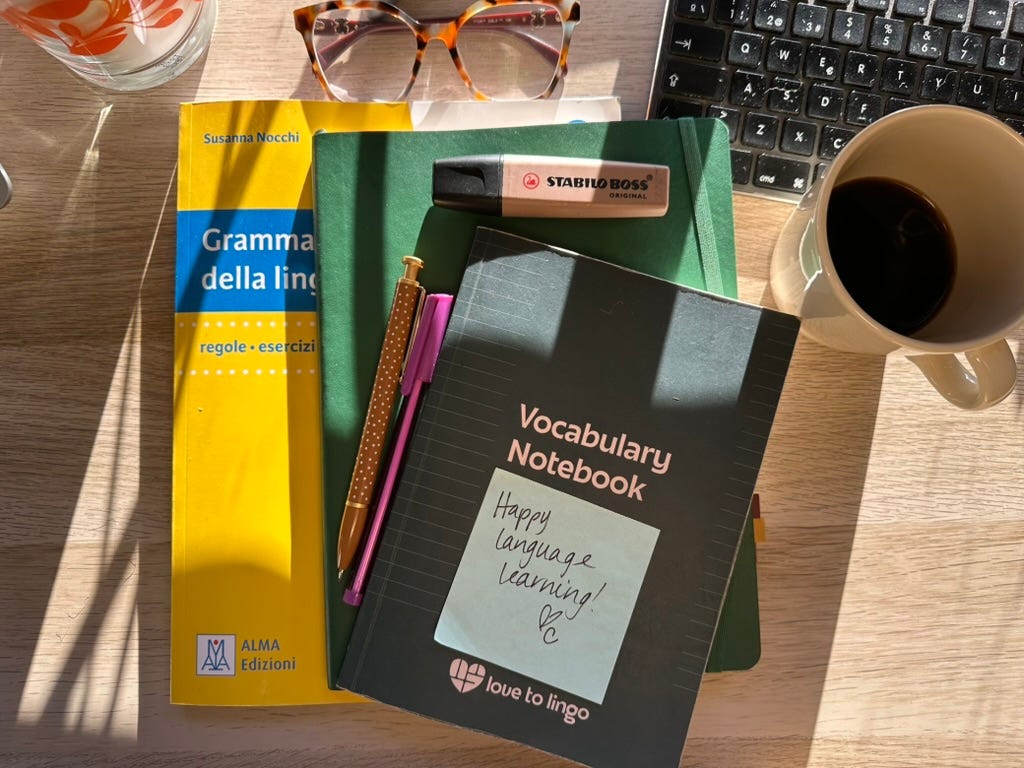
Just because you made the decisions once, doesn’t mean they’re set in stone. Create opportunities where you can meaningfully negotiate with yourself and tweak your system if it’s not working or if something changes in your life.
Review your progress. Progress begets motivation which begets more progress. Look at how far you’ve come!
Review your system and modify. Successful language learners use metacognitive strategies like planning, monitoring and evaluating their learning. This is all part of the journey.
My favorite weekly review system is simple. I write a list under each of the following categories:
What’s gone well this week?
What could’ve gone better?
What are my priorities for next week?
Many of my students hire me just so I’ll assign them homework (that they don’t always do 😅). That’s one of the upsides to following a course or using an app like Duolingo. Knowing exactly what you should be doing during your learning sessions is often a real barrier.
If that sounds like you, maybe you want to join us for Routine Refresh. It's a week-long challenge built around a simple, repeatable framework based on the Slow Language Learning approach I use.
Every day from 30 August-4 September 2026, you’ll get an email with a 30-minute learning task based on a source of input, text or audio, you’ve selected. Day one is dedicated to the “ritual” I mentioned earlier, picking your source and setting your intentions, so the rest of the week is just doing the work. By the end of the week, you’ll have a portfolio entry to show for your work and a system you can modify and use again and again.
From then on, you’ll know exactly what to do without needing a teacher or an app decide for you.
If you’re already a paid subscriber, there’s nothing extra to sign up for. You’ll get your first email 30 August.
If you're not a paid subscriber, right now annual memberships are on sale for 50€.
That gets you into Routine Refresh, every event in the Foreign Language Department, and The Language Practice.
You’ll have access to all the posts too, so whenever your routine slips, and it will, you can come back to them and start again.
It doesn't matter if you're someone who eases into a new season with a ritual, or someone who just starts on Monday. The first week of September is yours to get your systems in order.
What about you? Are you a ritual person, or do you just start? Tell me in the comments, I'm always curious how differently we all handle this.
Happy Language Learning! ♡
Connection through language has always been at the heart of Love to Lingo. Now, I’m finally building a space that reflects that. Think of it like the foreign language department of a university, without the exams.
It’s a place where you can:
Practice your target language, in a real context, with real people
Feel supported in your learning
Learn from experts who are passionate about their subject
And beyond the language, have something to look forward to. A reason to engage, to think, to connect with people who are curious about the world.
Here’s what’s coming:
Guest Lectures in Italian, Spanish and German
Cinema Club in Spanish with Not Textbook - Ana Pau Alverde
Cinema Club in French with Yann, French Teacher
Plans for additional guest lectures, lit clubs, workshops and cinema clubs…
Paid subscribers can join all of these events and have immediate access to The Language Practice, a 56-page self-study guide.
Comments
Nothing yet. Say the first thing.
Sign in to join the conversation.