
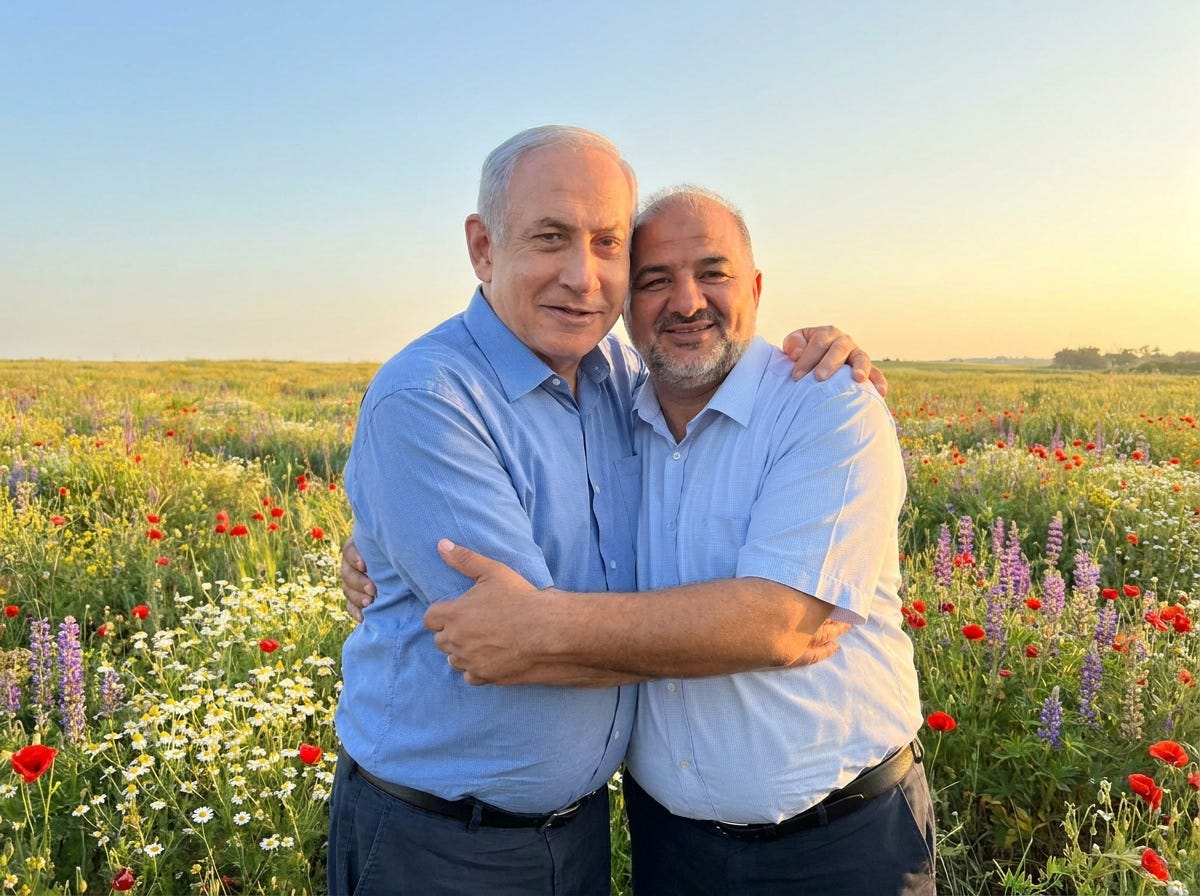
Last week, the Likud put out an election video depicting Yashar leader Gadi Eizenkot in a sunlit flower-filled field. Ostensibly walking towards a young Israeli man wearing a t-shirt reading ‘achdut Yisrael’ (‘unity of Israel’) at the last moment he walks right past him and into the arms of Ra’am leader Mansour Abbas, leaving the man looking on in disappointment before a message reads: “Eizenkot has no government without Yair Golan and the Arab parties.” According to most polls, this statement is accurate, but what attracted most controversy was the seemingly heavenly setting of the clip and what some saw as the resemblance between the young man and Eizenkot’s son, Gal, who was killed during the war in Gaza. As a result, Likud replaced the young man with a young woman.
We should return to Eizenkot’s embrace of Abbas, though, because it offers another reminder of what I believe to be the greatest tragedy in recent Israeli political history: Netanyahu’s failure to bring Ra’am into the coalition in March 2021. Israel had just held its fourth election in two years and once again no bloc had an obvious 61-seat majority. Ra’am, meanwhile, had four seats. Reportedly, Netanyahu, whose main concern has always been retaining power, offered Abbas ‘exclusivity’ on Arab issues if he supported the prime minister. Another report suggested that Rabbi Chaim Druckman, a leading figure in the national religious camp (who has since passed away), met with Abbas on Netanyahu’s behalf.
Netanyahu’s efforts were virulently opposed by Religious Zionism leader Bezalel Smotrich, whose support was also vital if Likud were to form a government. He and others tried to depict Abbas as a Hamas supporter, calling the party’s leadership “proponents of terrorism” who deny Israel’s right to exist as a Jewish state. He said: “I will not allow for a right-wing government to form based on the support of Ra’am leader Mansour Abbas, regardless of whether he endorses it from the outside, the inside or by abstaining. Not happening. Not on my watch.” Building on this theme, he said: “A government with Arabs will not be able to do anything right-wing. Do you think that Bibi will succeed in launching an operation in Gaza if there is a government with Abbas?”
Eventually, these negotiations collapsed with the start of Operation Guardian of the Walls, with Abbas negotiating instead with Bennett and Lapid, leading to the establishment of the ‘change’ government that included Ra’am as the first independent Arab party to be included in a government coalition (only twice previously had Arab Israeli parties backed a government. In the 1950s, a faction with one Arab MK joined the coalition as an Arab franchise of Mapai, and in the 1990s, when Rabin’s government was in danger of collapsing, the Arab parties prevented a vote of no confidence). Throughout its short duration, Netanyahu and his allies relentlessly attacked the government’s dependence on “Arab terror supporters,” although the evidence overwhelmingly suggests that he was willing to do exactly the same. As a leaked October 22 recording from Bezalel Smotrich makes clear: “If I wanted to take two seats from Bibi, I only had to attack him that he’s a lying son of a liar. He didn’t want to go with Ra’am?! He was desperate to! I was the only one who stood in his way.”
This is the reason Smotrich was so opposed to forming a coalition with Ra’am, and it’s why I believe the failure to do so was the biggest tragedy in recent Israeli political history. Just as Sharon was able to legitimize disengagement in the eyes of the Israeli public, so Netanyahu forming a coalition with Ra’am could have koshered coalitions with Arab parties and shown the Arab public that Abbas’s policy of focusing on the Arab community’s civic needs rather than emphasizing Palestinian nationalism was bearing fruit. If he had succeeded in forming a coalition with the Arabs, it would have been impossible for Bibi to criticise the opposition for doing it themselves.
The opposition’s response to Likud’s controversial election video (‘Netanyahu has no government without the non-Zionist parties’) reminds us of the support Bibi’s courting of Ra’am had at the time. Their clip shows current Diaspora Minister Amichai Chikli saying he was “very impressed by the very moderate line represented by Mansour Abbas” and that he’d “be very happy to see him as regional cooperation minister”; current Justice Minister Yariv Levin praising Abbas in the Knesset; and current Culture Minister Miki Zohar saying that he was “not opposed” to including Abbas in a coalition. We can add to this list right-wing radio host Jacob Bardugo, who warned that if a Likud-Ra’am coalition wasn’t formed “the left will celebrate” and that a right-led coalition with Ra’am was preferable to a left-led one; Netanyahu fanboy Yinon Magal calling Smotrich and his supporters “a bunch of ungrateful megalomaniacs who reject people because of their religion, even when they hold out their hand, renounce terror”; and current Education Minister Yoav Kisch, who wrote on Twitter: “there’s a difference between the Joint List that’s fighting against us over the character of the State of Israel and Mansour Abbas (I don’t think he’s a Zionist) who isn’t trying to change its character and has set aside our disagreements in order to work on civic issues for the public he represents…To treat them as the same thing is a mistake.” Finally, like a jilted mistress, there was Abbas himself in the Knesset, telling Netanyahu: “You invited me [to the prime minister’s residence] four times!”
Today most polls once again predict a deadlock between the two blocs, with neither side able to form a coalition without Arab support. For Israel to be a proper democracy, Arab parties will have to participate in ruling coalitions in the way Ra’am did from June 2021 to December 2022. Back then, Abbas paved the way by making the necessary compromises that would appeal to both blocs, helping Arab Israelis in the process. Had Netanyahu been successful in forming a coalition with Ra’am, the issue would now be moot, and there would be no point posting videos like the one Likud did last week. Tragically, though, it wasn’t to be.
No posts
Comments
Nothing yet. Say the first thing.
Sign in to join the conversation.