
I want to talk about something I’ve done a bit of a deep dive into this week, because I think it’s something that isn’t spoken about nearly enough, but perfectly encapsulates how flawed our maternity system is (I know, shock!)...
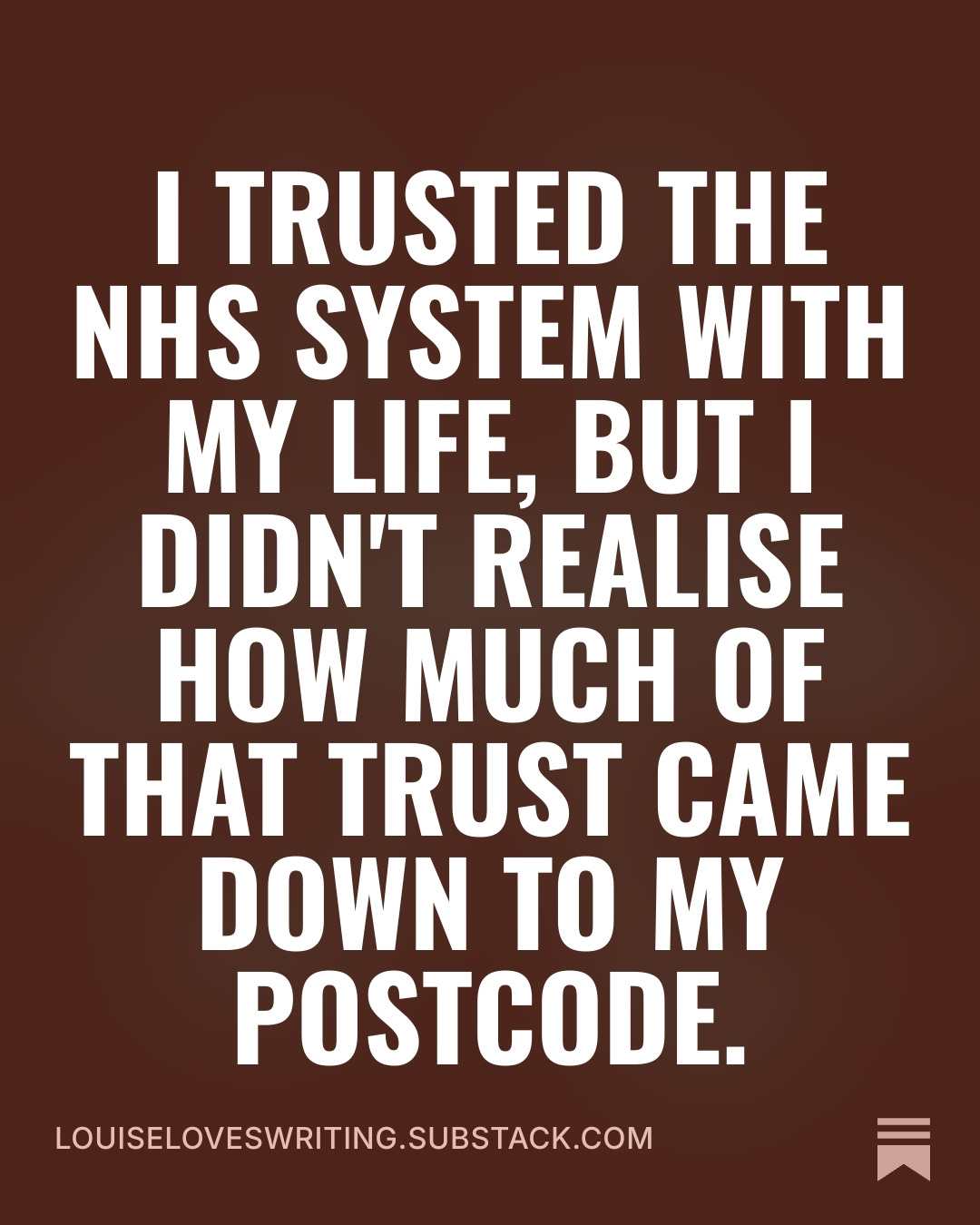
It’s the postcode lottery in maternity care.
Put simply, it’s:
The availability,
The quality
And the funding
of the healthcare you receive depending entirely on where you live, rather than the care you actually need.
To put things into perspective, here are some of the stats I read earlier this week: 43% of maternity and neonatal units don’t meet basic safety standards, only 35% of units have a dedicated bereavement room, and Maternal mortality in the 20% most deprived areas is roughly double that in the least deprived. So the care and facilities available to you can literally depend on which maternity unit you happen to attend. https://www.england.nhs.uk/long-read/maternity-and-neonatal-infrastructure-review-findings/
Some of the UK’s counties don’t even have a mother-and-baby unit for postpartum mothers suffering from severe perinatal mental health disorders. The whole of Wales only has 1, Scotland has 2, and there are precisely 0 in Northern Ireland. ZERO.
One reason this has really struck a chord with me is that it goes against one of the key principles of having a national healthcare system in the first place.
The NHS was founded on the idea that healthcare should be available to everyone, regardless of their circumstances. So surely, if you live in the same country, you should have access to the same standard of maternity care?
That’s what really baffled me about this postcode lottery, because we all trust this service with our lives, quite literally. I know I did, and I ended up feeling so let down by the care I received. The ironic thing is I live in a fairly affluent area within SW London, yet the outpouring of messages I’ve received from people receiving poor care in the same hospital as me is rather alarming.
Well, it was alarming until I read this article:
A 2025 Journal of Public Health study scoring every English maternity service against MBRRACE-UK surveillance 2015–2024 found Chelsea and Westminster reported higher-than-average perinatal deaths (amber band) in 4 of 10 years, including 2024.
So I wanted to understand why this inequality in maternity care exists.
And here are a few things I found that provide SOME answers (but also make my desire for further research all the more relevant)
Variation in staffing and funding
One of the biggest reasons for the postcode lottery is that maternity services simply don’t have the same resources behind them. Staffing levels, funding, and access to specialist services vary significantly between trusts, meaning some maternity units operate under far greater pressure than others.
For example, 68% of London's maternity units are in poor condition - needing major repair or replacement soon, or at serious risk of imminent breakdown - compared with 41% in the East of England.
England is also still short of around 2,500 full-time midwives, and 87% of midwives say they work in units they believe are not staffed safely. It’s difficult to deliver consistently safe care when the workforce itself is stretched so thin. In Yorkshire and the Humber, that figure rises to 90.4%… more than nine in ten midwives. https://rcm.org.uk/media-releases/2024/06/midwives-give-100000-hours-of-free-labour-to-the-nhs-per-week-to-keep-englands-maternity-services-safe-says-rcm/
Leadership and cultural differences
Leadership matters enormously in maternity care. The culture within a trust influences whether staff feel able to speak up, if concerns are taken seriously, and whether mistakes are properly investigated and learned from.
Baroness Amos’ National Maternity Investigation found that bullying, harassment and poor working relationships are recurring features of the most struggling maternity services, showing how culture can directly affect the safety and quality of care women receive. https://www.matneoinv.org.uk/updates/independent-investigation-into-maternity-and-neonatal-services-in-england-interim-report/
Repeated unresolved failures at certain trusts
Perhaps most concerning is that some maternity services have experienced the same problems repeatedly, despite concerns being raised time and time again.
When failures are identified, but the underlying issues aren’t properly addressed, they become embedded within a service. Donna Ockenden’s 2026 Nottingham Review found that many of the same safety concerns had been identified for more than a decade, yet improvements were often incomplete, delayed or simply not sustained.
That means women can continue to be exposed to the same risks because the system hasn’t properly learned from what has already happened. https://1corqmlr.com/2026/06/26/the-nottingham-ockenden-report-2026-key-findings-and-implications-for-clinical-negligence-practitioners/
Fragmented national policy
Then there’s the national picture, which can feel surprisingly fragmented for a service that is supposed to be part of one national healthcare system.
While national standards and guidance exist, implementation varies between trusts, and responsibility is spread across multiple organisations. Baroness Amos’ National Maternity Investigation concluded that fragmented oversight and a lack of clear accountability had contributed to repeated failures across maternity services, leaving the quality of care to be influenced by where you happen to live. https://www.matneoinv.org.uk/updates/independent-investigation-into-maternity-and-neonatal-services-in-england-interim-report/
And the scale of the paperwork says it all.
NHS England has now compiled 748 recommendations from maternity inquiries over the past decade. Most of these have been identified time and time again, whilst nothing changes.
Meanwhile, all five of the national maternity safety ambitions set for 2025 were missed - maternal mortality is now 12.8 per 100,000, against a target of 5.31 and 20% worse than the baseline it was supposed to improve on. On neonatal brain injury, the target was missed, and then the data collection was simply discontinued.
Baroness Amos' final report found that some trusts had no direct ‘ward to board’ route for concerns at all, and almost no evidence that improvements in one trust were ever shared with another… unlike the national networks that already exist for other illnesses like stroke and cancer care. We know how to run a joined-up national service. WE JUST DON’T DO IT FOR BIRTH
Training gaps and staff shortages
Staffing shortages don’t just mean there are fewer people on the maternity ward. They also affect whether staff have the time and opportunity to complete essential training and keep their skills up to date.
When services are constantly stretched, training becomes another item pushed down the priority list, with inevitable consequences for the safety and quality of care women receive.
We’re seeing this in real time in North Devon, where births have suddenly been suspended because the maternity unit could no longer be safely staffed, forcing hundreds of women to be redirected to other hospitals at short notice.
At NDDH, births were suspended from 11 August 2026, which was six days ago.
Up to 50% of consultant posts and 40% of middle-grade doctor posts were vacant
Women are now being redirected to Exeter, which is at least 1.5 to 2 hours away for some
And in the trust’s own words: “We cannot guarantee that women would consistently have access to the level of senior medical support during labour they may require.”
I have found it genuinely difficult to research the postcode lottery in maternity care.
Because you can do everything right. Attend your appointments, ask the questions, advocate for yourself, and trust the system to keep you and your baby safe, and yet the quality of that system can still depend on the postcode you happen to live in.
That shouldn’t be how maternity care works.
We should be asking why these differences exist, why they’re allowed to persist, and most importantly, what is actually being done to change them. I hope this is one of the first things a Maternity Commissioner prioritises when they are appointed.
My personal belief is that everyone needs to be reading from the same hymn sheet; ergo, there should be a national maternity strategy in place that every trust has to follow so that patients and medics are all giving and receiving the same standard of care regardless of where they are based in the UK.
Ultimately, every woman deserves to feel safe when she walks through the doors of a maternity unit, and it should never depend on which doors she does, or doesn’t (if she doesn’t make it), walk through.
If this struck a chord, here's one small way to help. We're building a maternity questionnaire, and I want it to reflect what women actually want to know. What's the one question you'd want answered? Send it to contact@louisethompson.co … and remember a single line is plenty.
No posts
Comments
Nothing yet. Say the first thing.
Sign in to join the conversation.