
Hi Everyone,
It’s a different type of post today as I thought it might be fun and interesting to write about the cover process – how covers are designed, what kind of feedback goes into creating them, how much input the author has, etc.
I’m going to do this through explaining how the cover for Betty Firth’s The Variety Girls came to be. If you haven’t guessed already, Betty is one of my authors and The Variety Girls was published yesterday. Here is the final, finished cover. I’m loving that gorgeous blue sky!
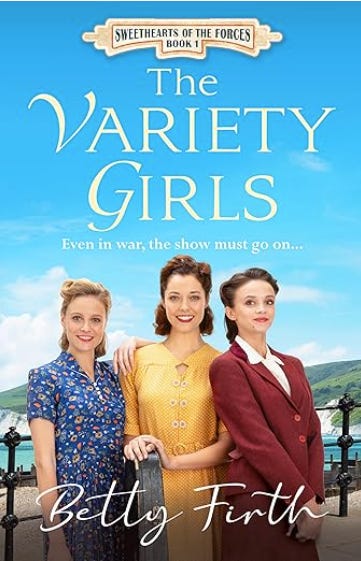
Betty is published by Hera and Betty’s editor at Hera created a ‘brief’ for the Designer to use when drafting ideas and cover approaches. With most traditionally published books, the editor will have read the book first and come up with some ideas for the cover from that initial read. In non-fiction the brief may be led more by the concept than the content. In the case of saga (or any books in a series), the author has often written a detailed outline of the content of the book – time-period, themes, characters, unique aspects and selling points – and in these instances the editor doesn’t always need to have read the book before giving a brief. In this instance, Betty’s editor knew that the series would be focused around a travelling variety troupe employed by ENSA, the organisation that provided morale-boosting entertainment to the armed forces in World War II, and so was able to send off a brief focusing on these aspects.
Sagas are unique in that there will often be a photo shoot for the picture of the women on the cover. Sometimes they are holding a baby, or a prop. Sometimes there are children on the cover, too. When I was an editor I was lucky enough to attend one of these photoshoots! If there isn’t a photoshoot, then a picture will be selected from a catalogue of unused photographs from other saga shoots, or stock libraries such as Alamy, Shutterstock and Trevillion.
Once a Designer has received a brief, they will usually spend a few weeks working on this before presenting one, two or several different cover ideas in a ‘cover meeting’. The cover meeting is usually attended by members of the Sales teams as well as Marketing and Publicity, who will all get a chance to feed back on the suitability of the designs. The Editor also has a chance to feed back on whether the books fit the series style or branding, or if all the aspects match the content of the book.
Sometimes, especially if a retailer has been especially supportive of an author in the past, or if they are hoping a certain retailer will come on board with the book, the draft cover will be sent to the retailer for their feedback. This is often the case with books that Publishers are hoping Waterstones will come on board with, and sometimes the feedback from a retailer will completely change the whole approach to the cover and the Publisher will go back to the drawing board after the meeting.
Once the company has a picture they are happy with in-house, it will be sent to the author to have a look at (in most instances!). As Betty says:
I always love seeing the first draft design of a new book cover, and how the designer has interpreted the story. I’m lucky to have a publisher who allow me some feedback on the way my covers look, which isn’t always the case. However, I know that the first job of a cover is to represent the story’s “vibe” in an appealing way to potential readers so I try not to be too precise about things like, for example, the hair or eye colours of the cover models compared to the characters. I do always check carefully for anything that might hint at a historical anachronism, which it’s important to get right (or readers will let you know about it!).
In the case of The Variety Girls, this is the cover that was sent to me and Betty:
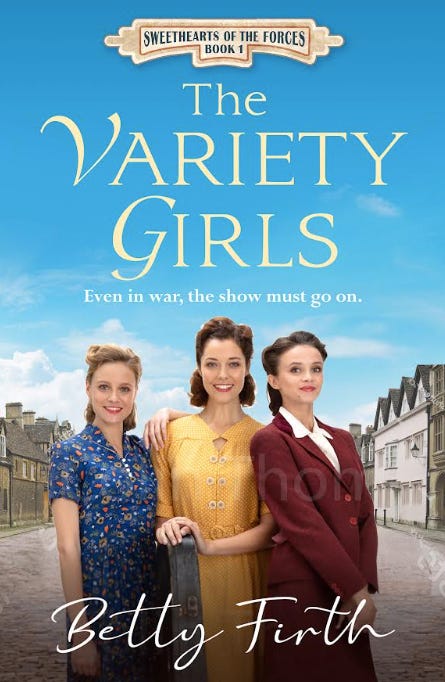
As you can see, much of the cover is the same, but the backdrop is different. This is what Betty (who is really called Lisa) had to say about this version. With the cover for The Variety Girls, I was sent multiple drafts for my feedback. The first one had an urban background that I felt wasn’t well-suited to the story, the significant parts of which take place on the coast, and also that the cover model looked older than the main character.
Once this was fed back, we were sent a second version, here:
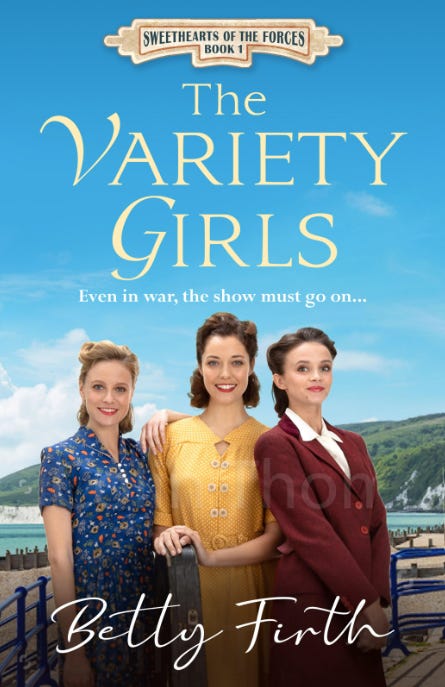
As you can see, the background has changed hugely. However, we still felt it wasn’t quite right. As Betty/Lisa says: The second draft fixed these issues, but included some rather modern seaside railings that didn’t suit the wartime setting. I included a reference photo for railing style with my feedback, and in the third draft, everything was perfect! The ultimate decision on design, title and shoutline is always the publisher’s, but it’s lovely as an author to feel I have a voice on how the book is presented as well.
And this is how we arrived at the cover I posted at the beginning!
You can find out more about the book here and here.
And read the blurb here:
Even in war, the show must go on… March 1940 But as she tours with her troupe, the Forces Follies, life proves to be far from the glamorous showbusiness world Molly had imagined. She and her new friends discover that raising the morale of tired, anxious soldiers is no easy task, especially now the so-called Phoney War has begun to heat up. Life changes for Molly when handsome crooner Jack Forrester joins the Follies. At first she finds herself exasperated by Jack’s laid-back attitude, but when the two are paired as a singing duo, they quickly grow close. But will a devastating secret from Molly’s past derail their growing romance? And as evacuated soldiers pour in from Dunkirk, can the girls of the Forces Follies lift the spirits of men who have given everything for their country?
Bradford mill girl Molly Clough can hardly believe it when she successfully auditions for ENSA, the organisation that entertains the troops. Despite the much-mocked ENSA’s reputation as ‘Every Night Something Awful’, singing on stage feels like a dream come true for Molly.
An emotional, captivating and uplifting romance for fans of Donna Douglas and Johanna Bell.
Thank you to all my subscribers! I really appreciate you being here. If you found this post helpful, please do like, subscribe and share with anyone else who you think will find this post helpful.
I am booked up with editorial work until mid-October, but if you are interested in working with me editorially from that point onward, feel free to reach out via my website.
I have written an ebook on writing a standout query letter, which you can find here.
No posts
Comments
Nothing yet. Say the first thing.
Sign in to join the conversation.