
Muni Storytelling
Every Muni employee and Muni passenger knows San Francisco has a huge fare evasion problem. On May, 10, 2024, Muni Storyteller, Melissa Culross, gaslighted on Muni’s website:

First, I am not ridiculing Culcross’ position as a Muni “storyteller,” but that is the exact job description she selected for her LinkedIn profile.[i] “Storytelling” literally may mean a liar or fibber. Good choice of words, Melissa.
Second, Culross is straight up gaslighting. Culross is psychologically manipulating Muni’s paying passengers to question their own observations on rampant fare evasion.
Culross claims the people that appear to be sneaking on Muni vehicles are actually allowed to under these safe harbors:
Seniors with low income
People experiencing homelessness
All the SF State sophomores, juniors, seniors and grad students that don’t pay because they are all 18 or younger (Didn’t know the city had so many precocious teenagers.)
People that paid on a previous Muni line and are merely transferring
People attending Warriors games ride Muni free, while Giants fans are required to pay a fare, and
My favorite, the passengers are logging onto their phone and secretly signaling Muni that they are paying.
Storytelling about invisible fare payments
Muni, as far back as Jeffrey Tumlin claimed that many passengers were paying their fares via a Muni Mobile. Muni Mobile claims, “you activate your ticket in the app (on your phone) and you don’t need to tap or show the operator anything.”
This is the perfect gaslighting setup for Muni. Rather than create the appearance of fairness by everyone tagging onto the buses, Muni has opted to perpetuate the mystery of whether someone is cheating or not. Gee, I wonder if all those people running out of Walgreens with their arms full of merchandise have a Walgreens Mobile app?
But wait, I had an accounting question which led to my public records request (#26 2132). How does Muni know whether or not those Muni Mobile customers are really logging on?
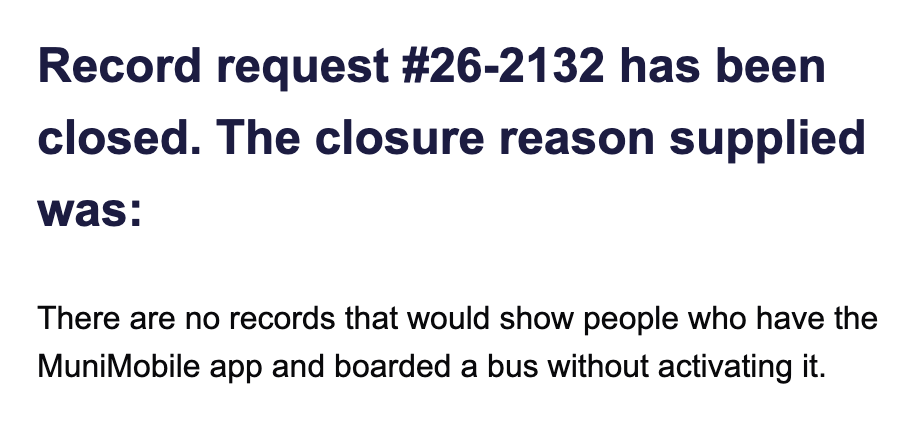
Typical dysfunctional Muni. Despite Culcross storytelling that these passengers “aren’t doing anything wrong,” she nor Muni has a clue whether Muni Mobile customers are paying. Or whether Muni Mobilers only log onto Muni Mobile in the rare instance they see a fare inspector board their bus. What a scam!
How to reduce fare evasion
The anti-car supervisors, like D7 Supervisor Myrna Melgar, are definitely going to attempt to bring New York’s congestion pricing to San Francisco. To provide context to the size of fare evasion problem entering through New York’s subway gates, the New York Times reported that revenue lost to New York’s fare evasion is twice the revenue gained from congestion pricing. To combat rampant fare evasion, New York City is investing $1.1 billion in better entry gates and security.
Similarly, BART has recently invested over $90 million to construct gates to deter fare evasion. BART claims, conservatively, they will recoup those costs within 9 years— conservatively!
While other agencies are strengthening public transportation gates, Muni purposely keeps the turnstile nearest the Metro station booths unlocked. That ensures passengers can board—even through turnstiles-- without paying!
Here’s how to address Muni’s fare evasion without major cash outlays:
1) Make everyone tag onto Muni
End the mystery of whether people are sneaking on or they have the Muni Mobile app. Issue Clipper cards to even the freebee riders so they can still ride free, but they must tag onto the bus. This will end the perception that people are sneaking on and discourage the why-should-I-pay-if-no one-else-is rationale of our formerly complaint San Franciscans.
2) Front door boarding
In 2020, because of epidemic fare evasion, London returned to front door boarding only. London found they were losing $5 million per year on a newly designed bus by allowing middle and backdoor boarding. Muni is losing hundreds of millions of dollars to backdoor boarding, and doing nothing about it.
Last summer, I had an eye-opening experience at the Daly City Bart Station. This is a transfer spot to board both Muni and SamTrans buses that are parked adjacent to each other. Next to a Muni bus where few passengers were paying, I boarded a SamTrans 120. The SamTrans bus was like time traveling back to pre-1990 San Francisco. I took out my phone, filmed, and posted on Twitter:
Please watch here: 37,000 Twitter views
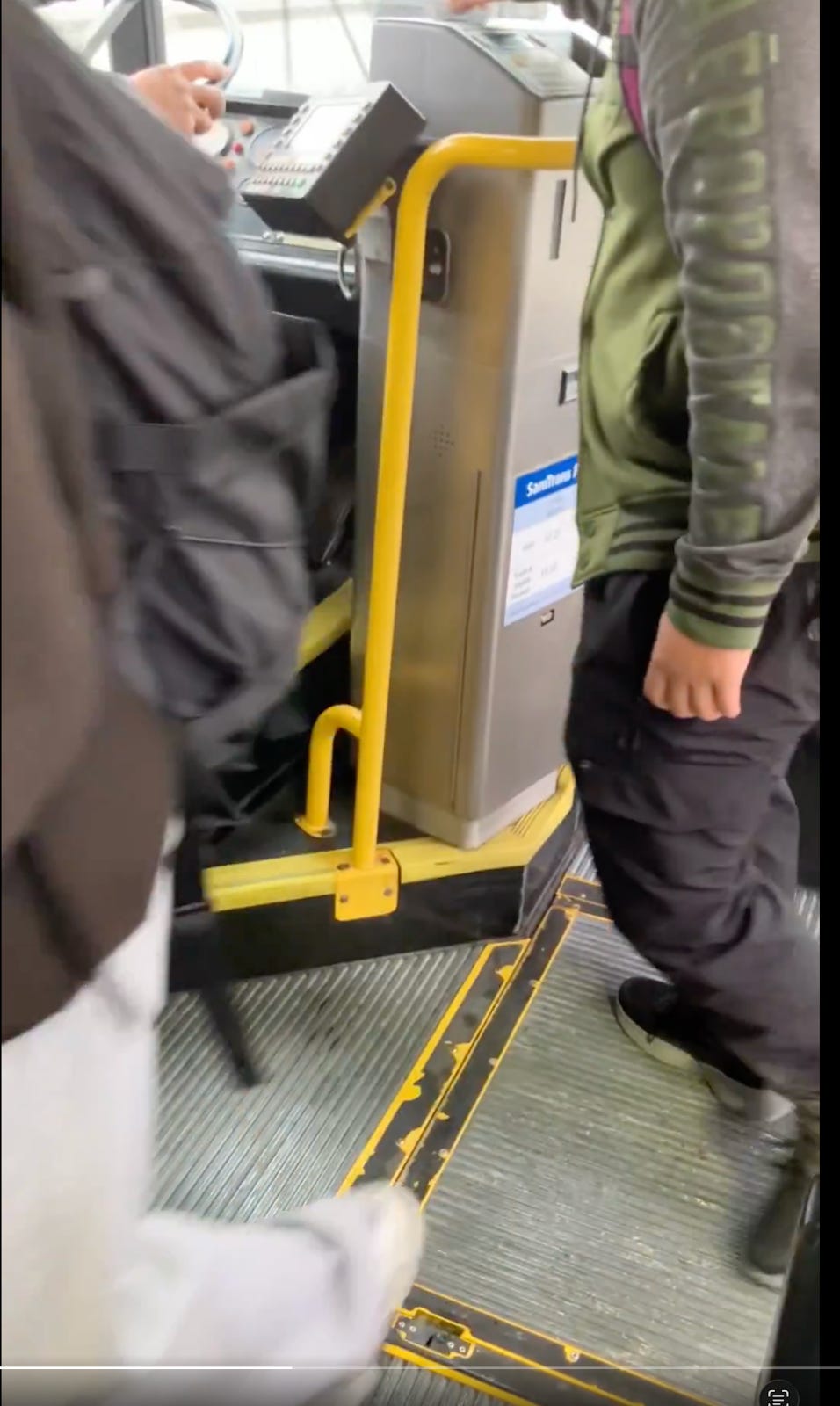
Unlike San Francisco, San Mateo students are required to pay. Unlike San Francisco, where college seniors evade paying fares, San Mateo high school students pay a whole dollar to ride the bus. San Mateo is preparing students for adulthood by teaching them they have financial responsibilities, while Muni trains our youth that it’s only the wealthy that have an obligation. Such a simple plan. Like my generation had to pay a Muni fare when we went to school.
Muni allows backdoor boarding because it claims it’s much faster to board. No Muni, it’s not faster.
In my video, six people boarded and paid within 11 seconds. For adults riding Muni, that equates to $981 more in revenue per hour. For context, the City could afford to pay SFPD officers quadruple time on every bus, and still generate more fare revenue then under the current system. Nah, it’s better for Muni to remain dysfunctional.
3) Have SFPD escort fare inspectors (again)
Per StreetblogSF, in 2010, SFPD assigned Deputy Chief John Murphy to coordinate Muni’s fare inspectors presence with SFPD officers. In a presentation to Muni’s (SFMTA’s) board of directors, Murphy claimed his operation halved crime on Muni. Juvenile crimes and vandalism also plummeted.
During that period, SFPD divided the city into “enforcement zones” based on crime stats. SFPD targeted locations, not people. Unlike the current Muni fare inspectors that rarely venture from downtown Muni Metro stations, Murphy conducted a statistical analysis to the bus routes that experienced the most crime, community complaints, and concerns voiced by Muni bus drivers. Those bus routes were the 14 Mission, T- 3rd Street, 19 Polk, M Oceanview, and the 9 San Bruno lines. Just like SFPD’s enforcement zones, Murphy targeted locations, not people.
Under Murphy’s supervision, Muni’s fare inspectors were writing 50 to 100 fare evasion tickets per shift. And engagement with passenger led to several high-profile arrests, including Muni employees personally selling stolen transfers.
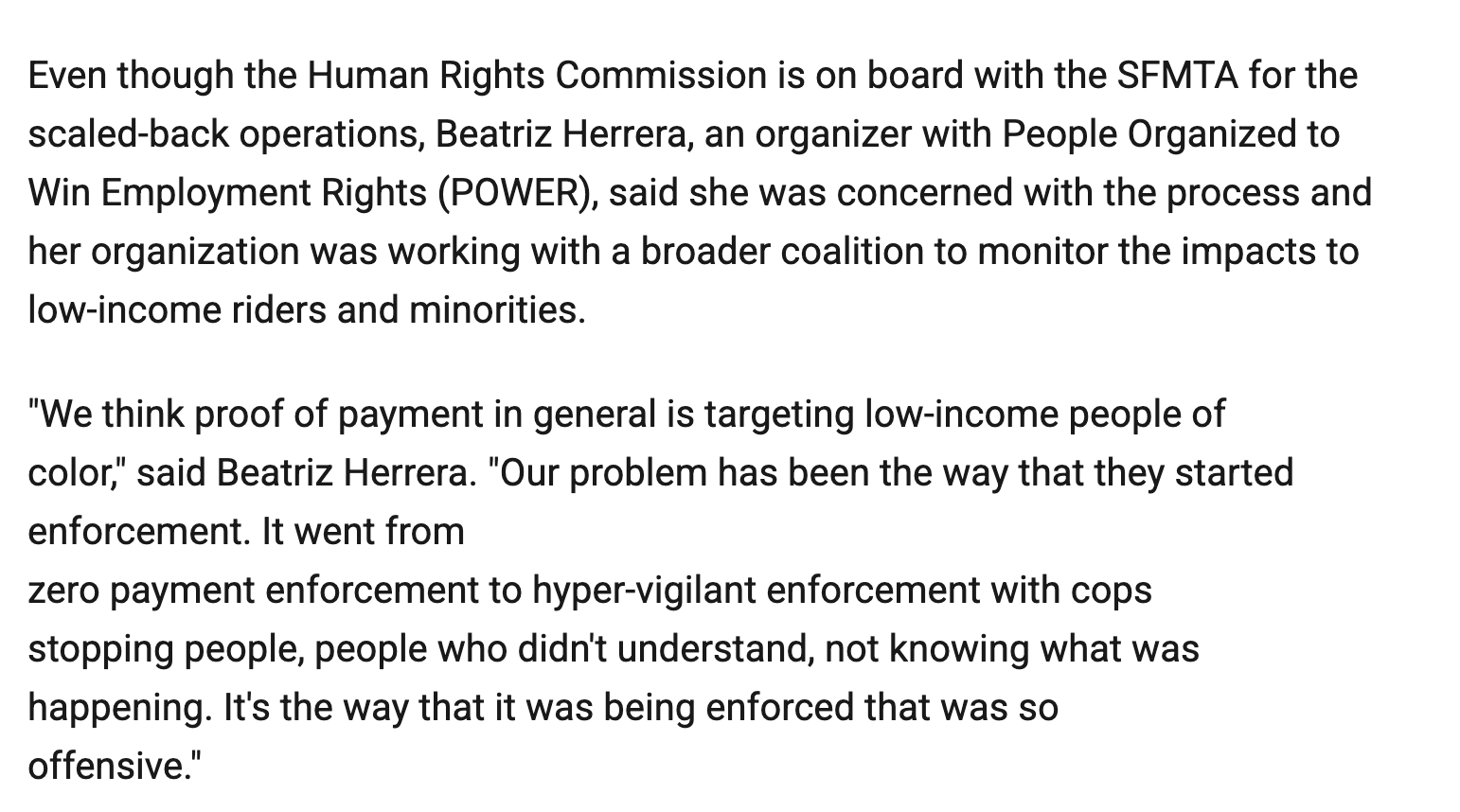
Unfortunately, the citations for fare evasion paralleled the same concentrated demographics of robbery suspects. “Community organizers” started to push back against the program, claiming it was targeting “low-income riders and minorities”[ii] —it was the beginning of the Prop 47 mentality of decriminalizing crimes to create diversity in incarceration. The City decided to remove SFPD from the fare evasion program.
Perhaps an offsetting fare evasion ballot measure is needed to offset the proposed Muni taxes
Rather than address the revenue bleeding from fare evasion, a prodigal Muni is now racing to increase homeowners’ property taxes and impose greater sales taxes on customers.
In March of 2024, fed-up voters in San Francisco overwhelmingly approved Prop E, which allowed SFPD to employ drones and chase violent car break-in crews. (Absolutely great video on the success of SFPD drones.). The will of the people overruled a timid SFPD Chief Will Scott, and a temporarily progressive police commission (Can you say MCO?). The voters passage of Prop E delivered an immediate and lasting reduction in crime that has been nothing short of historic.
Unfortunately, history is repeating itself. Just as a small group of nonprofits fought the success of Murphy’s program, tiny bands of progressives are claiming victimhood from the not-diverse arrests facilitated by the use of drones.
Maybe the will of the people is needed for a “Prop E” for Muni. A concise proposition that introduces simple and logical solutions to Muni’s dysfunction:
Make everyone tag on, even if the passenger is free
Require front door boarding,
Make students grow up and pay a small fare,
Have SFPD escort Muni fare inspectors.
Nah, too simple. Let’s just make the rich pay.
[i]

.
[ii] From StreetBlogSF:
No posts
Comments
Nothing yet. Say the first thing.
Sign in to join the conversation.