
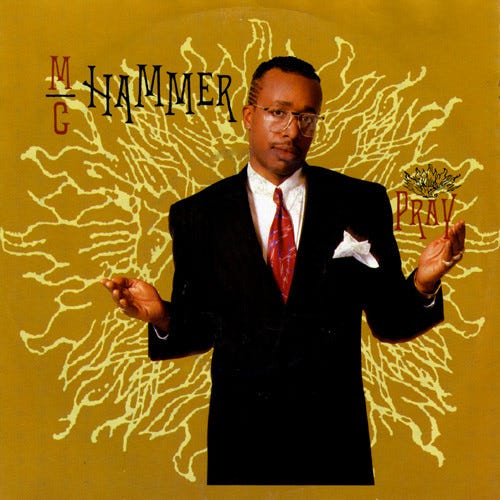
Peak: #2 on the Hot 100
Streams: 4.9 million
Before I get to “Pray,” let me acknowledge that “U Can’t Touch This” is MC Hammer’s signature song. In fact, it’s arguably one of the most recognizable rap tunes of all time. But because Hammer’s record label wanted more people to buy his album Please Hammer Don’t Hurt ‘Em, they deleted the physical single of “U Can’t Touch This” from the marketplace after just a few weeks in stores. Thus, since it quickly stopped having sales points to boost its performance on the Hot 100, the song stalled at #8. So while it is spiritually a #1 hit, it is technically… not.
From one perspective, the record label’s strategy worked: MC Hammer’s album sold over 10 million copies and was #1 for 21 weeks. If consumers had been able to buy the single of “U Can’t Touch This” during that entire stretch, then Please Hammer Don’t Hurt ‘Em may have sold fewer copies.
Eventually, though, this approach bit the record industry on its greedy ass. By the late 90s, singles were such a rarity in the marketplace that people were forced to spend $16 on the entire Natalie Imbruglia album, even if they just wanted “Torn.” When Napster and other file-sharing services were invented in the early 2000s, people naturally used them to get the track they wanted for free.
But even though “U Can’t Touch This” helped set the template for this approach, it’s actually not a great example of the “buy the whole album for one hit song” phenomenon. That’s because Please Hammer Don’t Hurt ‘Em had two other top 10 hits: “Have You Seen Her,” which peaked at #4, and “Pray,” which peaked all the way up at #2.
Hammer’s label may have known that “U Can’t Touch This” was the primary hit from the record, but they also knew they had other songs that got the public excited. I don’t pretend to understand the logic behind releasing both of those songs as physical singles, while pulling “U Can’t Touch This” off the shelves. But I don’t have a degree from Hit Song University, so what do I know?
Anyway, we’re left with a paradox: “Pray” isn’t the biggest hit of MC Hammer’s career, but in chart terms, it’s the biggest hit he ever had. I’ll leave you to ponder that while raking your Zen garden.
Regarding “Pray” as a song: I do remember seeing the video on MTV quite a few times. Listening now, I’m not upset to be hearing it again.
I mostly like “Pray” because it samples the hook from Prince’s “When Doves Cry.” Everything sounds better with that keyboard line underneath. You could diagnose me with rickets, but if you had the beat popping in your office, I’d still shake a diseased hip.
I’m sure this sample helped “Pray” get on the radio, too. You know there were DJs that segued from Prince to MC Hammer and vice versa. And it couldn’t have hurt that Hammer’s song had a positive, socially conscious message that could be played when kids were tuning in to the Top 40 station. One verse, for example, includes the following observation:
Children dying, oh so fast, from this or that
Needing that money, smoking that dope, and doing that crack
[…]
That’s why we pray
Just to make it today!
I’m not saying this is poetry, but in 1990 the culture was still nervous about the rise of hip hop and its potentially “inflammatory” messages. A song like this, which explicitly tells listeners to be good Christians, could be deemed a safe alternative. “Pray” is the reason my cousins, who were 12 and 10 at the time, got to see MC Hammer in concert. My aunt listened and figured it was fine. (Every kid knew the second side of the MC Hammer tape featured a song called “She’s Soft and Wet,” but we also knew not to tell our parents about it.)
Buoyed by songs like this one, Hammer leaned hard into family friendliness. He recorded a song about the Addams Family that Sarah and I discussed on our podcast. He had a Saturday morning cartoon and a Taco Bell commercial. He had a branded doll and a set of temporary tattoos. And while all this has now been distilled into the legacy of “U Can’t Touch This,” “Pray” and its brethren stand as testaments to just how big he used to be.
Thank you for reading The Lost Songs Project. It’s an independent journalism project that relies entirely on your support. Become a paid subscriber today!
No posts
Comments
Nothing yet. Say the first thing.
Sign in to join the conversation.