
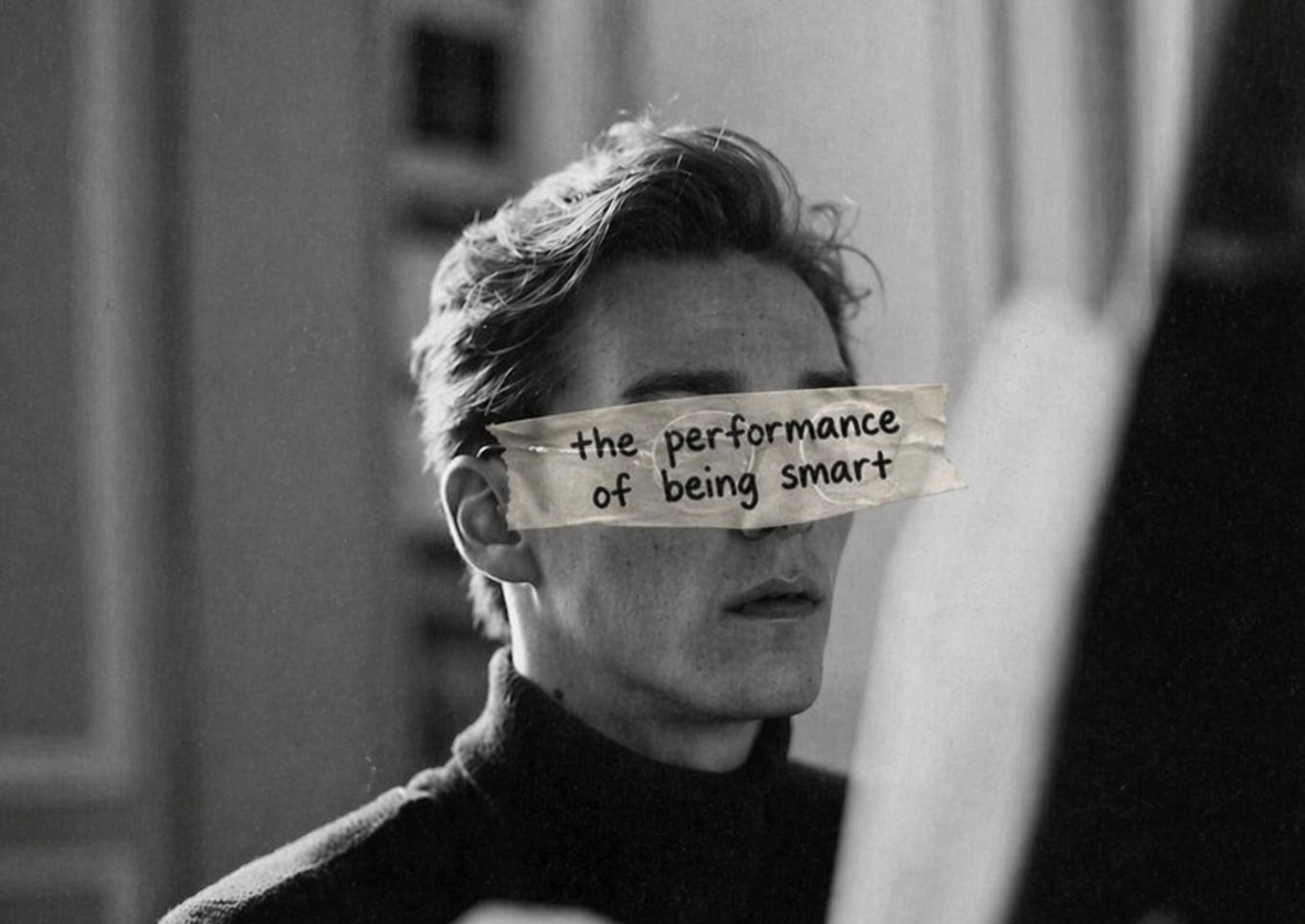
I have always been embarrassingly susceptible to the promise of becoming smarter, and so when the trend of becoming “disgustingly educated” first made its way onto my TikTok feed, I fell victim to its allure.
The content is endless: read these books (what—you haven’t read War and Peace?), watch these lectures, fill your vocabulary with words like “epistemic,” “obfuscate,” “didactic,” and “quixotic,” wake up earlier, listen to podcasts at 1.5x speed, and become the kind of person who can casually reference Foucault at dinner without visibly choking on the need to be admired. It seems that everywhere I look online, someone is trying to teach me how to be more capable of saying something impressive in a room full of people I probably already feel intimidated by.
And as much as I understand the appeal of intellectual self-improvement, lately I have started to suspect that this is not just some innocent internet trend enjoyed in good fun. I have started to wonder what gets lost when education becomes less about learning and more about manufacturing an aura.
Education co-opted for the ego
The problem with the pursuit of being “disgustingly educated,” at least in the way I see the term show up online, is that it is often primarily concerned with the aesthetic of intelligence. Instead of promoting learning or the pursuit of knowledge for its own sake, education has been co-opted as the newest way to impress your friends at dinner parties, soothe your own nervous ambition, win arguments, and signal belonging.
At its core, the allure of this trend has always been primarily rooted in finding a shortcut to becoming impressive; it reduces actual thinking into shallow hacks that promise to make you more intelligent. The trend teaches us, implicitly, that signaling your intelligence is more important than actually possessing it. We are taught to consume ideas the way we consume content: quickly and with very little digestion. What you know no longer becomes a reflection of individual idiosyncrasies and curiosities; intellectual taste itself is mass-cultivated in order to signal intellect to others.
And as much as I cringe at the term, it makes sense to me that this term has entered our online lexicon; we live in an age of relentless intake. The promise of becoming “disgustingly educated” preys on a society that has maximized for efficiency, a society that believes every problem should have a simple answer and every insecurity should have a simple solution. Not feeling smart? Read five books. Worried you are not interesting enough? Here is a list of things to consume until you are.
But as the name so aptly suggests, the pursuit of being “disgustingly educated” is disgusting because it functions like any other form of overconsumption; the consumption of knowledge acts as a panacea for a perceived fundamental lack in your soul. You overconsume educational content because you believe, somewhere deep down, that if you know enough, you might finally become the kind of person no one can dismiss. It is the intellectual equivalent of filling your cart with cheap clothes at Zara and hoping that, somehow, the next purchase will transform you into a self that has whatever it is you believe you lack—beauty, worth, love, admiration.
You are not disgustingly educated; you are neurotically overinformed.
While the obsession with style over substance is irritating enough on its own, the more insidious byproduct of the trend is that its values are, paradoxically, at odds with intelligence itself. Ironically, in our pursuit to perform intelligence, we often lose the very qualities required to cultivate it: curiosity, humility, patience, attention, and the willingness to not know.
At the core of this trend is a neurotic fixation on the intake of information—knowledge becomes something you possess rather than something that alters you. But when education becomes another way to construct a self, something essential is lost: the ability to form an original thought and to allow an idea to actually change the way you live.
A real education goes beyond the consumption of information; it means learning how to think. To be educated is to learn how to metabolize information into something that actually shapes how you live.
And thinking requires friction. It requires sitting with uncertainty long enough for it to bruise you a little. It asks you to hold competing ideas without immediately sorting them into a clean hierarchy of right and wrong. It implores you to risk being unoptimized—an idea that is antithetical to the trend of becoming “disgustingly educated.”
As children, we instinctively know this. We ask relentless questions. Why is the sky blue? Why do people die? Why do I have to go to school? Why can’t I touch the stove? We are not collecting answers so we can appear more impressive at dinner parties. We are trying to understand the world. We are learning how to stay inside a question without rushing to close it. We ask and ask and ask until the answer collapses into mystery again, or until our father stops entertaining our inquiries.
But somewhere along the way, we stop asking why and we start repeating what sounds right. We confuse information with intelligence and consumption with knowledge. We learn which conclusions are rewarded and what type of language makes us sound impressive. We fail to realize that what looks like education is often just the domestication of wonder—a shift from wanting to understand the world to merely wanting to be right about it. We learn that there are correct answers and efficient ways to arrive at them and that wandering too far off the path is a waste of time. Over time, we stop pursuing knowledge that does not promise a guaranteed return. And so what remains is overinformed emptiness—knowledge that is accumulated and displayed but never metabolized into a way of being.
Is this the fault of some internet trend? Probably not. If anything, the mass appeal of being “disgustingly educated” is probably the expected byproduct of a society that has been taught to consider an idea “learned” once it can be regurgitated on demand, rather than once it has altered a worldview.
An education should transform your life
Education devoid of transformation is mostly useless. It does not matter how much you know if you do not know what to do with what you know. If an idea never touches how you treat people, how you spend your time, what you tolerate, or what you refuse, then it does not matter how many impressive books you have read.
David Foster Wallace once wrote,
“Probably the most dangerous thing about an academic education… is that it enables my tendency to over-intellectualise stuff, to get lost in abstract argument inside my head, instead of simply paying attention to what is going on right in front of me.”
Being educated doesn’t mean just thinking for yourself; it also means learning how to exercise some control over how and what you think. Often, it means being conscious enough to choose what you pay attention to and how you construct meaning from experience.
We can talk endlessly and pseudo-intellectually about meaning, fulfillment, alienation, ethics, and relationships, but miss the basic conditions of our own lives: how we spend our days, who we are impatient with, what we avoid, what quietly exhausts us. The obvious truths—that time is passing, that death is inevitable, that choices are demanded of us, that the power to cultivate happiness and fulfillment might exist within us—are somehow dismissed as too banal to merit serious thought.
Maybe the real cost of being “disgustingly educated” is that you can spend years refining your ideas and still miss the very life you are living in, right now, and not for long.
What is worth living for? What is worth dying for? What do I want? Am I prepared for death? How should I make my choices? Are there better and worse ways to live? Better and worse things to believe? Better and worse thoughts to have? These are the very questions we should be most concerned with if we want to make anything meaningful out of our own precious, fleeting, mortal lives.
But when our intellectual curiosity is replaced with a ten-step TikTok tutorial, we outsource even the question of what deserves our attention. We let someone else tell us which opinions make us interesting. We become excellent sheep that consume what we are told to consume. Education, then, stops being a personal pursuit of our own questions and becomes another checklist of expectations.
So what should you think about? Where can you begin to find these answers?
But there you go again, expecting your education to arrive with instructions.
And so I ask nothing of you today except this: Let go of the need to be “disgustingly educated.” Stop letting strangers on the internet tell you what is worthy of your attention. Undomesticate your wonder. Follow the questions that actually belong to you—the ones that satisfy your curiosity rather than your ego. The ones that, if you let them, might rearrange your entire life.
If you’ve been reading along and want to support what I’m building here without committing to a subscription, buying me a coffee is a wonderful way to do it ☕️
I can be found on Instagram or on my second Substack publication, Not Actually Your Therapist.
Comments
Nothing yet. Say the first thing.
Sign in to join the conversation.