
Some of you know me for Hell of a Hat, the newsletter I started in 2021 to promote my book Hell of a Hat: The Rise of ’90s Ska and Swing. This is something different. It’s a love letter to freestyle music, and if you’re not sure what that is, please check out the introductory article I published last year. And before you read today’s installment, be sure to check out part 1, which discusses New Order and Information society.
Pretty Poison
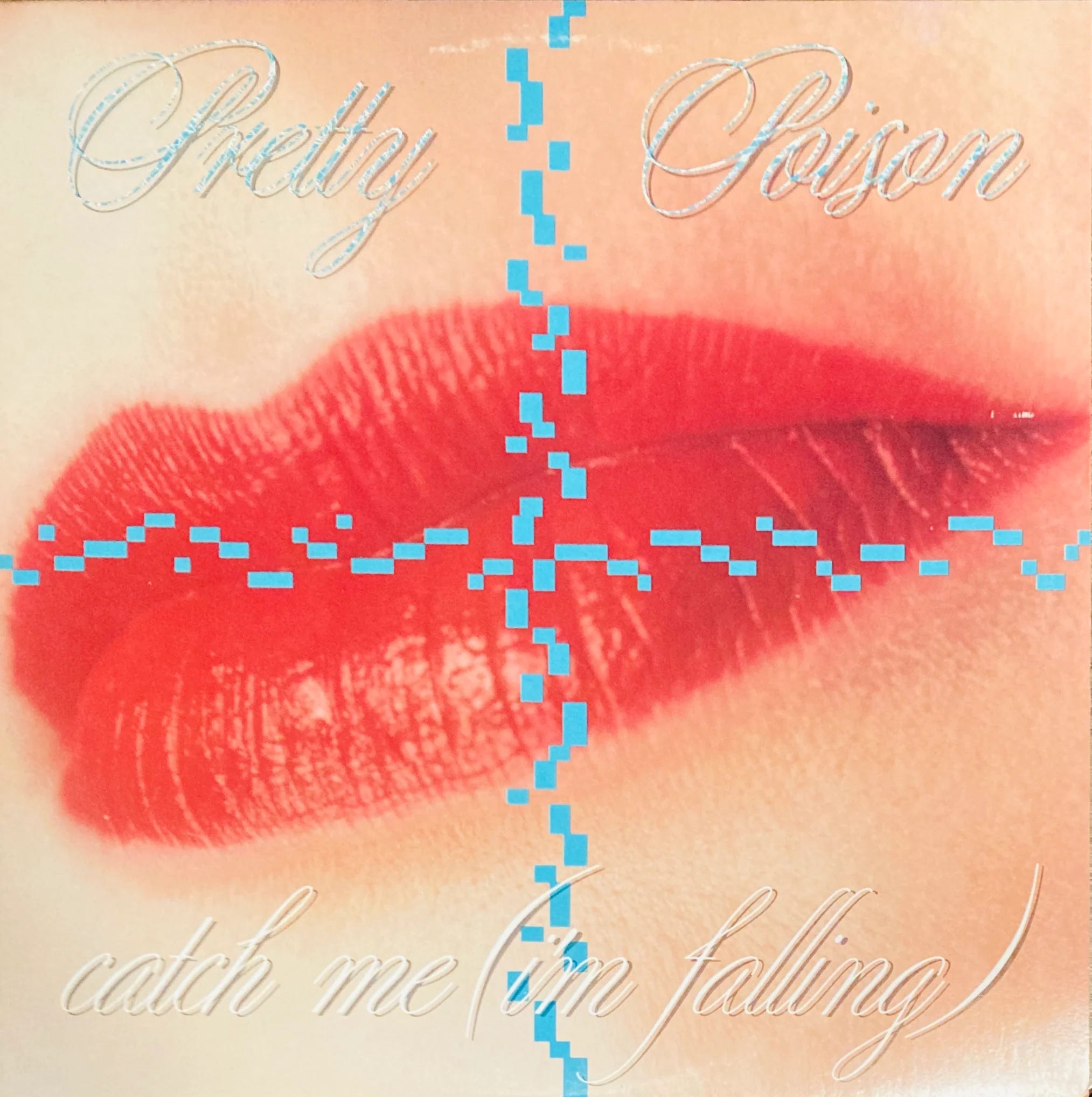
As strange as InSoc’s New Wave-to-freestyle story may sound, Pretty Poison’s trajectory is remarkably similar. Formed in New Jersey and later based in Philadelphia, the group led by awesomely named multi-instrumentalist Whey Cooler and glamorous redheaded frontwoman Jade Starling is responsible for 1987’s “Catch Me (I’m Falling),” a near-perfect exercise in genre fusion that fits together elements of rock, pop, and freestyle. Among the catchiest songs ever written, “Catch Me” topped the Billboard dance charts and reached No. 8 on the Hot 100. It’s still used in TV shows and movies all the time, and that’s because it rules.
Starling and Cooler grew up in Merchantville, New Jersey, right outside Camden. She was a former pageant kid who loved to entertain, and he hailed from a family of musicians, including a grandfather who played something like 20 instruments. As a white kid in a Black neighborhood, Cooler grew up loving The Beatles but also James Brown and Funkadelic. He started out on piano and switched to guitar for the same reason most young men do: to meet girls.
In high school, while playing in a cover band with his brothers, Cooler met Starling through a newspaper ad and found an instant creative partner. They quickly began writing songs together and launched a new band, Pretty Poison, named not for the 1968 black comedy about an ex-con mental patient who falls in love with a cheerleader, but rather for the hard rock band Ram Jam’s 1978 song “Pretty Poison.” (Cooler liked the name, not the tune.)
In their early years, Starling and Cooler were into Siouxsie and the Banshees and Depeche Mode, and as Cooler told podcaster John Parker, their initial output bordered on what’s now called “darkwave.” That said, their 1981 debut single, “Gimme Gimme Your Autograph,” is actually more reminiscent of The B-52’s, what with its surfy guitar and trashy organ sound. But 1982’s “Expiration,” their follow-up single, would have fit perfectly into a playlist alongside tunes by Joy Division, The Cure, and OMD.
The B-side, “The Realm of Existence,” is an inky swirl of Banshees-esque psychedelia. Pretty Poison had a cool thing going, and they started making noise in nearby Philadelphia. When they’d perform the song “No Tears,” a doomy post-punk single also released in 1982, Starling would tear stuffed animals to shreds on stage, creating a memorable spectacle (and lots of extra work for venue cleanup crews).
The following year, Pretty Poison released the Laced EP, on which Cooler and Starling turned up the synths and pushed further onto the dance floor. Part of this evolution was a matter of taste. Whey was getting into sequencers, and he was very much digging the emerging electro music coming out of New York City. Shannon’s “Let the Music Play” was a favorite.
“That song opened up, in our estimation, the whole entire market that might be called freestyle today,” Whey told the podcast Choons.
There was also a matter of practicality. It was nice being “America’s answer to Siouxsie and the Banshees,” as the influential punk and New Wave zine Trouser Press once called them, but Pretty Poison were stuck playing the same local New Wave club over and over again. They either had to move to England to chase success or soften their sound for American audiences.
“Nighttime,” first released in 1984, must’ve felt like a eureka moment. Existing at some previously uncharted midpoint between Shannon and Siouxsie, “Nighttime” is a goth-freestyle banger that taps into the nocturnal fixation shared by both genres. In the opening verse, Starling floats through the smoky, sexy, strobe-lit world that comes into being when the sun goes down.
Come feel the steady rhythm of the nightlife
And hear excitement in the air
Baby, when the night comes down
You know where I can be found
Dancing in a midnight fantasy
Pretty Poison made a noirish, Aquanet-drenched music video for “Nighttime,” and the song became an underground hit, reaching No. 14 on Billboard’s Hot Dance Club Play chart. The group were going places, but their manager, Robert Hazard, the Philly mover and shaker who wrote “Girls Just Wanna Have Fun,” wasn’t happy with where they were heading. Hazard wanted them to stick with rock and pop, and according to Cooler, this was the reason Pretty Poison didn’t release anything for about three years.
Ultimately, Pretty Poison split from Hazard and earned a spec deal with a local studio called Kajem, which had produced rock acts like Queensrÿche and Cinderella. During an early session with Kajem producer Kurt Shore, one of the songs wasn’t working, and Shore asked if they had anything else. Cooler played him the cassette demo of “Catch Me (I’m Falling),” and the producer instantly knew it was a hit. Probably because he had two ears and a pulse.
The version of “Catch Me (I’m Falling)” that descended from heaven above in 1987 was actually a remix of an initial version that featured synth programming by the duo Jan Kitten Clarke and Steve “Cat” Graham, known as Kitten & Cat. “It had no soul,” Starling said of that version. “I hated it.” So they hired Kae Williams, Jr., the man who’d produced “Nighttime,” and he and Cooler transformed the lackluster track into something that would boom from car stereos and make 1987 a whole lot more livable.
The song blew up in Philly, spurred a major-label bidding war that ended with Pretty Poison signing with Virgin, and became the lead single and title track off Pretty Poison’s debut full-length album.
“Catch Me (I’m Falling)” opens with dramatic strings—one part of the Kitten & Cat production that Cooler and Starling kept—and quickly becomes a banging club track. Except it’s more than that. Like Lewis Martineé, the Miami producer behind all of the classic hits by the freestyle girl group Exposé, Cooler is a proper musician who started out playing rock music. You don’t have to be a trained instrumentalist to make great music, but it helps. “Catch Me” feels sturdy and composed in a way that other freestyle songs don’t. There are little guitar licks scattered throughout and hooks on hooks on hooks.
Starling’s lyrics are equally great. “Catch Me (I’m Falling)” captures the dizzy feeling of new love, and in the second verse, Starling uses language related to music itself, much like Ann Godwin did with Shannon’s “Let the Music Play.”
Two hearts beating in time
The rhythm as one, I am yours, you are mine
For you, I surrender myself
Each night, everyday, always feeling this way
After some initial success on the club charts, “Catch Me (I’m Falling)” landed on the soundtrack for the now-forgotten Jon Cryer film Hiding Out, all about a state’s witness who poses as a teenager to elude the mafia. The song’s music video intersperses movie clips with shots of Starling—resplendent with her bright red hair, fringed leather jacket, and miniskirt—dancing around a high school with her bandmates and a bunch of energetic extras in tow. The video takes the deliriously fun song to another level, and it naturally became a fixture on MTV.
Thanks in part to the movie tie-in, the single cracked the Top 10 of the Hot 100 and gave Pretty Poison enough juice that their follow-up, a newer, glossier version of “Nighttime” hit No. 36, giving the band their second Top 40 hit. It would be their last.
In the early ’90s, Pretty Poison decided to get back to their roots, and they rebranded as the alt-rock group Sex in Violets. It seems none of this music has made its way to the internet, and that’s OK, because in the late ’90s, Pretty Poison had offers to reunite for Pride events across the country, so Starling and Cooler jumped back on that train. The group has remained active ever since, and you can often catch them on freestyle nostalgia shows.
“I don’t know how that actually happened, but I’m really glad that it did,” Starling told Daily Boom in 2018. “I don’t think that we’re a freestyle act, but we seem to be lumped in with that type of music, and I don’t mind that … We get invited to do big arena freestyle shows, and there are the same dozen artists or so that do these, so I’m happy to be part of that family.”
Pet Shop Boys
Whereas InSoc and Pretty Poison ultimately found their greatest success by leaning into freestyle, the U.K. duo Pet Shop Boys famously saw the end of their “imperial phase” when they teamed up with Lewis Martineé—the aforementioned Exposé mastermind—for “Domino Dancing,” an amalgam of their whip-smart, foppish synth-pop and Martineé’s Miami freestyle sound. “Domino Dancing” peaked at No. 7 in the U.K., where Pet Shop Boys had previously enjoyed back-to-back No. 1 singles, and it was somehow considered a failure, though it’s a terrific song that proves freestyle’s adaptability.
Pet Shop Boys are a bit of an outlier in this bunch because they always made club music. When Neil Tennant and Chris Lowe met in the early ’80s, they bonded over electronic groups like Kraftwerk, OMD, The Human League, and Depeche Mode, and from these inputs came a bright, shiny dance music powered by samples and fizzing over with wit and attitude.
Their first two albums, 1986’s Please and 1986’s Actually, yielded undeniable smashes like the vaguely hip-hop “West End Girls” (No. 1 on both sides of the Atlantic), the guilt-ridden thumper “It’s a Sin,” and the ingenious Dusty Springfield collaboration “What Have I Done to Deserve This?” In the lead-up to their third album, Introspective, they happened to be in America while Arista’s reissue of Exposé’s monumental debut single, “Point of No Return,” was burning up the radio. Tennant and Lowe loved the song, and they wanted Martineé to produce “Domino Dancing,” which they’d already written and demoed.
“Someone from their label called me and asked if I would be open to working with them,” Martineé told No Echo in 2016. “I remember I almost fell off my chair when he asked me that. I was like, ‘Yeah, I would even do it for free!’ [Laughs] I was being serious! When they came into the studio, they had the melody and lyrics already written, so I added the music, obviously, ’cause it doesn’t sound like anything else they’ve ever done.”
Martineé, who was born in Cuba, emphasized freestyle’s Latin elements in his productions, and “Domino Dancing” has a sweaty, tropical feel that fits with the lyrics. It’s a song about being in love with someone whose wandering eye never blinks. Tennant’s voice is buttoned up and proper, and you can imagine him at the club, watching helplessly from the corner as his lover plots the next extracurricular romantic conquest.
I don’t know why, I don’t know how
I thought I loved you, but I’m not sure now
I’ve seen you look at strangers too many times
The love you want is of a different kind
“Domino Dancing” came together in Miami, and Martineé enlisted the freestyle group Voice in Fashion—best remembered for the Martineé-produced 1988 freestyle triumph “Give Me Your Love”—to sing backup vocals. The track features live brass, and Tony Conception—whom Tennant remembers not speaking any English—laid down a regal trumpet solo. Nestor Gomez picked out the lovely Spanish guitar part.
“It was a really fantastic experience,” Tennant told the BBC, remembering how Pet Shop Boys’ “very British thing” mixed beautifully with Martineé’s production and team of Cuban musicians. “It was very hot. We were there for about 10 days. It was a great moment. I wish we’d done something else with [Martineé].”
“Domino Dancing” appears on Introspective, and in a reversal of the norm, it’s the extended 7:40 version that’s on the LP—not the shorter radio edit. (Introspective is filled with these extended mixes—the shortest song on the collection is 6:16.) The longer version emphasizes the Afro-Cuban-style piano and has a cool breakdown section.
There’s certainly no harm in watching the extended cut of the song’s music video, filmed on location in Puerto Rico. Rolling Stone once called it “probably the most homoerotic pop video ever made,” and while that may be true, the clip also stars the exceptionally foxy Donna Bottman, so musically and visually, there’s something here for everyone.
No posts
Comments
Nothing yet. Say the first thing.
Sign in to join the conversation.