
The Reignition Project explores stories of purpose, sparked in midlife. Have a story to share or know someone who should be profiled? Reply to this email and let me know. 🔥
What does purpose look like in an environment designed to strip it away?
At California’s oldest correctional facility, that question is being answered through a new arts initiative and the unique, incarcerated-led nonprofit behind it.
Chiaroscuro: Light Within the Shadows is a new project inviting world-renowned artists to paint large-scale murals inside San Quentin. Beyond visually transforming the institution’s imposing walls, the project gives the men inside a chance at leadership and responsibility.
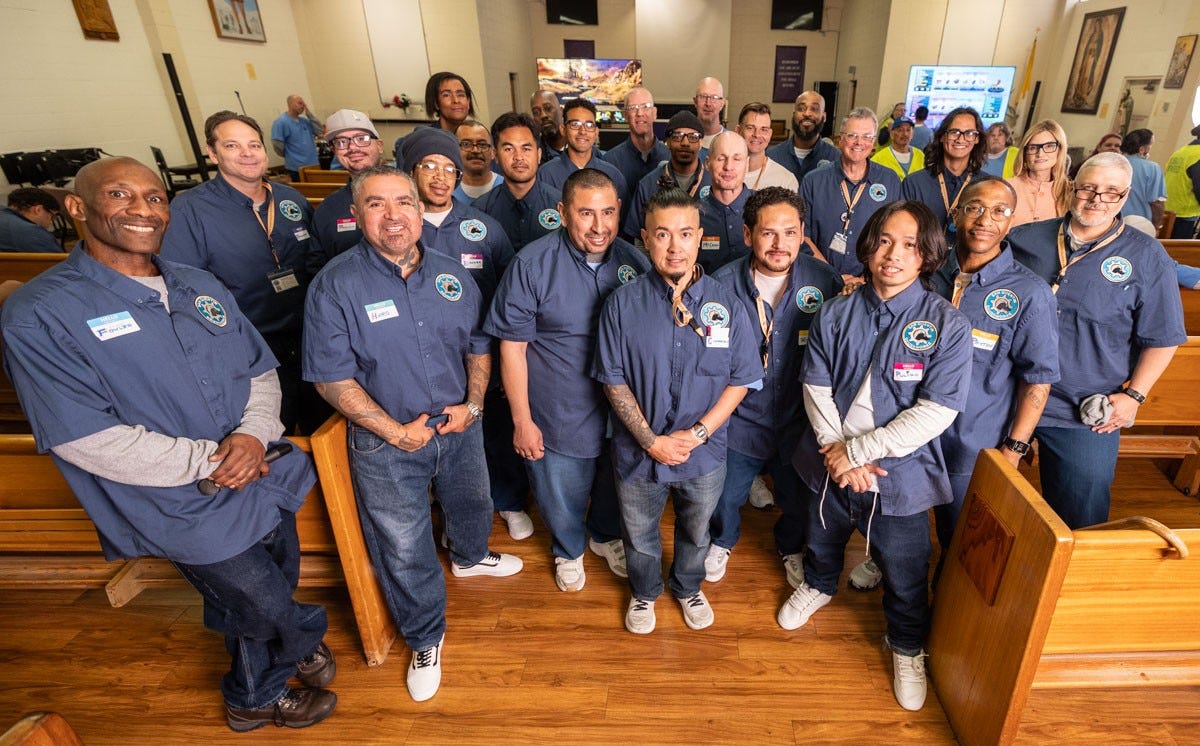
It’s being led by San Quentin SkunkWorks, a non-profit run by a team of more than 80 incarcerated people along with outside professionals. The organization was established in 2022 with a specific mission: to test new reform programs and place accountability for them in the hands of the residents themselves.
The SkunkWorks team began working on Chiaroscuro in 2024, securing approval, reaching out to artists, and fundraising. The first two murals, by South African artist FaithXLVII and her son Keya Tama, were unveiled on the grounds this past July. The third, by contemporary artist eL Seed, will be revealed on January 18th. Work begins on the 332-foot wall this week, with San Quentin residents and correctional staff painting alongside the artist.
Projects like this do more than change the physical environment. Correctional arts programs have been shown to improve emotional regulation, build stronger social skills, and reduce disciplinary incidents1. And when participants are released, they’re less likely to return: under 3 percent, compared with roughly 60 percent nationally.
For SkunkWorks co-founder Kai Bannon, who’s serving a sentence of 70 years to life, projects like Chiaroscuro aren’t necessarily about preparing for release; they’re about finding ways to grow and contribute now.
I spoke with Kai over email about the project, San Quentin’s larger approach to rehabilitation, and finding purpose through responsibility.
Across the U.S., most prisons operate on a custody‑first model: long sentences, limited programming, and environments that are noisy, harsh, and traumatic, with rehabilitation treated as an add-on, not a design principle. San Quentin is part of a different experiment: Governor Newsom’s California Model, which draws from Scandinavian systems by prioritizing education, vocational training, and normalized, more humane living environments as core tools for public safety.
Governor Newsom’s administration committed to transform San Quentin into a rehabilitation center2, but SkunkWorks is not using this allocation of money. We are strictly operating on our partner grants and donations alone.
Only a small set of California prisons are moving this far in that direction, and San Quentin is out front because of a unique mix of political will, bipartisan attention, and a long standing ecosystem of volunteers, programs, and incarcerated leaders who were already pushing reform from the inside.
Kyle [Winchell] and I founded SQSW because we wanted to give agency and the opportunity to give back while incarcerated. We hoped that incarceration could someday be a launchpad for change instead of a dead end. That idea came from lived experience ... seeing how the physical and emotional environment of prison shapes what people believe is possible.
We formalized San Quentin SkunkWorks as an incarcerated innovation lab that brings together people inside, outside professionals, and partners in government to research, design, and test justice reforms in the real world.
Since then, San Quentin SkunkWorks launched initiatives like Chiaroscuro: Light Within the Shadow and leadership training programs that bring incarcerated residents, staff, and outside partners into the same space to practice collaboration and conflict de-escalation.
All of those projects are experiments in a bigger idea: when people closest to the problem have real authority, reform becomes more grounded, creative, and sustainable.
Each program is co-designed and led by people in custody, supported but not controlled by outside partners and advisors.
SkunkWorks and Chiaroscuro give us purpose because they give us real responsibility. Prison is built to take that away.
You’re managed, monitored, and told what you can’t do. I built SkunkWorks to flip that, to create work where people in custody are expected to lead, make decisions, and be accountable for outcomes that actually matter.
Chiaroscuro matters because it changes the environment we live in every day. Color, beauty, and collaboration aren’t abstract in prison. They’re rare.
Creating something permanent together, something that will still be here after we’re gone, changes how people see themselves. I’ve watched guys who were written off as problems become steady leaders once they were trusted with something real.
When you’re treated like you matter, you start acting like it.
The hardest part has been aligning very different systems and timelines: an international artist’s schedule, state government processes, prison security rules, funding cycles, and the lived realities of people serving time. Any one of these delicate threads can unravel the project. Weaving all that together into something coherent and trauma aware, while still maintaining ownership from the inside, takes a lot of persistence and trust building.
There is also the emotional challenge of asking people, incarcerated residents, staff, and community members, to imagine something radically more humane in a place built for punishment. To move forward, we have had to create spaces where skepticism and hope can sit in the same room and still result in a shared “yes.”
I was first incarcerated in 2016. At the time, I honestly didn’t imagine much of a future at all. I expected survival, isolation, and a slow narrowing of the world. Years marked by loss rather than contribution.
What I couldn’t imagine then was that prison would become the place where I took full responsibility for my life and started building something that mattered to other people. I didn’t see leadership or service in my future. I certainly didn’t imagine founding an incarcerated-led organization or helping redesign how prison functions from the inside.
That shift didn’t come from hope at the beginning. It came from sitting with the consequences, deciding not to waste what was left of my life, and choosing to pay things forward where I could.
Before prison, purpose is often defined by speed and success: money, status, wins on the board. Inside, purpose gets stripped down; at first it can feel like just surviving the sentence, then it slowly shifts toward repairing harm, showing up for your community, and leaving the place better than you found it.
Today, purpose looks like building structures that will outlast any one person: leadership pipelines for incarcerated people, policy experiments that can be replicated beyond San Quentin, and art that keeps reminding everyone here that they are more than the worst thing they have done.
Website: San Quentin SkunkWorks
Consider sharing this with someone who cares about justice reform.
In 2023, California Governor Gavin Newsom announced plans to transform San Quentin State Prison into a rehabilitation facility, and invested over $200M in new vocational and education programs as part of a larger approach to public safety. Chiaroscuro is not a part of the state’s investment.
Comments
Nothing yet. Say the first thing.
Sign in to join the conversation.