
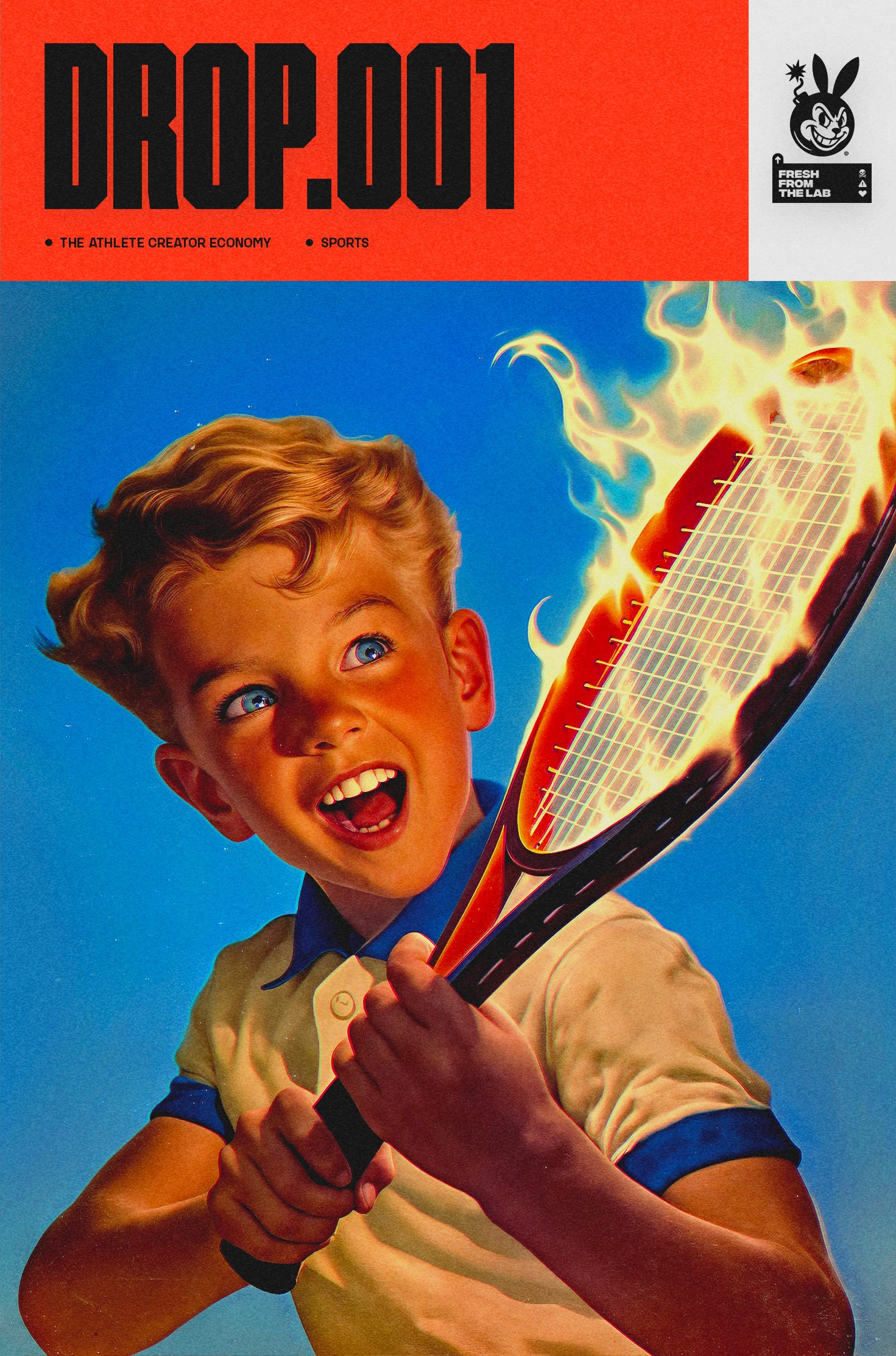
Athletes are no longer just talent inside the sports economy. They are creators, media companies, communities, distribution channels, and commerce engines. Yet the industry around them is still designed to monetize their image, time, and reach one deal at a time.
Sports has built sophisticated systems for media rights, sponsorship rights, licensing rights, and league rights. What it has not built is the infrastructure for creator rights. The ability for athletes to own the audience, IP, products, data, and businesses their influence makes possible.
This is the Athlete Creator Economy.
What follows is the blueprint for building it.
Note: 8,500 words incoming. It's not for casual readers. We tested shorter formats but the ideas kept escaping containment. The 1% who complete it will become very dangerous.
Last season, Ja Morant created two of the most viral NBA moments ever captured on camera. If you haven't experienced these 21 seconds of physics breaking down, fix that now, before we go any further:
Those two impossible plays generated 286 million views across every platform known to man.
So, what’s that worth, and who got paid?
First, let’s do some math. Brands pay $10-18 per thousand views to appear next to NBA highlights on Instagram and YouTube. (That's about double what normal content costs because sports fans watch ads.)
So Ja's 286 million views = $2.9-5.1 million in raw media value.
If you add earned media value, you’re looking at between $9-16 million in total economic value across two plays.
That $16 million flowed exactly where it always flows. Platforms kept their ad revenue, the NBA sold more League Pass subscriptions, the Grizzlies moved more tickets, House of Highlights built their following, and ESPN turned it into 17 different segments.
Everyone ate but the chef.
This is how sports economics works. Athletes create 100% of the value. Everyone else captures 90% of the money.
And this isn't an edge case. It’s the entire business model.
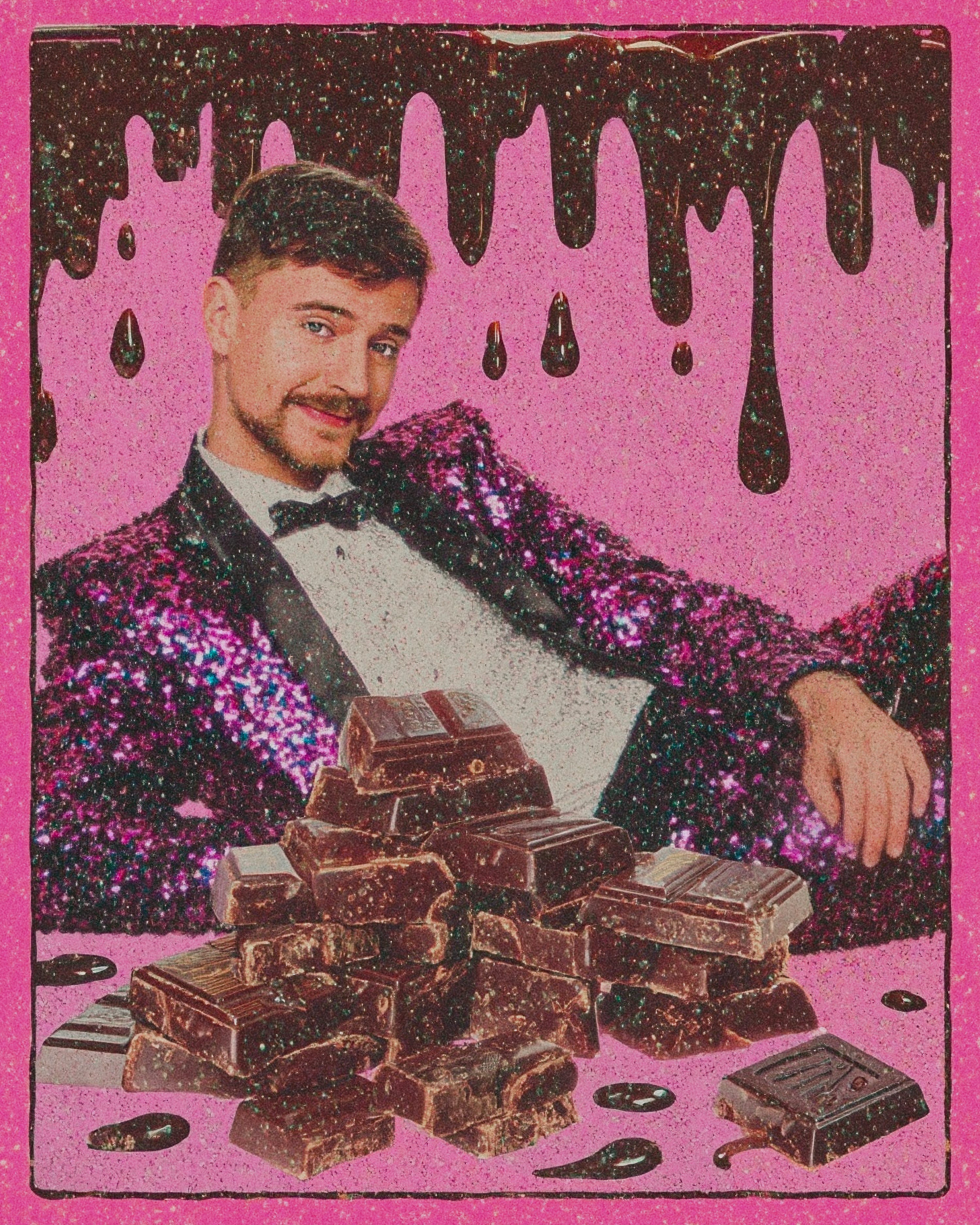
Here's what should piss you off about Ja's story: This problem has been solved. Just not in sports.
Five years ago, creators faced the same issue. They'd generate millions of views but capture barely any of the value. Platforms kept most of the ad revenue, brands lowballed them on sponsorships, and going viral usually meant watching everyone else get rich off your work.
Then the infrastructure changed. Stripe made accepting payments online easy. Shopify built stores on top of it. Patreon enabled memberships. Kajabi made selling courses as easy as posting videos. And email platforms like ConvertKit, Substack, and Beehiiv turned followers into owned audiences. Suddenly creators had tools to monetize directly.
Look what happened next.
MrBeast used YouTube to build an audience, then launched Feastables, and is now doing $250 million annually selling chocolate. Emma Chamberlain turned coffee content into Chamberlain Coffee in every Target. The NELK Boys built Full Send into a $70 million merch empire. Ashley Alexander posted matcha content while quietly building 50,000 email subscribers, and when she launched Nami Matcha, she sold out to her list before even going public. Even TikToker Miss Excel turned spreadsheet tutorials into $2 million a year in paid courses.
They all followed the same playbook: Build audience on platforms, convert followers to owned contacts, sell directly. The platforms gave them reach. But email lists, communities, and SMS subscribers, that's what gave them wealth.
What makes me crazy is that athletes generate more valuable content than any of these creators. Sports content commands 50% higher CPMs1 because athletes have the most devoted audiences on the internet. And those fans engage at rates that other creators dream about.
So why can’t they just copy the creator playbook?
Part of it's awareness. But the bigger problem is infrastructure. The systems that freed creators don't work for athletes. Creators own their content, and athletes don't. Creators can sell whatever they want, and athletes have contracts restricting everything from merchandise to sponsorships. Creators built direct relationships, and athletes' fan relationships flow through teams and platforms.
Before I show you how to fix this, you need to understand exactly how the value disappears.
By every measure, athletes create the most valuable content on earth. Yet they keep less than 10% of the value they generate.
So where does the other 90% go?
Picture a machine where athletes pour in everything they produce. Highlights, cultural moments, superfan devotion. The machine's supposed to turn that into money for them, but there are three massive holes where value leaks out.
Watch how the money vanishes.
Athletes create the moments. Media companies own the moments.
Think about all the content an athlete generates. Not just game highlights, everything. The tunnel walks that become fashion moments. The celebrations that turn into memes. The press conferences that fuel a week of hot takes. Athletes create thousands of hours of content every season, and most of it is given away for free.
House of Highlights monetizes their best plays. First Take monetizes their controversies. The Ringer monetizes their narratives. League Fits monetizes their fashion. ESPN makes $4.4 billion2 annually packaging their stories into programming.
Athletes are the world's best marketers for products they don't own.
When fans drop $150 on a Giannis jersey, he splits the money with every player in the league. The MVP gets the same cut as the guy who plays garbage time. Think about how insane that is, because it gets worse.
Remember when Kyrie Irving hit that impossible left-handed hook shot to beat Denver last year? He could've dropped commemorative merch that week and made a fortune. Instead, bootleggers on Instagram made money selling t-shirts of Kyrie’s moment, while he got nothing. Or when Shohei Ohtani wore a t-shirt his friend made featuring him and his dog, Decoy? Fans desperately wanted it. But Ohtani can't sell it. Someone else is, though.
Athletes constantly create demand they can't capture. They wear a chain, it becomes a trend, someone else sells it. They debut a headband style, someone else profits. They're running the world's most effective marketing campaigns for free.
Athletes have the most devoted fans on Earth, but let everyone else monetize them.
Sports fandom is religious devotion. People schedule their lives around games, name kids after players, and tattoo jersey numbers on their bodies.
Who captures that devotion? Well, teams run the fan clubs. Leagues control the access. Fanatics monopolizes the merch. Everyone makes money from superfan culture except the athletes that fans actually worship.
Meanwhile, look at other industries. K-pop stars run fan clubs that generate millions. OnlyFans creators build subscription empires. Twitch streamers sell exclusive Discord access. Every other creator vertical figured out direct fan monetization. Athletes just watch their most devoted customers pay everyone else for access.
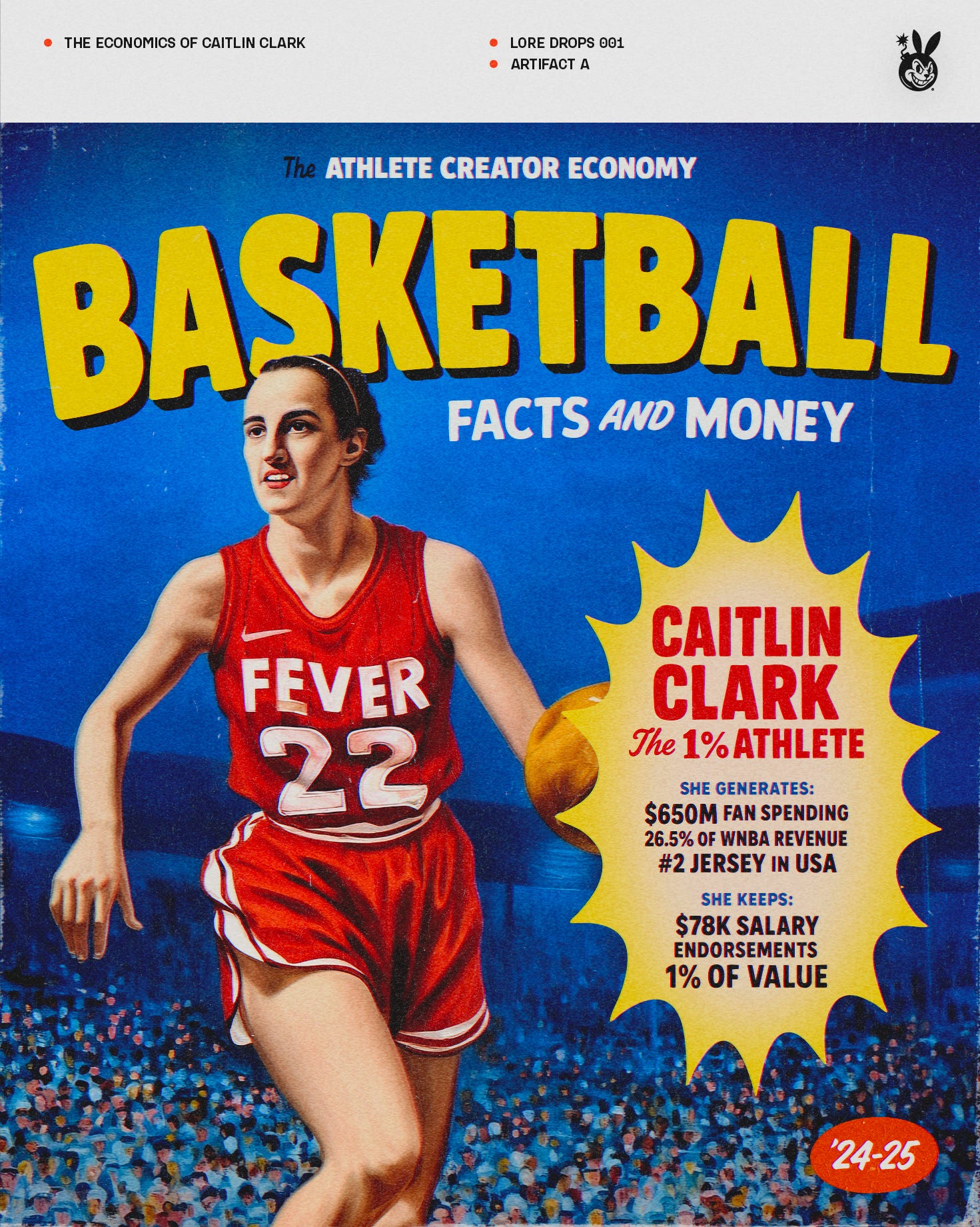
These three value leaks compound into shocking economics, and no one proves it better than Caitlin Clark.
In her rookie season, she drove somewhere between $650-900 million in total economic value. Or about 26.5% of all WNBA economic activity. Her jerseys outsold every NBA player except Steph Curry. A single rookie card sold for $234,850. Tickets to see her play resold at 140% markups. And the Indiana Fever went from 4,000 to 17,000 fans per game. Even her road games forced teams to move to bigger arenas.
Clark herself? She made $78,000 in salary plus maybe $4-5 million in endorsements.
Less than 1% of the value she created.
Her agent told ESPN it's "not possible" to pay Clark what she's actually worth to the league.
That’s the machine working exactly as designed.
So how do athletes escape this broken system?
They build a parallel one. A new economic model that sits on top of the traditional sports infrastructure.
I call it the Athlete Creator Economy: a system where athletes use creator infrastructure (direct fan relationships, owned content, digital products, community monetization) to capture the value they generate instead of letting it leak through the machine.
The creator economy proved that talent can own their audience relationships and monetize directly. The athlete creator economy applies this same principle to sports.
Here’s what the playbook looks like:
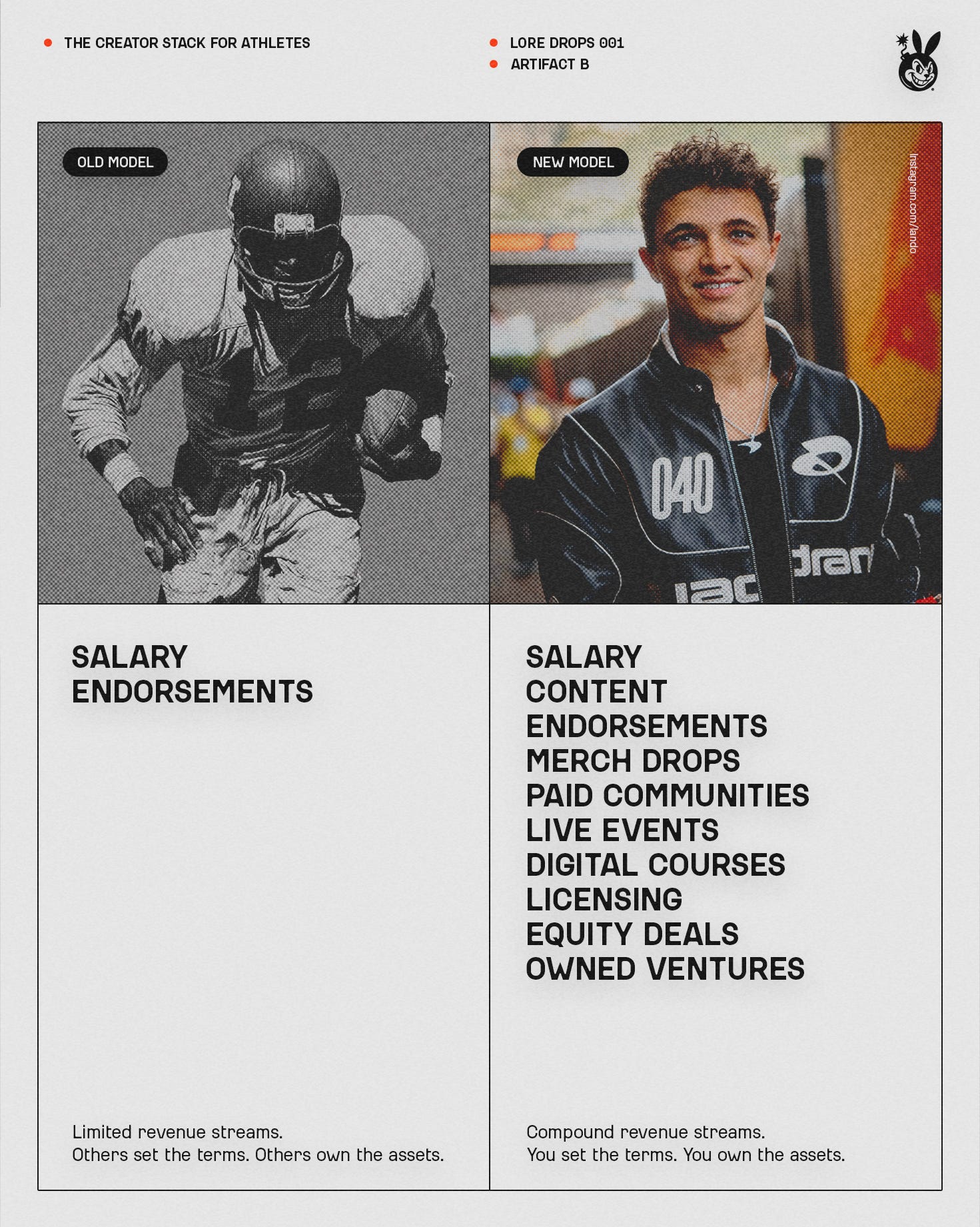
The old model gave athletes two revenue streams, both controlled by others, both ending with their career.
The new model stacks creator economy tactics on top of traditional income. Athletes keep their salary and endorsements as the foundation. Then they add what creators have been doing for years. Email lists they actually own. Exclusive merch drops. Courses teaching their craft. Paid communities. Equity stakes instead of just cash.
Unlike salaries, these assets compound. Email lists grow from 10,000 to 100,000. Communities become more valuable as they scale. And when athletes retire, these businesses keep generating revenue.
The new playbook sounds nice in theory. But does it actually work?
I've studied what's possible across every business model athletes can build. The math varies by approach, but one thing stays consistent: The opportunity is massive at every level.
Here are the four models that work best.
Athletes spend decades mastering their craft. That knowledge is worth more than they realize.
Let me show you how this works at the highest level. LeBron has 159 million Instagram followers. But remember, that’s an audience, not a business. The first step is converting them to an email list he owns.
He could start with a free video in exchange for an email. "5 Fundamentals That Made Me Unstoppable.” Even a 1% conversion would give him 1.6 million contacts. Now he has direct access to his most interested fans.
From there, the course model kicks in. Launch a $99 program teaching training methods, leadership principles, and mindset frameworks. With just 2% of that email list buying, that's $3.2 million. But that's just the beginning. Those buyers become the foundation for premium courses at $999, monthly masterclasses at $49, AI-powered coaching apps. By year five, this could generate $100 million annually from teaching basketball.
The beautiful part about this model is that it scales all the way down, even if you’re not the most famous basketball player ever. A Division II player with 15,000 local followers can launch a $99 training course, convert 500 kids and parents in their area, and make $49,500. That's more than most entry-level jobs pay.
The formula: Package what you know. Price it fairly. Sell directly to people who already follow you.
Courses are one-time purchases. Communities create recurring income that compounds monthly.
Let's build this example through someone like Puka Nacua, one of the NFL’s most exciting young wide receivers.
Puka's on a rookie contract worth about $1 million pre-tax. He's got 377K Instagram followers, but if you've ever seen him play, you know that he's basically Dani Rojas from Ted Lasso in real life. He makes football look like the most fun job on earth.
That’s the kind of energy that builds communities. People want to be around that.
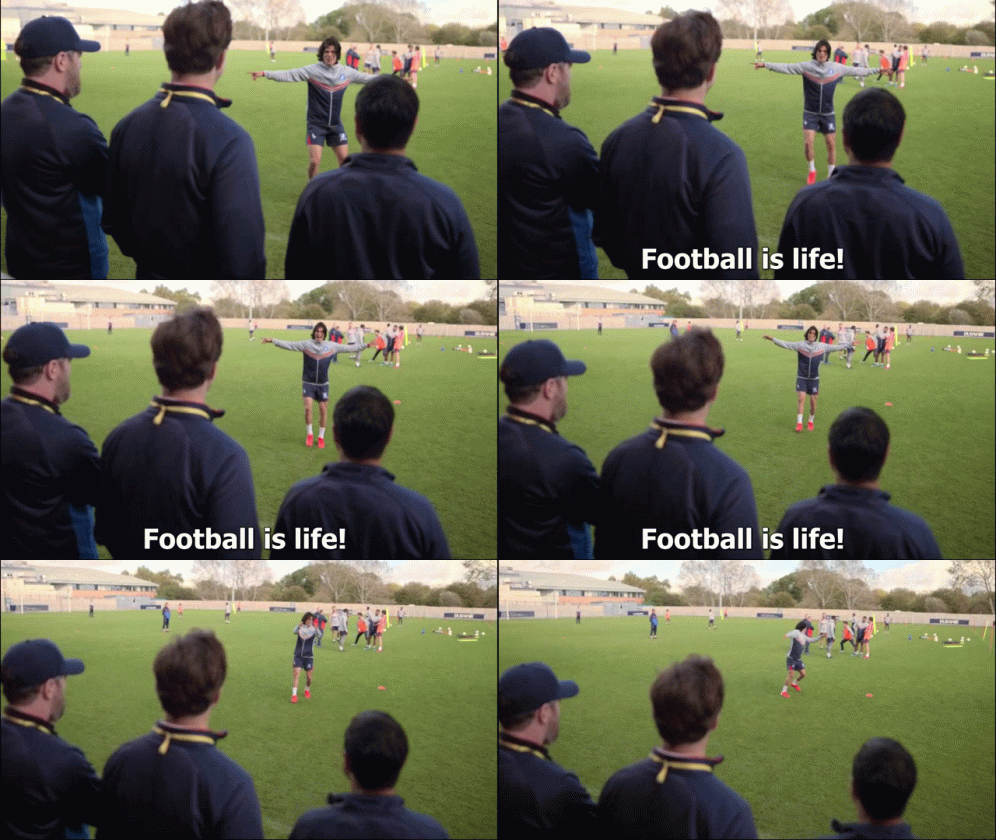
What if he launched a Discord community at $20/month? It could be built around morning motivation voice notes, film breakdowns for young players, community-designed touchdown celebrations, and voice chats after wins. If just 2% of his followers join, that's $1.5 million in year one. That's 50% more than his actual NFL salary.
And that's just year one. Like I said, communities compound. Members invite friends. Good vibes attract more good vibes. By year three, he could have 10,000 people paying $20 monthly. That's $2.4 million a year in predictable revenue.
Plus, community members spend differently than regular followers. They show up for everything. Every product launch, every event, every new venture gets their support first. If each member spends just $100 extra per year on Puka's ventures, that's another million annually. Add it up over five years? We're talking $15-20 million in total value.
Just like our first model, communities work at every level. An Olympic gymnast with 50K followers can launch a $15/month community for aspiring gymnasts. If they get 1,000 members? That's $180K annually from a sport that usually pays nothing.
The formula: Create exclusive access. Price it accessibly. Manage it well. Let the community compound.
Courses monetize knowledge. Communities monetize connection. But brand universes monetize identity itself.
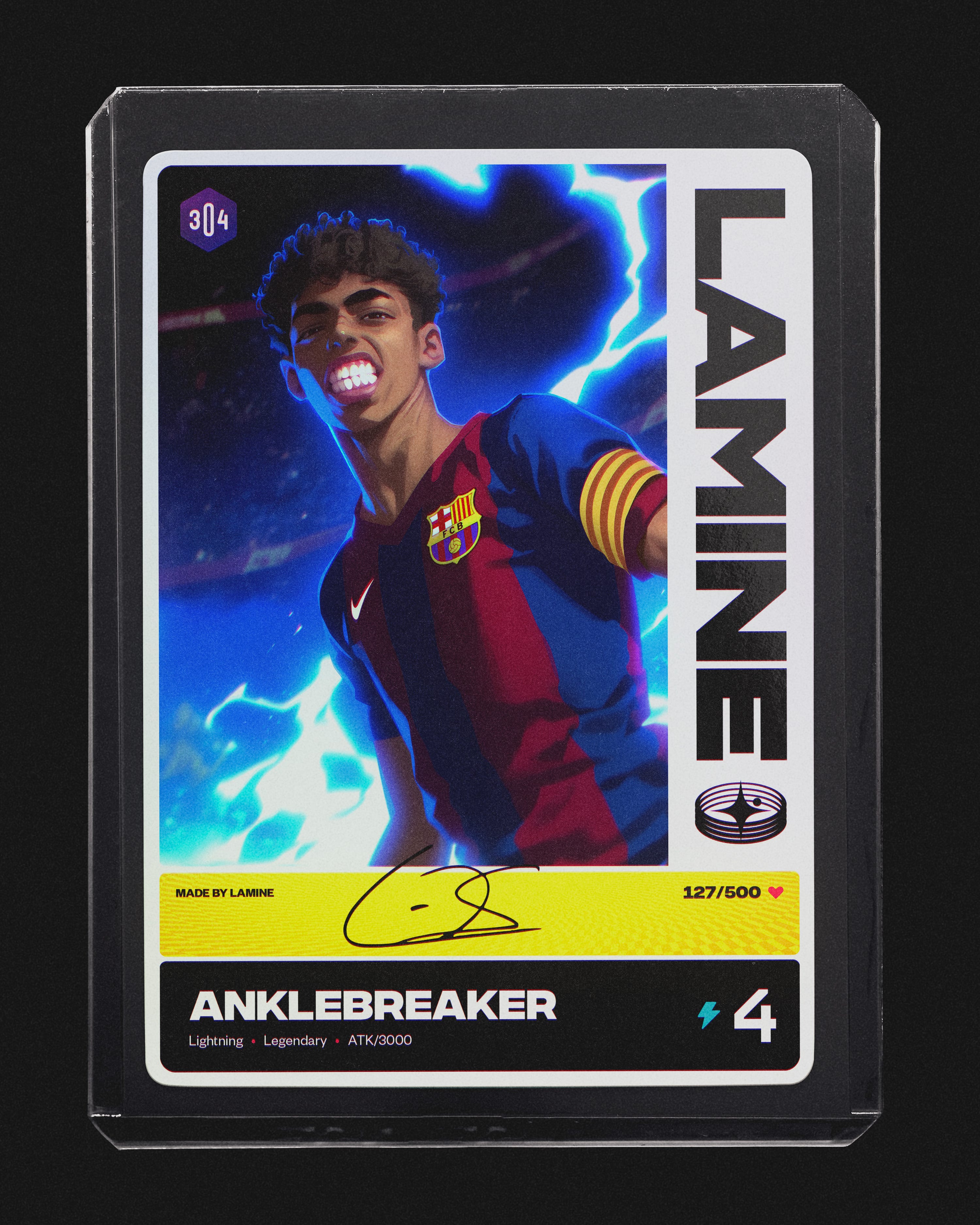
Let me show you what's possible through FC Barcelona’s Lamine Yamal.
Lamine's 17 years old with 66 million followers across Instagram and TikTok. He’s got an anime profile pic, and he’s culturally fluent in ways most athletes aren’t.
Right now Adidas pays him to wear boots. Standard athlete playbook. But what if he took the same approach as F1 driver Lando Norris?
On his personal site, Lando sells $245 disco ball helmets, gaming chairs, and keychains shaped like milk cartons. He also built an entire lifestyle brand called Quadrant that drops merch, collaborates with creators, and generates millions in revenue beyond his racing salary.
Yamal could destroy that blueprint. First, he'd need to be smart about his Adidas deal, carving out lifestyle merch, accessories, and anything that's not pure performance gear.
Then he could build his own universe. You know his signature 304 celebration?
This becomes the entry point to everything. He could partner with local artists and create a mythology where football meets anime, with Barcelona's streets becoming the backdrop for a story only he could tell. They could drop manga-style jerseys that look nothing like what Adidas would ever approve. A trading card game where fans collect moments from his journey. Gaming peripherals designed for the flick shots he learned playing Fortnite at 4AM. Jewelry that unlocks animated episodes about his rise. Every product connects to tell one massive story.
Lamine has 66 million followers ready to buy into whatever he creates.
The math at this scale breaks brains. One $75 hoodie drop to that many followers? Even 0.01% conversion = $495K. Get to 0.1% with the right hype? $4.95 million. From one drop. Do that monthly with different themes? $60 million annually. Add accessories, digital products, experiences? We're talking $100 million per year in direct-to-fan revenue.
Before Barcelona pays him. Before Adidas. Before any traditional deal. Just him and his audience and the value flowing directly between them.
The formula: Build a world around your personality. Create content and products that let fans live in it. Drop consistently to keep the universe expanding.
Not every athlete needs to pick just one approach. The real magic happens when you combine them.
This works especially well for niche sports that don't get primetime coverage or million-dollar contracts. Take an Olympic pole vaulter with 80K followers. Not enough for massive merch drops, but perfect for stacking revenue streams.
They could start simple. Partner with a local artist to create 100 prints celebrating their Olympic moment. Price them at $200 each, and that's $20K right there. Then get creative with products only pole vaulters need. Maybe custom chalk bags with their country's flag or specialized grip tape. Small batches mean high margins and everything sells out.
Pole vaulters have knowledge too. They understand physics, biomechanics, and training methods that took years to master. Package that into a course for track nerds who eat this stuff up, price it at $49, sell it to 500 people, and that's another $24,500.
From there, build deeper connections. A monthly community where they do Zoom calls with youth clubs around the world. Even just 300 young vaulters at $10/month becomes $36K annually. Hell, stream themselves playing track & field Roblox games on Twitch. The audience won't be huge, but pole vault fans are loyal, and they’ll show up for everything.
Add it all up, and suddenly they're making $100K+ from pole vaulting, a sport that usually pays nothing unless you're literally the best in the world.
The formula: Start with one model. Add others as you grow. Let them reinforce each other.
Every model works, and every level of athlete can build using the creator stack. LeBron could generate $100 million a year from emails and courses. Puka could out-earn his salary from Discord. Yamal could build a bigger business than his football contract. The Olympic athlete could turn their niche into a six-figure income.
So what's stopping athletes from building?
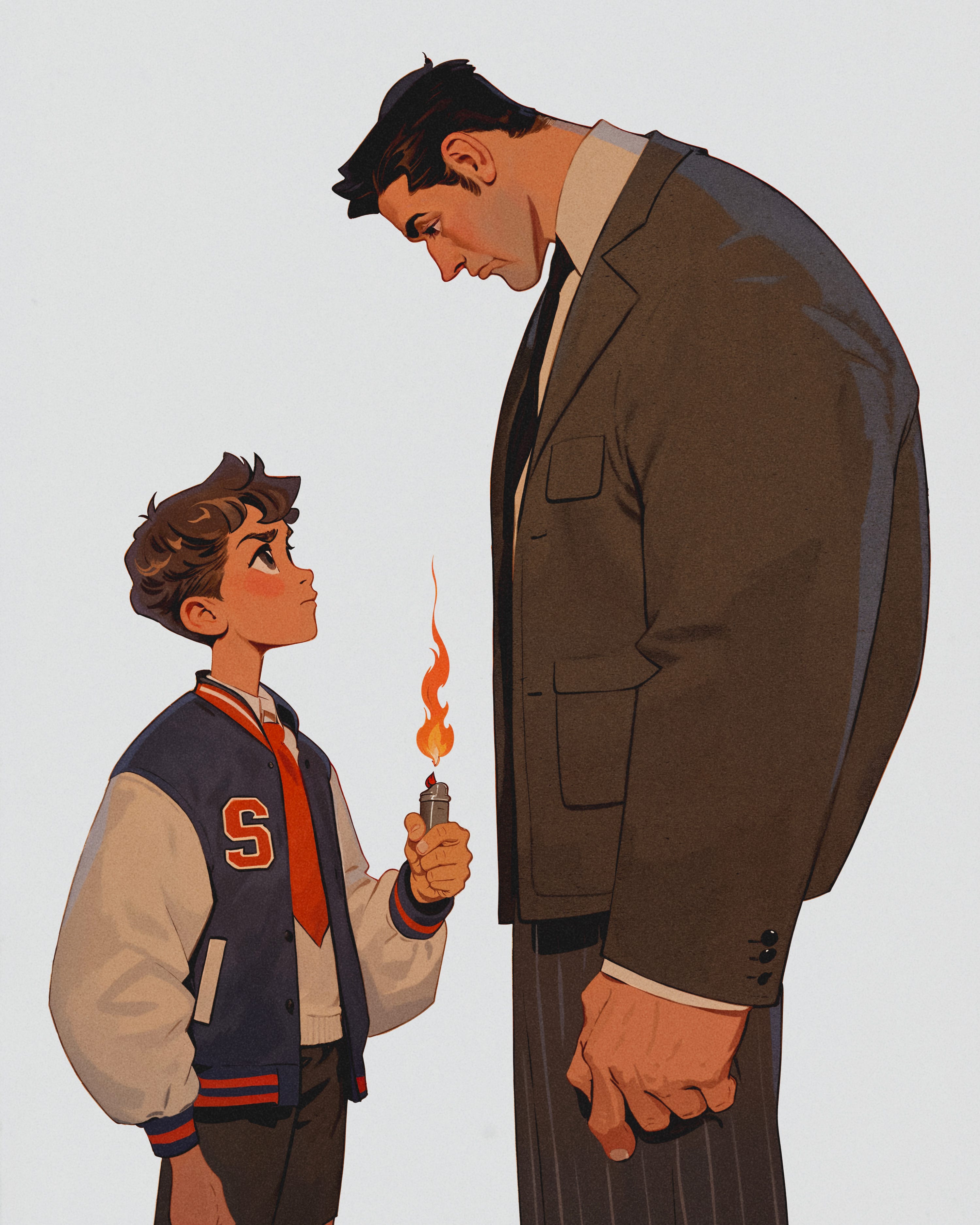
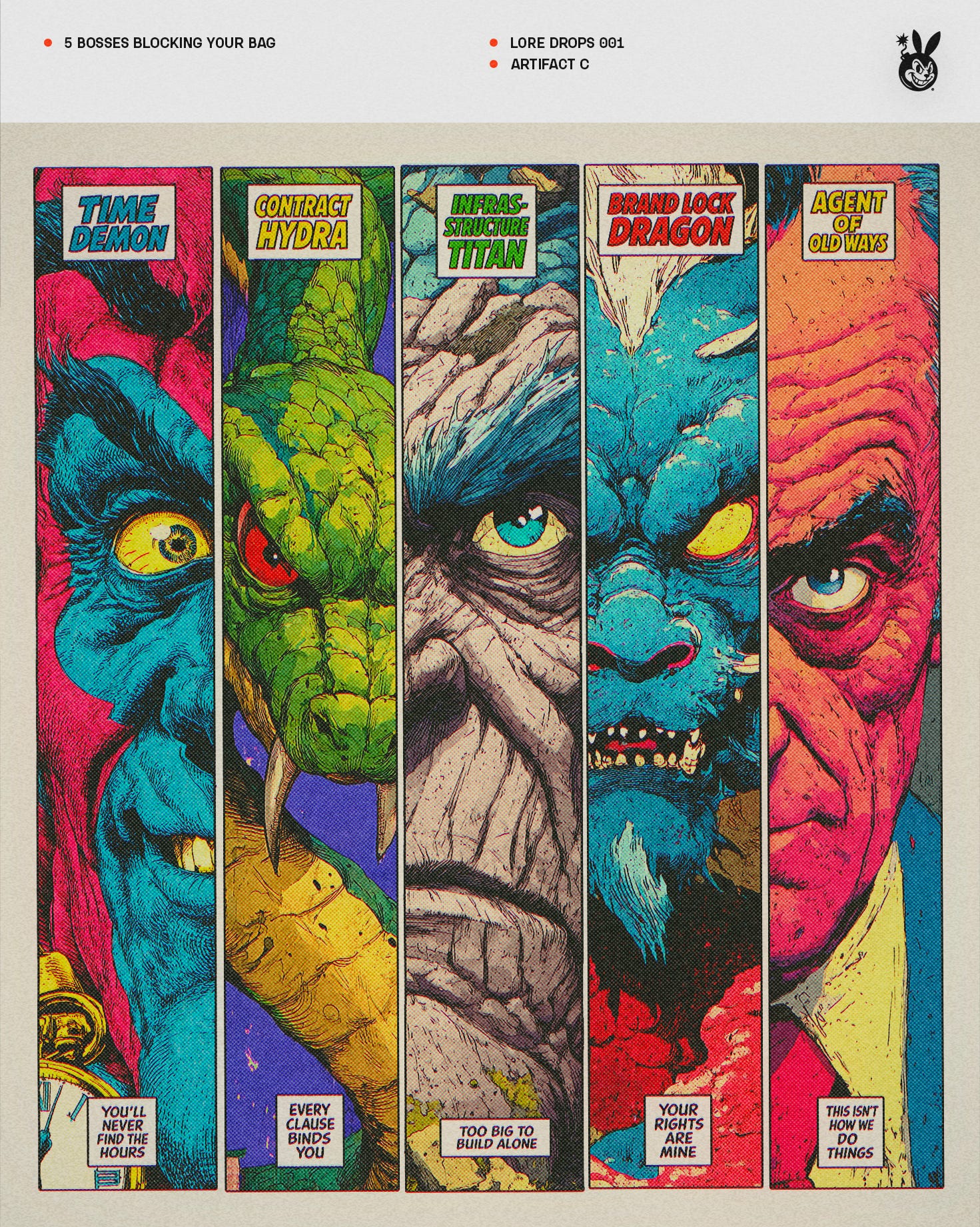
I’ve found that five structural barriers trap athletes in the old model. But each one has workarounds. Let’s get into it.
The first one's a mindset problem.
Athletes think creating content means adding work to their schedule. Between 6-hour practices, film study, travel, and recovery, when exactly are they supposed to become YouTubers?
But here's what they're missing: They're already creating content every single day. They just aren't capturing it.
That morning workout? That's content. The pre-game warmup routine? That's a training program kids would pay for. Film study sessions? Young players desperately want to hear how pros break down tape. Recovery routines? Injured athletes need exactly that knowledge. The music they're listening to before games? That's a Spotify playlist fans would follow. Those three hours playing Call of Duty after practice? Could be a Twitch stream building an audience.
Every routine that got them to the pros is content someone wants.
The solution is batch creation. Once a month, block out four hours. Film five training clips, five story times, five behind-the-scenes moments, five fan Q&As. That's 20 pieces of content in one session. Have someone cut it all up and post daily. One afternoon becomes a month of audience building.
And if you don't want to do all of that, just hit record during your regular life. Here's Jerami Grant making ramen on his TikTok burner account:
Athletes don't need more time. They just need to hit record on the time they're already spending.
Most athletes have never read their contracts, and they definitely haven't mapped what's possible within them.
"Can't sell team jerseys" doesn't mean you can't sell hoodies for your personal brand. "Team owns game footage" is about what happens in the arena, not about your 5am grind sessions, your driveway basketball with your nephew, or you teaching your grandmother your signature move. "Exclusive beverage deal" means drinks, not supplements or snacks. "League owns your image in uniform" doesn't mean they own their image period. What about your image as a comic book character? As a video game skin? Your silhouette as a logo? Those are all yours.
The truth is, every contract has gaps wide enough to drive a Cybertruck through.
The solution is mapping the gaps and working with consultants and counsel who understand both the old world of sports contracts and the new world of the athlete creator economy.
Building a creator business means building systems. Email capture, content production, community management, customer service, fulfillment. Most athletes look at this list and think "fuck that, I have practice at 6am."
But think about this: Building those systems is someone's dream job. Right now there are brilliant operators designing apps for brands that don't deserve them. Creative directors wasting talent on forgettable campaigns. Successful creators looking to teach what they've learned. They're all searching for something meaningful to build.
The athletes who crack this bring in partners, not employees. They structure it like tech startups. The athlete keeps majority control, the operator who runs everything gets serious equity (usually 15-25% vesting over time), and they save equity for other key roles as they grow. Everyone becomes an owner.
Of course, that's the ideal scenario for established athletes. Emerging athletes can start simpler. Partner with hungry creators who need portfolio pieces, use virtual assistants for basic tasks, and lean on tools like Grandstand, Stan Store or Beacons that handle infrastructure. The point is the same: don't try to do it all yourself.
Athletes get hypnotized by big brand validation. Nike wants to pay them to wear their shoes? Incredible. That’s the childhood dream.
But here's what that deal actually means: Nike gets exclusive rights to apparel. You can't create your own hoodies. You can't drop t-shirts with your name on them. You can't sell the basic merch that every creator uses to build their business. Even if you just want to make simple gear for your fans, you need Nike's permission. The Swoosh Gods must be consulted.
The new playbook is portfolio thinking, not paycheck thinking. Take the big brand money but carve out lifestyle categories. Or work with smaller brands that give you equity instead of just cash. Keep categories open for your own ventures. If Nike has athletic wear, build in wellness. If Gatorade has drinks, launch snacks.
Jason Day figured this out. He walked away from $10 million a year with Nike for equity in Malbon Golf. His Masters outfits generated 3 billion impressions in two days. Those impressions built value for a company he actually owns.
Sports agencies typically take 3-5% of your playing contract and 10-20% of endorsement deals. That's their entire business model. Creator businesses? They get zero percent. So why would they help you build one?
Traditional agents are dealmakers, not business builders. They know how to negotiate with Hotels.com, not how to launch a Shopify store. They can get you in a commercial, not build a YouTube strategy. Their whole operation runs on one-time transactions.
The workaround? Don't wait for your agent to evolve. Build around them. Keep them for what they're good at (contract negotiations, brand deals, the traditional stuff). But for creator businesses, go direct. Find advisors who've actually built what you want to build. Join communities where creators share playbooks. Learn from athletes who've already done it.
Some agencies are starting to build creator divisions, hire digital strategists, and take equity in athlete ventures instead of just commissions. But most are still playing the old game.
Until agencies catch up, athletes have to build their own brain trust.
Stop. Before I drag you through another 1,000 words about sports infrastructure, we need to talk about what just happened in women's basketball.
Angel Reese has been putting up video game rebounding numbers this season. 13.1 per game. Historic shit. But because the internet is undefeated at finding new ways to hate, trolls started tracking how many were off her own misses. They called them "Mebounds" - as in, rebounds that only exist because she missed the shot in the first place.
Most athletes would've ignored it or gone on some corny "haters motivate me" rant.
Reese did none of that.
She trademarked the insult, and then dropped a merch line with one of the coldest taglines in sports: "Anything that comes off that board, it's mine." Every hoodie sold sends money straight to her foundation fighting cyberbullying. The trolls who created the insult are now funding its destruction.
"Whoever came up with the 'mebounds' thing, y'all ate that up," she posted on TikTok. "And a brand? That's six figures right there."
She did all of this with a trademark lawyer and TikTok. Insult to income in literally 3-4 weeks.
Okay, back to our regularly scheduled programming...
So we've got athletes ready to build, workarounds for every roadblock, and proven models that print money. Some athletes will find their own operators and build teams, but that's individual solutions to a systemic problem.
The entire sports ecosystem still runs on infrastructure built for the broadcast era. Athletes need studios to create content, platforms to sell products, data on their audiences, and funding for their ventures.
The gap between what exists and what athletes need is massive.
This is a $100 billion opportunity waiting to be built.
Here's how leagues, teams, agents, media companies, and brands can get in the game.
Leagues have the infrastructure to turn every athlete into a media empire. They just haven't flipped the switch.
Right now, athletes get basic highlight-sharing tools through services like Greenfly. Meanwhile, leagues sit on the most sophisticated sports capture technology ever built. Arenas are literally wired with 4K cameras from 30 angles, and motion capture systems that track every biomechanical detail. They have petabytes of data about what makes athletes special, and athletes can't touch any of it.
The immediate opportunity is obvious. Give athletes AI-powered clip editing that pulls their best moments across multiple angles. Let them easily voiceover their own commentary, create memes, and turn highlights into any visual style they want. The NBA app already has multiview and AI "Dunk Scores." That should be table stakes, not innovation.
Motion data is the next frontier. Every play generates a complete 3D capture of how athletes move. Imagine AI that can predict injury risk from movement patterns, design personalized training programs that adapt in real-time, or create virtual athletes for fans to train alongside in AR. Athletes could license their biomechanical signatures for rehabilitation clinics, gaming studios, training applications, or robotics companies studying human optimization. They'd own and monetize their physical genius the same way musicians own their sound.
Another untapped opportunity is Creator Residencies. Start with Jesser teaching athletes how to be great in front of a camera. Bring MrBeast's team to teach athletes viral video architecture. Have Rhett & Link run workshops on building decade-long audience relationships. Have the Nelk Boys explain how to turn content into commerce through drop culture. Get Game Theorists to break down how to turn sports moments into transmedia universes. Bring in Theo Von or Andrew Schulz to teach podcasting—how to tell stories, work a room, and make three hours feel like thirty minutes. Don’t do one-off seminars, though. Build actual creative partnerships. Have a creator spend a week with a team during training camp, or do monthly virtual sessions during the season. Athletes can learn content strategy while creators get unprecedented access. The content from these collaborations alone would be worth millions.
The venture side also needs complete reimagining. Current league bylaws prohibit investing in player businesses to avoid salary cap manipulation. Those rules predate the creator economy by four decades, though. Rewrite them. Create League Ventures that backs everything from YouTube channels to fashion brands. When a player wants to launch a new content franchise, fund it, provide production, take equity. When they build a training app, push it to 50 million league users overnight. When they start a fashion brand, activate pop-ups in six markets. When they need seed money for their creator business, write the check. The Warriors already connect players to Silicon Valley. Imagine if every team had a venture arm.
The first major league to combine world-class content creation, creator education, motion data monetization, and venture funding will unlock billions in new revenue streams.
For more niche leagues (pickleball, padel, lacrosse), make all of this your competitive edge. You can't match NBA salaries, but you can build the right media and business infrastructure from day one. Make it part of your league DNA before old rules lock you out.
When your players become cultural icons beyond sports, your team becomes culturally relevant beyond game days. And the infrastructure to enable this costs less than a backup center.
Think about what actually happens when players build media businesses. Maybe they're not leaving in free agency for 10% more money because they've got thriving ventures in your city. They're probably turning your team into a cultural brand that matters 365 days a year, not just during the season. Your media rights explode in value because you're not just selling games anymore. You're selling constant content from athletes who actually move culture. Prospects recruit themselves to join your ecosystem. Even your sponsorship deals get richer because brands want to be near this energy. Meanwhile, happy players play better. That's not philosophy, it's brain chemistry.
So, let’s talk infrastructure.
Major sports teams have the most underutilized real estate in media. Practice facilities worth tens or hundreds of millions sit empty every afternoon. When players want to create content (and increasingly, they do), they're hunting for studios across town while your facilities collect dust.
What if you transformed that dead space into creator infrastructure? Look at what Whalar Group built with their Lighthouse campus in LA: 24,000 square feet where the world's top creators collaborate. Now imagine that inside your facility. Production studios. Podcast booths. Gaming setups pre-wired for streaming. Photography studios. Edit suites. Bring in creators who've cracked the algorithm to do collaborations and residencies. When players need to launch something, they don't have to scramble for help or hire their barber's nephew who 'knows social.' They can just walk down the hall.
Beyond physical infrastructure, teams should become business accelerators. You can't invest in player ventures directly (salary cap rules again!). But you can provide everything else. Entrepreneur-in-Residence programs with operators who've built real companies. Warm intros to VCs who write checks. The boring infrastructure that kills most businesses: legal frameworks, tax optimization, fulfillment partnerships. Things no player thinks about until it's too late.
Every city has geographic superpowers. The Dodgers and Lakers have Hollywood. But Kansas City has Hallmark's content empire. Memphis has FedEx's logistics network. Detroit has automotive designers who understand manufacturing at scale. The Kroenke empire in Denver sits next to Boulder's startup ecosystem.
Teams already have partnerships with these companies. They're sponsors, suite holders, logo partners. But those relationships often stop at the team level. When your point guard wants to launch a product line, or when your center needs distribution for their podcast, or when your rookie wants to understand content strategy, you could be making those introductions. Local expertise plus athlete influence creates content, products, and ventures nobody else can replicate. The infrastructure for connection already exists. You just need to activate it.
One more thing nobody talks about: the mental load of balancing all this. Athletes managing creator businesses on top of athletic performance are navigating uncharted territory. Algorithm anxiety meets game-day pressure. Comment sections meet locker room dynamics. Teams have an opportunity to add creator-specific mental health support. Because pretending this tension doesn't exist won't make it disappear.
All in all, teams that think of themselves as platforms, not just employers, will own the next era. That simple mindset shift changes the whole game.
Over the next five years, the fastest-growing portion of athlete wealth will come from creator businesses. Your current business model is cooked.
Look at the trajectory I’ve laid out. The creator economy is coming for sports. Your clients are starting to notice. They see creators younger than them building generational wealth from audiences smaller than their Instagram following. They're going to start asking more questions you can't answer. "How do I monetize my content?" "Who can help me build a product line?" "Why does my agent only care about my brand deals?"
Here’s the deal. Endorsement pools are going to stay flat while creator revenues grow 50x. Worse, athletes who build real audiences won't need you to negotiate with brands anymore. You aren't just going to be missing out on creator revenue, you’re about to be disintermediated from your core business too. Either you evolve or you become irrelevant.
The agencies of the future will build ecosystems beyond just contract negotiation. Your sports division handles the deals. Your ventures division funds athlete businesses. Your digital team produces content. Your brand partnerships team goes beyond endorsements to equity deals. Different entities under one roof, all aligned around maximizing athlete value.
So transform your capabilities across the board. Add venture partners who've built eight-figure brands. Hire operators who understand subscription businesses and community monetization. Build production capabilities that rival media companies. When an athlete wants to launch a training platform, you have the CTO ready. When they envision a product line, you've got supply chain experts on speed dial. When they need a thriving community, you've got moderators who've built 100K-member groups.
Your new pitch should be "We'll handle everything. Contracts, content strategy, production, and company building. Over five years, we'll launch three ventures together. We bring the operators, the studios, the capital, the infrastructure. You bring the vision and the audience. We align incentives across everything we build." Athletes get empires built while they focus on their sport. You get a percentage of multiple revenue streams instead of a percentage of single transactions.
The agencies that go full-stack won't have to compete on commission anymore. They'll compete on capability.
Athletes are becoming their own media companies. You can either be their platform or their competition. There isn’t a middle ground.
Let's be honest about what's happening. Every athlete now has more distribution power than you had ten years ago. They don't need your cameras. They don't need your announcers. They don’t need you to break the news about their injury. And they sure as hell don't need your hot take machines. They're going to increasingly go direct to millions of fans, and keep 100% of the content and the revenue.
So stop thinking "we own sports content” and start thinking "we enable sports creators."
Here's what that actually looks like:
Build "Studio as a Service" infrastructure, so that athletes can book your studios, your crews, and your editors when they need them. Price it like any other service. They use what they need, pay for what they use. Don't do rights grabs or exclusivity. You're providing tools, not taking ownership.
Imagine ESPN building creator studios in every major market. Not just their Bristol headquarters. Full production facilities where athletes can book Studio 3 for their podcast. Edit bays for their YouTube channel. Graphics teams for their content packages. The same quality that produces SportsCenter, but distributed everywhere athletes actually live and work. That's the model. From centralized monopoly to distributed infrastructure built for the creator economy.
When you distribute the content created in these studios, split the money fairly. Not 90-10 in your favor because "that's how it's always been." They bring the audience, and you bring the platform, so split it down the middle. Or 60-40. Real partnerships reflect real value.
The smartest media companies can go even further. Start buying stakes in what athletes build. When a player's YouTube channel blows up or their podcast takes off, don't compete. Invest. Bring your infrastructure. Let them stay the face. Share the upside when it explodes. Pat McAfee kept ownership while ESPN wrote the check. That's the blueprint.
Media companies that become platforms for athlete creators will own the next generation of sports content.
Stop renting athletes. Start building with them.
Let me be honest with you. The next fifteen years will flip everything you know about brand building. AI and robotics are about to enable local manufacturing at a global scale. Dark factories will produce custom products on demand. Distribution will be instant and personalized. The institutions that controlled production and distribution for the last century will see their moats evaporate. Everything I've written here is about power moving from institutions to individuals. The internet started it, and AI will accelerate it.
In this new world, the only thing that matters is connection. Who can command attention? Who do people actually trust? Who can make someone stop scrolling and say "I want that"?
Athletes. Not your boardroom. Not your brand managers. Athletes who've spent their entire lives building devoted audiences.
Start by evolving what you're already doing.
You already pay athletes to wear your logo and post about your products. But that's renting their influence, not building with it. When your athlete has an idea for content, do you fund it and split ownership? When they want to tell stories about their journey, do you give them your production resources? Stop thinking "campaign" and start thinking "content studio." Stop thinking "sponsorship" and start thinking "co-investment." That YouTube series your athlete wants to create? Fund it, enable it, share in its success. The podcast where they break down game film with their dad who coached them? Your brand should be powering it, not passing because it doesn't fit your Q3 marketing calendar.
Next, push into territory that scares you.
Your athlete wants to launch a podcast that has nothing to do with your product? Good. Fund it anyway. They want to create a graphic novel about their journey? Your creative team should be helping bring it to life. They want to drop headbands that unlock exclusive training content? Your tech team should be building the infrastructure. The further from your core product, the better. Red Bull doesn't make content about energy drinks. They make content about energy.
Look what happens when brands actually get this. Mattel just made LeBron the first male athlete Ken doll. A 65-year-old toy company and the world's most famous basketball player built something together that neither could create alone. That's co-creation.
The best partnerships create products that make both sides say "we never could've imagined this without you."
Finally, become the infrastructure for what athletes build.
They are going to launch their own products. That's not a threat, it's your biggest opportunity. When your sponsored athlete wants to start a nutrition line, don't see competition, see partnership. Offer your supply chain, your regulatory knowledge, and your distribution network in exchange for equity. When they want to launch merch, provide your manufacturing relationships. When they need to scale, be their infrastructure layer.
The choice is simple: You can watch athletes build brands that compete with yours. Or you can power those brands and own a piece of everything they create. "Powered by Nike." "Enabled by Adidas." "Built with P&G." That's the model. You become the platform that makes athlete brands possible.
Everything we just covered is messy. Leagues investing in athlete businesses. Teams becoming creator studios. Agents transforming into venture builders. Media companies turning into platforms. Brands funding their own disruption. Everyone is partner and rival simultaneously.
But zoom out. Market corrections are always messy. Chaos is the transition plan.
The old model extracted value from athletes. The new model creates value with them.
The glow-up is real:
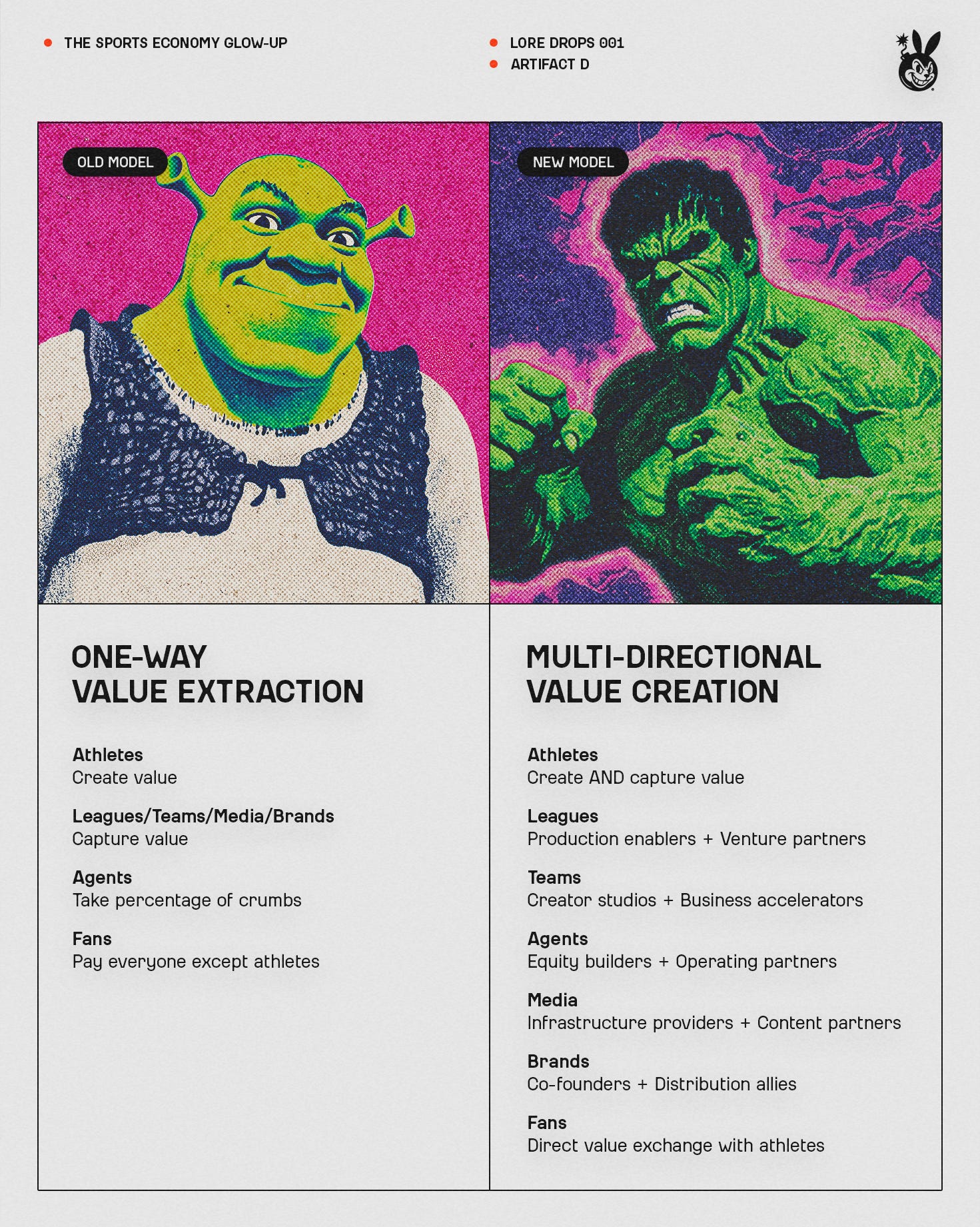
When new infrastructure gets built, new futures become possible. Here are three I’m betting on:
By 2030, some athlete will build a billion-dollar business with 10 employees and an army of AI. They'll stack every creator economy revenue stream imaginable. Their team will handle the strategy, creative direction, and actual community relationships. The AI handles scale across millions of transactions, global operations, and complexity no human team could manage.
The defining sports media network won't look anything like ESPN. It'll be athletes and creators who actually understand internet culture running everything. Expect to see athletes breaking down film with YouTubers who've memorized their moves since middle school. There will be players showing up to creator streams right after games, still sweating, explaining what the fuck just happened. There won't be any suits pretending to hate each other for ratings. Just pure, unfiltered sports content from people who love the game.
Ja hits another impossible layup at 9:47 PM. By 10:15, his AI has designed 50 merch variations and sent them to dark factories. There's no inventory or waiting, but there's instant creation of whatever fans imagine. Anime art on a hoodie, technical blueprints on a poster, street art on a jacket, whatever. The AI renders their exact vision while keeping Ja's visual DNA.
When this technology becomes standard, every sports moment becomes something you can wear, and the $400 billion sports merch market will explode to $2 trillion.
[End of Drop #001]
Still here? You beautiful psychopath.
Listen. You just consumed 8,500 words on building the future of sports that nobody asked for. That's 30 minutes of your finite existence. You could've watched an entire episode of something. Taken a walk. Had a real conversation with someone you love. Instead, you chose to do this. That's deranged. I respect it.
So tell me: You probably spotted something we missed. Some blindspot in our logic. Some opportunity we didn't map. Some friction point that's even worse than we documented. Tell me about it in the comments.
And if you’re an athlete, agent, operator, investor, or rogue builder who sees the same opportunity, we want to hear from you. Email or DM me on LinkedIn.
The revolution needs co-conspirators.
The Walt Disney Company, "Form 10-K Annual Report." 2023.
Comments
Nothing yet. Say the first thing.
Sign in to join the conversation.