
Thesis: GenAI is a platform shift
Key question#3: Is GenAI enabling new business models in the digital landscape?

When I started writing about GenAI, my goal was simple: to understand the role this technology could play in shaping the future of software products and to assess whether the value created by GenAI will reinforce incumbents' products and value propositions or create room for new challengers to drive the next wave of digitalization and redefine the competitive dynamics of the whole industry.
The first two articles laid the foundation by examining what defines a platform shift and investigating the dual nature of GenAI, which expands the range of programmable tasks while offering developers a new, more efficient platform for building software.
Now it is time to explore the second-order effects of this shift by assessing whether these new value creation mechanisms can challenge existing digital business models, weaken incumbents' moats, and create entirely new opportunities for innovation.
Jackie DiMonte from Grid Capital recently published a great essay on how GenAI is reshaping software’s role in solving customer problems. Her core thesis is simple: software applications are becoming polarized between platforms that enable customers to own the data and workflows, and services that fully outsource them. Everything in between, the tools that “operate” specific workflows without being a system of record, may struggle to survive.
This kind of polarization is being accelerated by GenAI. On one end, incumbent platforms can now ship “AI-native” features faster, deepening their control over workflows (and data) and expanding into adjacent tasks. On the other end, service providers (historically constrained by labor) are becoming more scalable and capital-efficient. GenAI reduces their reliance on humans, turning previously manual processes into software-driven workflows.
The result is a growing gap between those who own data and workflows, and those who depend on them. As GenAI amplifies both ends of the spectrum, the middle (the tools that merely assist) risks being squeezed out.
Software businesses in this middle tier must decide: Can they evolve into core platforms? Or should they pivot to an outsourced solution?
I think this perspective is valuable and distills many of the concerns VC investors are dealing with when assessing AI-native products. Let’s now drill down into the two extremes, exploring the business model implications for challengers and the competitive pressures they are likely to face.
Sell work, not software! That was one of the loudest VC mantras of 2024, fueled by the rise of a new class of “software service providers” that gained significant traction and media coverage over the past year.
This changes the software paradigm. Traditionally, we accessed tools (SaaS) to manage tasks ourselves. Now, with agents and LLMs, the task itself can be executed autonomously. Instead of software as a service, customers get services delivered through software. The application doesn’t just support the work, it performs it. And we are already seeing strong early examples of this in areas like legal, healthcare, recruiting, software engineering, and customer service.
A clear example from our portfolio is Insoore, which embraced this positioning early on. The company is redefining the insurance industry by using AI to deliver an end-to-end, software-centered, claim management service directly to insurance companies in Italy.
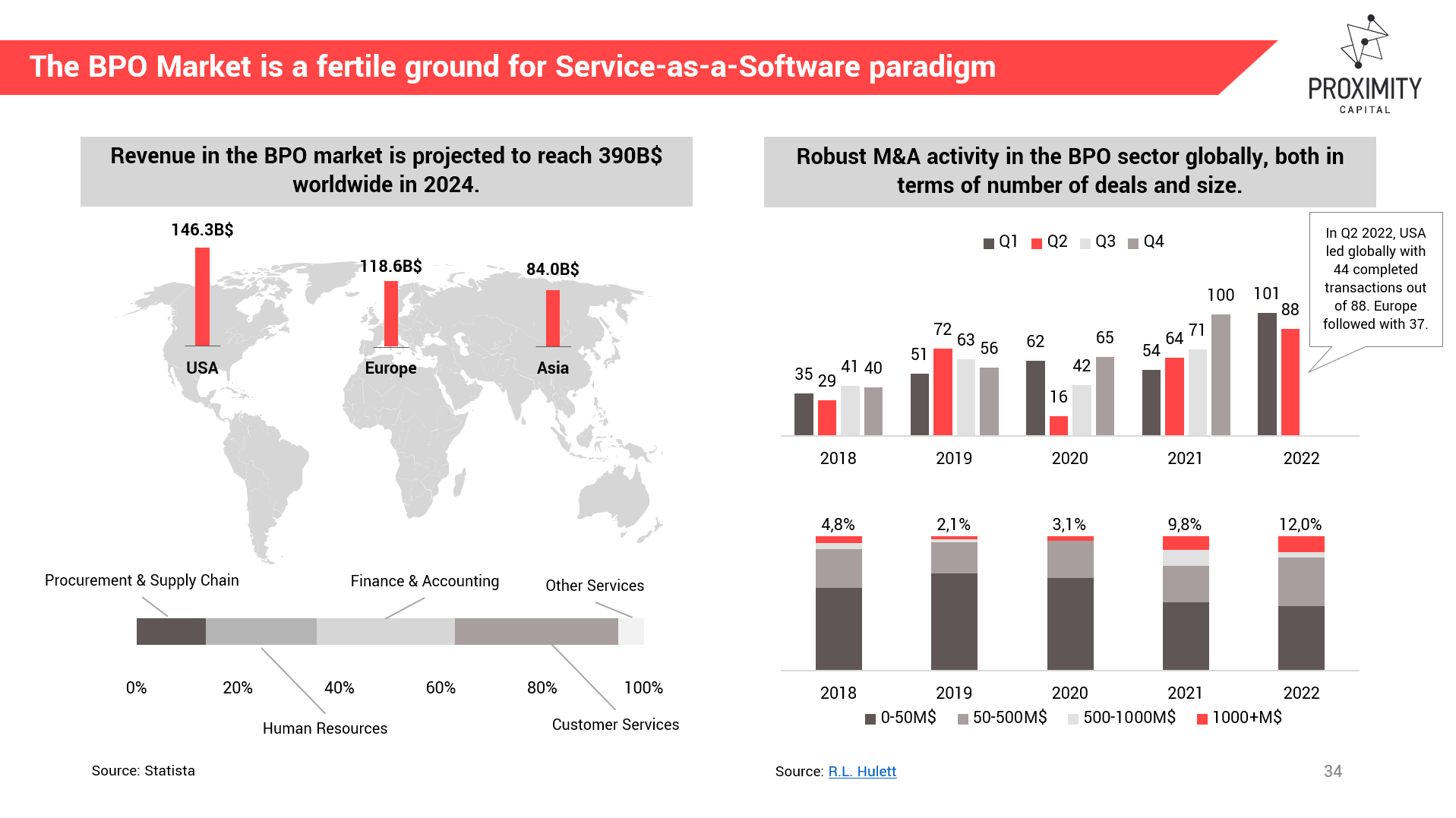
Put simply, Service-as-a-Software marks a new phase in the digitalization of labor: one where GenAI doesn’t just support human work, but increasingly takes it over. As knowledge tasks become software-executable, what we are seeing is software not just “eating the world,” but beginning to eat labor. What started as a 230B$ B2B SaaS industry is now expanding into a 5.5T$ labor market. This shift won’t happen overnight, but it began where the groundwork was already in place: services that are already outsourced to people today. That’s why the BPO industry has represented the most immediate entry point for this new category of AI-native products.
The new AI workforce, powered by agents and LLMs, is blurring the line between labor and software, expanding the addressable market of enterprise software while also pushing service margins closer to those of SaaS.
In this labor transition, we expect the historical margin gap between service businesses (below 30%) and SaaS businesses (above 80%) to shrink as AI services replace human-centric services enabled by SaaS tools. Service margins will become closer to software margins.
Service-as-a-Software business model is strategically interesting because it counter-positions itself against incumbent service providers. According to the 7 Powers framework, counter-positioning occurs when a new entrant adopts a business model that incumbents can’t easily copy without undermining their existing economics. In this case, AI-native service companies offer software-driven outcomes at lower cost and higher speed; something traditional, human-intensive firms struggle to replicate without cannibalizing their own revenue base or retraining their entire workforce.
But while this strategic asymmetry creates an opening, it also surfaces a critical question: how defensible is this model in the long run?
As David Peterson from Angular Ventures pointed out recently, many of these businesses, once digitalized, risk becoming victims of their own disruption in the long term. Once customers realize that GenAI is doing the heavy lifting, the perceived value of the service drops, and so does the price they are willing to pay.
The continued competitiveness of open source models suggests to me that most of “the work” itself will eventually become a near-commodity. If that’s the case, then the clearing price for that work will continue to fall. In that world, only business models that don’t rely on making money by selling that work will succeed.
This deflationary dynamic could replicate across every service sector being touched by AI, eroding margins for the winning startups. Unless companies build structural moats, they will find themselves in a race to the bottom.
The question remains open, and the concern is legitimate. But if we look at what drives perceived value when services are outsourced today, I believe the most promising moat for these kind of startups (especially in highly regulated sectors) may lie in one word: trust. And trust, in today’s enterprise software world, is increasingly a function of brand.
Brand isn’t just a communication layer, it’s a strategic asset. It signals quality, reliability, and alignment with the buyer’s values. It simplifies the decision process and reduces perceived risk, especially in a world where the product is invisible and the work is automated. In this new paradigm, to be chosen is to be trusted, and trust is increasingly brand-led.
At the opposite end of the spectrum from Service-as-a-Software, we find the “Own” case where companies don’t outsource the task, but instead rely on software platforms to manage core data and workflows internally. This has traditionally been the realm of systems of record: CRMs, ERPs, HCMs. These tools serve as infrastructure for business operations, allowing teams to control their processes rather than delegate them.
What’s changing now is that this model is being upgraded and a new wave of software is emerging. It doesn’t replace the classic software stack; it augments it, by adding an intelligence layer on top. As shown in the image above, this new layer sits above the traditional interface/business logic/database model and acts as a “co-pilot” or “agent” that automates workflows and executes tasks directly.
Sounds promising, right? But as Matt Brown pointed out: Beware what you wrap!
The drama with the emerging intelligence layer built on top of LLMs is that the startups developing it face two powerful forms of pressure that can quickly erode long-term defensibility.
First, AI wrappers risk being squeezed by LLMs. As foundational models get cheaper and more capable, the intelligence powering their product becomes a commodity. Taste and UI/UX can alleviate the agony, but wrapping API-available intelligence without a proprietary edge inevitably turns into a race to the bottom. The value starts shifting away from your application to the underlying model and with "vibe-coded" copycats multiplying fast, deflationary pricing dynamics are hard to avoid.
Second, they risk being eaten by incumbents who own the data. If your AI layer doesn’t own a System of Record (i.e. SoR), it becomes structurally weak. It can’t complete workflows, access real-time context, or deliver meaningful business outcomes without relying on someone else’s data. And in many verticals, that “someone else” is a full-stack Vertical SaaS or a SoR provider already distributed, and fully capable of launching an intelligence layer as a feature inside their platforms (think about Airtable Assistant, Notion AI, Agentforce by Salesforce). In this case, the startup product gets bundled into the incumbent’s one.
While adding intelligence on top of the stack unlocks new product possibilities, it also exposes startups to structural risks: commoditized intelligence on one side, and dominant incumbents on the other. In order to out-model OpenAI or out-bundle Salesforce, our hypothesis is that startups should turn data fragmentation from a liability into a moat. In many real-world scenarios, the data needed to execute a task isn’t confined to a single source of record but is fragmented across silos.
This fragmentation can happen across organizations, where executing a task (like coordinating a shipment or managing a deal) requires pulling in information from multiple stakeholders. Or it can happen within a single organization, where relevant data is spread across internal systems, tools, and database that don’t natively talk to each other.
Our thesis is that build intelligence layers on top of multiple SoRs or diverse data sources can help startups avoid the risk of being bundled by an incumbent. Instead of relying on a single platform, AI-native startups may target cross-silo workflows that inherently require interaction with multiple systems, departments, or organizations.
Athena, backed by Khosla Ventures, is a concrete example. It’s positioning itself as an AI executive assistant, but the real play is broader. To be effective, it must tap into calendars, emails, CRM records, project trackers, internal wikis, and more. This isn’t just a smart interface, it’s a system that navigates and orchestrates other systems. That cross-silo nature is what makes it defensible and difficult to replicate from within any one too.
This leads to a new architectural playbook we’ve started calling “System of Systems”. By operating above fragmented data and tooling, these products don’t just insert AI into workflows, they redefine how workflows themselves are structured. They create new software categories that adhere more tightly to the way organizations actually function, rather than how legacy software assumed they should, adapting alongside the business instead of forcing the business to adapt to them.
Moreover, this deep operational adherence also increases switching costs, creating an additional defensible moat. After all, why would you fire a high-performing employee who truly understands how your organization works?
In this context, the lakehouse paradigm becomes a natural tailwind and enabler for the System of Systems model. By decoupling storage from compute and standardizing access through open table formats, the lakehouse makes it technically feasible to build AI systems that operate across silos. Instead of relying on brittle integrations with individual tools, startups can orchestrate workflows on top of a shared, open data layer. This creates the foundation needed to accelerate reasoning over fragmented data, without centralizing it.
Over time, we do believe this SoS orchestration layer can further evolve into something even more powerful: a new kind of System of Record. Not one centered on a specific data object (like “customer” or “invoice”), but one centered on business processes themselves, coherently with how information flows, decisions are made, and tasks are executed across tools. In this sense, the lakehouse isn’t just infrastructure for analytics, it becomes the substrate for intelligent inference.
This third and final piece closes a journey that began with a simple question: is GenAI a platform shift?
At the end of this trittico, from the anatomy of platform shifts, to the redefinition of software development, and finally the emergence of new business models, one pattern seems to stand out: GenAI isn’t simply a faster engine or a better interface, but a new way of building, operating, and monetizing digital products.
We’ve seen how it expands the surface of what’s programmable, how it compresses labor into software workflows, and how it may create room for new categories like Service-as-a-Software and System of Systems products. In all these cases, GenAI doesn’t just automate, it reconfigures the rules of the game in the digital domain.
That said, the true shape of this shift will depend on more than technical capability: Competitive pressures and long-term defensibility will separate noise from signal. Intelligence alone won’t be enough and founders will need to build real moats to create companies that aren’t just smart, but embedded and irreplaceable.
Still, the macro-thesis holds: GenAI is a platform shift. And if that’s true, the application layer is wide open.
If you’re a founder building B2B products shaped by this shift, I’d love to hear from you: boldrini@proximitycapital.it
No posts
Comments
Nothing yet. Say the first thing.
Sign in to join the conversation.