
Greetings from a sunroom after dark thirty miles outside of Chicago. I’ll tell you more in a moment, but first I want to let you know that this newsletter will be getting more expansive. I’ll still talk about movies and music here, because how could I not? But I’d like to make it more of a venue for writing about whatever I’m interested in, which only seems to become broader and more random as I get older; lately I’ve spent time thinking about Rituel de Fille cosmetics, the fact that the Bible contains a bread recipe, dog grooming, Prefab Sprout, what it means to have a Midwestern temperament (because I think I do), and what rhubarb even is. Also, I’m neck deep in my third book and starting to realize I have some things to say about writing books that people might find useful.
If that all sounds good to you, there’s no need to do anything: you’re already subscribed, and most of the content will remain free. (But if you wanted to tell your friends, I won’t complain.)
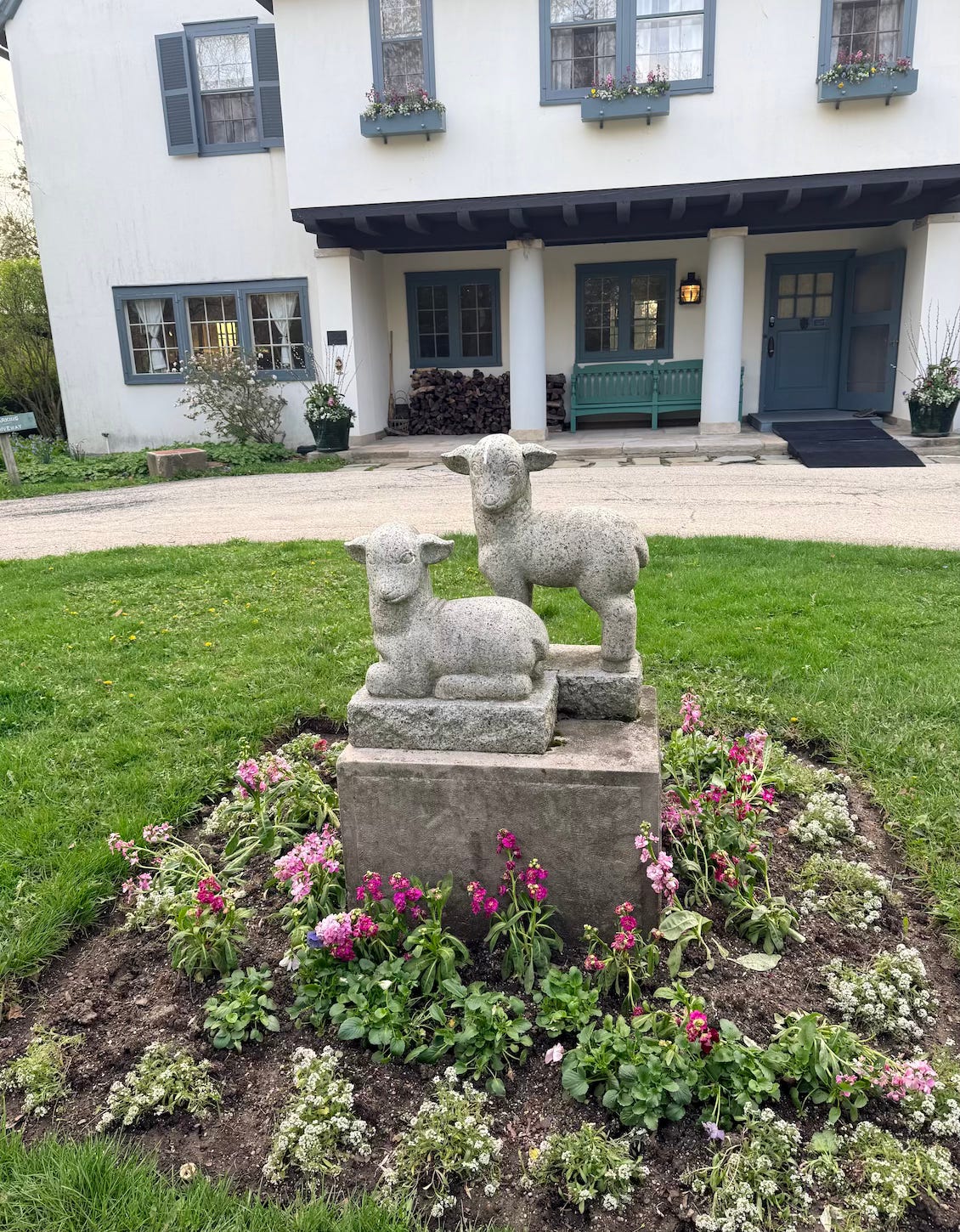
Okay, about the rhubarb. I’m thinking about it because I’m in the middle of three-week artists’ residency at the Ragdale Foundation in Lake Forest, Illinois (cinematic home of movies like Ordinary People and Home Alone), and one of the other residents is a dancer named Sana who now lives in Minneapolis like me, but was born and raised in Guinea. There was rhubarb sorbet at dinner last night, because there’s an alarming amount of rhubarb in the Ragdale garden at the moment. Sana had never encountered it before, and he turned to me and said “What is rhubarb?”
And I went: “Well, it’s…hmm. It’s like…I think it’s fruit, but it grows in stick form? Well, and it’s inedible.” Sana gave the bowl of sorbet a quick glance. “I mean you can make it edible,” I hastened to add. “I’m sure this is delicious! But you have to maybe stew it? Or something? And use an absolutely massive amount of sugar.”
“What do you mean, ‘stick form?’” Sana asked.
“Like celery,” I said. “Like dessert celery. Oh, and it’s pink.”
At that point he pulled out his phone, which is probably what I should have had him do in the first place. (Though honestly, he seemed kind of dubious about it even after googling.) I wish I could have been more helpful, but honestly, it was exciting just to have a conversation with another person, because for ten days I’ve done almost nothing but write, and I might be starting to get a little squirrely.
It’s a good kind of squirrely, though. The glory of a residency like this one is that your time is all your own. I have a live/work studio and a stocked kitchen I share with the four other artists in my building. At 6 pm each evening, all fifteen of us on the property meet up for a dinner prepared by Ragdale’s chef. And that’s the extent of the structure. When we applied, we all specified what we planned to work on here, but no one is checking up. At orientation, the executive director said “Invariably, if I cross paths with a resident on the grounds, they say ‘Oh, I was just on my way back to my desk!’ But I promise you: we don’t care.”
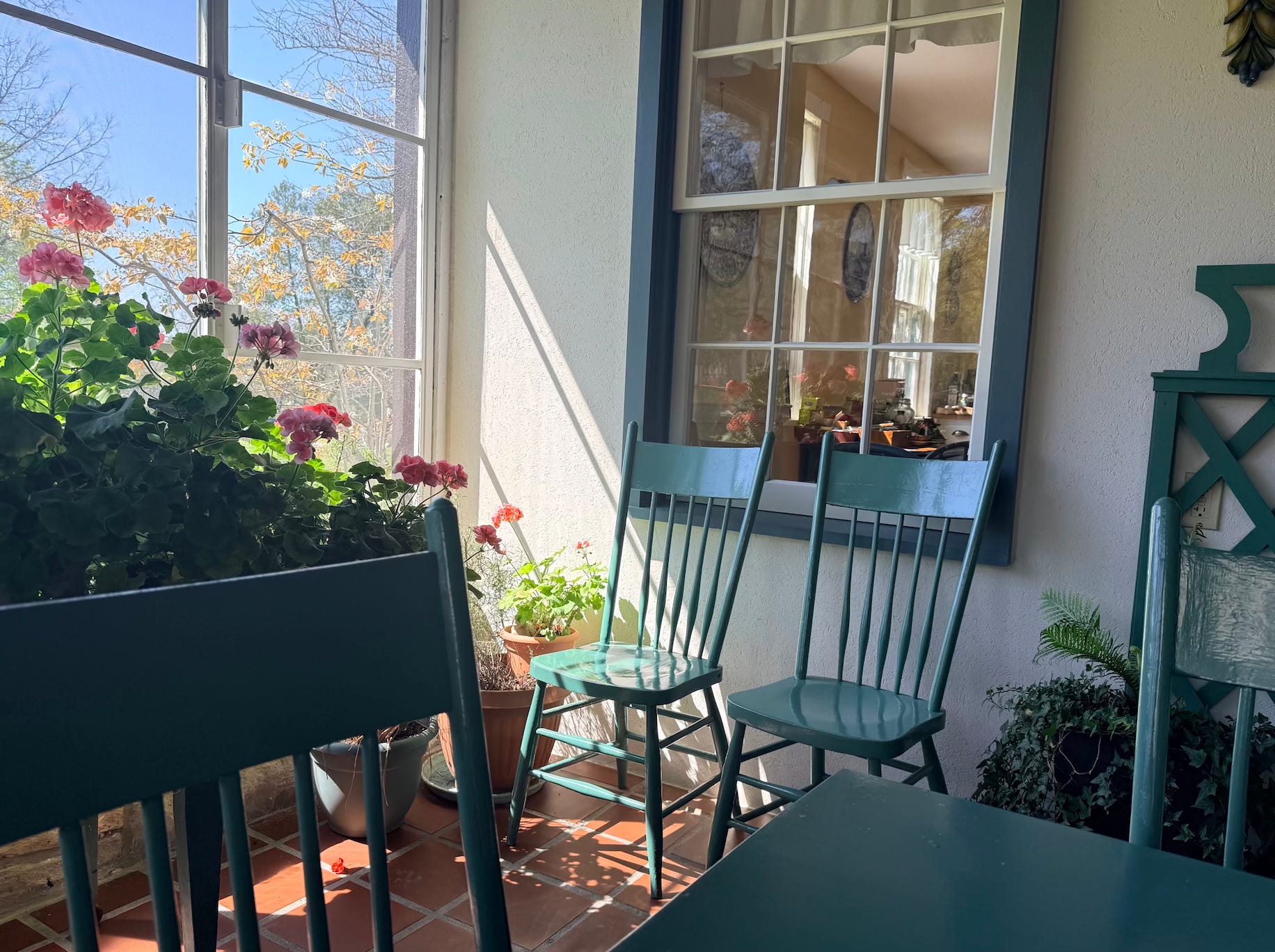
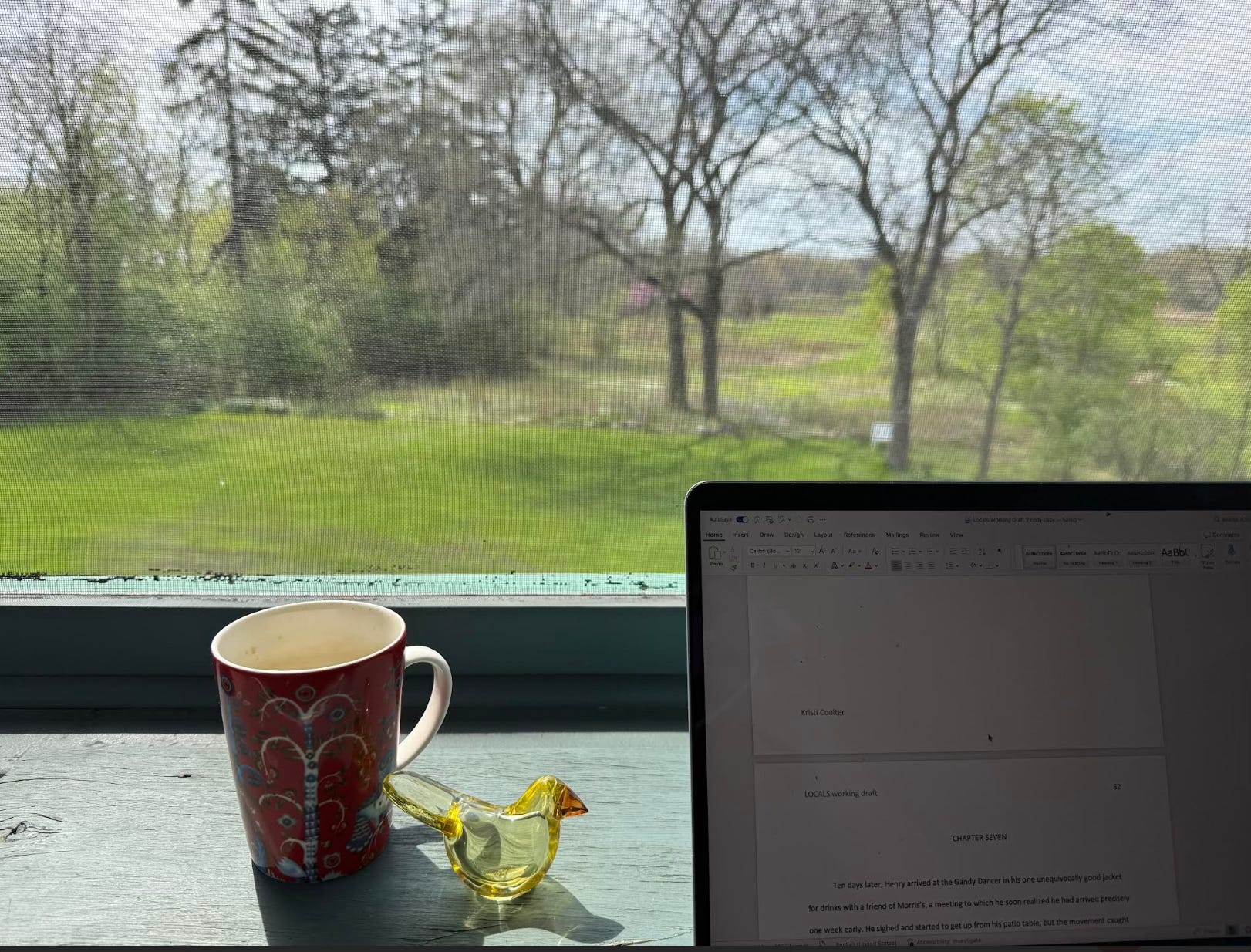
I love that. I love knowing I can go for a walk on the prairie, or drive into Chicago for the day, or lie around reading a book, and in Ragdale’s eyes it all counts as part of the artistic process. That said, I’ve pretty much been working my ass off since the day I arrived, because I’m eighty percent of the way through a novel draft, a novel I’ve been working on for three years, and I have a fire lit under me to finish. All I want to do is work, or at least, even when I don’t feel like working I can’t really think of anything better to do. I get a little claustrophobic writing the same room I sleep in, so when the weather is nice I work at the old wooden desk on my little sleeping porch, and when it’s not (which it hasn’t been for several days), I come down to this sunroom and I go as long as I can, and then I either go to the local college gym that Ragdale residents can use for free or I go for a walk or I go back to my room and read.
My novel is a rom-com of sorts, so I’ve been reading the authors who inspired it: Laurie Colwin most of all, but also Stephen McCauley and Diane Johnson and Alison Lurie. I had to avoid them for the longest time in the drafting process, but now the book feels solid enough and mine enough that I can go back to these writers I love, asking “How did you do this? How did you manage time, Laurie? How did you decide to allocate point-of-view, Stephen?” God, it’s been a relief. I’ve been lonelier than I knew.
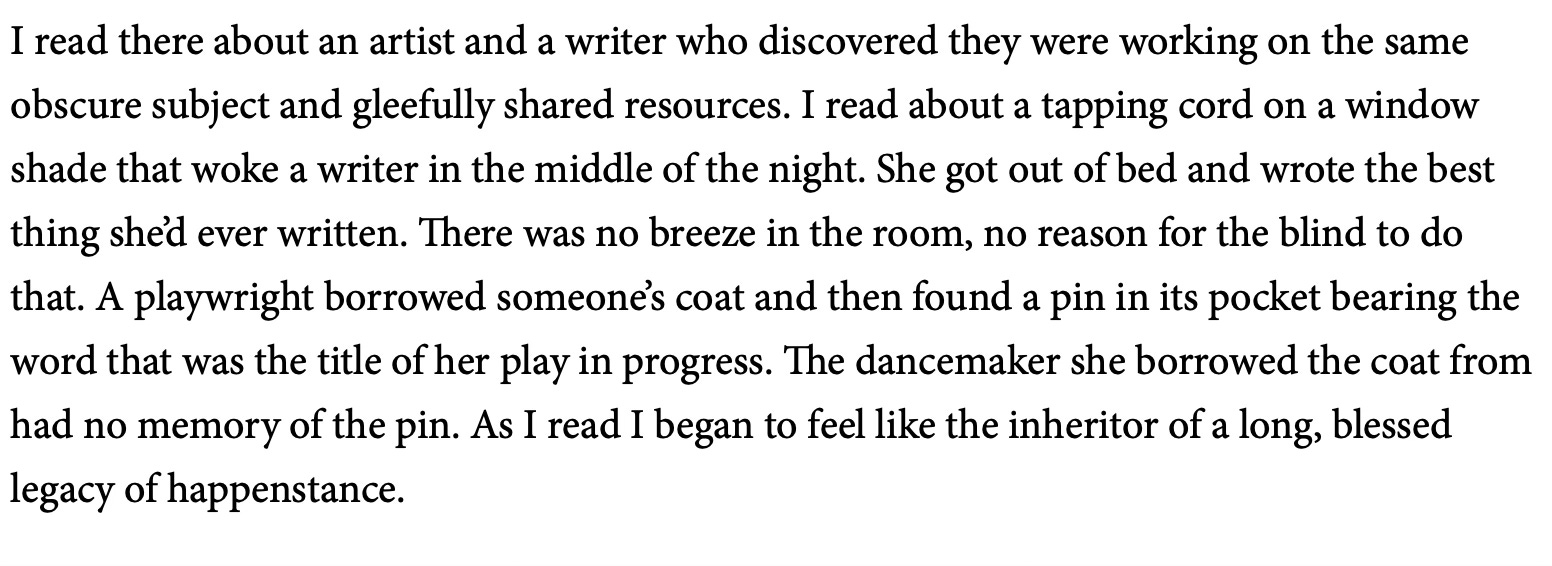
I have also been re-reading my favorite Rebecca Makkai novel, The Hundred-Year House, which was written partly at Ragdale and is about an arts colony not wholly unlike it in vibe, though to the best of my knowledge the characters and story are completely invented. It’s one of those books I’m jealous not to have written myself, not only because it’s so good but because I suspect it was fun to write. Rebecca also wrote a piece about Ragdale for the new issue of Poets & Writers. (You may have to register to read it.) It’s all about the serendipitous things that tend to happen here, including several that kept her pushing forward on projects that seemed shaky or even hopeless. She pays special attention to the “blue books” that live in every guest room at Ragdale, essentially spiral bound notebooks going back the entire fifty years it’s existed as a residency:
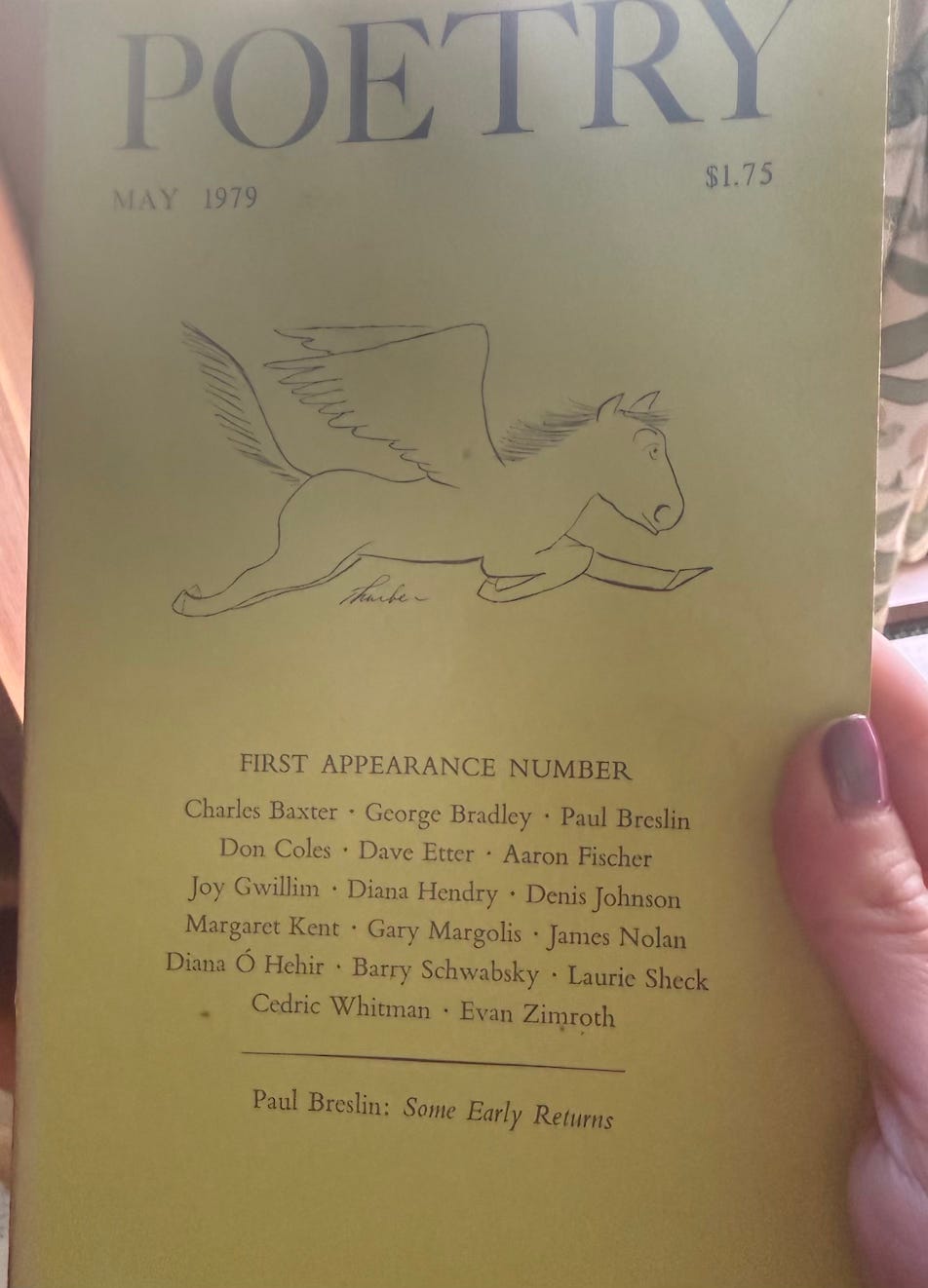
I read her piece one morning, and an hour later, wandering around the house, I pulled an old issue of Poetry magazine off a shelf at random from what looked like a full set. It was from 1979 and immediately my eye fell on the name Charles Baxter, who changed my life maybe a decade later, when I discovered one of his short story collections at a B. Dalton in my hometown of Boca Raton, Florida. I was sixteen and before I’d finished half the book, I knew I wanted him to teach me what he knew about writing fiction. Six years later, I was the youngest MFA student in my cohort at the University of Michigan in Ann Arbor, where Charlie taught for many years, staring at him like Chris Farley stared at Paul McCartney and trying to act natural.
I stayed in Ann Arbor for over a decade, and I also stayed in touch with Charlie off and on, including during the years when I was doing very little writing. He always made me feel okay about that, or at least like I could always start again. “I’m not sure I ever want to write again, either,” he told me multiple times by email, which was always kind of funny because Charlie has written a lot of books. But I knew he meant it, and it gave me a kind of ease I needed.
Charlie and I both live in Minneapolis now, and last fall we had him and his girlfriend Pua over for dinner. At one point he gave me an intent look and said “What deadline have you set for yourself with the novel?” Look, I may be an actual grownup now, but when he talks about how to be a writer, I snap to. I made something up on the spot, like I’d had it in mind all along. “Do you set deadlines for yourself?” I asked him then.
He made a face. “God, no,” he said, and then laughed and resumed petting my dog Waffle, who developed an instant obsession with him.
Anyway, what were the odds that out of a hundred issues of Poetry, that’s the one I’d pull? I’d forgotten that Charlie had even been a poet, since he’s spent the vast majority of his career writing fiction and essays. Serendipity. A reminder that some important writers in my life have been at this since I was in the third grade.
And then there’s Julie Showalter.
You see, I came to Ragdale once before, at the age of twenty-seven, a year or two before I decided it was all over for me and I would never publish a book. Julie was one of the other house residents—the same house I’m sitting in now, Ragdale House--and she was around fifty, so of course she seemed very old to me But I liked her, and what I heard of her work, and one day we played hooky and saw The Full Monty together.
The other thing about Julie was that she had breast cancer, and I had the distinct impression it wasn’t the kind she expected to survive. Because of her health, she’d been assigned to a room with a tub, and she was raving one day about how spacious it was, and the adorable sleeping porch, and the comfortable reading chair. And look, my room was fine, but it was on the smaller side, with a shared bathroom in the hallway, and I found myself feeling jealous of her, this woman who was very likely dying.
She did die, less than two years later. I found out in the early aughts, when she crossed my mind randomly and I looked her up and saw that Ragdale had announced a fellowship in her honor.
I hadn’t thought of Julie in a while until I arrived back at Ragdale last Monday and checked into my room. It was much more spacious than the one I had in 1997, with a private bathroom. Oh, and look, a tub! Sweet.
Something tickled in the back of my mind. I opened the French doors and stepped onto a small screened-in porch with a battered wood desk and a cot, for napping.
And then I made a beeline for the room’s Blue Books, and found her.
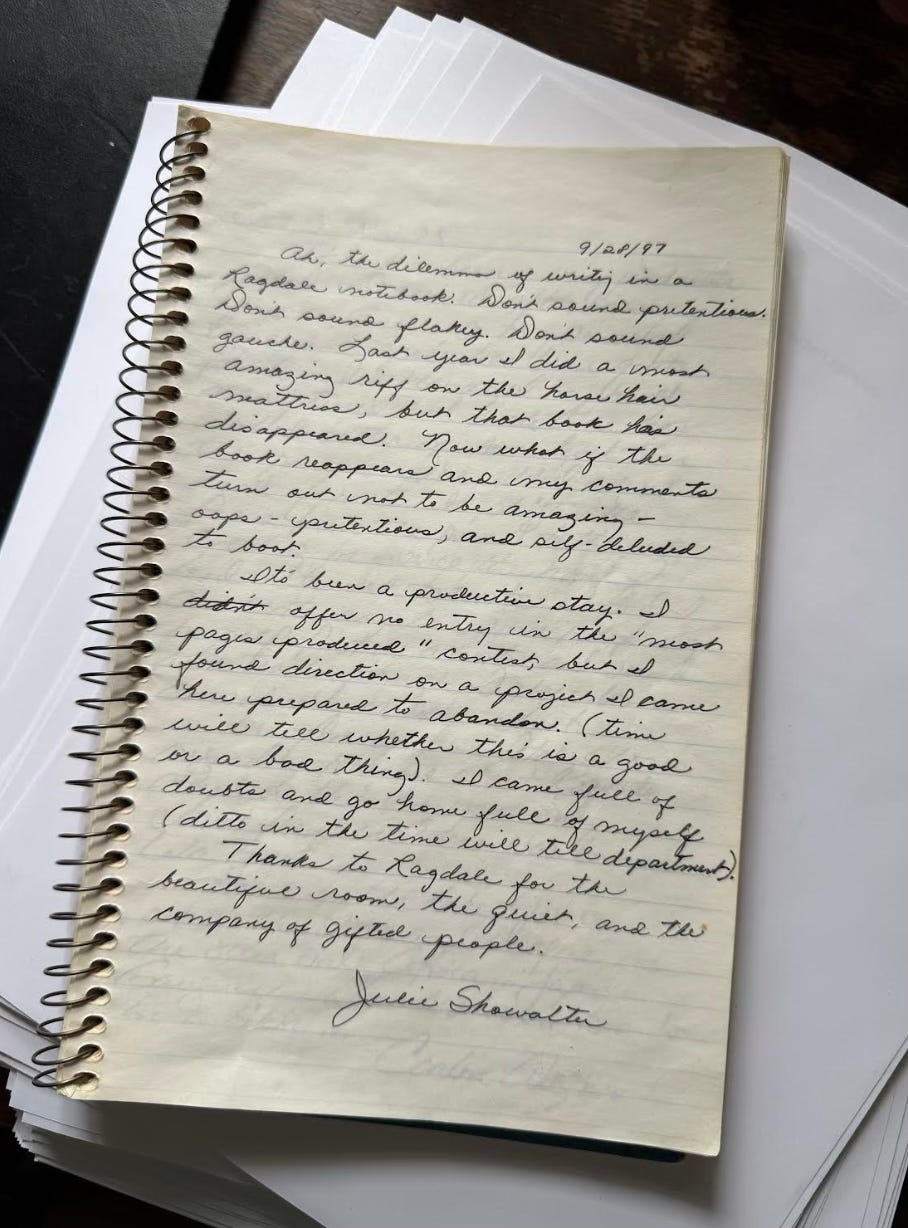
She was here, in my room, twenty-nine years ago. She was younger than I am now. Time is unfathomable to me. And it’s almost equally unfathomable to me that I’m here. Here as in still on the planet, and here at Ragdale. I mean, I quit. I wasn’t going to do this anymore. I didn’t think I could. And here I am, in Julie’s room, writing my third book. They let me come back.
Thanks for reading Loose Canon! This post is public so feel free to share it.
I think that’s one reason I’m working so hard here. I want to be worthy of this space that meant so much to her. I can’t let it go to waste.
Comments
Nothing yet. Say the first thing.
Sign in to join the conversation.