
Stay up to date on all of our data with the (free) chart pack below. Updated every month!

Canada’s Labour Market: A Genuine Turn or a Head Fake?
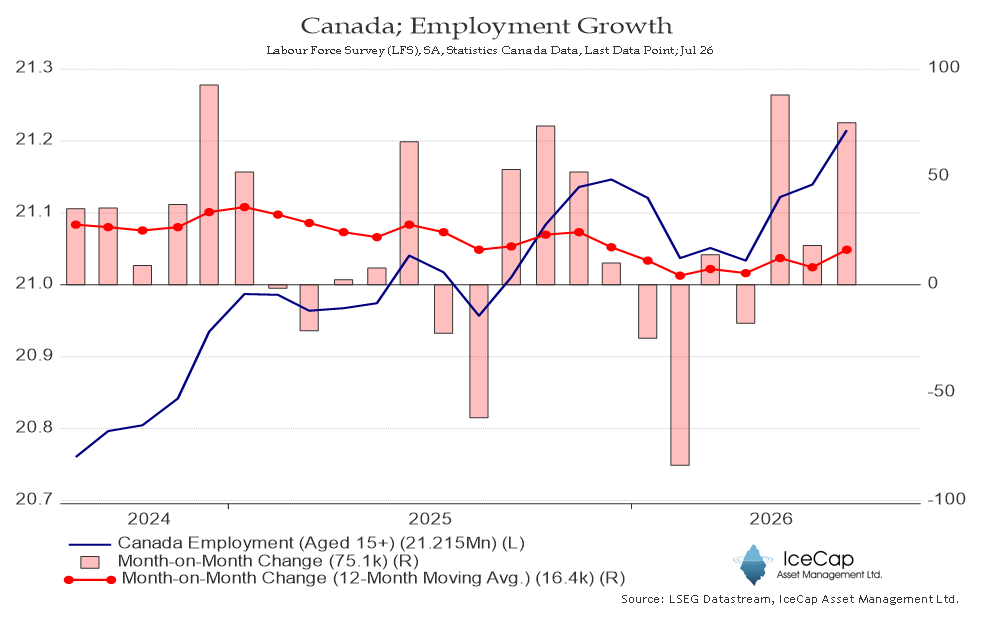
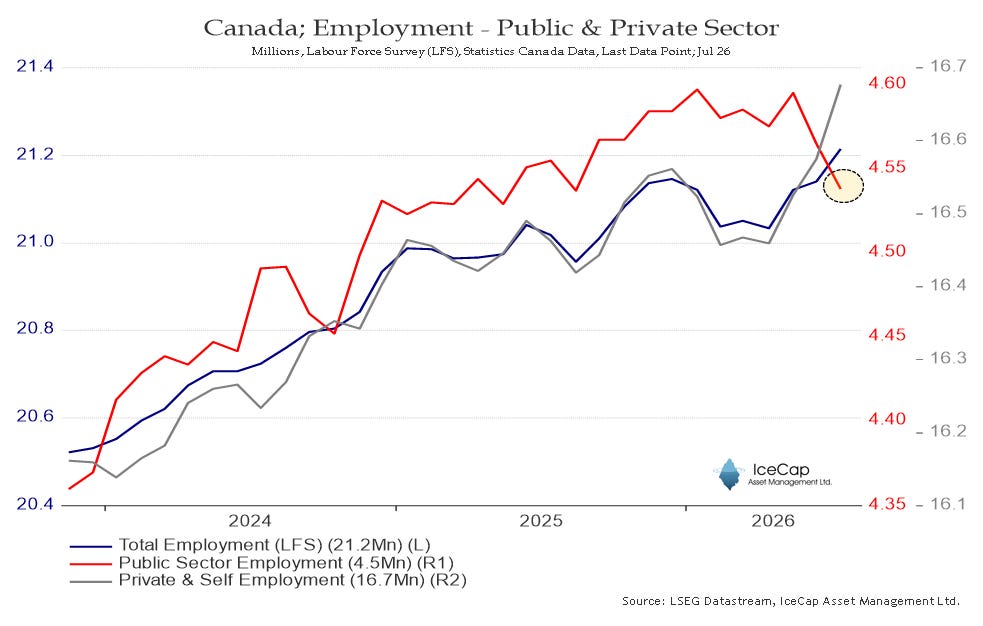
Canada added more than 75k jobs in July, pushing the unemployment rate down to 6.4% — its lowest level in two years. Since April, employment has increased by more than 180k, and the unemployment rate has declined by half a percentage point for three consecutive months. Critically, the recent employment growth has been driven by the private sector. This is a reversal of what we saw last year.
Context matters, however. The 6.4% unemployment rate continues to signal an economy operating with slack, and new tariffs still pose a meaningful downside risk. The labour market is healing, but it is healing into a headwind.

A single strong report does not change the structural picture outlined elsewhere in this chartpack — weak productivity, anemic growth, and a central bank with limited room to manoeuvre. For now, the turn is real. Whether it lasts is the right question to be asking.
Canada’s Public Sector Employment Has Peaked
There are still too many passengers in Canada’s labour market. Public sector and public administrative employment as a share of total employment remains near its 30-year high. Public sector employment includes workers in government departments and agencies, crown corporations, and publicly funded schools, hospitals, and other institutions. These jobs are obviously important. Government employees provide essential services, which are foundational to any modern economy.
But there is a cost that rarely gets discussed. An outsized public sector crowds out private investment, consumes a disproportionate share of tax revenue, and can entrench inefficiencies that would not survive in a competitive market. When government employment grows faster than the economy it serves, productivity suffers — and Canada’s productivity record over the past decade makes that point better than any chart could.
The good news for taxpayers is that it appears the worst is behind us. Public sector employment has finally peaked. The question now is whether it retreats at a pace that gives the private sector room to breathe. Or if it simply plateaus at a level that continues to weigh on Canada’s long-term growth potential.
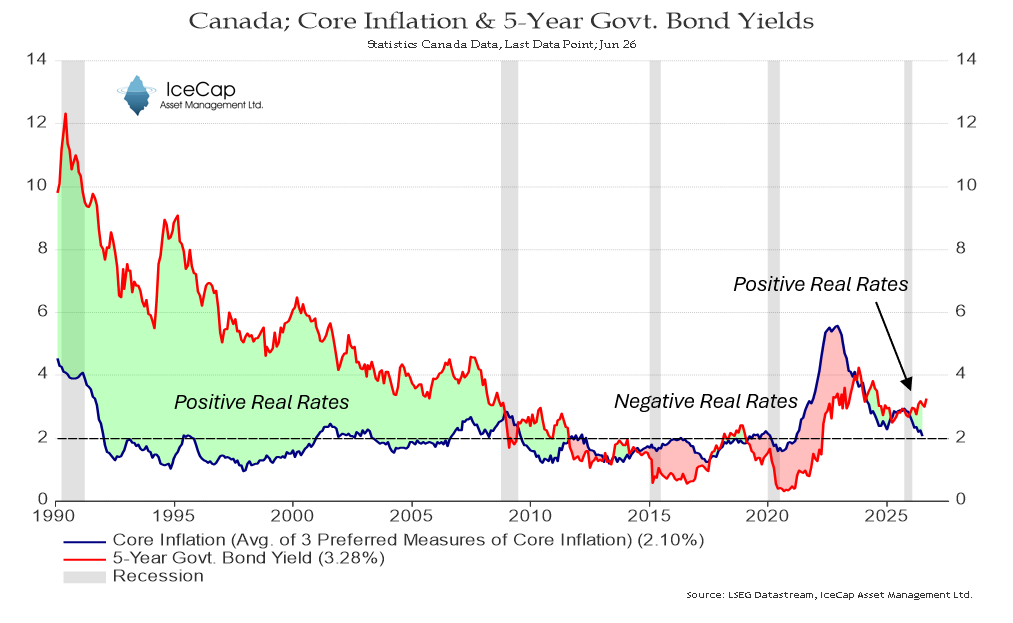
Real Interest Rates Are Positive Again - It’s About Time!
From an economic perspective, few things make me happier than positive real interest rates. Savers are compensated. Borrowers face a genuine cost of capital. It rewards prudent capital allocation and protects the real purchasing power of savings. Investment decisions are made on the basis of real economic merit rather than the artificial urgency created by rates held below the rate of inflation.
The alternative penalizes those who save, subsidizes those who borrow, and misallocates capital toward assets that appreciate in price rather than investments that generate productive output. Canada lived with precisely this condition for the better part of a decade after 2010, and the consequences were predictable.

Capital flooded into real estate rather than factories, machinery, and technology. Housing prices detached from incomes. Productive investment withered.
The Bank of Canada’s failure to normalize rates throughout the 2010s was a significant, if underappreciated, contributor to both Canada’s housing bubble and its productivity emergency. Cheap money made speculation rational and investment optional — a legacy Canada is still reckoning with.
Positive real interest rates are not a panacea. But they are a necessary condition for an economy that allocates capital honestly. After a long absence, their return is genuinely welcome.
Download the full chart pack (updated monthly).
No posts
Comments
Nothing yet. Say the first thing.
Sign in to join the conversation.