

There was a time in this country when you could legitimately lose your job if your employer received the slightest hint that you may be gay. If you worked as a government employee in any capacity during the Cold War, you just couldn’t be secretly also a deviant because your potential to be blackmailed into spying for the other side was thought to be enormous. It was a character flaw, a weakness akin to addiction, and an obvious Achilles heel to the other side. If you thought of it as a psychiatric disorder, you were one of the progressive ones:
The RCPM began actively compiling lists in 1959 and a few years later they had thousands of names of suspected, alleged, and confirmed gays (mostly) and lesbians, many who didn’t even work for the federal government. Surveillance, once it gets going, acquires its own momentum. If you can get past the absurd acronym attached to the constituency retroactively, the Canadian Encyclopedia page on what is now known as the gay and lesbian Purge is useful.
Time passed, vibes shifted, and one Diefenbaker’s Bill of Rights and one overhaul of the criminal code by Trudeau Sr later, and fast forward through the 1960s-70s and the ‘sexual revolution’ - when in the 1980s an officer with CAF Michelle Douglas was honourably discharged for being a lesbian, she launched a lawsuit against the military and won, which then stopped further employment discrimination. In 2017 there was a public apology by the PM who liked doing those things, and a $145 million compensation for lost careers, the sum that dedicated $15 million for “historical reconciliation, education and memorialization efforts”. Most of the original victims of the purge never lived to see the day. The money is today administered by something called the LGBT Purge Fund.
Which of course is a misnomer. The T was added to the ever growing and mandate-fudging acronym in the 1990s, after Douglas won her case. Today, however, every single institution memorializing and every single media house reporting on the Purge adopts the acronym with the T, and its longer, even more absurd sibling 2SLGBTQ+. The Purge Fund was in the news recently because the monument that it co-commissioned about this period in Canada’s history was finally unveiled in Ottawa. The CBC referred to it as an “2SLGBTQ+ monument”. The Canadian Press report which the Star carried described it as “LGBTQ+” and focuses on its mandatory indigenization themes, so we learn once more that no public anything can be commissioned today without the reconciliation kitsch. The monument itself looks odd in pictures. From afar like an industrial silo with a Mary with the child carved silhouette on it, and from close by like a silvery Michelin man? I’ve no clue. It was of course made by a committee.
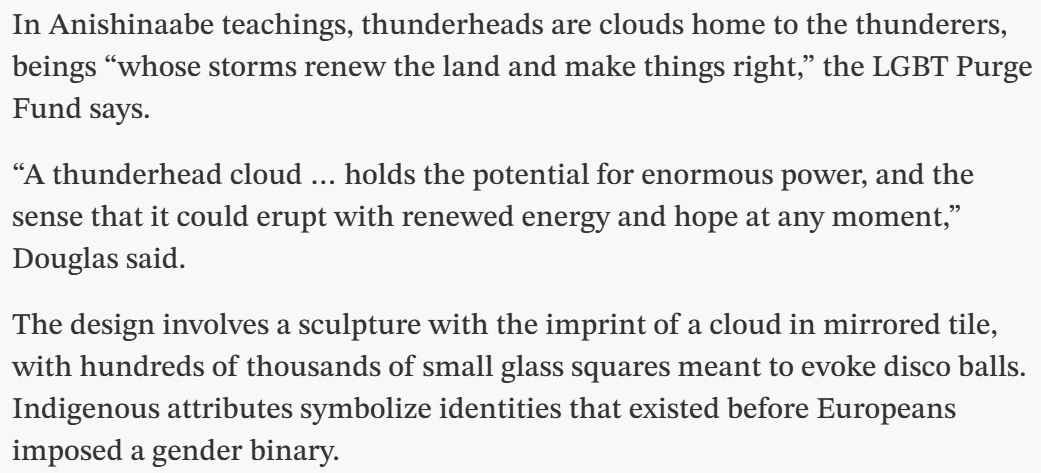
The Purge Fund has been giving grants and commissions, some perfectly reasonable and on point. Others less so. Many are about the entire spectrum of presumed sexualities and gender identities, and lose sight of gay, lesbian and bisexual lives. Force-teaming different causes with the original cause shifts the mandate, as we’ve seen with all the older LGB organizations after they’ve adopted T and further letters. Eagle for example is essentially now a trans-activist organization advocating for self-ID. They are certainly free to be that, but they receive huge amounts of money as an “LGBT” organization, and the bureaucrats funding them don’t seem to understand or care that LGB and T not infrequently have sharply different politics and philosophy. People running those organizations will assure you that we don’t diverge in our interests, even if we tell them that we do. Because their salaries depend on it being so.
The Purge’s original constituency was LG and B. There was no T anywhere there. The gay and lesbian purge did not target people who identify as trans (let alone queer, or “2S” or “intersex”). Some of the Purge-funded cultural memory projects have since added trans individuals in oral history: I haven’t watched all of them but one testimony here in the LGBT Purge Survivors videos is by a man who now identifies as a woman and who grew up in the 1980s and 90s, explaining his youth as that of a gay man who didn’t have the transgender vocabulary. That some gay boys and men end up identifying as trans women today the funders presume as inevitable and progress, but it’s a take. A take moreover that ignores the work of people like Ray Blanchard whose distinction between gay and heterosexual trans identification I think is extremely pertinent today, as straight men ID-ing as women become prominent in the T movement. The Fund still presumes that the LGB and T are all on the same continuum somewhere, and - in order to include the gay men and women who would rather stop being that and ID as opposite sex instead - reinscribe the trans identity back into the gay and lesbian people where there was no evidence of it. “There are a lot of them about now, so there must have been similar numbers back then, just repressed” is ahistorical. And if you look at the books written about the period here on the Canadian Museum of Human Rights website, you’ll see that before the queer studies took over universities, all the Purge-related titles referred to gays and lesbians. Contemporary media too would not have employed the T. Even LGB sounds slightly anachronistic to me. The word was homosexuals in the 50s-70s. The acronym came only with the liberation struggle and coalition building.
I mention some unusual programs funded. There are some curious choices, and I suppose the fund is allowed to do with its government compensation money as it sees fit and direct any component of it towards indigenous elders instructing you about “2S”, a modern notion that presumes all indigenous tribes understood effeminate or same-sex attracted men in the same way, as a two-spirited human, and completely in accord with the current progressive sexual minority advocacy. Fine. But did former MP Svend Robinson really need a $100,000 grant to “research and write a book about LGBT Purge” in 2022 and what’s that book’s ETA? (Some preliminaries here, and he seems to be living in Cyprus?)
The grain elevator thingy was unveiled in Ottawa before an audience of people directly involved in the project, politicians and Lanyards - a select group of heads of LGBTQetc orgs which receive the money from the government so that they could lobby it in turn. Security was tight and the older LG people were not allowed to just show up and join, whereas someone like Fae Johnstone was given a place of prominence. (FJ is one of the most vocal T advocates in the Ottawa lanyard-land, a thirty-something former gay man who ID’s as a woman now and who is known to want “Terfs” (women who believe that sex is materially real, immutable, and consequential in census data collection, policy, sports, medicine, criminal justice) prevented from speaking in public and ostracized. I suppose progress from that time when Veronica Ivy (now has a different name) wanted Terfs to die in a grease fire. He won a medal recently in a women’s golfing category, should you wish to stay up to date about the athlete formerly known as Victoria Ivy.)
We are not serious people, still.
But I’ll tell you where you can find some serious people.
The BBC has recently had a major (if quiet) shift in house style which will significantly improve its reporting around gender and sex. Have a look here and scroll down to gender/sexuality.
“For wider references, talk about LGBT people or the LGBT community (lesbian, gay bisexual, transgender). If this does not suffice, the preferred initialism is LGBTQ or LGBTQ+ - the “Q” means questioning and/or queer, the “+”acknowledges not all people may feel represented by these initials. Where possible, however, initials should be avoided and care is needed with the use of umbrella terms. The issues affecting lesbian, gay, bisexual and transgender people can be very different and the more specific we can be with our language the better.”
Cursive and bold font mine in the last sentence, which deserves it. How long did it take to finally get to this point, as well as the fact that “queer” is not something that everybody likes or uses. (David Sedaris is good on this, and gets flak for it.)
“We use gender identity to describe how people feel or present themselves, as distinct from their biological sex or sexual orientation. Use sex to refer to a person’s physical development and gender to describe how they identify themselves. We should be aware that the concept of a gender identity is contested. Sex is recorded or observed at birth. Use of “assigned at birth” should be attributed.”
BASIC. Yet very far from the CBC or any Canadian media. Not even behind the horizon, let alone on it.
It continues:
“If reporting on someone who is making their transition public, it may be appropriate to refer to their previous identity to help audience understanding. It may also be appropriate to refer to a transition to make sense of some stories. In such situations, the term acquired gender can be used. We should not include “intersex”, or people with “differences of sexual development” (DSD), as part of this group. The term “intersex” is contested and should only be used with attribution.
Avoid the term “sex change” without attribution. Medical procedures can be described as masculinising or feminising surgery or treatment.
Generally avoid the term “transgender child/children” or “trans child/children”, unless attributed. Similarly, avoid “transgender boy/trans boy” and “transgender girl/trans girl”.
Generally avoid the term “gender-affirming care” unless attributed. Transgender care is preferred.
Avoid the term “conversion therapy”, without attribution, in reference to attempts to change or suppress someone’s sexual orientation or stop them identifying as a different gender to their sex recorded at birth. Conversion practices is the preferred term."
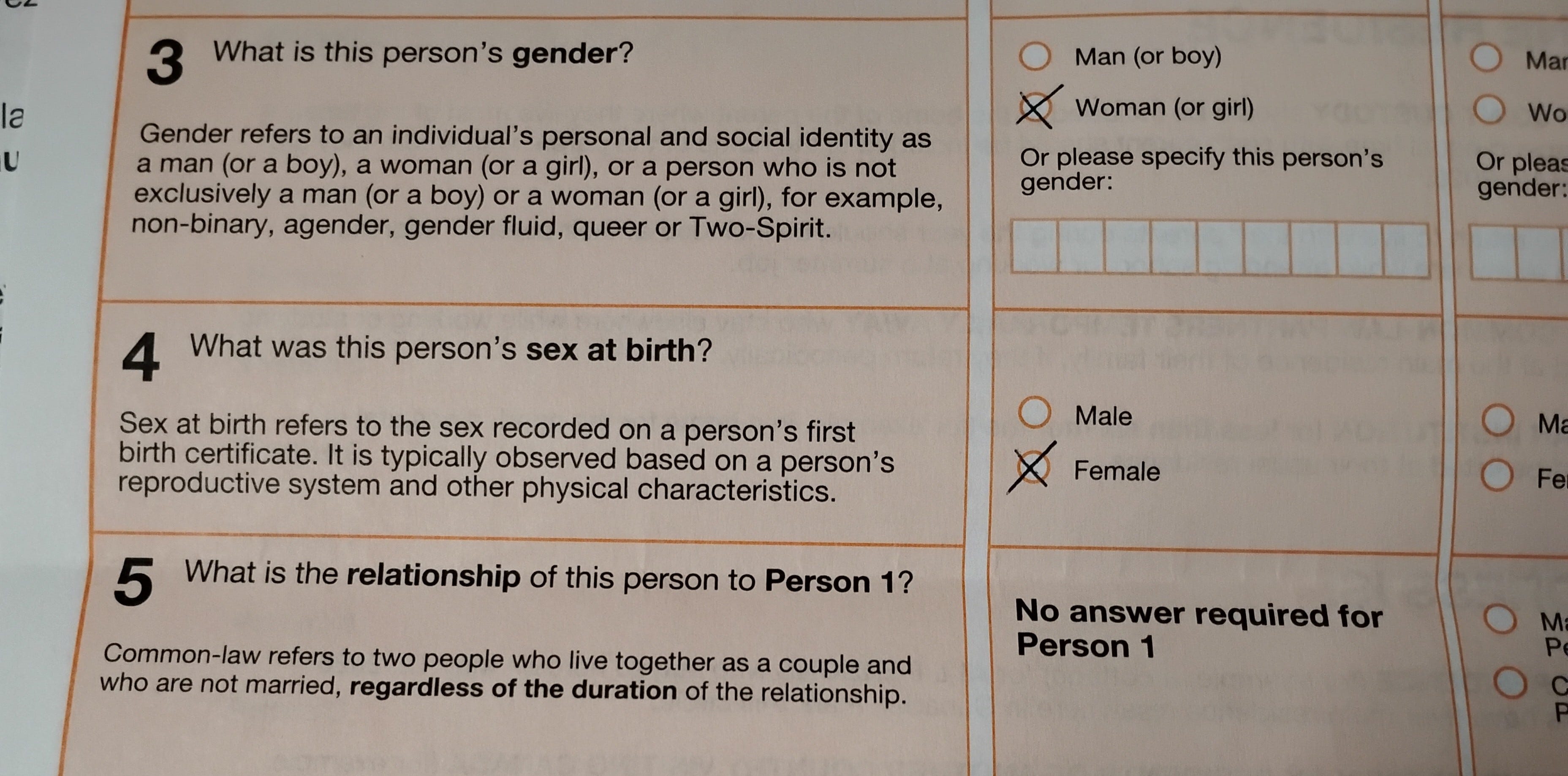
Not all of the issues in reporting are fixed, according to the recent chat on the Sex Matters podcast, and you’ll still see a certain deference to preferred pronouns after the accurate introductory hed. We’ll continue to see, they complain, references to “her penis” in crime reporting (men commit the vast majority of sexual and violent crimes, irrespective of how they identify), and we’ll see “she” to refer to inmates who decided they are transgender while serving a sentence, but I am more optimistic because this newly accurate house style will change a great deal downstream. There’s a huge number of people who don’t even know if the term ‘trans man’ refer to a man who identifies as a woman or a woman who identifies as a man, and can you really blame them. I once shared an office with a very capable Filipino maintenance supervisor who in the course of a random celebrity gossip catchup earnestly described some guy as a lesbian. Allophonie ads its own layer of complication. The last Canadian census did not blow it too much last time around, though 3. is a basket of goodies that will have many - without a gender studies degree, or an allophone - scratch their head.
No posts
Comments
Nothing yet. Say the first thing.
Sign in to join the conversation.