
Denisa was 9 years old, in a town in Romania, when she read a book she did not like. Not the writing — the ending. She remembers thinking, with the flat certainty children sometimes have, that the book should not have ended that way. So she rewrote it, in her own words, and brought the new version to her mother, who looked at it and said, essentially: okay, you can keep doing that. She did. She started professionally publishing short stories books around the same age, and a while later, poetry.
Fourteen years later, Denisa is the co-founder and president of LongX, and she describes her life’s work in a similar vein.
“I want to change that ending. I don’t want one’s human life to end in a way they don’t like, or the universe to end without us knowing what happens to human life and legacy after. I want to change many endings, given how the unavoidable entropy affects every part of reality.”
It’s not incidental: Denisa has said outright that she often writes stories with the end in mind, because she loves circular stories, bridging threads until they arrive at an ending she premeditated from the start. Most writers are told not to work that way, it may ruin the fun, spontaneity, and evolution of the characters; but for her, the ending is the point.
Denisa’s parents didn’t attend college, and they thoroughly wished to give their daughters a great future, which they were sure relied on a strong educational foundation. Thus, education came first, harder and earlier than it did for many kids around her. But it also meant something rarer: her parents ensured she didn’t have to worry about much in day-to-day life, giving her room to think and ask big, impractical questions, while trusting she’d land somewhere good.
“I had a lot of freedom from that standpoint. I could ask deep philosophical or sociological questions from early on, and know my parents would be supportive of my curiosities and inclinations.”
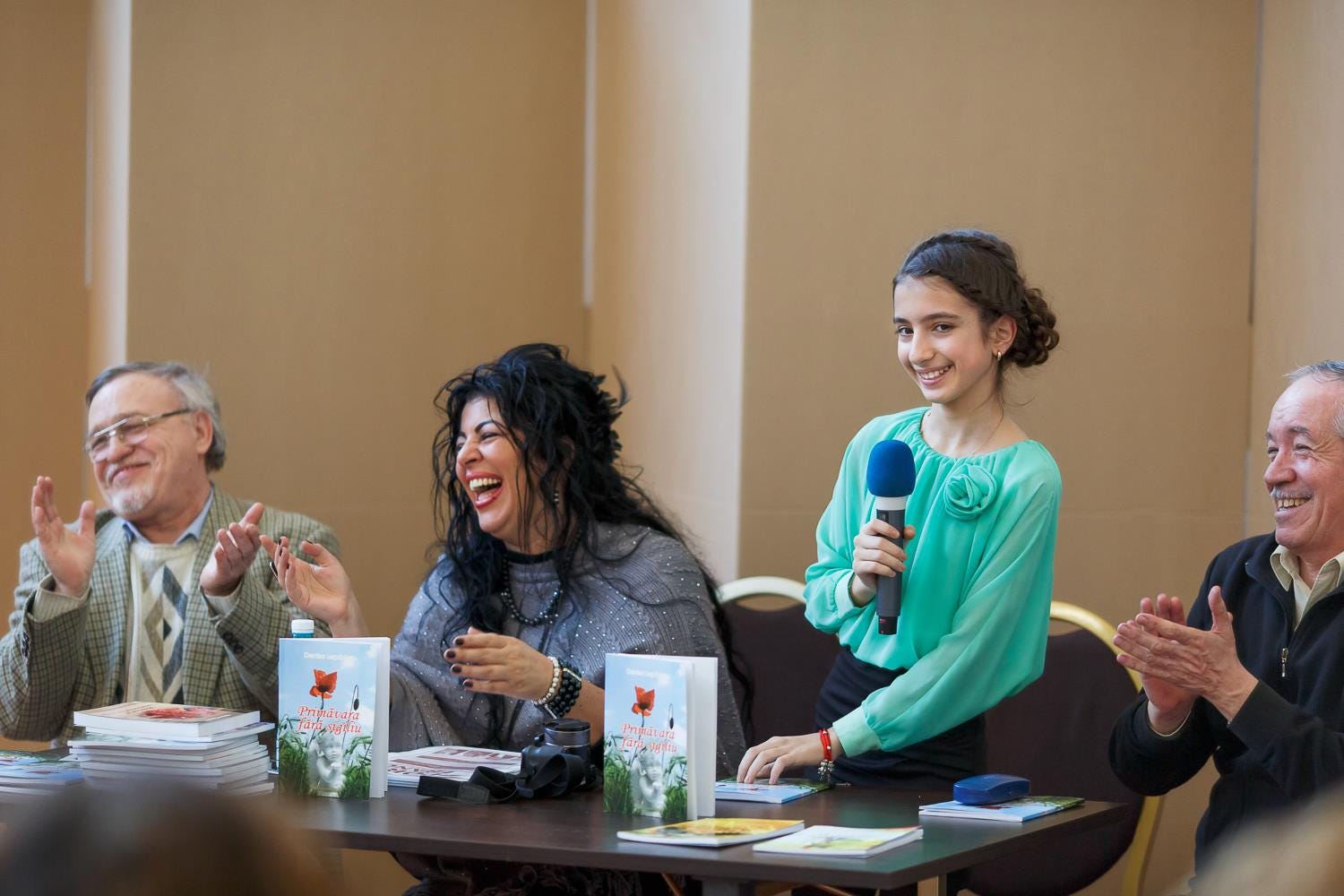
That freedom produced a precocious kid, more interested in the heat death of the universe than in having friends. “I didn’t have a lot of friends growing up. Shocker,” she says, half-laughing. The isolation gave her time to read, write, and think, about the universe, about what it means to be human, about why people behave the way they do. Writing became her first language for that thinking: a way to introspect and try on new points of view. She published books until her teenage years, treating writing as the “most playful form” of expressing herself, something she still tries to protect in whatever she’s doing now.
Then a mentor entered the picture: engineer by profession, who initially agreed to coach her writing and ended up teaching her math too, at his kitchen table, guided less by formal pedagogical rules (he never taught math otherwise) than by a feel for when a solution was beautiful. Denisa thus understood that math, poetry, and self-understanding aren’t separate disciplines but all about pattern-finding and meaning-making.
She went along with the math and computer science major she chose in high school, and even did very well in math olympiads at the national level. She never disliked CS exactly but unlike most classmates, she chose not to pursue it; at the time, she didn’t feet it was a tool built for the things she cared about. It took one discovery to show her what those things were.
“I have an absolute, uncanny fascination with the heat death of the universe,” Denisa says, and she means it as more than a quirky remark. If the universe eventually dies, she reasoned as a kid, then everything inside it — every choice, every life, every legacy and meaning anyone ever built — dies with it. “All that we will have done will have been in vain. Besides the meaning derived from subjective experience, of course, but that is not sufficient for me.”
Rather than let that thought sit as dread, she turned it into a principle: continuity must happen, one way or another — for humans, biologically; for the universe, physically.
The particular flavor of the problem that fully captivated her arrived when she discovered futuristic philosophical currents — and through those, AGI, neurotech, nanotech, and longevity biotech.
“Longevity biotech tells you you’re able to conquer something as fundamental in reality as the constant of time. How cool is that?”
The reason why time was a cooler variable to work on first and primarily, cooler and more urgent than any other, goes to a particular mindset of hers. Life’s constraints, she argues, come in two kinds: fundamental ones and non-fundamental ones. Time is the fundamental constraint, one of the most limiting ones humans deal with. But there are non-fundamental constraints too: governance, regulation, institutional stagnation. Yet, she considers that second category a much bigger threat than most people realize. So the biology was always going to be step one, the big, daunting system that limits humans fundamentally. Step two — the years she’d later spend running governance experiments — was the second half. They’re interrelated for her too: someone has to make sure the environment longevity science needs to survive exists by the time the science is ready for it.
Step one meant a decision that looked, from the outside, like a detour from everything she’d built so far. Choosing longevity meant choosing biology, a discipline she started essentially from zero, instead of math and computer science degrees and jobs. Everyone around her told her to stay in something more practical, more (now she’d say) Silicon-Valley-shaped. Yet she switched into biology for her undergraduate studies anyway, against nearly everyone’s advice.
The technical résumé that followed is a Bachelor’s in Biochemistry and Cell Biology in Germany, biological research positions at ETH Zürich and the Biozentrum in Basel, an advisory role with Apollo Health Ventures and with the Public Longevity Group, and being an On Deck Longevity Biotech Fellowship (now LBF) fellow. She started, and then dropped out of, a Master’s in Computational Biology at ETH Zürich — the decision people ask her about most, and the one she has the least settled feelings about. More on that below.
Behind that résumé sits a cost the CV doesn’t show. Denisa is honest about what the pursuit of her mission — understanding and changing interrelated complex systems, like aging biology and governance — cost her.
“I never optimized for happiness,” she says. “I made peace with happiness not being something I attain now or in the near future.”
She optimized understanding reality instead, and before that, for understanding herself — chasing, she says, a grasp on her own identity and meaning in philosophy and writing.
She remembers a single, specific counter-example: a TV interview at 15 or 16, talking about her writing career, when a host asked if she had regrets in life. Teenage Denisa answered instantly and completely without doubt: no regrets, because everything led here, and she was happy with where she was. She’s returned to that memory for years, because she thinks it might be the last time she felt that way so fully.
That honesty extends to the decisions people assume she regrets — leaving her master’s degree two years ago, chief among them. Her answer isn’t a clean no regrets or I do regret leaving. It’s fully textured: she can’t imagine an alternate version of her life clearly enough to know if she’d choose differently, but she does wonder about staying in engineering, about the early computational path she walked away from at eighteen, about the pivot from VC into grassroots community organizing that swallowed two and a half years of her life.
“I wouldn’t call any of my pivots, regrets, but questions that could plausibly have as an answer, “yes, I regret that” if I knew more about whether they could get me closer to my goals than my current path.”
One of those open questions is really a two-and-a-half-year chapter of its own in the trenches of governance: the first quest studying a non-fundamental yet limiting variable in human life. Truly, the community chapter deserves its own mention in Denisa’s life, because on the surface it looks like a detour that runs parallel to her longevity life — a deep dive into “pop-up cities” that started half year after LongX was ideated. The parallel tracks (longevity and pop-up cities), however, turn out to be the same track.
Pop-up cities — temporary, self-organizing communities of a few hundred people, co-living and co-working for a month or two at a time — became her lab for the non-fundamental constraint: governance. Inside them, in places across Thailand, Argentina, Honduras and more, she ran the infrastructure that formal institutions haven’t built yet: aging-biology summer schools, longevity residencies, longevity (un)conferences. She learned fundraising, operations, international logistics, and how to work across networks whose language and culture she didn’t start out sharing.
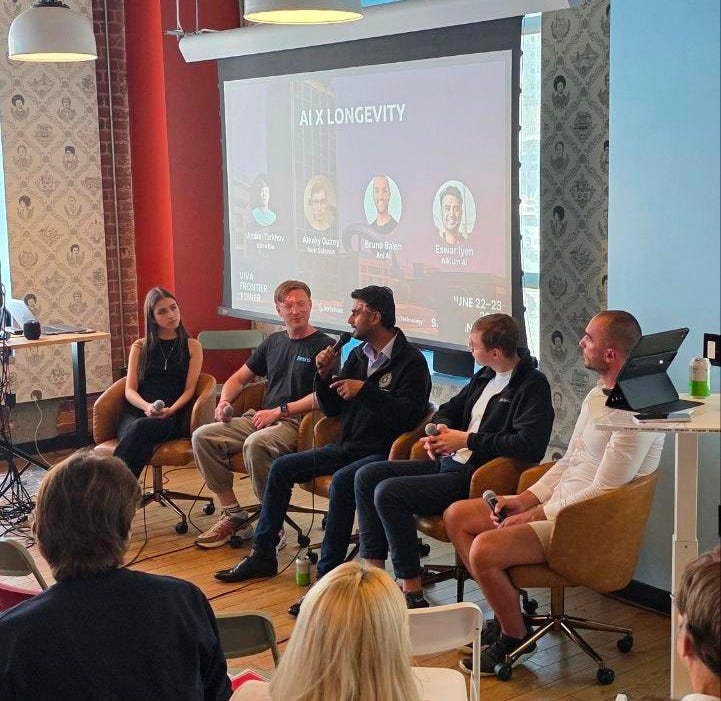
The premise underneath all of it: the regulation, environment, and infrastructure longevity science will need — especially for clinical trials and governance — may not exist yet, and may even be actively opposed in the future. Someone has to build the on-the-ground capacity before the science is ready to need it. These past 2.5 years across the globe were a season of giving that taught her things about people, coordination, and institutional design that she’s only now learning how to fold back into the professional, technical side of her work.
That fold-back started earlier than the order of these sections suggests — the pop-up cities chapter ran parallel to LongX because LongX already existed to fold back into.
LongX — co-founded with Sufal Deb and Marvin Yan — grew out of a conversation Denisa had while she still thought she wanted a traditional academic research career. LongX ended up having nothing to do with academia in the end. Instead, among other projects, LongX ran a fellowship (the Xplore Program, open to early-career professionals and students new to the field) built specifically for people who don’t have the conventional on-ramps into longevity.
“I didn’t want people to feel excluded from the longevity space the way I did. It’s a bit of rebellion. And it’s built on top of my love for community and organizing people toward higher goals. Who doesn’t love a bit of rebellion that helps people?”
The proudest moments as a LongX co-founder are when someone tells her, unprompted, that they heard about LongX and it changed something for them: a fellow who found the organization through a Substack post, another who was referred by a labmate she’d never met. It moves her, that something she and her co-founders built traveled through the world on its own and came back with a person attached to it.
Yet she’s careful not to overstate the impact: “I don’t know if the longevity space became truly more equitable through the existence of LongX yet, but I do hope it did, in at least a 0.1% manner” — and she’s specific about what LongX gave her personally: not a platform to take from, but a channel to give through, to help. Speaker networks shared, one-on-one mentorship calls, courses built from scratch with knowledge she’d gathered in events, online materials, and conversations. The clearest evidence she can point to that LongX gave something back to her, specifically, is the friendships it produced with her co-founders and fellows — the fact that she now has people to turn to and say plainly, I may need help. Truly, having “your people“ in a niche field like this is a blessing — one she tries to offer to the Xplore Program fellows as well.
That personal lesson about belonging scales up into a professional critique. The critique: that the longevity community is too insular, too quick to write off people who question whether extending life is even a good goal, too unaware of how deeply its own research questions are shaped by funders, policymakers, and public perception long before a single experiment is run.
“I took one step back again and again — from research to VC to community — to realize this mission is so much bigger than I thought it was when I entered.”
Her hope for LongX’s next chapter is to build the case for longevity in public, for people who’ve never been given a reason to take it seriously.
That next chapter already has a specific shape in her mind. Asked what 2027 looks like, Denisa describes a potential gradual redirection: less time on community-building and outreach (she learnt as much as she needed from that, for years), more time back on the technical, hands-on question of aging itself. Specifically, what tools and datasets are needed to mechanistically map aging as a set of biological processes, and how to compress the timeline for solving it to 1-2 decades.
She’s begun sketching out what that looks like in public: a framework she co-authored called “universe conquering”, the idea that biology could become a design discipline once we map it down to the building blocks and their interactions. Medicine today still mostly works by educated guesswork: nudge one molecule, hope the effects ripple correctly through the tens of thousands of interacting parts inside a cell. The proposed fix is to first build the tools to map biology’s building blocks and their interactions, then design interventions on top of that map instead of discovering them by trial and error — turning aging, and eventually other limits of human existence long treated as fixed, into problems that can be engineered away.
Truly, biotech and governance are only her first targets in this quest of understanding complex systems to their building block level, because her core life value is freedom. Freedom to live as long as you wish for, be it 30 or 80 or 800 years.
Freedom is also the reason why, when asked about the thing she’d chase if longevity were somehow off the table entirely, she points back at the universe – at space engineering. At sixteen, before she’d found longevity, she tried to convince her parents to let her apply to Mars One, a one-way mission to Mars. “I wanted to work at this obvious human frontier,” she says, but physics didn’t come as easily to her as other fields did, and biology won out. But the astrophysicist she might have become is still visible underneath the longevity researcher she is now: same fascination with entropy.
Whichever frontier she'd chosen, the refusal underneath it would have looked the same.
That, in the end, is the throughline worth handing to anyone reading this who is early in their own path into longevity, or still wondering if they belong in it at all: Denisa didn’t arrive here through a straight line, a home-field advantage, or a moment of certainty. She arrived by refusing, over and over, at every scale from a library book to the heat death of the universe, to accept an ending as final — and by building, in LongX, a door for other people who feel as out of place as she once did to walk through it too.
The nine-year-old who rewrote a library book’s ending would recognize the rest of this immediately.
Denisa Lepădatu is co-founder and President of LongX, a long-term operator in the spaces of longevity biotech and new institutional and governance models.
No posts
Comments
Nothing yet. Say the first thing.
Sign in to join the conversation.