
I wrote my first poem at the age of 5. It’s a dark piece titled The End of the World that centers on a cataclysmic disruption of the Earth’s gravitational field. All matter is pulled into the sky and the atmosphere. The closing line reads ‘Whales swallow rocks to make themselves heavier but it is no use, and they too fly wildly in the air. The world has ended.’ Poetry, even for a five-year-old, is serious work.
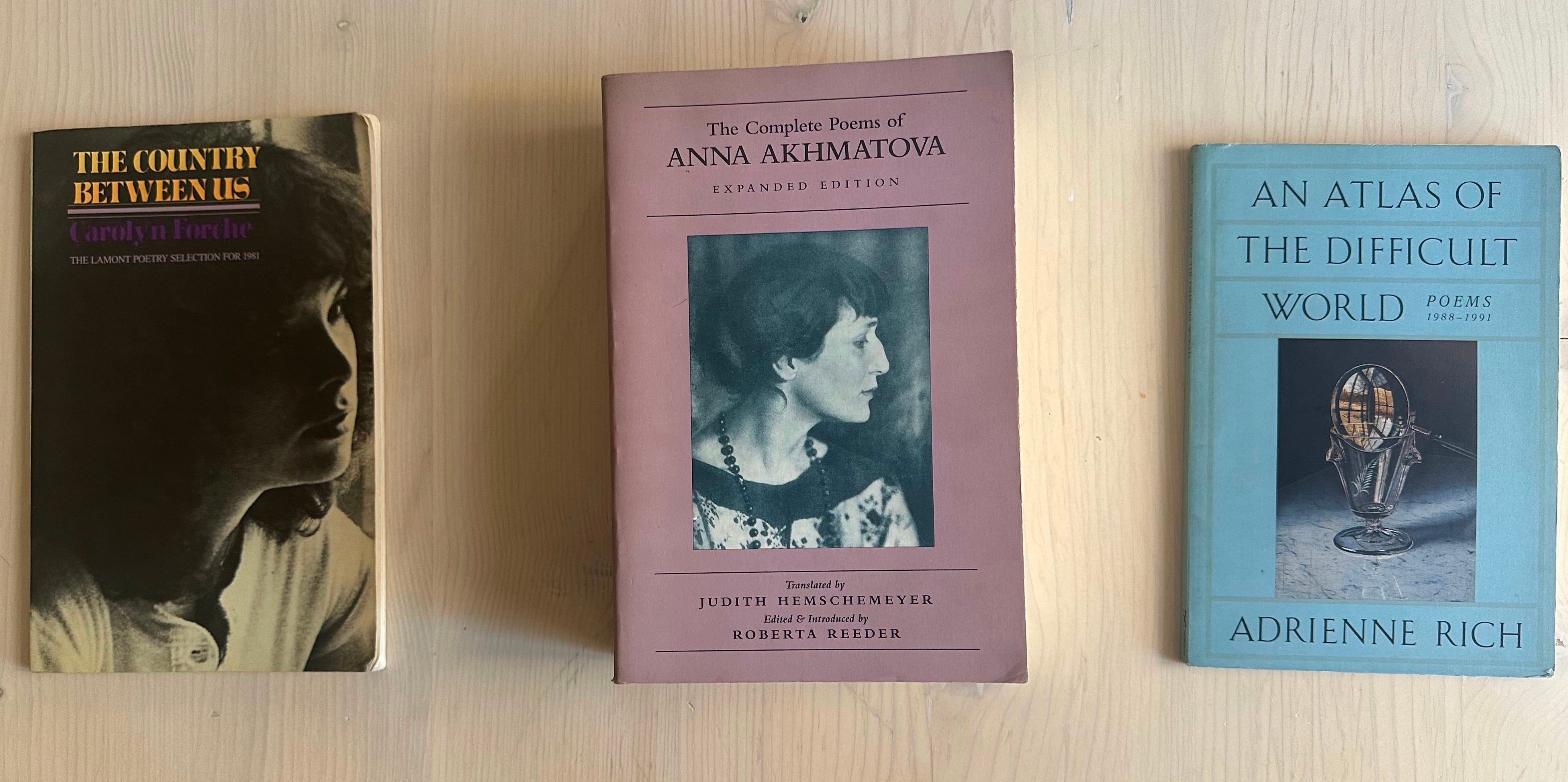
In the intervening decades I’ve often heard the phrase, ‘I don’t get poetry.’ I distinctly remember reading Carolyn Forché’s seminal work The Country Between Us in bed to my then boyfriend, now husband, only for him to say ‘I have a confession to make: I don’t like poetry.’ I see this reticence as opportunity. To those who believe that poetry is impenetrable, impossible to follow, wholly abstract, I say: the best poem is a very short story. And then I change minds. Several years later, my husband’s gallery cited Carolyn Forché for a group show themed The Poetry of Witness, so I guess I changed his.
In times of civil unrest, government overreach and outright oppression, writing poetry becomes a necessary, subversive, even dangerous act. After the rise of Joseph Stalin, Anna Akhmatova was surveilled, her work censored. Still her poems passed, hand to hand, whispered, read once and burned, “It was like a ritual: hands, matches, an ashtray. A ritual beautiful and bitter.”1 In the opening of her (arguably) most famous poem, Requiem, Akhmatova writes of visiting her son imprisoned in Siberia, ‘One day somebody in the crowd identified me. Standing behind me was a woman, with lips blue from cold, who had, of course, never heard me called by name before. Now she started out of the torpor common to us all and asked me in a whisper (everyone whispered there): ‘Can you describe this?’ And I said: ‘I can.’’2
The artist Shilpa Gupta devotes much of her practice to honoring the work of imprisoned, killed or otherwise silenced poets. Using text, recordings, bookmaking, and sculpture, Gupta returns voice to the voiceless. For, In Your Tongue, I Cannot Fit is Gupta’s large-scale sculpture, and accompanying book, named for the 14th century Azerbaijani poet Imadaddin Nasimi who was executed for blasphemy. The work traces 100 international poets across thirteen centuries, and examines monitoring systems that ‘penetrate, control, and exile voices and bodies.’ Says Gupta, ‘Poets, like writers and artists, are dreamers who speak of the nightmares of the living world. This work is about the persistence of beliefs, of dreams, which make us into what we are as individuals.’3
These days, everything is poetic and everyone is a poet but no one likes poetry. This artist’s exhibition is A Poem for Deep Thinkers.4 That songwriter’s album is Tortured Poets Department. Everyone wants the aesthetic of poetry but no one wants to dive in. I founded the independent imprint LONESOME PRESS to bring poetry to people who would not otherwise seek it out. ‘I didn’t know I like poetry,’ one of my best friends told me after reading our first volume. We out here, changing the world, one mind at a time.
Every artist knows we create because we must. Now is the time to read poetry and certainly past time to write it. I will read poetry to my five-year-old daughter who uses a tiny notebook titled Future Poet. I will teach her to know her rights, her value, her autonomy because ‘It is either the beginning or the end / of the world and the choice is ourselves / or nothing.’5 Says Adrienne Rich, ‘I don’t want to know / wreckage, dreck, and waste, but these are the materials / and so are the slow lift of the moon’s belly / over wreckage, dreck, and waste, wild treefrogs calling in / another season, light and music still pouring over / our fissured, cracked terrain.’6
I wrote this essay for the second issue of The Trops, which debuted last night at a lovely Yalda celebration hosted by Nora Tofigh. Ilka and I read, we kibitzed with Madeline Weinrib, and basked under Luigi’s gorgeous flags while enjoying a Persian/Afghani feast. Purchase the issue here.
Rashid Johnson, Guggenheim Museum (through January 19, 2026)
Carolyn Forché, The Country Between Us, Harper & Row, 1981 from the poem Ourselves or Nothing
Adrienne Rich, Atlas of the Difficult World, W. W. Norton & Co., 1991
Comments
Nothing yet. Say the first thing.
Sign in to join the conversation.