
Standing dazed in the shadow of New York's skyscrapers, I had no idea I was witnessing two parallel revolutions: one of concrete reaching skyward, and another, digital and invisible, that would transform how we measure the very worth of those buildings.
I still remember with vivid nostalgia the first time I visited the so-called Big Apple, nearly 11 years ago. The scenery presented to my five senses, as soon as I got out of one of its central underground stations, is something difficult to put into words. The magnitude of its skyscrapers was beyond comprehension for someone who was brought up in a humble neighbourhood in a small city in inner Spain. The noise coming from all sorts of directions, siren sounds I had never heard before, people around, traffic, helicopters… The smell was also part of that sensory feast. The street had its own particular smell, likely exacerbated by the hot summer weather, from numerous food trucks and restaurants, the characteristic yellow taxis exhausting smoke... My brain was processing an elevated number of inputs for which I had no previous track record.
One random afternoon, a friend suggested we check out an event happening just steps away from the New York Stock Exchange on Wall Street. I had no idea what to expect, but we ended up at the Bitcoin Center NYC.
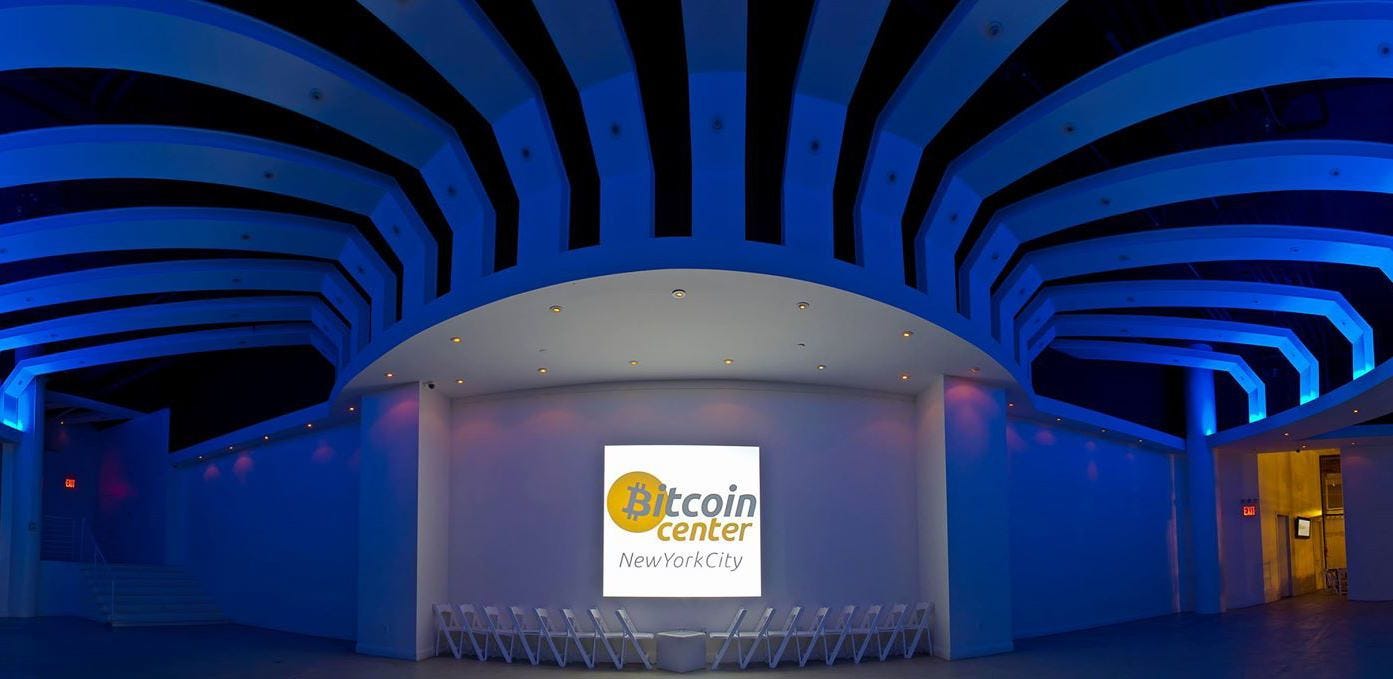
At the time, I was a young professional in banking—someone who was supposed to understand how money works. But it wasn’t until I fell down the Bitcoin rabbit hole that I truly began to grasp what money actually is.
That visit turned out to be more than just a casual detour. We found ourselves chatting with people from all walks of life, from different corners of the world. Then, almost by chance, we were pulled into a surreal and unexpectedly inspiring conversation with none other than the center’s founder, Nick Spanos—an encounter I’ll never forget.
One of the most vivid memories from that day was witnessing a live trading pit in action.
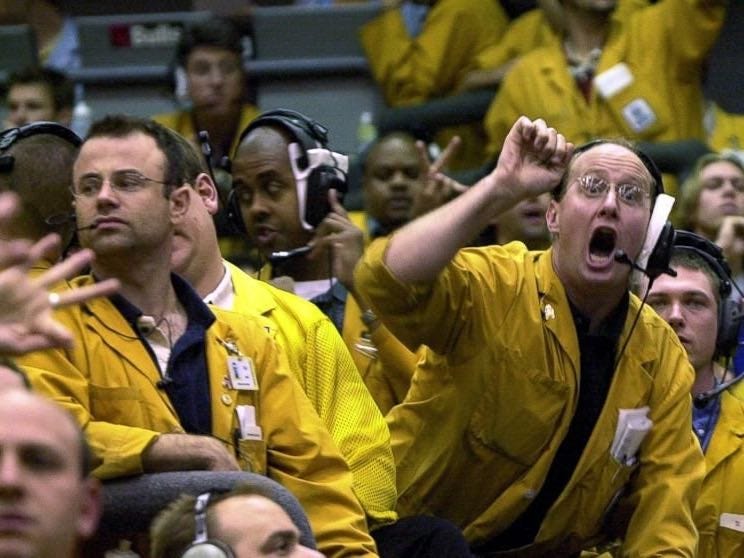
Until then, I had only seen scenes like that in movies like Rogue Trader or in old YouTube clips—traders in colorful jackets shouting orders across the floor. But here it was, happening in real life. Bitcoin was trading at around $1,000 back then—a fraction of its value today, nearly 85 times less. That raw energy and early-stage enthusiasm left a deep mark on me, adding a unique chapter to my personal and professional journey.
Back then, Bitcoin felt like a fringe curiosity, a digital ‘toy’ for hackers and libertarians. I didn’t really have a formal view about what it really meant. Today, in my view, it is reshaping how we think about value itself.
After spending over a decade working in finance, it wasn’t until a few years ago I started to dig deeper into the true, philosophical meaning of money. Now, analysing the London property market, I ask myself the following question: “What is something really worth, not in pounds or dollars, but in something truly scarce?”
Long before money, there was barter. A shepherd might trade 10 goats for 3 sacks of grain, or a craftsman might offer a metal tool in exchange for meat or cloth. Every transaction was a trade-off, not just of goods, but of needs, time, and opportunity. There was no universal "price", only relative value, negotiated between parties, based on what each one needed at that moment.
But barter had limitations. It required a coincidence of wants, both parties had to want what the other had. It was clunky, inefficient, and impossible to scale. So humans invented money, first as commodities like salt, shells, or silver, and later as gold and fiat currencies. These made value more fluid and trade-offs more measurable. But over time, something changed: Modern money became untethered from scarcity. The pound, the dollar, the euro, all of them could now be created endlessly. And just like that, the trade-offs became distorted.
Bitcoin was created in 2008 during the global financial crisis by an anonymous figure (or group) known as Satoshi Nakamoto. In response to widespread distrust in banks and centralized finance, Satoshi published a white paper titled "Bitcoin: A Peer-to-Peer Electronic Cash System," outlining a new form of money that would operate without intermediaries. On January 3rd, 2009, the Bitcoin network officially launched.
The core of economics is scarcity — and Bitcoin is engineered scarcity. Real estate is tangible and desirable, but when priced against the likely hardest (i.e. scarce) asset ever created, we start to ask deeper questions:
Is this home still worth the same to me in Bitcoin terms?
What’s the trade-off between owning property and holding BTC long-term?
Am I gaining shelter… or losing purchasing power?
That’s not to say everyone should choose Bitcoin over property — but in a world of limited capital and competing assets, thinking in trade-offs is essential.
In a world where central banks can create money out of thin air, how do we really measure the value of a flat in Shoreditch? Or a home in Hampstead?
London property prices, when measured in British pounds, seem to rise almost forever.
Figure 1: Average property price in London, 1995-2024
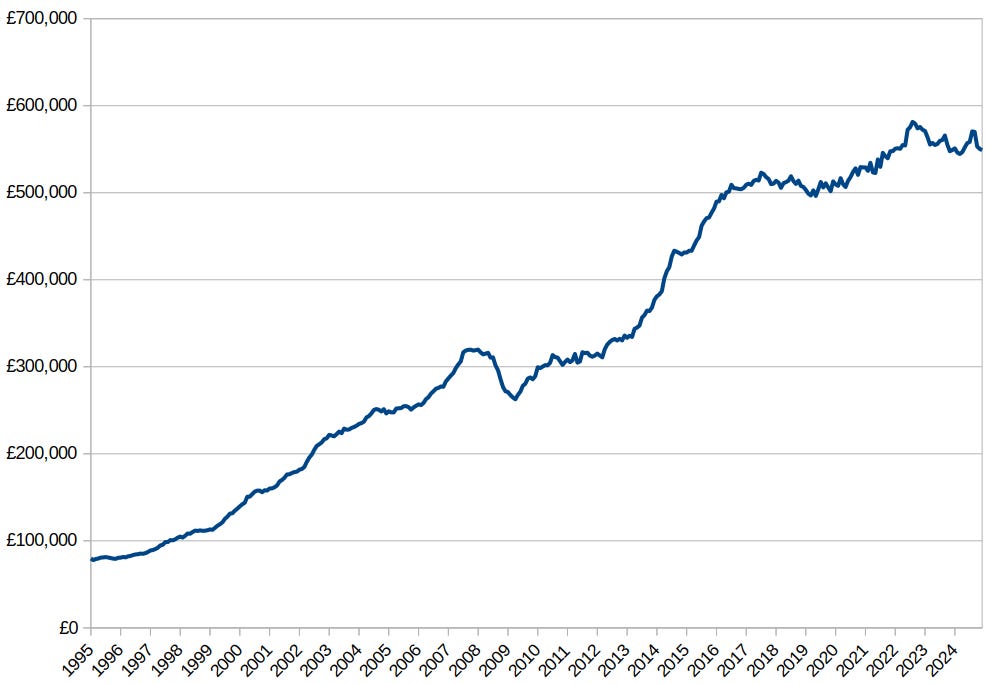
It feels safe. Predictable. But if the measuring stick (the pound) is shrinking, is the property really gaining value, or is the pound simply losing it?
That’s where Bitcoin come in. Unlike fiat, it can't be printed at will. And when we reprice London homes in Bitcoin prices, the story changes dramatically.
Here’s the key insight: London real estate and Bitcoin are both perceived as potential stores of value, but only one of them is truly scarce.
Property supply increases over time (new developments, conversions, planning permissions); however, since the sharp increase in interest rates the picture has slightly changed, at least temporarily.
Bitcoin’s supply is fixed: 21 million.
This doesn’t mean real estate is a bad investment. It means we must rethink what "going up" really means.
If your home has doubled in pound sterling terms over 10 years, but has halved in BTC terms, have you really gained wealth? Or have you just kept up with a devaluing currency?
Figure 2: Average property price in London, in BTC terms 2013-2024
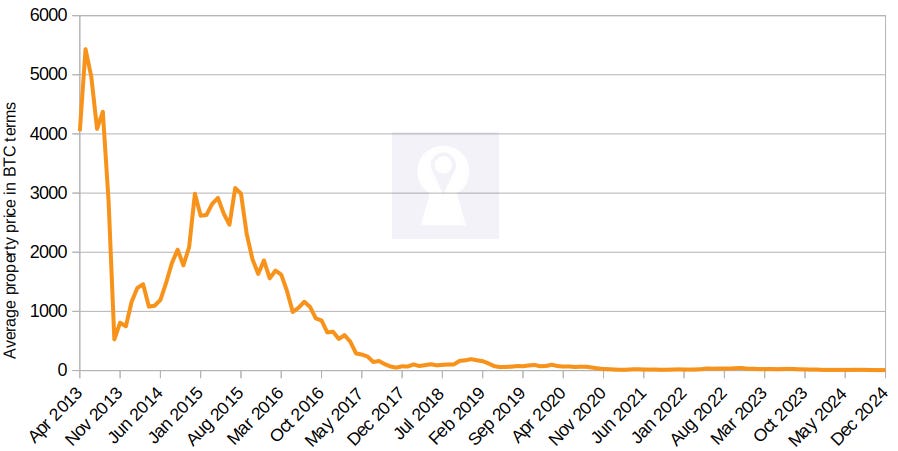
In 2014, the average property in London was worth nearly 3000 BTC. A similar property, was worth 7 BTC in 2024. Over 10 years, the average property has declined in BTC terms by around 99%, while increased by 27% in GBP terms.
Figure 3: Average property price in London, in BTC terms (log-scale) 2013-2024
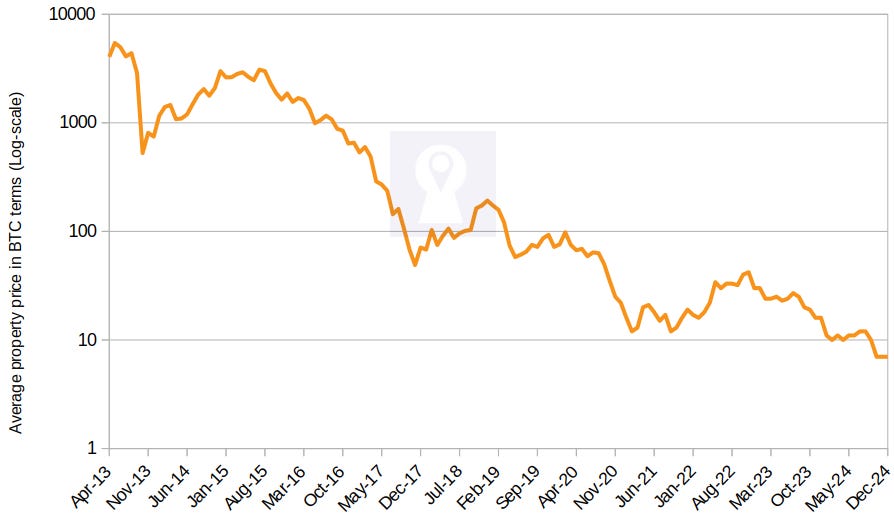
Property is undoubtedly one of the most important acquisitions a person can make in the 21st century. However, when looking at Bitcoin’s price evolution, one has to wonder: does the price of everything, when denominated in Bitcoin, tend toward zero? At what point does our understanding of value begin to shift?
For homeowners, landlords, and investors, repricing property in Bitcoin isn’t just a thought experiment. It’s probably a wake-up call, although I suspect it will take time until stakeholders look at this through this lens.
It challenges the myth of permanent real estate superiority.
It exposes fiat inflation as the silent driver of asset bubbles.
And it offers a more grounded way to compare long-term stores of value.
If Bitcoin is no longer just a tool for speculation, it might evolve into something far more consequential — a benchmark. As digital natives accumulate wealth, many will begin pricing the world not in pounds, dollars, or euros, but in Bitcoin — especially when it comes to high-ticket, long-duration assets like property.
Disclaimer:
The content of this article is for informational and storytelling purposes only and does not constitute financial, investment, or legal advice. The views expressed are my own and based on personal experiences and opinions. Please do your own research and consult with a qualified financial advisor before making any investment decisions.
No posts
Comments
Nothing yet. Say the first thing.
Sign in to join the conversation.