
I came across a thread on cultivating agency in kids, and I have some thoughts on it. Henrik Karlsson gives an astute definition of agency as the ability to come up with meaningful projects and see them through. A lot of people who don’t have kids seem to think these both come naturally to children: it’s a cliche that children are curious, that left to their own devices they let their imagination shine, and that it’s grown-ups and schooling and pressure that kill their creativity.
In my experience, this isn’t quite accurate. Expanding a little on Karlsson’s definition, I think agency requires curiosity and imagination (to come up with ideas), initiative (to start doing something about them), and perseverance (to see them through). I don’t think children have these to a larger extent than adults, but I do think there are things parents can do to help their children make the most of what they do have. Agency isn’t something children possess and adults lose; it’s something that has to be actively cultivated from an early age.
Children ask a lot of questions: an episode of QI claimed that children ask 107 questions per hour on average. This can’t be true — that would mean one question every thirty seconds throughout the day. But granting it actually proves that children aren’t genuinely curious — or at the very least, they lack the attention span to get answers to their questions: thirty seconds isn’t enough to hear and process a response. Parents who take their children’s questions seriously, and try to answer the countless ‘whys’, often find their kids’ interest fading after a sentence or two.
Still. The fact children ask many questions is a good foundation for developing long-lasting curiosity. I think parents can show children how to find answers, and help them realise that doing so can be exciting. Technology makes this easier than ever: children ask questions that even most educated grown-ups cannot answer, so parents can find answers to those questions in front of their children. I often put GPT on loudspeaker, and ask my children’s question (and then encourage them to ask follow-up questions). (The downside to this is that GPT has a very confused idea of my personal interests:

)
Basically, if you want children to do something, you need to do that something yourself. If you want them to be genuinely curious, you need to be so too.
Children are brimming with imagination! say people. Counterpoint:
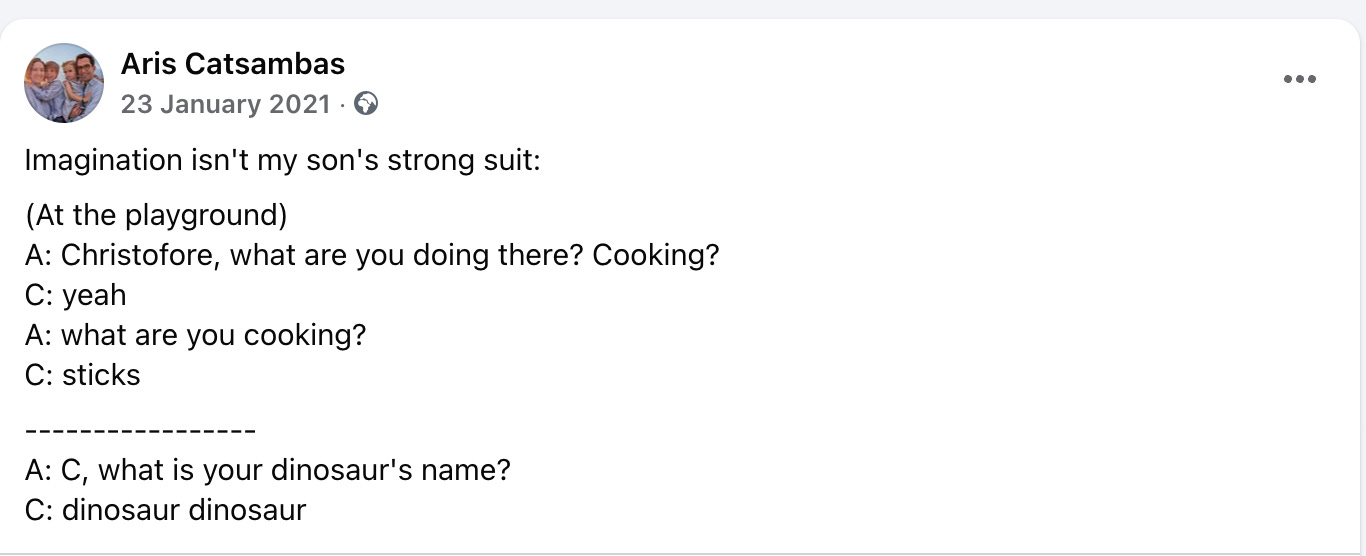
He has since acquired two more dinosaurs. Their names are dinosaur’s friend and dino.
Yes, children often play pretend games (where they dedicate 90% of their time to setting up the game, rather than actually doing anything: ‘Christopher pretend that we’re X.’ ‘Yes, and pretend we’re doing Y’. ‘Yes, and pretend that Z’. It’s like they’re in improv). But that doesn’t mean their games are particularly imaginative. When I discussed this with my wife, she pointed out that children are likely using these games to make sense of reality. Their games often involve playing teachers or parents (which, btw, is a great way to learn how you come across as a parent), so they are more like exercises in empathy: the children are putting themselves into the shoes of their parents (sometimes literally).
So we need to distinguish between imagination in the sense of playing games, and imagination in the sense of creative power. Unfortunately, I think the latter is a skill that some people are born with: some people have a truly unique way of looking at things, and are able to come up with novel ideas, worlds, and stories: they are original. It’s not a skill that all children have but which only a few maintain in adulthood: rather, like intelligence or height, it’s an attribute some have from birth, and others lack.
This doesn’t mean that those of us who aren’t born with exceptional imagination are hopeless. You don’t need to be truly original to come up with a good story (though you do have to learn what makes for a good story). And there is something that children do have to a larger extent than most adults: a sense of wonder. Children find things exciting, they aren’t jaded. Their imagination might lack the power to create fantastic worlds, but it can be fired up, and it lets them enjoy the worlds created by others (or even just properly appreciate the world God has created for us). Many adults let this atrophy. Sometimes this happens because we let daily stress and chores get in the way of appreciating things around us; but even worse, sometimes it happens because we’re told that being earnest and excitable is childish, naive, and something to be embarrassed about (these are the very qualities Dostoyevsky’s Idiot exhibits in the eponymous novel). One thing you can do as a parent is protect your children from this tendency.
(However! As a European who is exposed to earnest and excited Americans on the internet, I must caution against earnestness killing humour. You can be passionate and open to ideas without taking yourself too seriously. )
Initiative is realising and acting upon the fact that you can just do things. As with imagination, I think some people are born with a higher proclivity towards taking action. At the same time, it’s probably true that children are more inclined to do things than adults, and that this is often beaten out of them as they grow up. A child sees a blank wall and writes on it; or they see a slide in the playground and they try and climb it; or they try to serve their own breakfast.
They then get told off for doing these things, sometimes rightly (no-one likes to clean paint off walls), sometimes wrongly (Jesus Christ, let your child try and climb the slide, worst case they fall and get a little bump), and they learn that acting on their initiative gets them into trouble much more than it earns them praise.
The difficulty is in communicating to the child that, when you tell them off for something they did, you are not penalising the fact that they exercised their own judgement, but that they got that particular judgement wrong, and that this should not prevent them from making their own decisions in the future.
A secondary challenge is that letting your children do things themselves is tiring. When they serve their own breakfast, or try to help with cooking, they are guaranteed to make a mess. There are many times when I stop my children from helping and doing things themselves, because it’ll be much faster if I do it for them — but this is clipping their wings. It takes conscious effort to hold back and let them take the initiative.
Now we come to the thing that most children (and adults) lack: perseverance. Many of us are inclined to procrastinate or to put in the minimum effort required, unless this tendency is checked by one or more of the following:
deriving pleasure from the work itself (rather than seeing it purely as a means to an end)
an appreciation of excellence, and a sense of duty or commitment
incentives
Parents can teach all of these to at least some extent, yet most parents (including myself) often fail to do so.
It’s a hackneyed observation that the moment something is labelled ‘work’ it becomes less fun. But the reverse of this observation is equally true — if you reframe a chore as a fun activity, it becomes enjoyable, as Tom Sawyer proved so memorably when he got his friends to pay him to paint his aunt’s fence.
Parents can do a lot to make activities including learning and chores fun, and to teach children that how they choose to see the world is within their control. As always, role-modelling matters: if you are grumpy when you do your chores, then your child will resent doing them too. If you make things like cooking or setting the table fun, then kids will be begging you to do them.
Making mundane things fun is easier than it sounds. You can see setting the table as a boring activity in which you’re placing objects on a surface without looking at them. Or you can buy nice glasses and linen napkins and candles that you enjoy looking at, touching, and lighting (striking a match is actually very satisfying!), and you can appreciate the way it looks when you’re done — and your children will too.
Many of us push through unpleasant or boring work by anticipating the satisfaction of having done something well, or by holding ourselves to a minimum standard even when we’d rather stop. This doesn’t come naturally. We are hard-wired to discount the future and overweight the present.
Parents can help children moderate this instinct by praising genuinely good work, by reminding them of past successes (‘remember how proud you felt when we framed that picture?’), and, crucially, by giving honest feedback when children do not apply themselves.
Most parents and teachers fail at this last part. They either have absurdly low expectations of children, or they are not honest with children when they (the children) don’t do as well as they could have done — I call this the tyranny of low standards.
You can see it everywhere: in sports classes where children perform exercises badly and no one corrects them; in school or drama performances where the focus is solely on memorising lines rather than delivering them well; in drawings praised and hung up regardless of care or effort. The message is consistent: performative effort matters more than doing the thing properly.
I understand the reason behind this: it’s the fear of discouraging children. The thinking is that if a child tries something, and they’re reprimanded for low effort, they will just stop trying in the future. But the underlying assumption here is that it’s better to do something badly than to not do it at all. Is this really true? I am not so sure. I think it’s important to teach children to apply themselves — even if this means causing them minor upset and discomfort at times. Children are much more capable than you think, and they can tolerate gentle pushing. We can teach them to value good work, and to disdain low effort.
Finally, incentives. There’s a lot of debate on whether it’s a good idea to bribe children to do things that are good for them. Personally, I don’t think I’ve ever done it — I much prefer to rely on the previous two approaches to encourage (what I consider to be) good work and effort. I think they are more reliable in the long term.
I’m also lucky in that my children enjoy the kinds of things I’d want to incentivise them to do, such as doing sports or reading books. But in principle, I have no objection at all to incentives: if all else fails, and you can’t get your child to put real effort in something you think is beneficial for them, try setting a price for it. As long as they learn to apply themselves, I reckon it’s worth it. The one exception here is things that children have a duty to do — e.g. help around the house.
So there we are. I think it’s silly to draw a distinction between children and adults when it comes to most character traits; but I think there’s a lot we can do as parents to encourage positive traits and control the impact of negative ones.
If you liked this post, you might enjoy…
No posts
Comments
Nothing yet. Say the first thing.
Sign in to join the conversation.