
Robert Schumann’s quirky writing on the musical world after Beethoven is very special: the best way to read it is with no preconceptions, enjoying every surprising impression. I’ll try to articulate my own impressions.
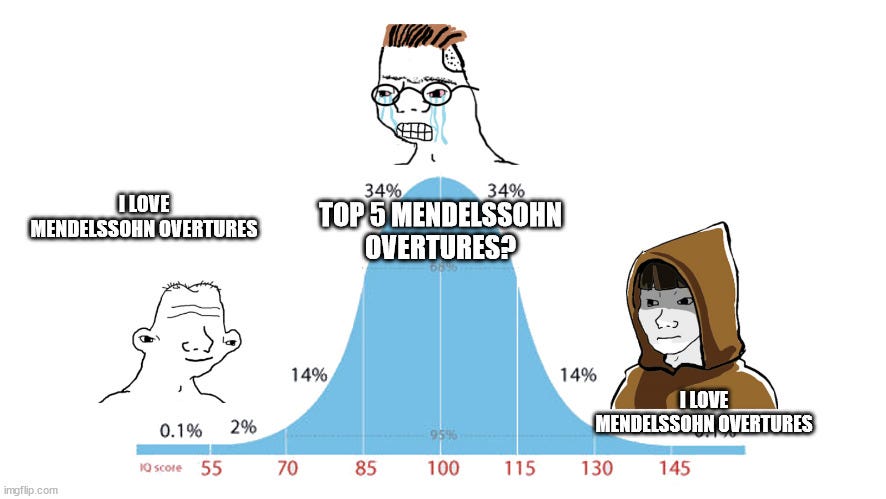
Schumann’s concern is to distinguish between trivial and transcendent music, which often means distinguishing between serious and unserious composers or between sincere and insincere listeners. But his gatekeeping, as it’s called now, is endearing. The most popular form of classical music criticism today are the endless lists of “top 50 symphonies” or “top 10 Romantic composers” or “15 female composers to listen to right now” that sites like ClassicFM, forums like TalkClassical and reddit, or even Gramophone magazine churn out. Schumann has an answer to these tedious pointless rankings in his response to a fellow Leipzig concert attendee who asked him which of Mendelssohn’s overtures was the best1:
Which of F. Meritis’ overtures,’ some simpleton asks me, ‘do you like the most?’
The tonalities of E minor, B minor and D major6 blend suddenly into a triad of graces, and I can think of no better answer than:
‘Each of them!’
So the most sneering and sensitive critic, full of steretopyical disapproval of the common audience member—see Florestan’s Shrovetide Ovation for the severest of sneers—unstereotypically both likes the most music and likes music the most. This is the kind of positivity-inflected elitism that today’s classical music evangelists could embrace: good classical music is the best music (no caveats or concessions necessary)—and anyone can love it! You know, like this:
After the untimely death of his contemporaroy Ludwig Schunke, Schumann reviews2 Schunke’s “Grand” piano sonata by relating a series of excessively Romantic anecdotes—the truth of which, who knows!—culminating in his experience hearing the sonata for the first time. What if we take this fanciful illustration of the talented and sensitive musician rising above the mundane to become a composer of true music completely seriously instead of scoffing? Are any composers today this crazy and unjaded about music? (A genuine question).
A storm hung over us, with all its beauties and forebodings. I can still see his face illuminated by a flash of lightning, and his upward glance as he said, almost inaudibly: ‘A flash for us!’
. . .
Everyone was agreed that he must be an artist, so distinctly had nature engraved his calling in his countenance.—You all have known him, the eyes aglow with enthusiasm, the noble, aquiline nose, the mouth with its smile of self-deprecation, the luxuriant head of tumbling curls, and beneath it all a lithe, slim torso that seemed, not so much to bear, as to be borne. Even before he had quietly spoken his name, ‘Ludwig Schunke, from Stuttgart’, I heard a voice within me saying: ‘He it is whom you are seeking’—and in his eye I read something similar.
. . .
A few weeks after Schunke’s arrival, a Berlin composer10 passed through and was invited to a gathering at which Schunke was also present. Ludwig was proud of the association of his family name with virtuosos, particularly horn players. Somehow, during dinner, the conversation turned upon horns. The Berliner dismissed them rudely, remarking: ‘One should give them nothing to blow except C, G and E,’ and he asked if the first horn theme in the Symphony in C minor, although very easy, ‘did not always sound horrible enough’. Ludwig said not a word. But an hour later he burst in upon us in the cellar and said that this was how things stood, and that he had written the Berliner a letter accusing him of impugning the family name11 and inviting him to choose between daggers and pistols, and would Florestan be his second?
. . .
That he was a master pianist we knew from the first chords. But on that occasion Florestan was unmoved, and on the way home he let loose upon me all his old impatience with virtuosos. A virtuoso, he said, who could not lose eight fingers in order to use the remaining two to write down his compositions was not worth the powder it would take to kill him. And was it not the virtuoso who was to blame if divinely gifted composers starved to death? Etc.
The finely grained Schunke sensed all this. He knew that he had been found wanting, and he knew where. Then came the special evening to which I have referred. A number of Davidsbündler were gathered together, including the Master. No one was thinking of music. It was as if the grand piano had opened itself of its own accord, and as if Ludwig, now sitting there, had been wafted thither on a cloud. All of a sudden we were caught up in a stream of unfamiliar music.—I can see it all now in my mind’s eye, the dimmed light, the still walls, as if they, too, were listening, the friends grouped around, breathless, Florestan’s pale features, the musing Master and, in the midst of it all, Ludwig, who held us spellbound, as if in a magic circle. When he had finished, Florestan said: ‘You are a master of your art, and I pronounce the sonata to be your best work, particularly when it is you who plays it. Truly, the Davidsbündler would be proud to number such an artist among the members of their order.’
LETTERS FROM A (MUSIC-) LOVER, I
FROM THE DAVIDSBÜNDLER ARCHIVES, IV
No posts
Comments
Nothing yet. Say the first thing.
Sign in to join the conversation.