
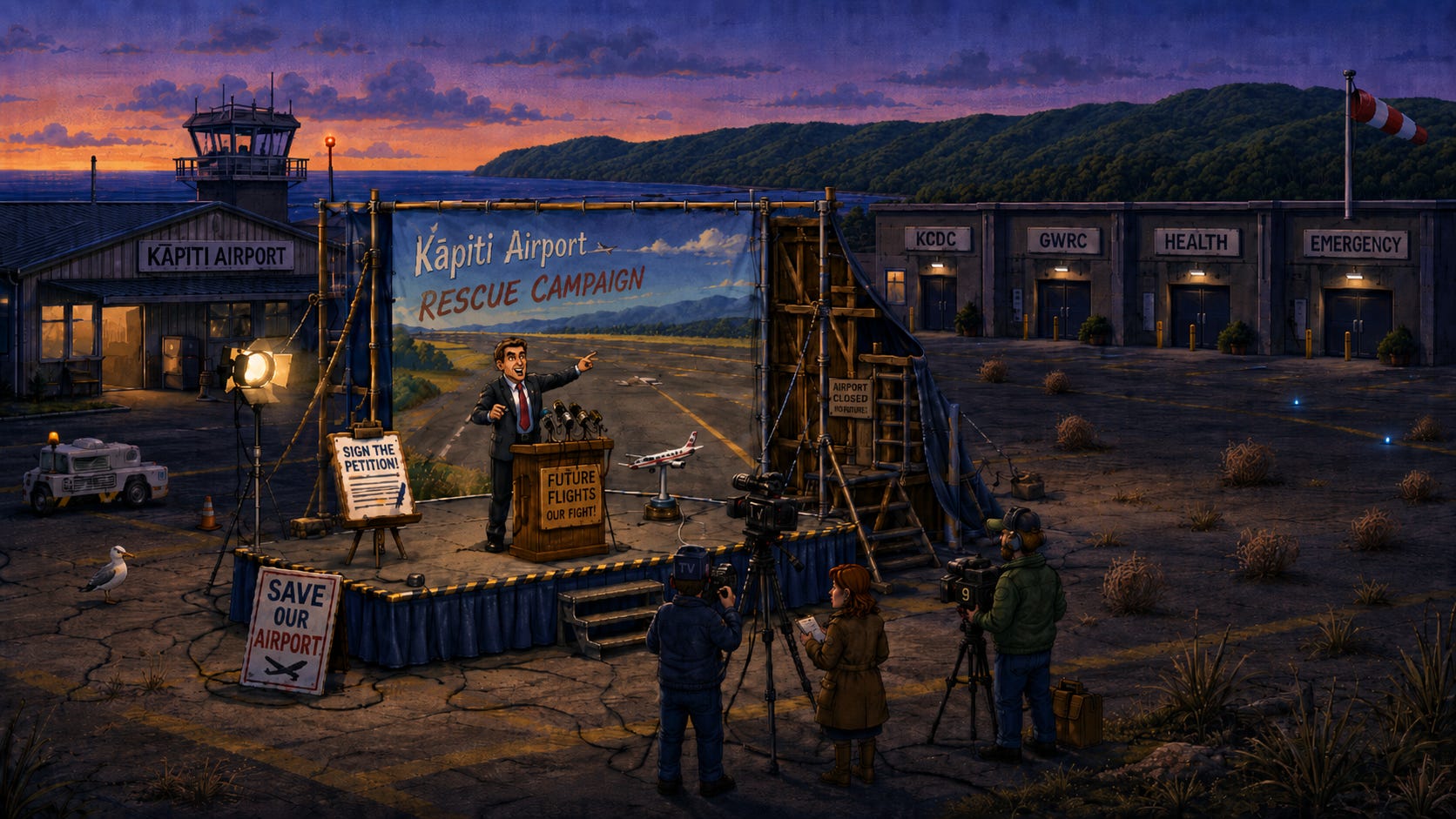
Building on Local Aotearoa’s previous story revealing that the Government has no position on whether Kāpiti Airport remains open or closes, three further official information responses raise fresh questions about whether Ōtaki MP Tim Costley’s campaign to save it has been matched by meaningful advocacy to decision-makers behind the scenes.
The records suggest the campaign has generated considerably more publicity than meaningful engagement with the councils and ministers whose support would be needed if the threat of closure is as imminent as airport advocates repeatedly claim.
Costley has had little difficulty finding microphones, newspaper coverage, radio interviews, petitions, and social media audiences for his campaign to save Kāpiti Airport. He has described it as a necessity for the entire Wellington region, said he has been working behind the scenes for months, and repeatedly pointed to its potential role in civil defence and air ambulance operations.
But three more official information responses to Local Aotearoa suggest his campaign remains strangely quiet in some of the rooms where a serious attempt to secure the airport’s future would need to be built.
Speaking as a former politician, political staffer, and lobbyist, this does not resemble a comprehensive advocacy campaign. At best, the engagement with key local and central government decision-makers appears half-hearted if not forgotten. At worst, it creates the impression that being seen to fight for the airport has become more important than doing everything possible to save it.
For example, Greater Wellington Regional Council has no record of Costley contacting its elected members about Kāpiti Airport since last year’s local government election. If, as we have been repeatedly told over the years, the airport is vital to regional resilience, then surely as the local MP you would be beating down the doors of the regional council to make the case to its elected members to mobilise in support of the airport’s retention.
Similarly, the response from Kāpiti Coast District Council shows that the only substantive, targeted engagement with one of its councillors was initiated by the councillor, not Costley. Given Costley frequently makes various demands of KCDC in his social media videos on the airport, the lack of proactive engagement by him with the councillors whose support he needs is staggering.
Finally, the Minister of Health’s office has released no correspondence from Costley despite the airport’s role in providing a backup for air ambulance operations being one of its clearest public-good functions.
These responses do not prove Costley has done nothing. Previous material shows he has briefly engaged with the Associate Transport Minister, the Civil Aviation Authority, Airways, airlines, and others, particularly around regional airline funding and the cost of the Aerodrome Flight Information Service.
But they add to a growing gap between the scale of Costley’s public-facing campaign and the much thinner record of behind-the-scenes advocacy aimed at decision-makers across local, regional, and central government.
I know why this gap matters. I have been involved in successfully advocating and lobbying for major policy changes and infrastructure investments. While publicity is helpful to create public pressure and political urgency, without meaningful engagement and relationships with relevant decision-makers, it is unlikely to get anywhere useful.
MPs are uniquely positioned and resourced to do this work. Chris Bishop was an exemplar of this as a list MP from 2014-17 where his fearless lobbying for initiatives in Hutt South saw his work behind the scenes match his robust public advocacy and get results from ministers.
In my previous story, I revealed that the Government had no position that Kāpiti Airport must remain open.
Air Chathams’ chief executive had also privately told Associate Transport Minister James Meager that demand from Kāpiti was “really poor” and that the airline was not selling enough seats to cover its direct operating costs, despite cutting back on services.
Meanwhile, Emergency Management Minister Mark Mitchell’s office held no correspondence, meeting notes, briefings, or other records about Kāpiti Airport from the previous 12 months.
That was striking because the airport’s purported importance during a major Wellington earthquake has been one of the main arguments advanced by Costley and other airport supporters.
At the time, I noted that further official information requests were still outstanding.
Three of those responses have now arrived. They do little to strengthen the idea that any meaningful and coordinated advocacy work has been taking place behind the scenes.
The clearest response came from Greater Wellington, and echoes the lack of communication with Emergency Management Minister Mark Mitchell in my last story.
My LGOIMA sought any communications involving Costley or his staff relating to Kāpiti Airport since the 2025 local government election. Greater Wellington searched its information management systems and contacted councillors to identify any relevant material.
It found nothing.
No emails. No letters. No meeting requests. No records of phone calls. No briefing notes. No communications identified by councillors themselves.
This lack of engagement with the regional council is difficult to reconcile with Costley’s claim that Kāpiti Airport is a necessity for the entire Wellington region.
If the airport is genuinely regionally significant infrastructure, Greater Wellington is an obvious organisation to engage. It represents the wider region whose resilience Costley says depends on the airport, and has responsibilities spanning regional planning, transport, infrastructure, and emergency management relationships.
That does not mean Greater Wellington has the money or appetite to purchase or subsidise a privately owned airport. If approached, it may have reached exactly the same conclusion as central government and decided that the airport’s future is primarily a matter for its owner. It certainly has more than enough on its plate with the Simplifying Local Government reforms amongst other massive challenges facing it.
However, Costley does not appear to have approached its newly elected members at all. Drawing again on my own experience in politics and lobbying, that is inexplicable.
He has gone on regional radio to tell the public the whole Wellington region needs the airport. Yet the official record shows no attempt since the election to make that case directly to the region’s elected representatives.
That is not regional lobbying. It is regional rhetoric.
Kāpiti Coast District Council is frequently the target of Costley’s calls for action in his traditional media coverage and social media content. He frequently calls on councillors to somehow block the airport owners from requesting a private plan change or lodging a resource consent (something they cannot do, but that appears to be beside the point).
Having repeatedly called on the local council to act, you would expect Costley to be directly and actively lobbying its councillors. However, while Kāpiti Coast District Council released more material than Greater Wellington, it ultimately tells a similar story.
In May, Paraparaumu Ward councillor Glen Olsen emailed Costley after watching one of the MP’s Facebook videos about the airport. Olsen asked whether Costley could meet with him. He said he wanted to understand what he could do as a councillor to support the airport remaining open and hoped for a “free and frank discussion”.
Costley’s office responded and arranged a meeting at a Coastlands café on 4 June.
It was entirely appropriate for Costley to accept the invitation. But the initiative came from Olsen and, regardless of my thoughts on the future of the airport, Olsen deserves for doing so.
Olsen saw Costley talking publicly about the airport and went looking for information about how he might help. The local MP had not approached him with a plan, a request, or a coordinated lobbying strategy. Given how central Costley claims KCDC is to saving the airport through blocking plans to change its use, his lack of proactive contact with its councillors is bizarre.
Another released exchange began when a third party emailed Costley, Mayor Janet Holborow, and council chief executive Darren Edwards about the threat to the Air Chathams service.
Costley replied that he was “way ahead” of the sender, but the communication was again initiated by someone else.
The council also released copies of Costley’s general monthly newsletters sent to the mayor and chief executive (which they have presumably subscribed to themselves to stay aware of what their local MP is doing in the community). These included sections repeating his public support for the airport and referring to his work with ministers, the CAA, and Airways.
But a newsletter repeating public talking points is not the same as lobbying elected members to take a particular action.
There is no detailed proposal to the council. No request for councillors to pass a resolution, commission work, engage Greater Wellington, approach ministers jointly, or help build a funding and ownership model. There is no evidence of Costley bringing the district’s elected representatives together and setting out what, specifically, he needs them to do.
The only direct councillor engagement in the released material happened because a first-term councillor contacted him after seeing him on Facebook.
Contacting the councillors whose support you need, building relationships with them, and giving them a clear role in your campaign is basic advocacy practice. A new council was elected in late 2025 and Costley should have been in their ear from the get go.
The response from Health Minister Simeon Brown’s office raises a different but equally important question.
My request sought all correspondence, briefings, meeting records, and other information relating to Kāpiti Airport over the previous 12 months. The only material released was a technical document about how Airways calculates its charges at the airport, held through Brown’s State-Owned Enterprises portfolio rather than his health responsibilities.
There were no emails or letters from Costley. No records of him meeting the Health Minister about the airport. No documented case about what closure could mean for air ambulance operations, patient transfers, or health-system resilience.
This matters because air ambulance use is probably the strongest public-good argument airport advocates have, alongside the airport’s more debatable role in responding to a major natural disaster in the region.
Commercial passenger demand has proved insufficient to sustain the Auckland service. Claims about substantial economic benefits are increasingly difficult to reconcile with the actual number of people using the airport.
But the airport demonstrably has some value when Wellington Airport is unavailable and medical aircraft need an alternative place to operate. Costley himself highlighted three air ambulances using Kāpiti when Wellington was affected by fog, saying this demonstrated why the airport had to remain open.
If losing Kāpiti Airport could materially compromise air ambulance coverage, patient outcomes, or the resilience of the health system, the Minister of Health is an obvious person to brief.
A credible case would identify how often the airport is used, which services rely on it, what alternatives exist, what additional risks closure would create, and what preserving that capability would cost. There is no evidence in the response that Costley has presented such a case, or asked for such an investigation to be undertaken by the minister.
As with the lack of communication with Emergency Management Minister Mark Mitchell, that does not prove the airport has no health or resilience value. It shows that the argument has not been prosecuted through one of the most obvious ministerial channels.
It is worth pointing out that official information responses have limitations.
They reveal information held by public organisations, but cannot capture every passing conversation, informal discussion, or phone call for which no record was created or which respondents no longer remember.
But these requests were broad. Greater Wellington went beyond searching its systems and asked its councillors. The Kāpiti response provides the relevant email exchanges held by the council. The Health Minister’s office identified only one technical Airways document.
If months of intense and coordinated lobbying had taken place across local government, regional government, and central government (via transport, emergency management, and health), it would be reasonable to expect a more substantial paper trail, especially in the wake of Air Chathams’ decision to suspend its Kāpiti–Auckland route.
This is particularly true because Costley is not an ordinary member of the public trying to influence the system from outside. He is a Government MP with access to ministers, officials, councils, media, parliamentary staff, and political resources that most community advocates could only dream of having.
All of this matters because Costley presents himself as one of the airport’s leading defenders, yet the documented mahi with several of the most important decision-makers, especially if the clock is ticking, is strangely lacking.
There is nothing wrong with using social media or the news media to build public support. Political pressure can be a legitimate and effective part of lobbying. However, media activity is the visible part of a campaign, not the campaign itself.
Serious lobbying requires a clear objective. Is Costley asking the Crown to buy the airport? Does he want Greater Wellington or Kāpiti ratepayers to fund it? Is he seeking a long-term operating subsidy, regulatory changes, health funding, emergency management funding, or simply more time for a private buyer to emerge?
All of this, if it were happening, would require evidence, defined requests, and engagement with the organisations that would need to make decisions, supply information, or contribute money. It needs communication, relationships, briefings, meetings, and more.
At present, Costley’s public position appears to be that the airport must remain open and that someone should ensure this happens. I do not doubt that he has engaged with some of the players involved, including the local airport campaign. But the lack of documented advocacy to key ministers, district councillors, and regional councillors creates the impression that Costley is more comfortable being seen to fight for the airport than putting sustained pressure on his own Government.
Which is odd to say the least, because central government is the organisation best placed to intervene quickly if the threat of closure is genuinely as immediate as the public campaign claims.
However, the Government says it has no position that Kāpiti Airport must remain open. The Emergency Management Minister has no records about it. The Health Minister has no correspondence from Costley. Greater Wellington’s elected members have not been approached. The only targeted meeting with a Kāpiti councillor in the released material was requested by the councillor.
That is not the foundation of a credible rescue plan.
Costley may genuinely believe Kāpiti Airport should remain open. I have little doubt that he does.
But political accountability is not measured by how sincerely an MP holds a view, how often they repeat it, or how many social media videos they produce. It is measured by what they ask decision-makers to do, the evidence they put before them, the alliances they assemble, and the results they achieve.
So far, the airport campaign appears far more developed as a communications exercise than as a programme capable of securing new ownership, funding, or long-term viability. That may be because no realistic private or public-sector rescue is available. On the latter, we know the Government has no position on whether the airport should remain operational.
The Government may not want to fund it. Greater Wellington and Kāpiti councils may not want to buy it. The health and emergency management benefits may not be significant enough for central government to justify preserving any of the site as an operational airport.
A private buyer willing to accept ongoing losses, or returns far below what the land could otherwise generate, may never arrive. That prospect looks even less likely now that Air Chathams has confirmed the lack of demand for commercial services and exposed the weakness of the economic case for retaining regular air connections.
Those are uncomfortable possibilities, but they are precisely why I have continued writing about this.
Kāpiti Airport does not need more of the same runway rhetoric.
Yet after six years, that is still largely all we have been offered. Our community deserves to know that, behind all the public campaigning from our local MP, there has been a significant lack of equivalent advocacy directed at the decision-makers who actually matter.
Update - I just realised I didn’t include the OIA/LGOIMA responses as I normally would, so here they are below:

Comments
Nothing yet. Say the first thing.
Sign in to join the conversation.