
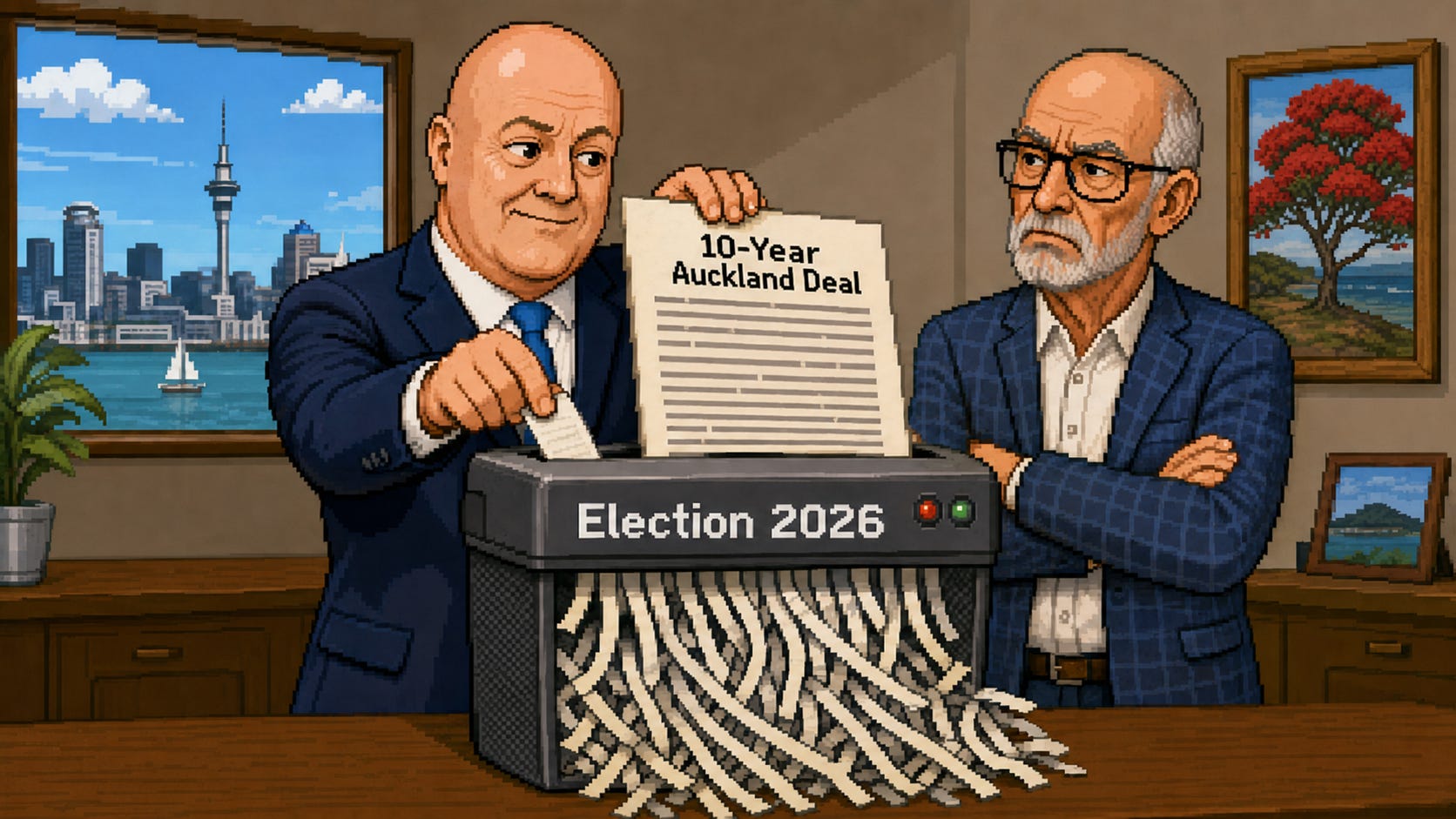
Four months ago, Christopher Luxon and Wayne Brown stood together to announce what the Government called a “landmark Auckland Deal” and a “new era of long-term partnership” between central and local government. Now, fresh from National’s election promise of “no new taxes”, it’s increasingly difficult to see city and regional deals as being worth the paper they’re printed on.
As part of their “no new taxes” pledge, National has ruled out introducing an accommodation levy, commonly referred to as a bed tax, if it is returned to government in November. There is just one fairly significant problem with that. The National-led Coalition Government has already signed an agreement with Auckland Council committing it to explore precisely that policy in 2027.
When the Auckland Deal was signed on 10 April, central government explicitly agreed to explore an accommodation levy policy in 2027 and to work with Auckland Council towards sustainable long-term funding for destination management and major events. The document isn’t presented as a loose collection of ideas either. The Auckland Deal describes itself as a 10-year commitment, while the agreement says both parties have the authority to enter into it and that it creates binding obligations in accordance with its terms. Any changes are supposed to be agreed by the parties and recorded in writing.
National has now announced that, if returned to government, one of the most significant commitments it made to Auckland Council will lead nowhere.
To be clear, the Auckland Deal never guaranteed Auckland would receive a bed tax. The commitment was to explore one. There was always the possibility that work could conclude it was impractical or that another mechanism was preferable. But there is a significant difference between examining an option in good faith and announcing, months before that work is supposed to begin and just months after promising to do the work, that under no circumstances will you implement it.
This all sits rather awkwardly alongside the first of the Auckland Deal’s own “partnering principles”, which requires both parties to “act in good faith and demonstrate honesty, integrity, openness and accountability in their dealings with each other”. If the answer has already been decided, there isn’t much left to explore.
Unsurprisingly, Auckland’s mayor Wayne Brown isn’t impressed. Brown says National’s decision undermines the Auckland Deal and has argued that a bed-night levy is a user charge rather than a general tax, allowing visitors to contribute towards the events and infrastructure that help attract them to the city.
But the bigger problem isn’t Auckland, or even accommodation levies. It’s now the credibility of the Government’s entire City and Regional Deals programme. When the Auckland Deal was signed, the corresponding media release touted it as setting “a new standard for collaboration between central and local government”, while the Government described its deal with Auckland as the model for future agreements with other regions.
The Government’s own material says these deals are supposed to “signal commitment” between central and local government and provide the basis for detailed planning and negotiation. The Auckland experience is now signalling something rather different: that these agreements cannot be relied on.
The problem is that these deals only work if councils, and the communities they represent, can reasonably believe that the commitments central government makes in these agreements will survive longer than the next political announcement. That is now no longer the case.
Why would a council make difficult planning, funding or investment decisions on the strength of a 10-year deal with central government if central government can simply change its mind a mere four months later? Why compromise on local priorities during negotiations if the Crown’s side of the bargain can disappear when it becomes politically inconvenient? And why should councils devote significant staff time, money, and political capital to negotiating these agreements if they ultimately amount to little more than vision boards that central government has no genuine intention of delivering on?
It’s all particularly awkward when other regions are being actively encouraged to enter exactly the same process.
Queenstown Lakes Mayor John Glover has already called National’s accommodation levy reversal a “complete U-turn” given his district was also meant to be signing a deal with a similar accommodation levy commitment. This is a view no doubt shared by other tourism-heavy councils who have been among the strongest advocates for giving local government new tools to meet the costs created by visitors.
This is why City and Regional Deals were meant to matter in the first place. Their value wasn’t supposed to be another glossy strategy or photo opportunity. It was meant to be the ability for central and local government to make durable, long-term commitments to each other that stretched beyond the normal political cycle. The Auckland Deal itself talks about “long-term certainty” and a new partnership between Auckland and Wellington. National has managed to undermine that certainty in near record time.
The accommodation levy might be only one line in a much larger agreement. But by ruling it out in bad faith before the agreed work has even begun, National has created a much bigger question for every council being encouraged to enter one of these deals: what, exactly, is a 10-year agreement with central government worth if its commitments can be discarded so quickly and easily?
National has, at a minimum, seriously undermined, if not completely wrecked, the credibility of its entire City and Regional Deal framework.
Voters around the country might now reasonably ask: If National can so casually walk away from the substance of a major agreement Christopher Luxon signed just four months ago with our largest city, how much weight should they put on the myriad of promises he and his party will make over the coming weeks on the campaign trail?
Comments
Nothing yet. Say the first thing.
Sign in to join the conversation.