

Context:
My journey with this topic started with a “this is dumb” initial reaction back in 2023, and has evolved to “this CAN makes sense” recently. I am still against the proposal, but let me walk you through the thinking process. I think a lot of the actual nuance is buried in a sea of vague arguments. Let’s try to fix it.
First of all, three big headlines you’ve probably seen - to get them out of the way.
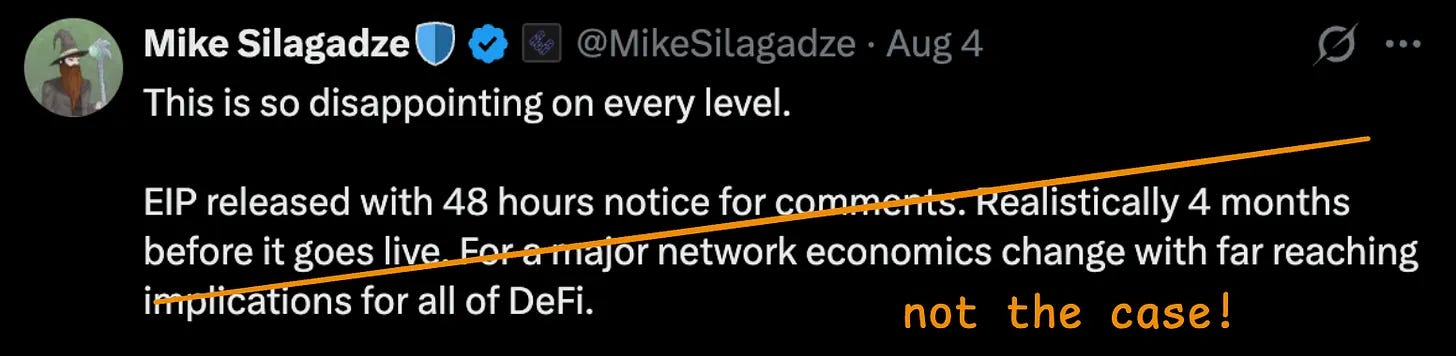
Note #1: There is no inclusion yet, nobody rushes such important changes within 48 hours. There is no big process abuse here, since a ton more procedural work would have to be done, which can alter the details a lot (PFI -> CFI -> SFI -> etc.) Proposals get rejected or postponed very often. See here, but also there is this comment. In any case, it’s not like someone can easily slide in big changes like that immediately.

Toni Wahrstätter ⟠@nero_eth
Tbf, it was not proposed late in the process at all. We have the PFI -> CFI -> SFI -> mainnet pipeline for 2 forks now, and the issuance eip, without judging its merits, has been proposed (alongside ~40 other EIPs) in time to be considered for next year's fork. PFI'ing is simple.

Hasu⚡️🤖 @hasufl
Timing of this proposal is at best unfortunate, and at worst highly erosive of Ethereum governance practices.
6:28 AM · Aug 5, 2026 · 4.2K Views
5 Replies · 8 Reposts · 47 Likes
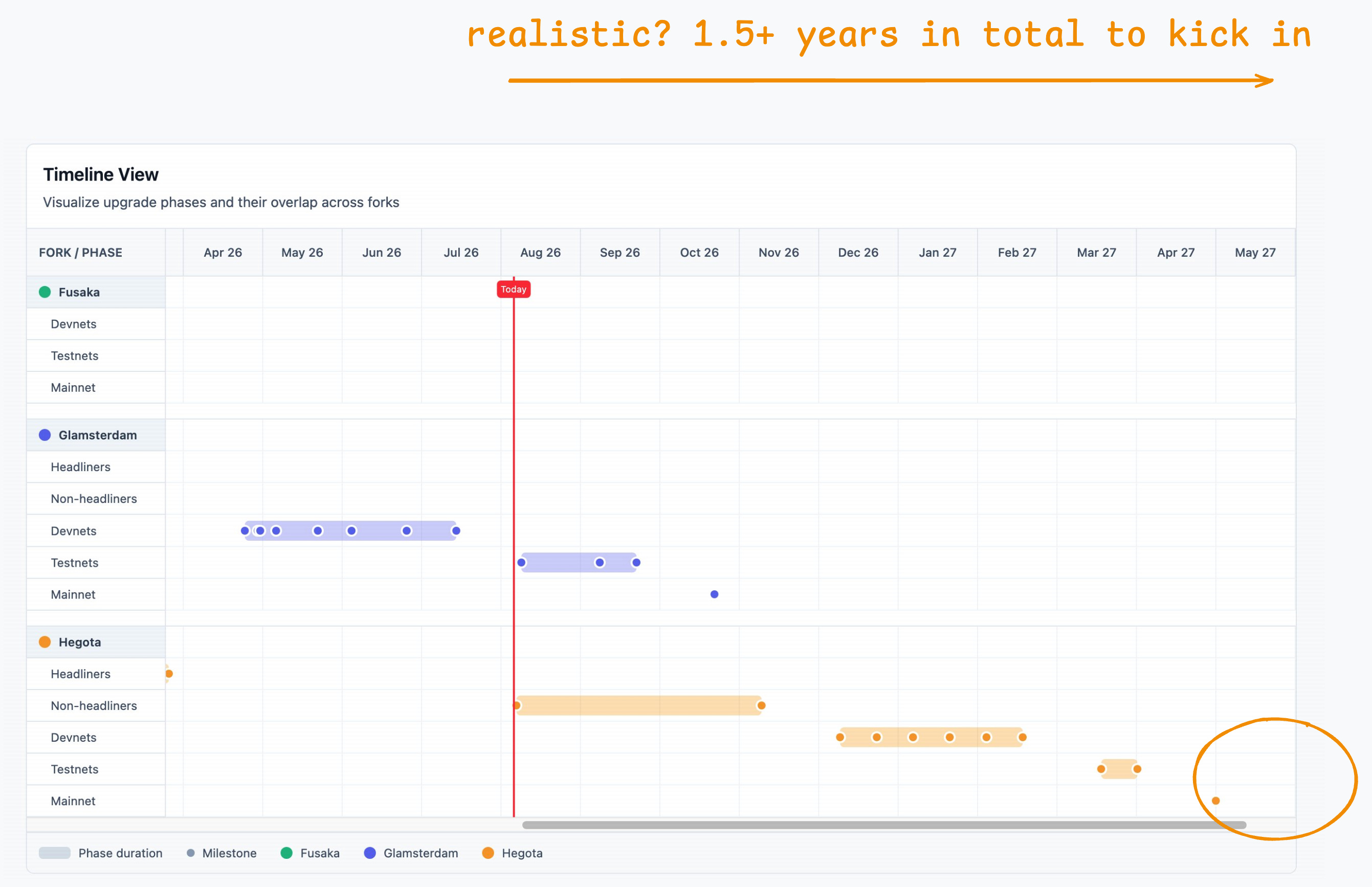
Note #2: There is no mismatch of priorities here, because network changes have to start very early. “There are bigger priorities now, this isn’t relevant for the next couple of years” - sure, but proposed today, such a change can only really be there in 2 years if not more. The timeline to Hegota is 1yr+, and then 18 months on top to fully reflect changes. Realistic Hegota mainnet? You’ve seen software launch cycles before, always add a few months on top. Anyway, a minimum of 2 years from today for the effects to be really felt - is the fastest scenario. See here.
Note #3: Most authors are not part of the EF - they are community members who can do whatever they want in their free time. EF has no consensus over this and many don’t even get involved since it’s not their line of work. This is a community proposal in an open forum. Yet communications should still be done better, but lack of comms is part of decentralized networks unfortunately, hence each one of us should express their opinions and thus form a more educated opinion in the process.
A while back, at an Istanbul side event in 2023, I heard Ansgar talk about the issuance curve reduction research. At the time, I remember thinking to myself: This is so stupid. Why are people wasting time on this? ETH goes +/- 10% every day, why do they care about this minimal underlying change? They are so out of touch!
Back then, I was building a DeFi protocol (Gearbox), grinding to figure out how to get even $10 million in TVL through the door. I certainly wasn’t thinking about how to secure hundreds of billions onchain, so those ideas seemed very strange to me.
My reaction back then is the perfect lens through which to view the current issuance debate. When you run different projects and occupy different roles, your priorities completely alter your perspective. It’s not that one side doesn’t care about the other - it’s that both sides have totally different primary objectives, even if the “growth of Ethereum onchain economy” is the end goal for all. A DeFi founder thinks of survival, especially in the current bear market, while researchers and security experts have to think of all hypothetical attack vectors 5+ years down the line.
The clash of “we WILL suffer today” vs “we MIGHT suffer in 5 years”.
There is a reason why separation of powers exist in the real world for such concepts as rates. However, a crypto network can’t really replicate such a centralized system. Therefore, we have to have a wide consensus on economics which is an impossible challenge to begin with, and you can’t make everyone agree, because:
(a little off-topic)
Off-Topic: Economics is Not Deterministic, it’s Confidence → Behavior
The ideal outcome to any economic problem is simply that enough of the participants agree on the outcome. Even if a change is technically wrong, it simply needs people to believe that it is right. Did you see it? I just said bullshit! It can’t inherently be right or wrong - it’s the belief in free markets that counts, not an incremental 1% change up or down. We aren’t selling potatoes with a definite cost basis; this is a frontier high-risk market where the underlying asset fluctuates 10% intra-day at minimum.
The real cost here is alignment. If you don’t align the ecosystem fully, your proposed change ends up wasted and becomes a net-negative brain pollution in the short term. Poking a bear has a lot of downside and highly questionable upside. Therefore, even proposing an economic change requires a staggeringly strong reason. Markets are built on confidence and forward-looking scenarios. So while I apologize for disagreeing with some and not letting this ship sail smoothly, we have to look at the actual arguments being made. If the two choices are:
we WILL suffer today, and;
we MIGHT suffer in 5 years.
Then to have people take the stance of (1), the arguments can’t be just solid. They have to be super strong and absolutely immovable. However, I (and everyone commenting) don’t see them as such, and that’s a problem. And that is partly because:
(back to the topic)
I mentioned that the pro-reduction agenda clicked for me a little bit today (not convinced, clicked). But that came from ecosystem participants deciphering the proposal, and not the most arguments presented by some pro-reduction authors. PS: you can refresh your memory on all arguments here: https://issuance.wtf/.
The proposal text talks of issues of security and over-staking which can be reasonable arguments for a discussion and for properly discussing the issue (even if one disagrees), with one sprinkle of “ETH as money” section fugazi which makes the proposal more vague. I’d suggest removing such subjective narrative context.
My problem is that a lot of importance is buried in the sea of vague arguments posted all around, which degrade the debate and become pseudo-economics fights.
“Solo staker’s return net of dilution improves under reduced issuance” (forum post, not EIP text) - pseudo-economics number one. This would be true if there was some USD peg of the ETH price, but there isn’t. If there is an implied assumption that less inflation means that ETH price go up - that’s pseudo-economics number two. If there is no such implied assumption, then the yield stakers get would be lower in the new proposal as a total.
“Most jurisdictions tax nominal yield, a lower nominal / higher real mix shrinks the solo staker’s tax wedge” (forum post, not EIP text) - pseudo-economics number three, making opinions about staking security based on tax rules.
“Nominal yield minus dilution is the number an institution should underwrite” (forum post, not EIP text) - very subjective. We aren’t even talking of forex here, we are talking of an asset that does +/-10% intra-day. Staking helps model structured products on top of having a risk-on asset exposure which makes it attractive to many (which is growth of the onchain economy). Humans love passive incooom as a way to justify higher risk on an asset, even if it’s not passive or net income as such (to each their own taste, free markets after all).

pintail@pintail_xyz
@tigzorr @cloudsfables @jdetychey @dapplion @Pa7x1 @ladislaus0x This proposal is all that would keep solo stakers like me viable. Once we reach 60% staked my post tax income will no longer compensate dilution. Same in many jurisdictions.
12:25 PM · Aug 5, 2026 · 484 Views
2 Replies · 3 Reposts · 12 Likes

Jerome de Tychey 🦇🔊@jdetychey
Why it matters (part 1)? Security. 🔒 Past a point, more stake makes Ethereum LESS secure: ➡️ solo stakers forced out first due to taxes on nominal yield and dilution (real yield = yield - issuance) 💸 ➡️supply concentrates with custodians & staking providers 🏦 The social layer
1:53 PM · Aug 4, 2026 · 19K Views
10 Replies · 2 Reposts · 43 Likes
Sorry to single out like that, but this logical line is present across many tweets. With all due respect to these researchers-authors and fellow holders, this is flawed.
Overall, an argument that “solo stakers are forced out first due to taxes on nominal yield and dilution in the current status quo” (forum post, not EIP text) is not strong - but is being thrown around sooooo much. The reality is that the percentage of solo stakers is small right now, and it will likely remain small in the future whichever of the two paths gets chosen. Arguing that the current system uniquely punishes them is not a strong factual anchor - the new system punishes them as much by paying them less. Solo stakers, this magic abused and killed unicorn, is a group of people that will either not change their behavior or will wither away anyway, and neither the current situation nor the new proposal address this. Therefore, you can’t use this argument, it’s too shaky. Stop mentioning solo stakers if you don’t have 100% solid footing.
DON’T MAKE 10+ ARGUMENTS IF MOST OF THEM ARE WEAK.
There is a tendency between the lines to hint like less inflation is good for the price, or that bonds work better with less issuance - all of these are subjective at best. What enrages me is the mixup of proper arguments with these pseudo-economics. Furthermore, we are wasting time debating whether ETH is “money,” a “unit of account,” or something else. Ethereum has the lowest inflation among almost any asset, be it gold or bitcoin or something else. It’s already not a problem.
This drags the conversation away from the core technical realities of network security.
Instead of making up stories about how less inflation makes the price drop less, the pro-reduction side should just resort to the default position (at least that’s the position that makes sense to me in the sea of other points): “Infinitely growing staking rewards are not necessary and in fact become kinda bad at some point. This is not a problem today, but it might become in the future, so we have to address it.”
That’s it. Done. It is vastly more respectful and clear.
The arguments which are probably relevant but we can’t loop them in, could be about some thoughts around (1) MEV reduction if and how this ever happens, and (2) finality and number of validators discussions. There is likely some canary there too, but I am not qualified to say how either will affect either side of the argument with certainty.
One of the authors said it well in here (it gets the point across):

Lion ⟠ dapplion .eth@dapplion
@avsa That’s the problem: the curve is almost flat from 50% onwards. After 50% you have to stake to not be diluted. Staking becomes and obligation not a service.
1:03 AM · Aug 5, 2026 · 223 Views
3 Replies · 1 Repost · 8 Likes
The proposal text says it in more words:
Beyond a certain level, additional stake makes Ethereum less secure, not more: the marginal contribution of new stake to economic security falls as the ratio rises, while several risks compound. As an ever-larger share of the ETH supply is held by custodians and staking providers rather than its owners, the social layer is deprived of its ability to hold large operators to account…
Let’s decipher it: as the asset gains mainstream popularity, retail users and institutions will naturally park their ETH into staking. Under the current incentive curve, there is absolutely no reason for those providers not to stake every single user deposit they hold. Staking becomes a default, and there is continuous payment for a default that’s not needed. - That’s a scenario one can’t argue with, right? It’s not a “ser, all 100% will be staked”. No need for exaggeration like that.
And here is what I feel is the real issue: an attractive asset utility being staking is essentially a bad thing for network security? What DeFi teams present as a positive is actually a self-fulfilling prophecy, or they say so.
We are back to where we started: the same question, but different priorities.
The current curve is a high payment (yes/maybe/whatever) → is it an issue economically in terms of high inflation, or an issue for security? → not economically (argued below, ETH inflation is already super low) → if the latter (security), then the argument is that it becomes net-negative when too much is staked → this is something that can be a strong argument, at least it can be).
Economically bad: no. Ethereum has the lowest inflation among almost any other asset, be it gold or bitcoin or something else. It’s already not a problem.
Economically good: more yes than no (for now). DeFi, the argument Stani and all founders are making, predictable institutional growth, structured products, etc. You can read the text here, it’s a good summary of the DeFi stance. DeFi can change and go through the pain, but the reason for that has to be super strong.
Security good: no (the argument of the proposal): agree, it’s useless but harmless. Don’t confuse it with “overpaying for security” - that’s not it, that would have been okay to overpay if it gave actual security. It’s overpaying for nothing.
Security bad: yes (the argument of the proposal): don’t agree, not really.
The “security, neutrality, and resistance to capture” section addresses this.
Note: I am not qualified to answer 3 & 4 properly to be honest, but this is where the debate should be. Not pseudo-economics, not inflation stories, but network security.
To me, out of the 4 points above, number 4 at least has merit for being a strong argument. Maybe I read between the lines too much, but this is the single aspect that can make staking growth a problem - but I don’t feel I see the consequences as bad as they are portrayed to be. In fact, in the new proposal CEXes will eat some solo stakers (or might not) and some LST market share (likely to some extent). CEXes can still stake at super small rates - while solo stakers, smaller firms, and some LSTs - can’t (and they all say so, I read the reports and don’t see how it’s different).
If Coinbase today has 30% of the 30% staked - and will later have 30% of the 60% staked - what’s the real centralization / coercion issue? That’s already quite big. Passive ETH holders don’t have any way for a social push regardless in either case.
I am in the camp of people who don’t agree with the forking and coercion arguments (see “Stake concentration leads to moral hazard” and “The social layer loses its backstop” in the text). Why? Because with the growth of USDT, USDC, and other RWAs - it’s unfortunately (practically) a different game altogether. It’s a social layer and communications that do it, and currently that social layer says “don’t”. I think it’s better to respect that layer than the 5yr+ down the line hypotheticals.
The downside scenario probably doesn’t change as much with either direction, but one comes with a huge pain and less printing - and the other one doesn’t come with a huge pain but comes with excessive (so what) printing.
Maybe I am wrong, but my thinking goes as follows:
The threat isn’t as big as described;
The threat, even is real, is less than the pain it will cause;
The pain is fine to have, if the fix is actually strong and more permanent…
If we can at least agree on the proposers’ genuine network security argument - the debate can take a better shape. And then we have to answer: is a “fix” suggested good enough for the pain it will cause - or the problem requires a better fix? It will take time, but at least the pain will then be justified? Something like that.
I am not against capping issuance as such, I recognize the security argument as potentially valid and respect the research that was done. But again, pain has to come from strong logical anchors and not arguments about solo staker tax bills and ETH as money narratives. The app layer stack would be able to take the pain and work with it - if the fix and the arguments seemed more solid and be really long-term fixes.
Therefore, in its current state, I am still against the proposal. Not because of the timing, not because of the curve itself - but because I believe ETH’s staking rate is a stronger second-order effect - being a feature, not a bug.
I align with DeFi here more than the hypothetical threats. Although I am not worried about DeFi changing or ETH going into different yield avenues (I’d actually want to see it), the solution which comes with so much pain - has to be stronger.
I could be totally wrong, but this helped me to at least put the whole picture together, removing fluff from the arguments. Hope it helped you too! And again, debating things online and not having a dictator is why I am here, even if my opinion ends up being wrong (again).
My apologies to colleagues and friends who disagree with me on this, but it’s an issue I can’t be silent on since it’s within my scope of interest. It is important to note that the EF doesn’t centrally push EIPs or proposals, and EF members can and do disagree on these topics. Ethereum is a huge network. Curious if ethlabs posts an alternative to this! And curious how strong the arguments from Bitmine and Sharplink will be, for example.
This is not an EF-capacity message. I wasn’t involved in any of these conversations internally, as this is a long-dated topic. I am speaking purely as an ecosystem member and a holder of ETH (and LSTs). I don’t have any beef with either side, and I am happy to be proven wrong, but make me rich, please.
Comments
Nothing yet. Say the first thing.
Sign in to join the conversation.