
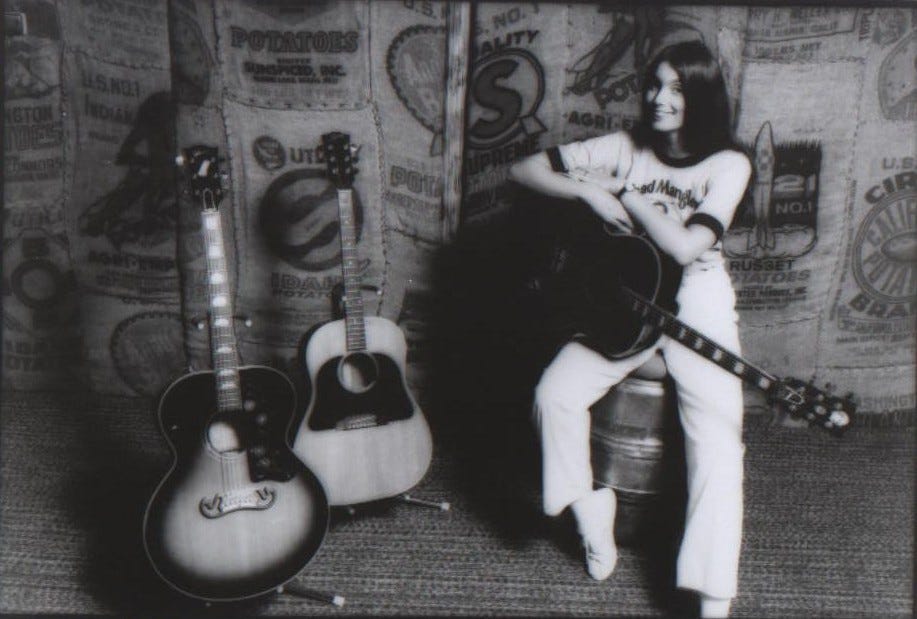
As a lifelong fan of Appalachian folk music, and as a songwriter myself, I often find myself lost in the lyrics of the songs that I love. Knee deep in the stories that they tell, wading through decades of tradition and generations of community, I follow the words that flow through the lips of Doc Watsons, Elizabeth Cotton, or any of the other writers that were raised under the pines of Appalachia. Listening to these artists and the stories that they tell, I can’t help but wonder, how does this differ from the act of writing literature?
When we write poetry, what is it that we aim to achieve? When we read it, what do we gain? These are not questions that can be answered easily, and I would go so far as to say that these are not questions that can be answered at all, at least not universally. Each writer has a unique motivation. Each reader derives a distinct meaning. Yet, how different is the outcome of a writer publishing a book of poems from that of a songwriter releasing an album? Of a reader annotating from that of a listener reflecting? The form is practically the only difference. The substance inside is just the same.
So, below I have compiled a collection of Appalachian folk songs that can be read as poetry. With the removal of the resonating strings and the prancing melody, what you are left with can only be described as a poem.
Seeds of the Pine by Martha Scanlan
Cottonwood a-shakin in the breeze
Surrounded by a starry sky
Easy to forget the things we need
Easy to stumble around mostly blindI could tell you not to come in from the storm
I could tell you not to be so kind
I could tell you not to close the door
I could say I never wanted you for mine
Picking what to highlight in the quote above felt like a gargantuan and entirely impossible task. I say this to emphasize the profundity of every single lyric in this song. “Seeds of the Pine” is a pinnacle of writing that blends imagery, metaphor and a conversational tone seamlessly. Yes, it is a song about being in love, but it is also saying something entirely singular, something that needs to be said and can only be said in this way. That is the mark of every poem that I have truly loved. One cannot summarize it or explain it away. That would eliminate the need to write it. It is only itself and it is only saying exactly what it must.
Rains fell cold through June
Grass is up to my thigh
Say if it dries up it’ll burn just like the moon
Say it opens up the seeds of the pine
The chorus of the song, pasted above, returns to the image of a wildfire. She writes of pine cones opening from the blaze, an allusion to serotinous cones, a type of pine cone that is naturally glued shut with resin. Underneath the hard protective layer, mature seeds lay dormant for years. It is not until wildfire melts through that they cast the seeds to the wind and to the soil, allowing for new growth. I read this as a metaphor of the walls we build around ourselves in hopes of self preservation. The fire, on the other hand, signifies the force that would be necessary to take down these walls. I also notice her use of simile, “it’ll burn just like the moon.” It is counter intuitive, the cold image of night, an icy blue moon. Yet, the moon casts light because of the sun’s reflection. It is the indirect force of the raging sun, diffused by thousands and thousands of miles. It is this distance that she writes from when she sings, “Say if it dries up…” By adding the “say” she is no longer the speaker. She avoids the danger of facing what she needs, protected by indirect speech.
Oh, bury me beneath the willow
Under the weeping willow tree
So he will know where I am sleeping
And perhaps he'll weep for me
So reads the repetitive chorus of the iconic ballad. Although popularized by The Carter Family in 1927, the original writer of the song is unknown. However, for this example I will link to my favorite version by Emmylou Harris. The song takes the perspective of a woman who is separated from the man that she loves by her own death, that occurs before their wedding day. She longs to be buried beneath the willow tree so that her love may mourn her there. The willow acts as both a metaphor for grief, the word weep reflecting both the verb and the name of the tree (weeping willow) and as a symbolic representation of the southern Appalachian landscape. By establishing the listener in this postmortem point of view, a rare and unique look at love and grief (or lack thereof) is achieved. Yet, the repetition of the chorus, and the speakers refusal to give up hope that her love will someday return to her place of rest to mourn her, emphasizes a truly devastating denial. Even from beyond the grave, the trivial resilience of human hope lingers, attached forever to the soul. It is this disembodied and eternally optimistic spirit that haunts this morbid take on love after death.
Angel From Montgomery by John Price
Make me an angel
That flies from Montgomery
Make me a poster
Of an old rodeo
Just give me one thing
That I can hold on to
To believe in this livin'
Is just a hard way to go
This is a song that sticks with you. Like a piece of gum on your shoe, it’s got words you can’t shake. And there is a universality in it that leads me to believe that to be the case for anyone who might listen. The lines tell the story of a life drained of meaning. Monotonous and stagnant, the protagonist—a middle aged woman who feels very old—dreams to be an angel, one that can fly away from her life and towards a better one. Now, I know there are some who may claim that this doesn’t neatly fit into the Appalachian folk genre and that would be fair—Prine is from Illinois after all. Yet, the cultural wake of Appalachian music is wide and far. Its influence is challenging to measure. And, the center of the story told, as the name suggests, takes place in Montgomery, Alabama. So, allow me this wiggle room to honor a piece of poetry that has nestled deeply into my life. There is no way to expand on every detail of a song as vast and pervasive as “Angel From Montgomery.” Prine captures the resignation of exhaustion, the upstream battle of living in the face of decades gone by, of a past that came and went. The song is a plea for anything worth holding. It is a grasp for meaning that makes it all worth it. There is one line from this song that I always return to when considering why it is that I write. It reminds me why it is always worth it to put words on a page. It reads, “How the hell can a person go to work in the morning then come home in the evening and have nothing to say?”
My race is run beneath the sun
Hell is waiting for me
For I did murder that poor little girl
Whose name was Rose Connelly
This old tune is another that has been around for too long to track the author. In that lies a notable difference in form between poetry and song. The act of singing, folk music especially, is a communal act. It is built upon sharing and passing along. The history of folk music began with word of mouth, many who sang could not write, and many who listened could not read. This accessibility allowed for a universal community, especially compared to the more solitary act of writing poetry. Still, the words persevere to this day and “Down in the Willow Garden” also referred to as “Rose Connelly” is proof of just that. From its untraceable origins it has been passed down and immortalized in hundreds of songbooks and in thousands of minds. It tells the cautionary tale of greed, murder and retribution. A man lies with his love, eaten by guilt just above the river bank where he killed an innocent girl. The song is an admission of fault, but the man does not beg for forgiveness or pray for holy mercy. He instead imagines his father tears upon seeing his son hanged and accepts his fate in hell.
⁂
No posts
Comments
Nothing yet. Say the first thing.
Sign in to join the conversation.