
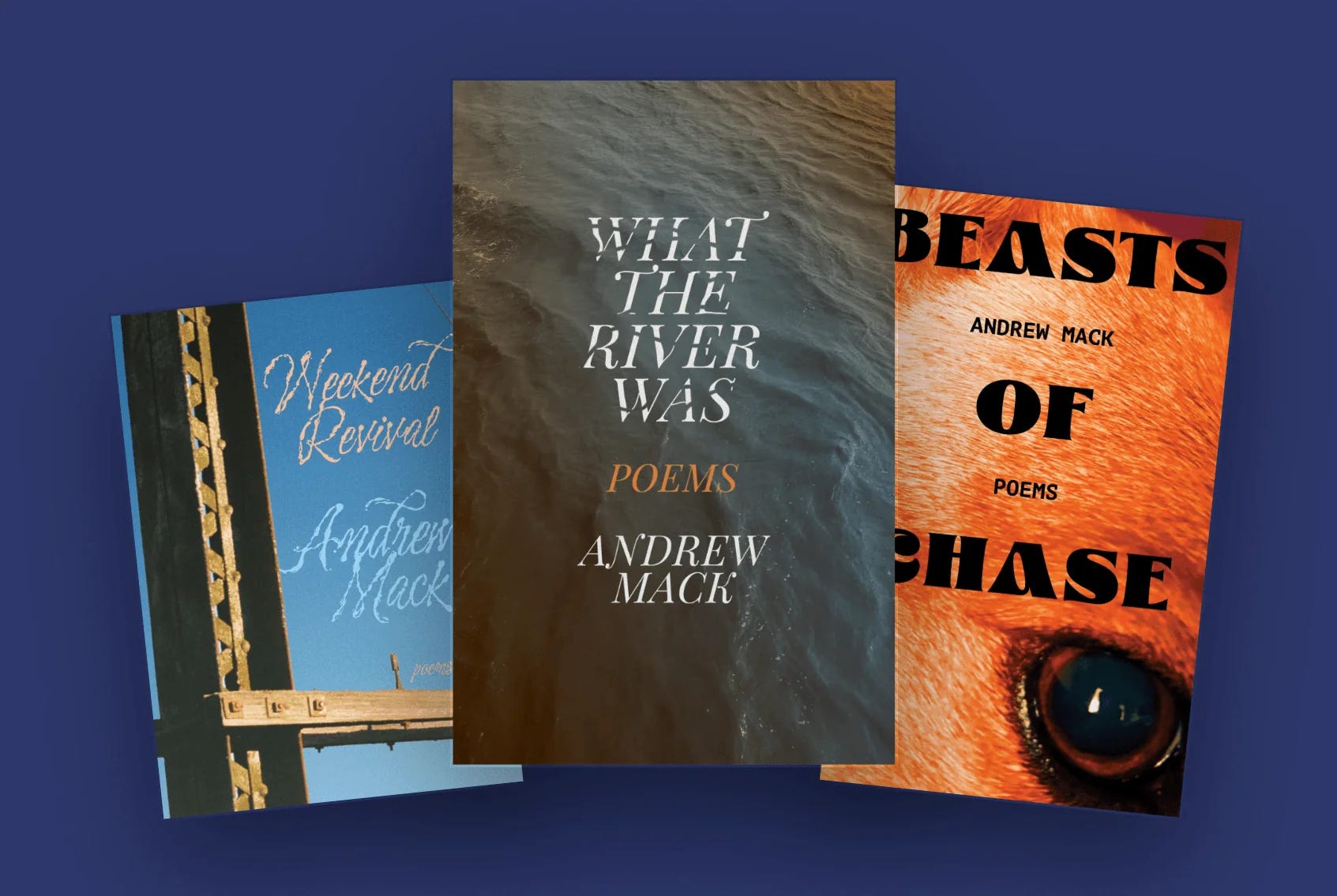
Ahead of the rerelease of his chapbooks Weekend Revival and What the River Was, I sat down with Andrew Mack, Loblolly’s very own founder and editor (not to mention wildly talented writer!) to discuss what goes into a rerelease and reflect on the current state of indie publishing. He discusses the creative and practical decisions behind reshaping the books, from new covers and formats to revisions, photography, and the relationship between visual design and the reading experience.
The conversation also gives us a glimpse into FURY, an ambitious full-length collection shaped by family history, regional identity, archival research, and the complicated landscapes of South and North Carolina. Along the way, Andrew discusses the role of music, Appalachian folklore, environmental records, and found poetry in his practice, including the collage-based work at the heart of What the River Was. He also offers some candid advice for writers navigating both the solitude of making art and the entrepreneurial, communal work of bringing it into the world.
I'm doing this re-release now because when I was originally designing my books, the inspiration was really just: I want to get my work into the world, I want to control how it looks, how I market it, and build my own following. I was entrepreneurial about it. But I didn't have the design skills or the resources to produce a great cover or a great interior. I'm proud of what they looked like at the time, but when I put them side-by-side with what the press produces now, they didn't feel like they fit. At the same time, I knew the work was something I was really happy with — I wanted to be able to sell them alongside all of our other books. So I took the design skills I'd built doing titles for Loblolly and applied them to new editions of Weekend Revival and What the River Was. I also changed the trim size of Weekend Revival — it was an 8½ x 5½, and I brought it to 5 x 7 to match our other chapbook formats.
On the publishing end, a re-release is pretty manageable. I did all the design work myself, and I had most of the material — though there is some new work in the collection, so if you already have a copy, there’s new stuff in there. I pulled from my journal from that time period and looked at everything with fresh eyes: what could be improved, what still felt true to the period in which I wrote the originals. I wanted it to feel like a really nicely packaged thing. The photography on Weekend Revival is from the Broad River in South Carolina, where I grew up — from an old trestle bridge that inspired a lot of the feelings in those poems. Weekend Revival is really all about voices speaking through time. There’s a story of a doctor who died on that bridge on his way to give medical care in another town, and that always stayed with me.
I was never really happy with the design of What the River Was — specifically how the cover turned out. Being able to redesign it with the skills I have today was great. I also got to reformat a few of the poems in ways that felt like they really helped the reading experience. Format is just such an important part of how people read poetry.
FURY is my full-length collection. I've been working on it for the last six years. I've been talking about it for a while, and I really wanted it out this year but honestly, it's just been a lot harder to write than I thought it would be. It's at first a personal exploration of my family's history, the interaction between both sides of my family tree, who comes from where. I take into account what it was like to be raised in South Carolina and now live in North Carolina, and I trace some of that journey. South Carolina is one of the states I love the most, and I also know it's history, intertwined with mine, is fraught. I want to engage with all of the elements of the place I consider home and shine a light on its untold stories.
Beasts of Chase is my most recent chapbook and is actually not being re-released — I'm just really happy with how it turned out. And honestly, how well that one came together is part of what made me think about repackaging the previous two. There's a list of songs at the end — the songs I listened to on repeat while writing it. I was lucky enough to write the book at a friend's house on Lake Lure over the course of one weekend, with some editing done on another weekend. They've since moved, but it was a really important place for me to write. The book started with an inspiration and fascination with history, which you'll find throughout my work. I'm interested in family history, oral history, Appalachian folktales. One of my nerdier things is that I like to read old forestry documents from the US Forest Service — surveys, animal population data — to understand the impact of our actions on the environment. My work is very often grounded in truth and in shining a light on facts — things that show up in survey documents like the weight of the largest bear ever harvested. I find those words and I flip them, to reveal their brutality, especially around animals. I never want to be insensitive; I always want to respect those animals and tell their story.
I feel that same way about FURY, but it's even harder to get that granular about my own history. I'm using archival documents, pulling in history from the region and from where my family comes from. This new project is less about identifying a personal arc — "where I come from" — and more about where we all come from. What's the unifying factor we share? I believe in something larger than myself, and that thing is a shared experience of a place. How we experience that place is different for everyone and changes over time, but the physical landscape, it's geography and history, is something we share.
The music I listened to you while writing needs to be rhythmic and almost trance inducing — not everything but I definitely find things that I like to keep on repeat and it helps me just stay focused on the creative moment. It's really important for me to be present while I'm writing so one song I'd say that's really inspired FURY and keeps FURY going is Shady Grove the Taj Mahal verison.
In What the River Was, I do collage — I reorder language from articles published in National Geographic. It's called found poetry, and I think a lot of young writers get a lot of inspiration from it partly because it's playful, and language should be playful. Building a collection based on reordering words — and for me, using physical collage to do that — is one of my favorite things I've ever done, though it's sometimes hard to get back into it. I used to have huge stacks of National Geographic magazines around the house. But it's similar to what I said about flipping the meaning of historical documents: you can read something from 1952 and just placing it in the context of today — and then taking the words and turning them into something new — can reveal things that weren't visible before. Music does this too — thing about how many versions of any particular song can exist in the world and still be so different. Found poetry is just the cover song of the poetry world.
One of the pieces I've written comes from an article about exploration in the Arctic Sea. What interested me most was how inhospitable that place is for us, and yet how much we crave extraction from it. How much harm we do to it even though we're so fascinated by it. It's not all monetary — there's something about the end of the Earth. The further north you go, the more people are drawn to it, and the same is true of Antarctic exploration. I built that found piece around three letters — I took words and created three letters from three different time periods, starting in the 1800s, moving into the 1900s, and then something closer to the present — tracing the impact of climate change on the psyche of the people who are there. They're written as letters from the past, but between people I've made up. That's part of the power of a found poem: I don't have to focus solely on the words. I get to focus on how to repurpose language in a way that is interesting, new, and also visually compelling — which operates more like a visual art practice.
For writers looking to be published, the first thing you should be thinking about is what the work feels like to you. We don’t write to get published. We write because we’re interested in something and we want to share it with others — and that’s very different from getting published. If you want your writing published, write something and share it with your closest friend, your partner, your parents. Seek feedback and also enjoy the encouragement. Enjoy the process of doing it. I find that when I’m really in the writing headspace, I’m closer to my own spirituality than almost anywhere else. I felt that way writing all three books.
I’d also say: writing requires solitude. I don’t think people understand how much of writing is spending time with your own thoughts and being comfortable with that.
That’s the creative side. The publishing side is business. It’s how you build something around your work. And no matter what anybody says, being an author means being an entrepreneur. People will want to read your book not just because of what’s in it, but because you are interesting — you are part of it. There’s this myth that you can be a writer who never talks to anybody. Maybe some people can do that. But most writers have to get in front of people, share their work, and understand that they are also performers and that they are thinking about business applications of their creativity. Writing is the first part of the work. If you want to publish, you have to be open to the idea that it’s not just about the art anymore. It’s about getting your work into as many hands as possible — and how many hands that is, that’s a goal you get to set.
If you desperately want to be published by a large publisher, there are certain steps you have to take. But if you're like me and you wanted to do it on your own — you can. It's harder in some ways, but in others it's easier. You have the freedom to design your own work, plan your own tours, connect with the people you want to connect with. That autonomy mattered a lot to me. For others, maybe not — maybe you want someone to handle that side so you can focus on writing, and that's fine too. But I don't think you can pretend that writing and then trying to publish isn't, at its core, an act of community.
⁂
Andrew Mack is the Founder and Managing Editor of Loblolly Press. He oversees editorial direction, acquisitions, and author partnerships across the catalog. His work at the press is grounded in a commitment to sustained editorial care, transparency, and building space for writers whose work is often sidelined elsewhere. Andrew is the author of three poetry collections, Weekend Revival, What the River Was, and Beasts of Chase.
No posts
Comments
Nothing yet. Say the first thing.
Sign in to join the conversation.