
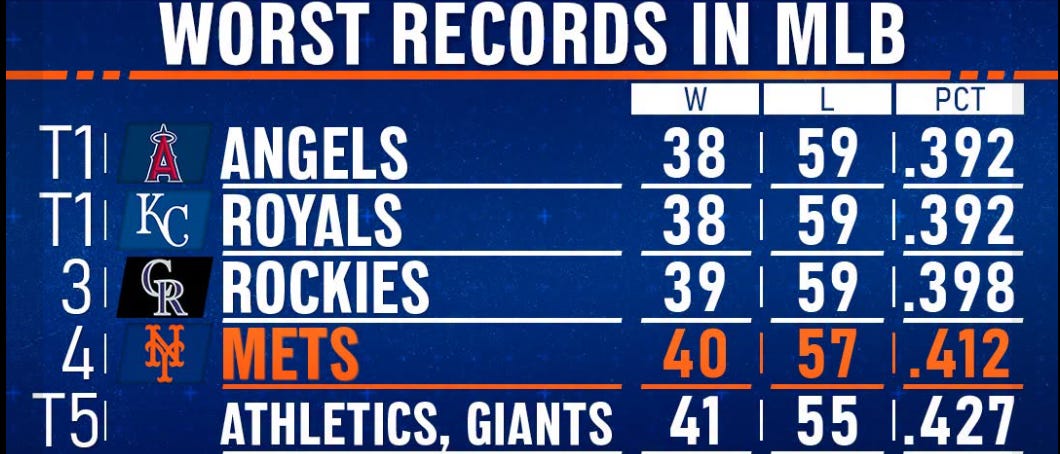
Thank goddess for the All-Star Break - amirite Giants and Athletics fans? Mets Nation is right there in the cellar with you. Both NorCal teams are playing .427 ball, Mets a dismal .412. Only the Royals, Rockies, and Angels are doing worse halfway through the season. Pathetic.
Typically, I hate the AS Break. In recent years, I was concerned Alonso would be injured during the Home Run Derby or some other stupid injury will remove a key player for the season. Most years, we’re rolling into July on a high and the week off breaks up our flow. This year, our flow needs to be destroyed and our Polar Bear is an Oriole. Sigh. I’m still not over it and may never be. Yes, I’m still whining about the 1977 Midnight Massacre Tom Seaver trade.

News from nearby: The Chico City Council voted Tuesday to create an Entertainment Zone in downtown Chico and in South Chico’s Meriam Park, copying downtown Redding’s successful experiment in embracing alcohol. Adults of drinking age will be able to get a wristband and take an alcoholic beverage out of an establishment and onto the sidewalk, like New Orleans or Savannah. Civilized.
Chico has been trying to eliminate alcohol from its downtown for 40 years. Chico State University is immediately adjacent to downtown and being crowned “Number One Party School In America” in 1987 by Playboy Magazine only added to the Town vs. Gown tension. Downtown wanted to be attractive to the Ladies Who Lunch, not the college students, apparently unaware that Chad and Tiffany had Dad’s Visa card.
They put an end to Pioneer Days, destroyed Halloween, and pressured CSUC to schedule Spring Break so it included St. Patrick’s Day. They got what they wanted - no students or their money in downtown Chico. Throw in the Camp Fire and Covid, and you have a recipe for an abandonment. Nature abhors a vacuum, so the homeless moved in.
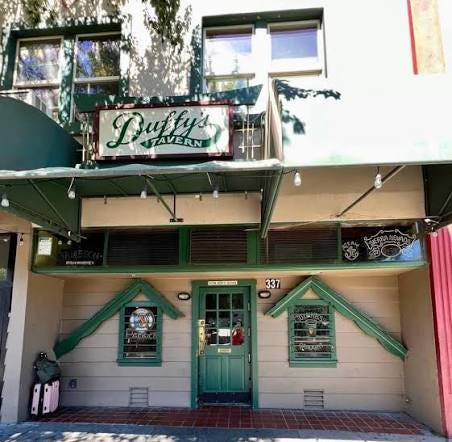
Zucchini and Vine, (Mecca of the Matrons of Mansion Park,) closed. Then the other anchor corner spaces on 2nd and Main were vacated and stayed that way for YEARS. 7-11 closed. Shocking. Then recently, Starbucks. Careful what you wish for. With venerable dive bars like Duffy’s hanging on by a thread, an Entertainment Zone might help save downtown Chico.
This Monday, July 20, the much anticipated Public Hearings over Groundwater Fees will take place in the Supes’ Chambers at 727 Oak St. in Red Bluff at 10am. The Farm Bureau will hold its quarterly tailgate meeting at 9 in the parking lot and they’re bringing coffee and donuts, so come early. They’ll be collecting protest vote letters, too, to be presented in public at the hearing so they don’t get “lost”.

Not that a protest will make a difference, even if enough letters are presented, which is a long shot. The District will just switch to “regulatory” fees. Remember Ordinance 9-2022 that required groundwater extractors to register their wells and pay 29 cents per acre per year for three years for the privilege? Sure, you do! That’s what the Garst case was all about.
Requiring registration by law gives them the idea that they are “regulating” groundwater extractors. However, the nexus of the so-called regulation to the activities that will be performed by the Groundwater Sustainability Agency is distant and weak, IMO.
Water Code 10730(a) says “A groundwater sustainability agency may impose fees, including, but not limited to, permit fees and fees on groundwater extraction or other regulated activity, to fund the costs of a groundwater sustainability program, including, but not limited to, preparation, adoption, and amendment of a groundwater sustainability plan, and investigations, inspections, compliance assistance, enforcement, and program administration, including a prudent reserve. A groundwater sustainability agency shall not impose a fee pursuant to this subdivision on a de minimis extractor unless the agency has regulated the users pursuant to this part.”
Requiring de minimis (domestic) users to register their wells is a one time activity with no burden on the GSA after the well is entered into the database, so to require ongoing fees is not relevant. A one time data entry is not “pursuant” to ongoing activities that have nothing to do with registration.
No groundwater extractor, large or small, is currently required to meter, report use, or comply with allocations or restrictions of any kind in Tehama County. We have some voluntary measures for ag folks. Those are not regulations either.
I’ve been reading the fee structures of many GSAs around the state and the three that keep coming up in my google searches are the three GSAs (out of 14 subbasins) in Sonoma County. They have similar fee structures and all three charge de minimis users under their well registration “regulation”. We copied, apparently.
The GSAs used the registration ordinance to satisfy the regulatory requirement of 10730. They stated as much in writing while looking for outreach consultants. “In 2019, the Santa Rosa Plain GSA approved development of a Groundwater User Registration Program (“GRP”) to enable, per SGMA, the GSA to charge groundwater use fees to de minimis users in the groundwater basin.”
At least they were honest about it. They received significant pushback from the public when their fee structures were presented back in 2019, but nobody sued. They do not have a David Garst over there.
There are significant differences between Sonoma and Tehama. Sonoma has a population of over 7 times that of Tehama and agricultural groundwater use is less than half. Here, agriculture is around 95%. De minimis is 1-4% - negligible.
Another huge difference is that all the GSAs in Sonoma charge the incorporated cities directly because they are the actual well owners and extractors. They sell their water to the customers, domestic and commercial. In Tehama, the GSA wants to charge every city user individually. The Garst Appellate decision left that idea dead in the water, however.
The Garst decision specifically says, on page 12, “we conclude a groundwater fee adopted under section 10730(a) may only be imposed on owners or operators of groundwater extraction facilities.” That would be the Cities, folks. The kitchen faucet is not an extraction facility.
The GSA’s own Ordinance 2026-2 exempts de minimis users “below a board established threshold” from fees. Then that threshold was intentionally left undefined, as Supervisor Matt Hansen gleefully pointed out during a board meeting. No matter - the state has already established that and it’s 2 acre feet a year. Tehama County cannot just make one up.
There are board members who believe everyone should be chipping in to protect groundwater and I totally get that sentiment. But that’s a policy decision, which is separate from what the law says. There are two subbasins in the San Joaquin Valley currently under state control for not complying with SGMA. The state has opted not to charge the de minimis users in those basins because they use a negligible amount of groundwater. You know, like in Tehama.
This fee structure cannot pass as currently written. If it does, there will be lawsuits and the county will lose. Again. With the Garst trial costing almost half a million dollars, can we afford the acceptance of this fee structure and another three years in court?
The Groundwater Commission, which approved the fee structure, was not given all the information by our consulting firm, Luhdorff and Scalmanini, who should have known all this and shared. I still haven’t seen a single example of de minimis users being charged fees in subbasins with heavy ag use, or any use fees at all being charged without meaningful relevant regulations. Until we have those, I don’t see how we move forward with fees.
Comments
Nothing yet. Say the first thing.
Sign in to join the conversation.