
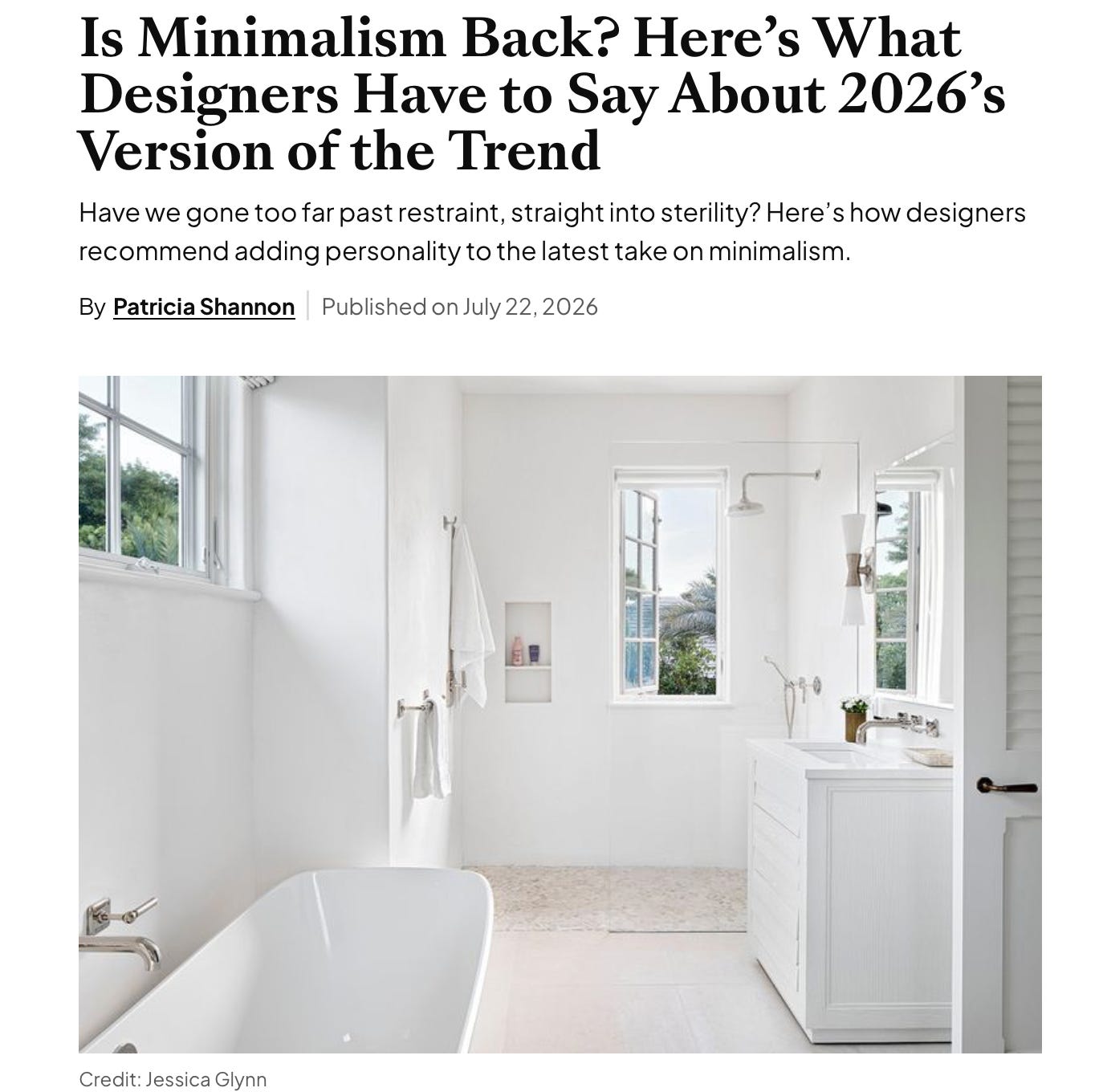
A recent article in Better Homes and Gardens asks, Is Minimalism Back? It talks to three designers who say things like “To keep your minimalist space from looking boring, add layers. “It is a must,” says [designer Meeshie] Fahmy. “Think knit or chunky throws on the sofa, pillows with texture, and a light neutral pattern for interest.”
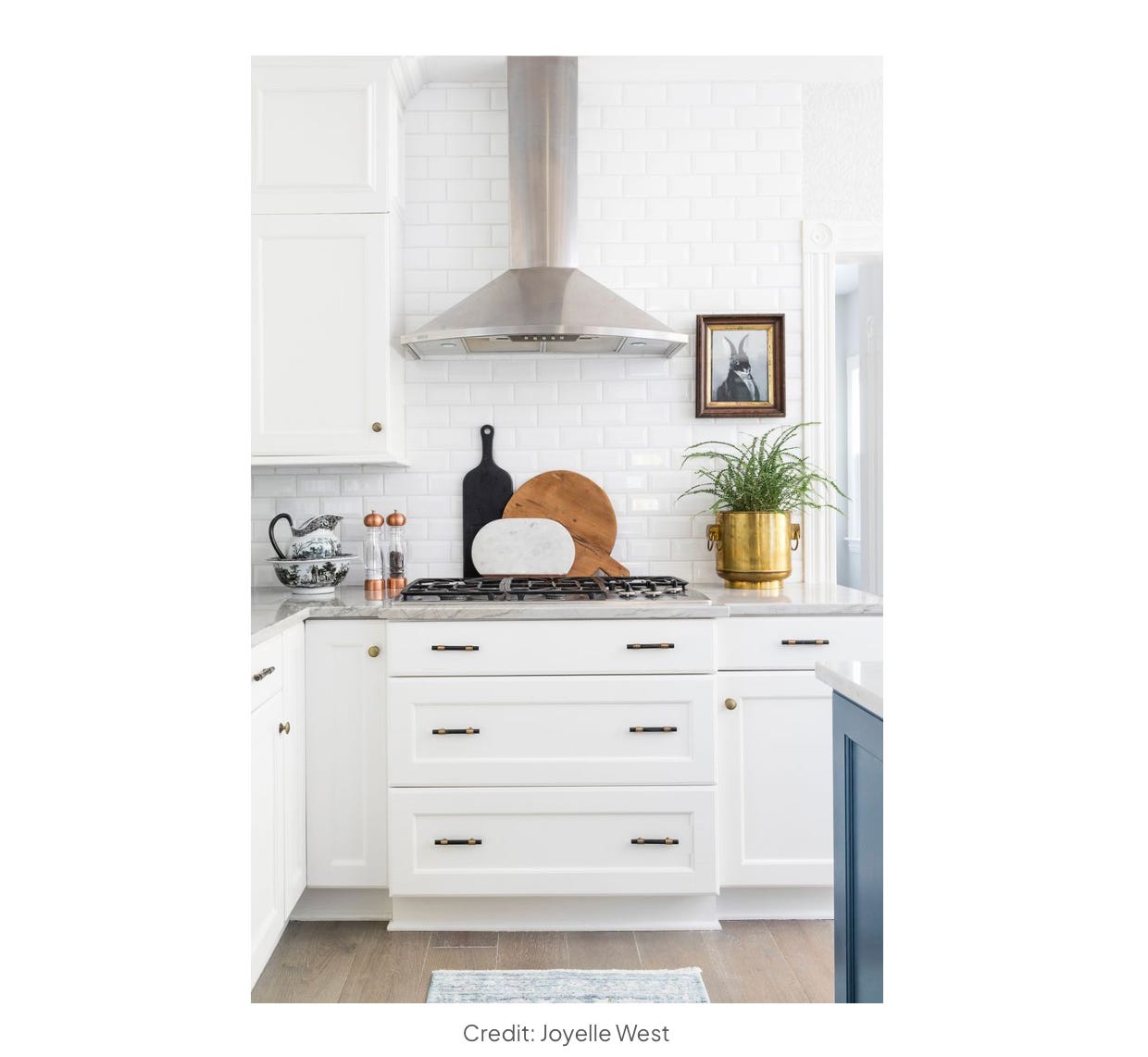
BHG then shows an image of a kitchen with a gas stove, a wood floor, and a loose rug, at which point I got the sense that they really don’t know what minimalism is, where it came from, and why it is so important now, a hundred years after it started.
Minimalism is defined by Architizer:
“Minimalism emerged in the mid-20th century as a reaction against the ornamentation that characterized earlier 20th-century architectural styles, such as Classical Revival and Art Deco. It reduces architecture to its basic forms, embracing the “less is more” principle that architect Ludwig Mies van der Rohe popularized. Minimalism focuses on clean lines, simple forms, and minimal ornamentation, allowing for spatial clarity.”
But it was not a style; it was a prescription for healthy buildings in a time when tuberculosis was rampant, scientists had figured out what causes it, but had no drugs to deal with it. Biatriz Colomina writes in X-Ray Architecture:
“Modernity was driven by illness… Nineteenth-century architecture was demonized as unhealthy, and sun, light, ventilation, exercise, roof terraces, hygiene, and whiteness were offered as means to prevent, if not cure, tuberculosis.”
Paul Overy wrote in Light, Air and Openness:
“Dirt and dust harboured germs that must be destroyed by fresh air and sunlight. Homes should be cleaned thoroughly every day, and windows and doors opened each morning to let in the sun and air, to destroy the germs. Heavy drapes and curtains, thick carpets and old furniture with decorative features that harboured dust and microbes should be thrown out and replaced with simple, easily cleaned modern furniture and light, easily washed curtains.”
This was the start of minimalist design. As Columbina notes, white walls, expansive glass, clean lines, and the absence of ornament were all medical protocols derived from tuberculosis sanitaria before they became iconic modernist and minimalist architecture and interiors.
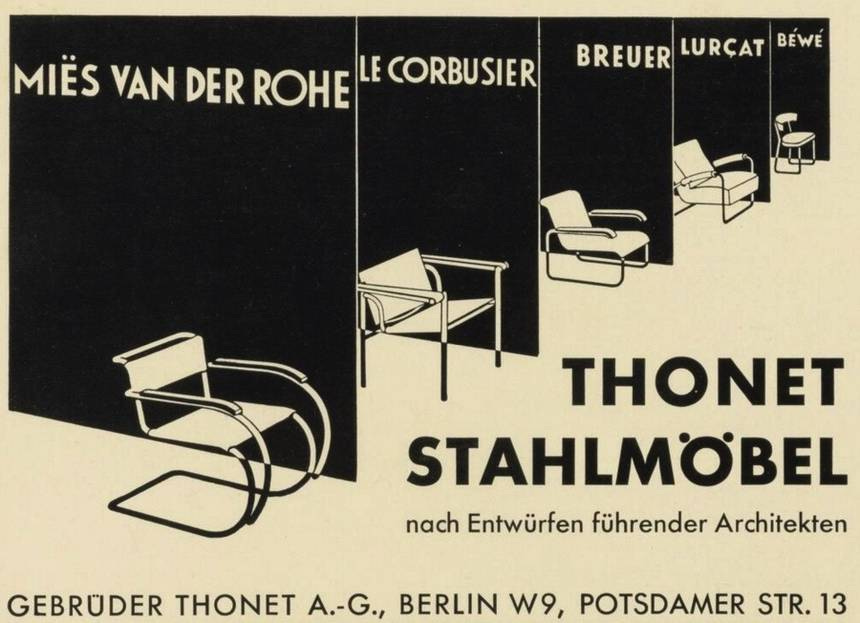
So you don’t want chunky throws on the sofa or layered pillows with texture. In fact, you don’t want sofas; Miës van der Rohe designed lightweight tubular furniture which could be “easily moved by anyone and because of its sled-like base it can simply be pushed across the floor.” He wrote:
“It therefore promotes comfortable, practical living. It facilitates the cleaning of rooms and avoids inaccessible dusty corners. It offers no hiding place for dust and insects and therefore there is no furniture that meets modern sanitary demands better than tubular-steel furniture.”
Kitchens, in particular, should be designed like hospitals. One architect noted in 1933:
“The kitchen should be the cleanest place in the home, cleaner than the living room, cleaner than the bedroom, cleaner than the bathroom. The light should be absolute, nothing must be left in shadow, there can be no dark corners, no space left under the kitchen furniture, no space left under the kitchen cupboard.”
Hence my complaint about the kitchen in BHG- if you care about health, you don’t have gas. If you care about cleanliness, you don’t want a wood floor and a rug.
Minimalism is all about health. We now know about the dangers of particulates, so we don’t want carpeting or stuffed furniture where PM2.5 can settle and be resuspended when we sit or walk on them. One study found that babies crawling on carpets were inhaling 8 to 21 times as much fungus, particulates, or bacteria as a person walking. “Crawling induces resuspension of floor dust from carpeted flooring, creating a concentrated and localized cloud of microbial content around the infant.”
You don’t want all those cushions and pillows and throws, often made of synthetics. Another study found “Indoor airborne microplastics represent emerging pollutants of fast-growing concern that are especially important as potential invaders of the human respiratory system, reaching the alveoli of the lungs and finally entering the circulatory system and other tissues.”
Then there are bacteria, viruses, fungi, and parasites- and the rise of Antimicrobial Resistance (AMR). The World Health Organization says, “Antimicrobial resistance is outpacing advances in modern medicine, threatening the health of families worldwide.” Designers forgot about fighting disease with design when antibiotics were introduced, but it’s time to remember all those minimalist tricks.
“WHO estimates that bacterial AMR was directly responsible for 1.27 million deaths in 2019 and contributed to nearly five million deaths globally. Without action, experts warn, resistant infections could cause an estimated $3 trillion in global GDP losses per year by 2030.”
Our minimalist and modernist heroes were dealing with tuberculosis, and we have to worry about this too. Drug-resistant TB is on the rise. And thanks to the anti-vaxx movement, other diseases that we thought were beaten are coming back with a vengeance.
Dealing with AMR means giving bugs no place to hide, having surfaces that are easy to clean, and having furniture that’s easy to move.
Of course, there are many other, important things to worry about if we are going to design healthy buildings, including ventilation, insulation, comfort, light and air. But we have to re-learn the lessons that Duiker, Bijvoet, Aalto, Chareau, Miës, Neutra, and Le Corbusier taught us: minimalism is not so much a style as it is a prescription for healthy interiors that don’t harbour PM2.5 from wildfires or bacteria we don’t have antibiotics for, or microplastics and PFAS that float into the air every time we sit down on that fluffy sofa.
And we must never forget my favourite theory of everything: the vast number of aging baby boomers need minimalism. Studies such as Fine Particulate Matter Air Pollution and Lung Function Among U.S. Older Adults “highlight the negative impact of PM2.5 on older adults’ lung health.” Aging lungs are subject to cellular senescence. “Many of these age-related changes can impair the normal function of the respiratory system and its capability to respond appropriately to potential pathogens that are encountered daily.” This is why older people are more susceptible to pneumonia, flu, and COVID.
One designer tells BHG, “Often, when a homeowner chooses minimalism, the warmth and soul that come with a more expressive and personalized aesthetic get lost.” A hundred years ago, designers didn’t want much warmth and soul. They wanted a different aesthetic, as described by Paul Overy: “designed not only to be easy to clean but to appear to be spotlessly clean- potent visual symbols of hygiene and health.” I suspect this kind of extreme minimalism will be making a comeback.
Comments
Nothing yet. Say the first thing.
Sign in to join the conversation.