
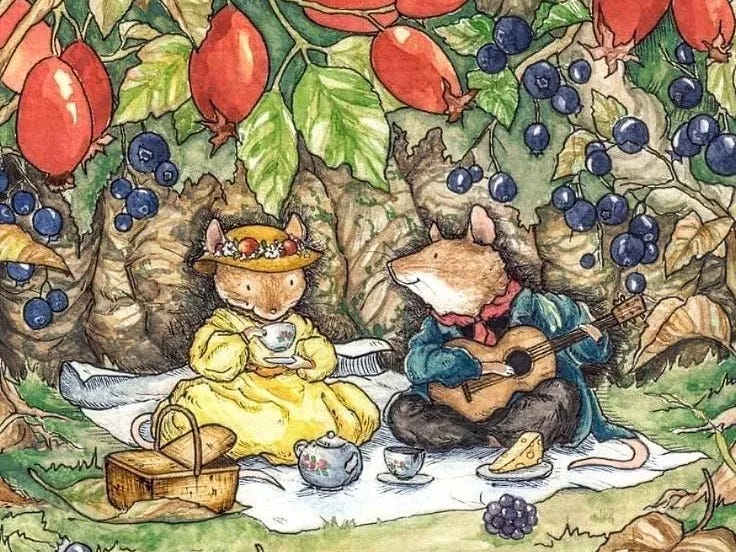
Since 1945, Britain has lost over 300,000 miles of hedgerow. This figure might be hard to grasp in the abstract but to picture it: that is a strip of living habitat long enough to circle the earth about twelve times. While the hedgerow is of course a tried and true method of boundary making, it is a whole world in itself. It is a natural super highway for the rare hazel dormouse who struggles to safely cross open land; it holds the yellowhammer’s nest, and is the winter larder of the bank vole. It is, if you grew up reading a certain series of seasonal picture books, where the Thistledown family store their grain, where Mrs Apple makes rosehip jam, and where Wilfred Toadflax dozes in a tiny hammock strung between two blackberry briars.
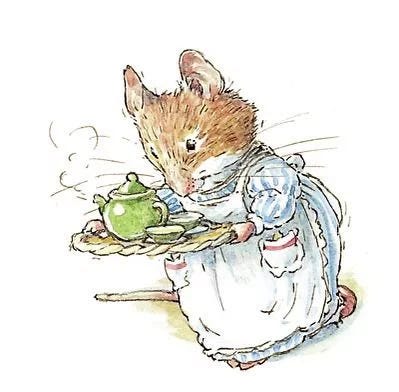
Before Jill Barklem drew a single mouse, she spent five years learning the hedgerows that bordered her Essex market town. A children's illustrator doing the work of a naturalist, Barklem catalogued local botany with painstaking care. She knew by heart the precise curl of a bryony leaf, the way a blackthorn flowers in bright sprays, the exact shade of a hawthorn berry in October. This attention to detail rightly earned Brambly Hedge the accolade of being 'the most research-crammed fantasy ever set before small children.'
*************************************************************************************************************
*************************************************************************************************************
What Barklem was cataloguing, though she may not have framed it this way, was a habitat already in decline. The four seasonal stories were published in 1980. By that point, Britain had already lost half its post-war hedgerow network as rapid urbanisation and changes to agriculture meant fields needed to be at best widened and at worse, replaced entirely. Though Barklem’s hedgerow certainly speaks to an idyllic English rurality that many can identify with, beyond the acorn cups and hazelnut cakes of her domestic mice, this illustrator was working against the clock to preserve an accurate rendering of what was already slipping through her fingers.
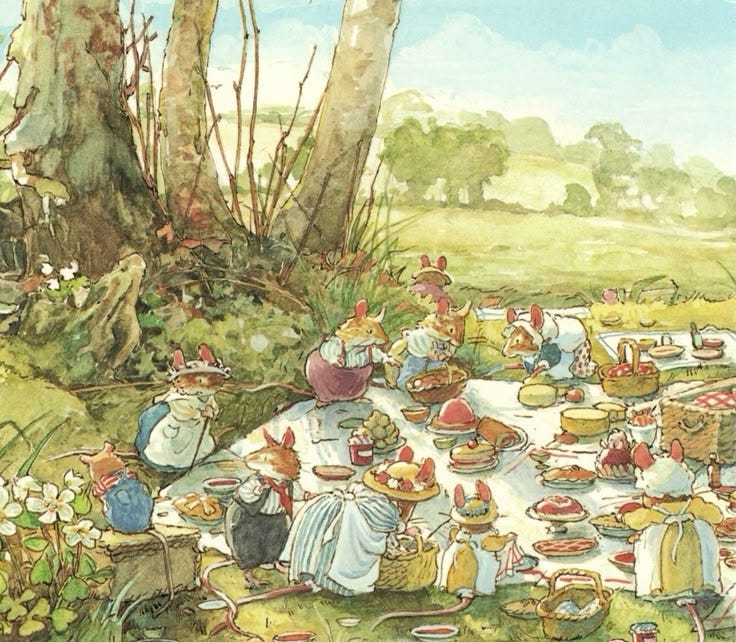
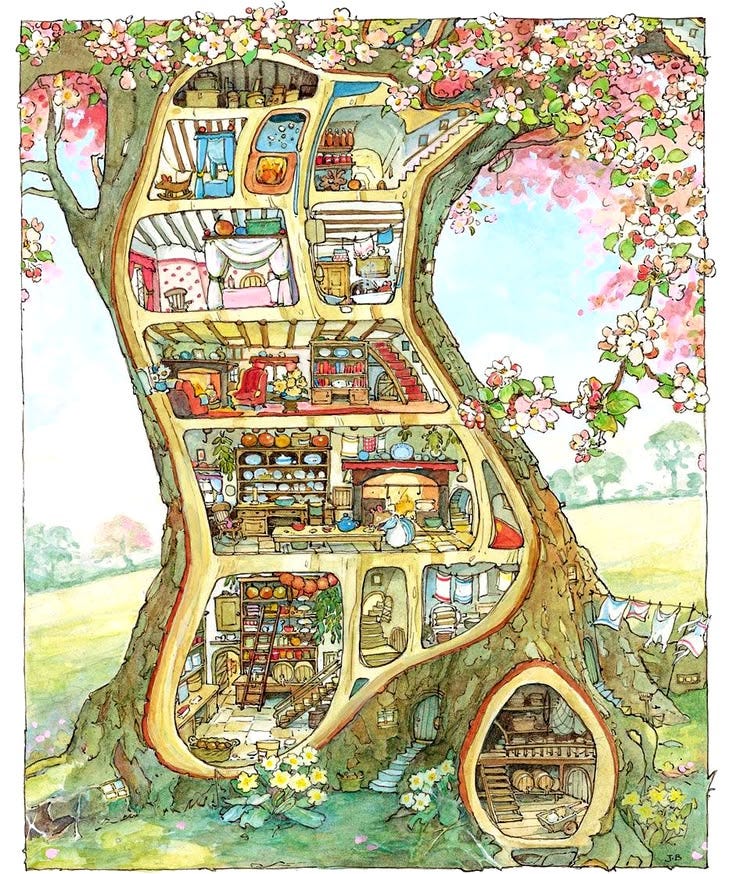
This matters because Brambly Hedge is so often received as pure enchantment. Of course the magic is undeniably present in this miniature world of mice in sensible knitwear and dungarees but to say it is pure escapism I fear is to undermine the ecological urgency that inspired its creator. Brambly Hedge excels in navigating the line between enchantment and reality, couching its narratives in worlds seldom seen, yet irrefutably real to corners of every field in England. Enchantment and urgency are by no means opposites; the world Barklem conjured with such care and tenderness was one she watched attentively and in some sense knew was passing us by unnoticed. Underneath the cosy cross sections of tree houses is a real, thriving ecosystem. The Thistledown’s Store Stump—so central to the happenings of the hedge—is a charming interpretation of how small mammals indeed use the hedgerow for survival, hoarding and preparing for the colder months.
I do not know a single soul who has flipped through a Brambly Hedge book without wistfully imagining what life might be like in a toadstool cottage or furnished grass nest. This enticement is a greater gateway. By drawing readers so completely into this world, Barklem compels us to reckon with what a loss its disappearance would be.
Anthropomorphism of charming woodland creatures is by no means a novelty in children’s literature. The British, in particular, have a penchant for the well dressed squirrel or toad; sympathetic small mammals have milled about the English countryside for quite some years. Kenneth Grahame’s hazy riverbank, Beatrix Potter’s fell farms, Julia Donaldson’s dank forest floor—all cornerstones of a literary tradition that grants the non-human world a kind of interior life that is, in turn, inhabitable by the curious reader. It seems each of these writers understood, rather instinctively, that a child will follow a small animal into places and feelings they might not follow a human. Though the species gap might impose a rift in total understanding, the emotional distance that the animal provides is paradoxically also a kind of closeness. One might approach close truths about survival, community and loss that might otherwise feel overwhelming.
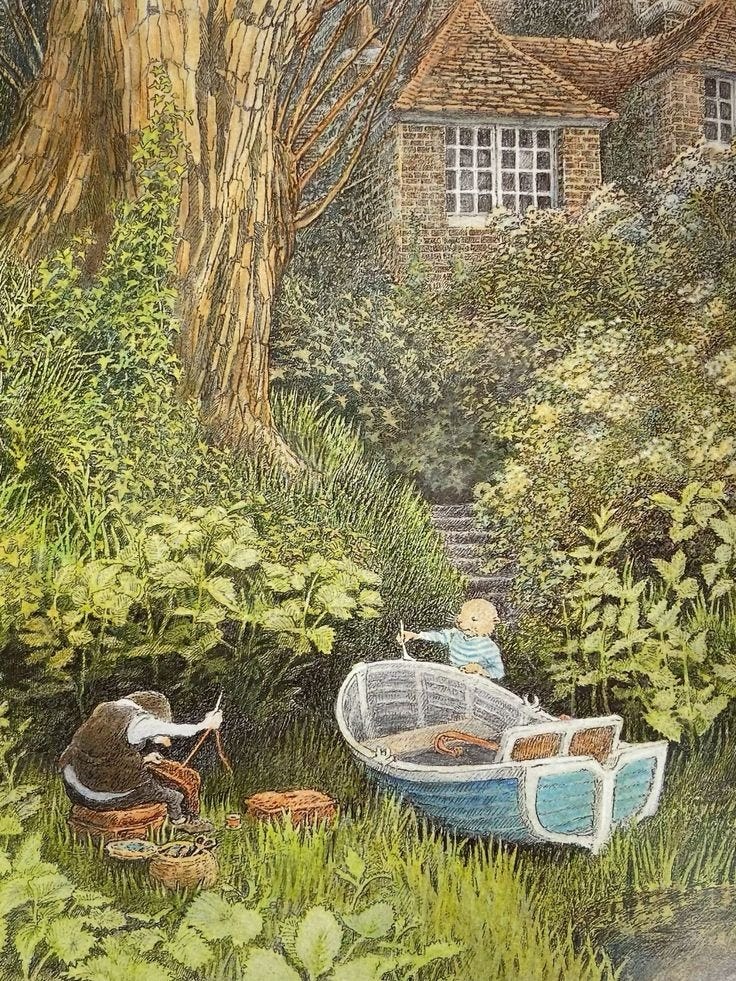
Despite the excellent allegorical success of the personified beastie, the ways in which these animal worlds operate understandably differ from author to author. Naturally, there is simply no way of knowing what the chaffinches chirrup about, and so, these little societies often cannot avoid becoming backdrops upon which authors might project their personal interpretations of the world at large. Grahame’s riverbank is essentially a social comedy, its animals acting primarily as vehicles for Edwardian anxieties about class, mobility and belonging. Potter’s world, though closer to Barklem’s in its botanical precision,* frequently turns on danger and consequence that always keeps the fringes of the human environment visible. Donaldson’s animals, beloved as they are, tend towards the fable: their existence illuminating a moral truth with habitat serving as backdrop rather than subject.
Barklem differs in that her hedgerow is unmistakably the entire point. The seasonal structure of the original four books—Spring, Summer, Autumn and Winter tales—reaches beyond the organisational. It insists that the lives of the Thistledown mice are intelligible only in relation to the natural world that sustains them, that their joys and tribulations often pivot first on the ecological and second on the personal. Yes this ‘loving and caring society’ of creatures happen to live in the hedgerow, but we rest assured their interpersonal dilemmas will always be resolved. What we should be less certain about is the integrity of the natural stage upon which they unfold.
Brambly Hedge is, in the language of conservation, a priority habitat. Hedgerows are the most widespread semi-natural habitat in Britain, supporting over 130 Biodiversity Action Plan species and providing food, shelter and movement corridors for creatures that simply cannot survive without them. The collection, whether intentional or otherwise, is a record of something we might not recognise beyond the next few centuries. The hazel dormouse, perhaps the creature most dependent on the hedgerow’s specific architecture of interlocking shrub and canopy, has declined by over half in the last two decades alone. Hedgehog populations have fallen by a similar proportion across the country since the turn of the century, with rural areas suffering most acutely as the field margins they rely on are lost to more intensive farming. Eighty-four percent of Britain's farmland birds rely on hedgerows for food and protection. Soon enough, we might no longer be able to delight in the almost incantatory names of the endangered cirl bunting, bullfinch or dunnock due to fast dwindling numbers in the wild.
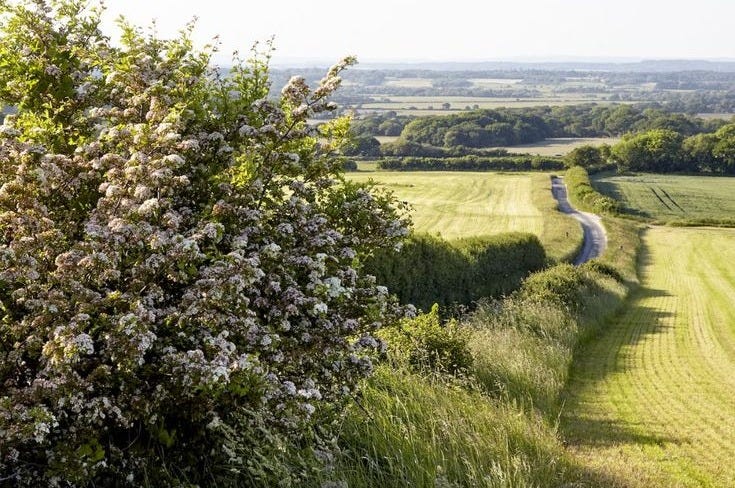
The ecological case for hedgerow conservation is overwhelming and has been made repeatedly by bodies from Natural England to the Committee on Climate Change, which in 2019 recommended a forty percent increase in Britain's hedgerow network as part of the country's net zero commitments. Hedgerows sequester carbon. They prevent soil erosion. They filter water. The arguments are good arguments. And yet the hedgerows keep disappearing, because good arguments, marshalled at the level of policy ], have a limited purchase on the imagination.
This is where Barklem’s achievement veers decidedly away from the aesthetic and into the functional. The Thistledown mice have names and temperaments and favourite foods and complicated feelings about winter. A child who has spent just half an hour in their company has been afforded an intimate experience of hedgerow life. The dormouse is a neighbour, and a friendly one at that. But there is a deeper argument available here, one that our current ecological crisis has made harder to avoid. The idea that human lives are somehow separable from the natural systems that sustain them is the precise error that has allowed the destruction of hedgerows to continue. The diminutive nature of the hedgerow, coupled with the natural human impulse to break boundaries, unfortunately makes them easy victims of industrial progress. We have long treated the non-human world as resource or amenity, when in fact our own emotional and cultural lives are no more intelligible without it than those of Barklem's mice. Our seasons, country customs, instinct for the domestic are not separate from the natural world, rather they are bred from it.
One of my all time favourite nature writers, Robert Macfarlane has argued that language shapes what we are capable of noticing, and that the erosion of our vocabulary for the natural world is itself a form of ecological loss. His book Landmarks assembles thousands of words from regional British dialects for specific features of land and weather. The project is urgent precisely because those words, like the habitats they describe, are disappearing. Robin Wall Kimmerer makes the related argument from a different tradition: that the English language's grammatical habit of referring to living beings as ‘it’—objects rather than subjects—enacts a certain violence, converting the animate world into a collection of resources. To grant something personhood, to imagine its interior life, is a political act as much as a poetic one.

Something peculiar happens when domesticity appears where you do not expect it. A tiny patchwork quilt in an underground burrow, a lively picnic beneath a dandelion clock, a mushroom with a chimney and glowing circular window. Why should these be lightyears away from the neat weaving of a harvest mouse’s nest, a hedgehog’s worn path through the base of a hedge, a clutch of blackberries, all pecked just-so? A creature, in its own terms, has made a home, established a routine, solved the problem of shelter and warmth and food with a particularity that feels familiar to us. The reader who has spent time in the Store Stump, who knows where Mrs Apple keeps her preserves and how the mice bank up their stores against the cold, goes out into an actual hedgerow differently.
Brambly Hedge gives the reader an imaginative address in a world they might otherwise have walked past without stopping. To borrow Kimmerer's language: Barklem has utterly refused the dreaded ‘it’ of natural inanimation. Our hedgerows are full of neighbours and we do not, as a rule, watch our neighbours homes tumble down without feeling something. Jill Barklem, who never named herself as an activist, always had the right to the title. She gave the hedgerow a dozen little voices, showed us its larders, its seasons, its collective joys and anxieties. The hedgerow, in the minds of multiple reading generations is not only habitable but hospitable. In an age of ecological unravelling, The ability to imagine a wild place as something that welcomes us, rather than something we have merely failed to destroy is a necessity. Jill Barklem hid this in plain sight, tucked into every teapot, folded under every blanket, pressed into every page of Brambly Hedge.
*Beyond her work as storyteller and illustrator, Beatrix Potter was an avid naturalist and mycologist, as can be evidenced throughout her many works.
Jill Barklem, The Complete Brambly Hedge
Kenneth Grahame, The Wind in the Willows
Burke and Copenhaver, Animals as People in Children's Literature, click here
Hedgelink, click here
Robert Macfarlane, Landmarks
Robert Macfarlane and Jackie Morris, The Lost Words
John Wright, A Natural History of the Hedgerow: Ditches, Dykes and Dry Stone Walls
The Wildlife Trusts' formal partnership with the Brambly Hedge estate is also worth a note—it can be found at bramblyhedge.com
Thanks for reading Lurker! This post is public so feel free to share it with all the little creatures in your local hedgerows.
No posts
Comments
Nothing yet. Say the first thing.
Sign in to join the conversation.