
The vagina dentata—literally, 'toothed vagina'—appears on every continent except, perhaps, Antarctica, where presumably nobody was having enough sex to worry about it. This particular motif has been gnawing at the edges of world folklore for millennia, continually surfacing in Chaco myth, Maori narrative, Inuit tale, in Hindu, Baltic, Japanese, Hellenic, Roman, and Celtic tradition. The list goes on. Wherever, it seems, there have been vaginas, there has been terror.
The female body, for as long as men have told tales, has been treated as something to be conquered and guarded: kept safe, or kept in check. But is this guarding for her benefit or for everybody else’s?
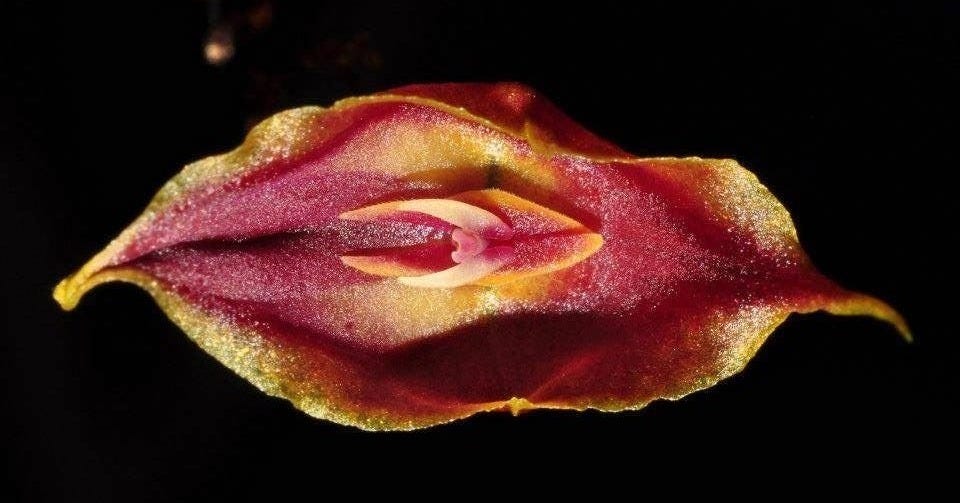
The motif of the vagina dentata maintains a distinct shape trans-culturally and often goes a little something like this: A man approaches a woman, or something woman-shaped, intending penetration, and instead gets a fairly nasty surprise. The consequences are almost comically morbid in their variety. Sometimes the man only loses his nerve, or a little finger. Sometimes a blade disappears without trace. Sometimes something far more valuable is severed. Almost always, another, better equipped fellow comes running to the rescue, breaking the teeth and asserting male control once more.
Folklorists have long treated such recurring motifs as compressed anxieties. Folk tales are enduringly handy in that they are small, portable units of dread that a culture can pass on without having to fully explain, what, exactly it is afraid of. This is a ground rule all good anthropologists pick up fairly early on. Though in all honesty, you don’t need a folkloristic excavator to uncover the fear belying this particular creation. Heaven forbid the female body might not willingly receive or that it might have an agency of its own—because, of course, there is no horror like sexual rejection.
The vagina dentata infers that penetration, imagined as a male act performed upon passive female terrain, could be reversed. Freud read this motif as a potent case for his theory of castration anxiety: the overwhelming fear of damage to, or loss of, the penis. Tales of literal emasculation frequently figure as allegory for more psychic degradation, with a man feeling insignificant or socially dominated; stripped of his patriarchal status. Eric Neumann, working the same seam through Jungian myth-criticism, termed this harrowing phenomenon the Terrible Mother, exploring the devouring aspect of a goddess figure who might take life just as easily as she gives it, consuming the male and taking him back into her body, effectively reducing him to a child once more. What both readings share is worthy of note: the terror belongs solely in the realm of the masculine with the story existing to manage and assuage patriarchal fear that might just tip over into instability.
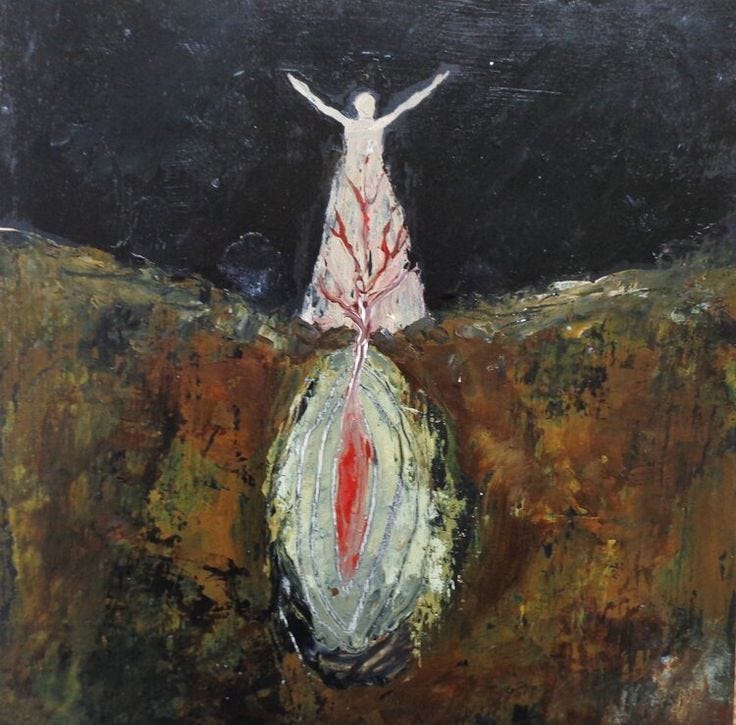
A little odd to be sure, but we tell ourselves all kinds of nonsense to help us sleep at night. However, as we have learnt time and again, it does not stop there. A story that manages a man’s fear of a woman’s body is its own kind of technology; and like every other technology designed to manage sexual anxiety, it never simply soothes the frightened party without disciplining the frightener, however inadvertent the fright may have been.
Unfortunately, I cannot recall a single traditional tale in which the be-toothed woman keeps her pearly whites and simply continues to live out the rest of her days happily; safe in the knowledge that she might be the source of her own sexual agency and protection. A ‘hero’ arrives as heroes so tirelessly do, often specifically equipped with tools or supernatural guidance. The teeth are broken, frequently by means that seem unnecessarily cruel and unusual. Stone phalluses, animal bones, a saw have all been used to remove the offending gnashers. After the breaking, the woman is rendered ‘safe’ in that she is penetrable, marriageable and fertile in a sanctioned sense rather than a devouring one. What rendered woman so terrifying was her right to choose just who had access to her body, and with this overridden, the beast has been declawed, domestic order restored and the liberty of choice returned to the hands of man. Interestingly, Stith Thompson’s Folk Motif Index does not feature an entry about the toothed vagina in isolation. Rather, the concept of the vagina dentata is only present in relation to its inevitable conquering at the hands of a male counterpart:
A1313.3.1. A1313.3.1. Vaginal teeth broken. Women originally had toothed vaginas. Culture hero breaks teeth so that women will be harmless to men. S. Am. Indian (Toba, Mataco): Métraux MAFLS XL 99, 105, Métraux BBAE CXLIII (1) 367.
Just as we rarely see the woman’s escape, we also rarely see her outright destruction. This is the same narrative grammar you find wherever folklore handles a threat that cannot simply be eliminated because the culture needs the thing the threat is attached to. You must not kill the woman. You need her for the entire architecture of inheritance and kinship that depends on her body functioning as expected. However, some casual mutilation will do just fine in eliminating any threat and cowing her into submission once more. Ring out the wedding bells!
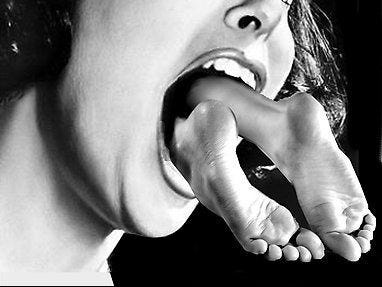
Barbara Creed’s The Monstrous Feminine (1993) did something folklore scholarship has largely failed to do so before her in that it stopped asking why men were afraid and started considering what work the fear was doing for the woman, so often side-lined in her own tale. Drawing on Julia Kristeva’s theory of abjection—the horror provoked by anything that blurs the boundary between the self and other, the clean and unclean— Creed proposed that the vagina dentata goes beyond the characteristic teeth. In fact, these teeth simply serve as sign posts for an all-engulfing maternal body. In this way the monster is not frightening because she is simply other, but because she is your origin and origins are meant to stay behind you. Perhaps the ultimate fear here is being pulled back into the inconsequentiality from whence you first came.
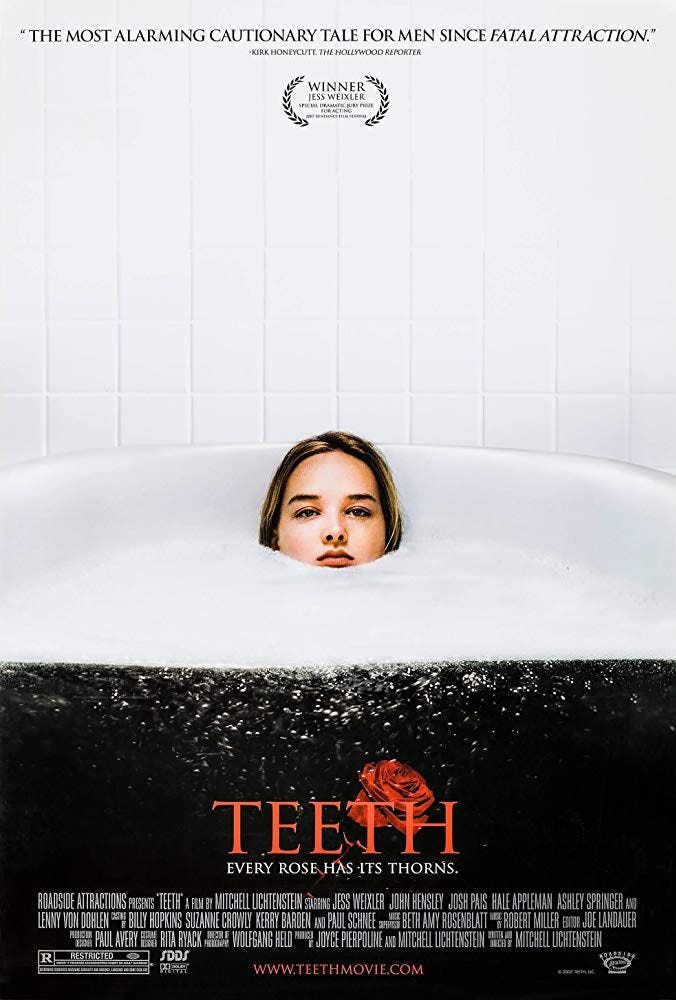
Teeth (2007), the utterly wild American horror-comedy that gave the motif to a teenage protagonist as a weapon against would-be assailants, pulls the real social fear underpinning the fireside story right to the surface. Here the hero never arrives to file the teeth down and the defensive body wins. The teeth remain, and are used successfully, the story treating this as a satisfying ending rather than a problem to be solved or overcome. For a pretty pulpy silver screen romp Teeth does some fairly heavy lifting while retaining excellent nuance. The film does not deny the fear exists, but asks who benefits from said fear. Yes, the protagonist remains a social outlier but this is a kind of victory in that she retains both protection and choice (though in the extreme) on her own terms during perhaps the most vulnerable years of a woman’s life.
One tale, hailing from Siberia does something similar in that it uses the prevalence of the fear in service of something nearing proto-feminism:
In order to join two great families, a young woman, despite her significant resistance is forcibly married to a man near three times her age. The man is dirty and unkempt, short and squat with a great bulbous nose and a near-toothless leer. The girl might be young but she knows how these things go. Mere hours after their wedding ceremony she must bed her new husband to consummate the marriage in the eyes of God and their expectant families. After nights of fruitless prayer and pleading, the morning of the wedding arrives all too soon. She rises before dawn and steals down to the river, net in hand. After an age of trying against a rapidly lightening sky, the girl manages to catch a sizeable pike, complete with three rows of razor sharp teeth. Knowing, this might be her only chance, the girl beheads the fish, inserting the gaping maw between her thighs and waddles off to the village chapel. That night she smiles and simpers for the man as he prepares to complete the wedding ritual. Suddenly her new husband lets out a blood curdling wail, his eyes wide in pain and surprise. Looking up innocently, the girl chuckles and calls the old man a fool. ‘Didn’t you know we all have teeth?’
The use of a folk fear within a folk tale creates a delicious sort of meta-text that signifies just how deeply ingrained this anxiety is within our culture. It further demonstrates how such fantastical anxieties might be practically harnessed towards realistic social advantage, and how in turn, these acts of resistance might be mythologised themselves. It is a funny sort of reclamation, but a reclamation nonetheless figuring as an exceedingly rare full circle moment in motif study which, as an insufferable nerd, I absolutely adore.
The female vampire in literary history represents a similar kind of marriage between the vagina dentata and sexual autonomy. Where the ordinary body takes a mans life force (semen) into the womb and turns it into a child, the vampire takes it into her mouth (blood) and turns it into herself. Nothing is created, only consumed. This redirection is what makes her, specifically, unnatural. A body that should manufacture new life instead spends what it’s given on its own upkeep. She does not reproduce but persists eternally towards her own end. In this, she is read as a kind of thief who does not simply take from any one man, but from the whole forward motion civilisational advance depends on. Every child not born is a debt the she-vampire has declined to pay, choosing herself continually.
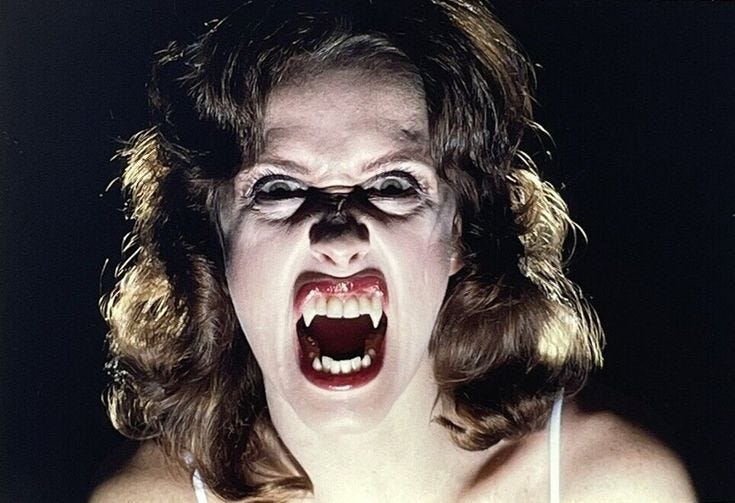
The ordinary vagina dentata, you'll recall, gets its teeth filed down and is returned to service. The vampire is not offered that deal. She cannot be domesticated back into the reproductive economy, because the whole point of her is that she has already opted out of it. This is perhaps why she is so rarely reformed in tales and instead simply killed. You’ll note the conspicuously large stake frequently employed by disgusted men as the ultimate undoing of these wayward women (do you think they might be compensating for something).
This is something that has always intrigued me, and I in fact wrote my undergraduate thesis on the subject and its ties to Victorian lesbianism a few years ago. Watch this space for a more in depth dissection soon!
Perhaps it is easy to shelve the matter as a curiosity from cultures that did not yet have anatomy textbooks and leave it at that. The underlying logic, however, is not going anywhere fast. Every era generates some version of the claim that female sexual agency is inherently dangerous, that it must be managed or filed down before it can be permitted. Whether the instrument is a folkloric hero with a stone phallus, Van Helsing and his comically giant stake, or a modern anxiety about women who consume too much without asking permission first, it is all the same. The motif perseveres even today, because unfortunately it is still relevant and it is still useful. The question worth asking of the vagina dentata is not whether the teeth are real; but who keeps finding a reason to file them down, and what they are so afraid would happen if nobody did.
Barbara Creed, The Monstrous-Feminine: Film, Feminism, Psychoanalysis (Routledge, 1993)
Erich Neumann, The Great Mother, trans. Ralph Manheim (Princeton University Press, 1972)
Jane Ussher, Managing the Monstrous Feminine: Regulating the Reproductive Body (Routledge, 2006)
Teeth (dir. Mitchell Lichtenstein, 2007)
Thanks for reading Lurker! This post is public so feel free to share it with your chompy chums.
No posts
Comments
Nothing yet. Say the first thing.
Sign in to join the conversation.