
A few days ago, I set my 3.5-year-old son up with some cucumbers, an Opinel knife, some fish sauce, some vinegar, and a bowl. We had friends over, and I was searing Korean short ribs. Figure it out, buddy.
The cucumbers were not evenly sliced, he was overzealous with the fish sauce, but it worked well enough as a side dish, saving me five minutes of time. It wasn’t busy work; I really needed my time freed up, and I judged him capableish of handling the responsibility. My hope was not that the task would be done perfectly, but that the salad would not be dressed with blood. Success.
We do this with laundry: I sometimes ask him to load the washer. And with clothing: He has a child-sized wardrobe and small hangers and I throw his clean laundry on the bed, asking him to hang it up. It ends up looking less orderly than when I do it, but I don’t mind if it saves me time and teaches him responsibility. He sets the table (poorly!) and uses a small vacuum to attack clumps of dog hair before we host friends for dinner. Amazon packages are his magnum opus––he gets that Opinel knife out and stabs them as soon as they come.
A few hundred years ago, children did a very different form of labor: “In the 18th century, the arrival of a newborn to a rural family was viewed by the parents as a future beneficial laborer and an insurance policy for old age,” reads a 2017 report from the Bureau of Labor Statistics, looking back at how work has changed in the U.S. “At an age as young as 5, a child was expected to help with farm work and other household chores. The agrarian lifestyle common in America required large quantities of hard work, whether it was planting crops, feeding chickens, or mending fences. … Most families simply could not afford the costs of raising a child from birth to adulthood without some compensating labor.”
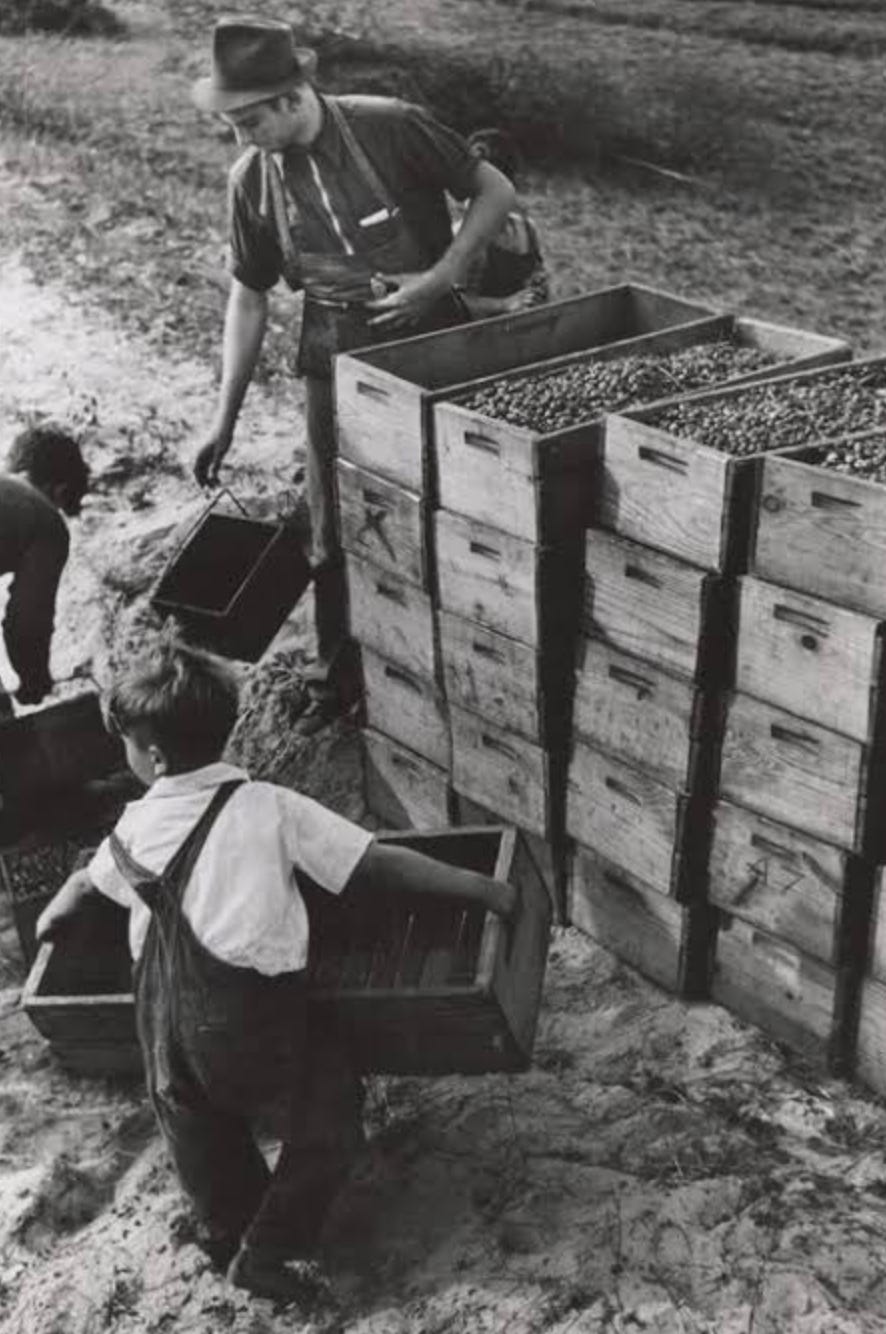
A son born to a farming family “was worth a thousand dollars” remarked one farmer, according to Chaim Rosenberg’s history of this practice. During the years between the Civil War and the start of World War I, about two-thirds of child labor happened on farms. Though children did not tend to be given jobs operating heavy machinery until they were sufficiently capable, their work was often grueling.
In the cities, conditions often looked much worse, with children expected to operate dangerous machines far from the oversight of their parents. “In 1900, 25,000 of the nearly 100,000 textile workers in the South were children under 16,” reads the same BLS report. “By 1904, overall employment of children had increased to 50,000, with 20,000 children under 12 employed.” Cotton mills were where children in the semi-urban south could find work; little boys entered the glasswork industry in cities like St. Louis and Pittsburgh and Muncie, their small hands coming in handy; young girls were given work in the garment industry in New York City, sometimes working alongside seamstresses in factory settings, other times sewing in home workshops where they could be more closely supervised by their mothers. We don’t have reliable statistics on child injuries and deaths from factory work around the turn of the century, nor on the long tail effects, like the chronic lung disease that could spring up later in life from exposure to toxins.
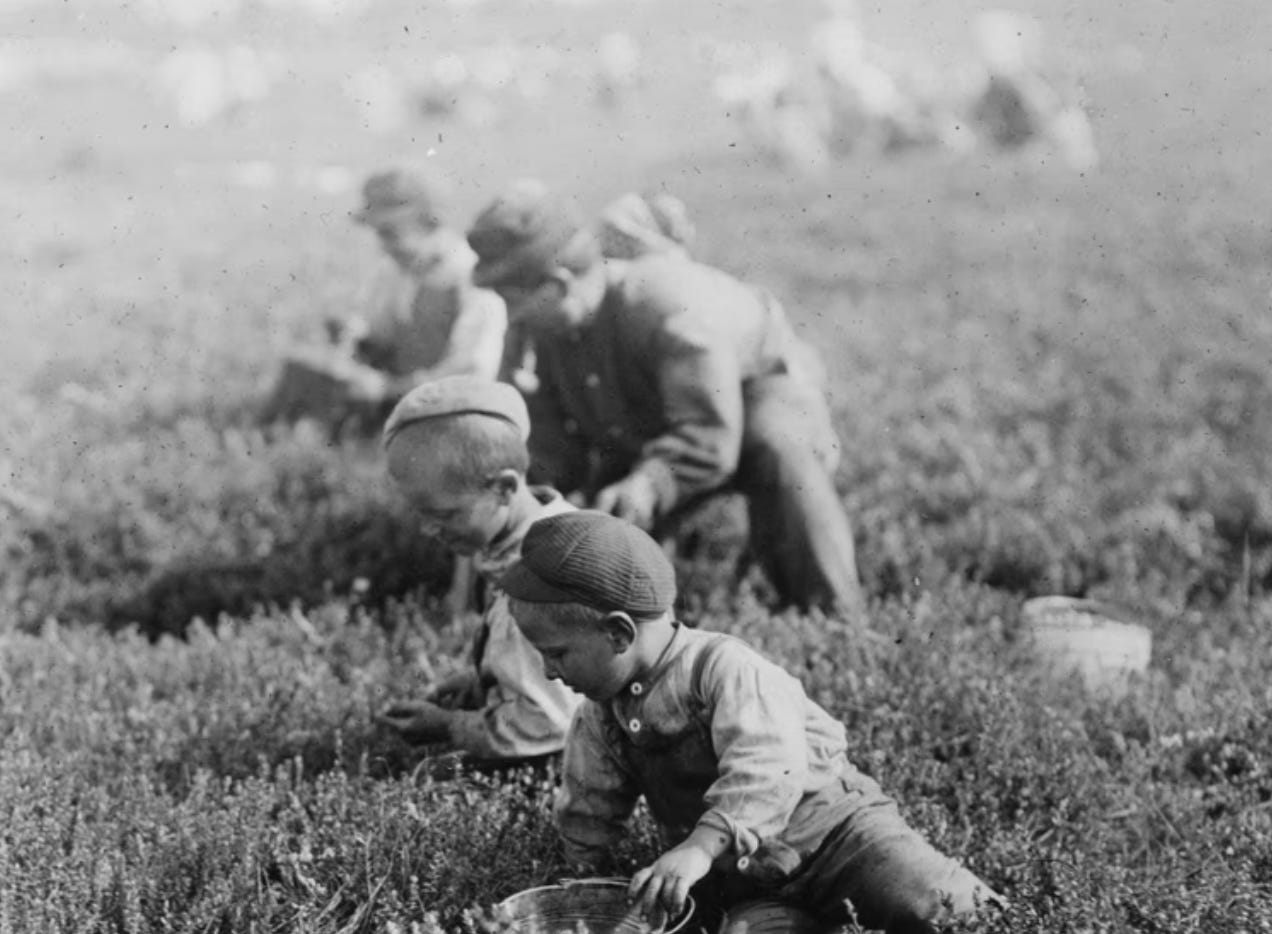
By 1900, approximately 20 percent of children between the ages of 10 and 15 had legitimate jobs. But many children well below the age of 10 performed labor for their families in more informal capacities: children aged 3 and 4 would be put to work hulling berries on farms. Slightly older kids could harvest shrimp and shuck oysters.
This was a very dark era for children, and I’m not advocating for a return to that. They’ll revoke my libertarian card for saying this, but FDR signed valuable laws forcing children out of the workforce, and our cultural norms shifted, as the law began to punish workplaces for their child labor practices and society became more prosperous: We got kids out of the factory, we made schooling compulsory, and we came to agree upon a different set of beliefs about childhood. When most families were struggling to make ends meet––either farming and homesteading out west, or living in cramped and crowded tenements out east––they didn’t have real ability to protect their children from the harshness of adult life; as we became richer, our beliefs about child labor shifted.
Nowadays, you’ll occasionally see a teenager helping out their family business: bussing tables or serving as a dishwasher in the restaurant, checking customers out at the bodega, helping their mom run an at-home daycare after school. But nowadays we’ve moved toward the belief that children not only shouldn’t do meaningful work, but also can’t. This belief appears to be less pervasive among immigrant and small-business-owning families, but extremely pervasive among the upper-middle-class, highly-educated, highly-agentic elites.
Enter Montessori.
Maria Montessori spent many years studying children with cognitive delays and learning difficulties. In 1900, she was made a director of the Scuola Magistrale Ortofrenica, a "medico-pedagogical institute" that trained teachers in how to help children with learning difficulties. It was here that she developed pedagogy that would then be used for normal children. In 1907, she opened up Casa dei Bambini, for the poor children of Rome, where she studied her charges, noticing that the children were sensitive to their environments, capable of deep focus and concentration, and interested in repetitive, often highly practical activity. She began to develop theories about children having “absorbent minds” and needing the correct conditions to develop discipline, focus, and a love for learning. A well-prepared environment could allow children to make and correct their own mistakes; work at a pace that felt right to them; and explore their innate curiosities. "Help me to do it myself" became the guiding principle.
Those beliefs haven’t caught on to nearly the degree that the Montessori branding and aesthetic have. Among upper-middle-class mom circles, the Pikler Triangle rules. Lovevery toys can be found in every playroom (at the price of $120 per play kit). High-contrast mobiles adorn the nurseries. “Sad beige playrooms” for “sad beige children” have become a meme, but the aesthetic is a somewhat Montessori one: More wood, less plastic. More pastels, muted colors, and colors found in nature. Less lurid. No battery-operated nonsense. Fewer moving parts.
Montessori, more broadly, has grown into a big culture force: Lovevery, founded in 2017, logged $226 million in revenue in 2024. Chains like Wildflower Montessori Schools, Bezos Academy (a "Montessori-inspired" program), and Guidepost Montessori have all exploded. The American Montessori Society estimates there are now roughly 5,000 Montessori schools in the country, with 2017 serving as an all-time high for public school membership in AMS. Many other daycare programs and preschools use the “Montessori-inspired” designation to appeal to eager parents.
Purists would say that people are ignoring the actual principles Montessori championed in favor of an aesthetic: Toys ought to provide isolated difficulty (a child practices a single skill or concept until ready to move forward) and control of error (a way for children to notice if they’ve made a mistake without an adult intervening). But that’s a little in-the-weeds. My concern is less pedantic, and much bigger.
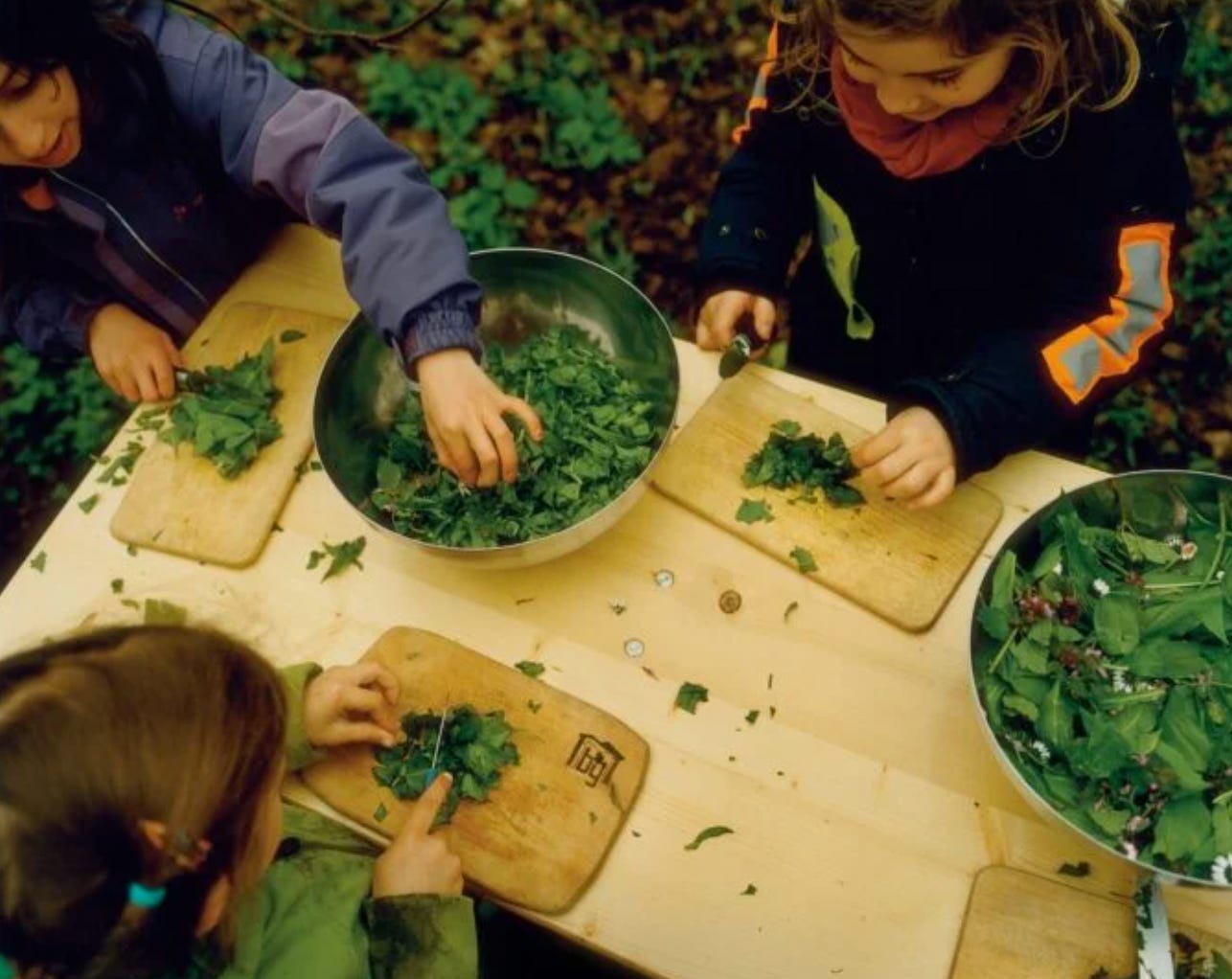
My theory, which I hope gives parents sufficient benefit of the doubt, is that the parents adopting half-assed Montessori-ism understand on some intuitive level that children yearn for meaningful work. Taking things apart and putting them back together. Glimpsing the adult world, grabbing some component of it, turning it over in their hands, seeing how it’s made. Being gifted some responsibility for the stuff of daily life––the meals, the clothing we wear, the keeping of our spaces––and being able to playact as adults in order to better understand what the world around them is made of. Children don’t need the weight of the world placed on their shoulders, but thoughtfully meting out little pieces of the adult world can be a real joy for them––especially if their “teachers” (parents) can help them make sense of it all, setting appropriate expectations, and onboarding them to the tasks in an age-appropriate way.
Consider the 4-year-old’s excitement at helping diaper the baby, or the 3-year-old’s interest in checking out at the grocery store. Our Montessori revival is good evidence of the fact that the philosophy intuitively makes sense to many parents.
But Montessori-ism requires taking risk. Consider my son using the knife to chop the cucumber: there was a non-zero chance that it would end in bleeding. There was a low chance, but not nonexistent, that it would result in an E.R. visit. I assumed that risk because I saw the benefits to him and to me as worth it. Many parents make a different calculation, which could be perfectly rational behavior. Maybe they had a bad experience with a knife as a child. Maybe the nearest E.R. is 45 minutes away. Maybe their kid is too wild, struggling to heed any advice, that they don’t feel like they can trust them at this juncture. (Haven’t we all been there, where someone is going through a developmental phase or a multi-day mood that just renders them…kind of nuts?)
But I’ll posit something a little different: Just as many a mom has told me that they read Emily Oster’s Expecting Better but can’t totally bring themselves to actually sip a glass of wine in pregnancy, embracing the freedom her new data provides, I wonder if parents buy the Lovevery Montessori toys because the philosophy makes sense to them, but they can’t bring themselves to hand their toddler a real knife.
If these parents were en masse saying they have a great experience of parenthood, I wouldn’t feel compelled to offer a suggestion. But headlines abound of “depleted mother syndrome” and “how working parents can spot signs of burnout” and how parents today feel “exhausted, burned out and perpetually behind.” I wonder if the sorry state of parenthood in our biggest cities leads to people having fewer kids, and enjoying it all less. Handing your child a knife and some cucumbers, or some laundry and hangers, won’t be the thing that makes juggling a 50-hour-a-week job and middle-of-the-night wakeups suddenly doable. But we can do small things to build a habit of stretching our risk tolerances––and letting children contribute to the household in ways that are meaningful to them and to us.
No posts
Comments
Nothing yet. Say the first thing.
Sign in to join the conversation.