
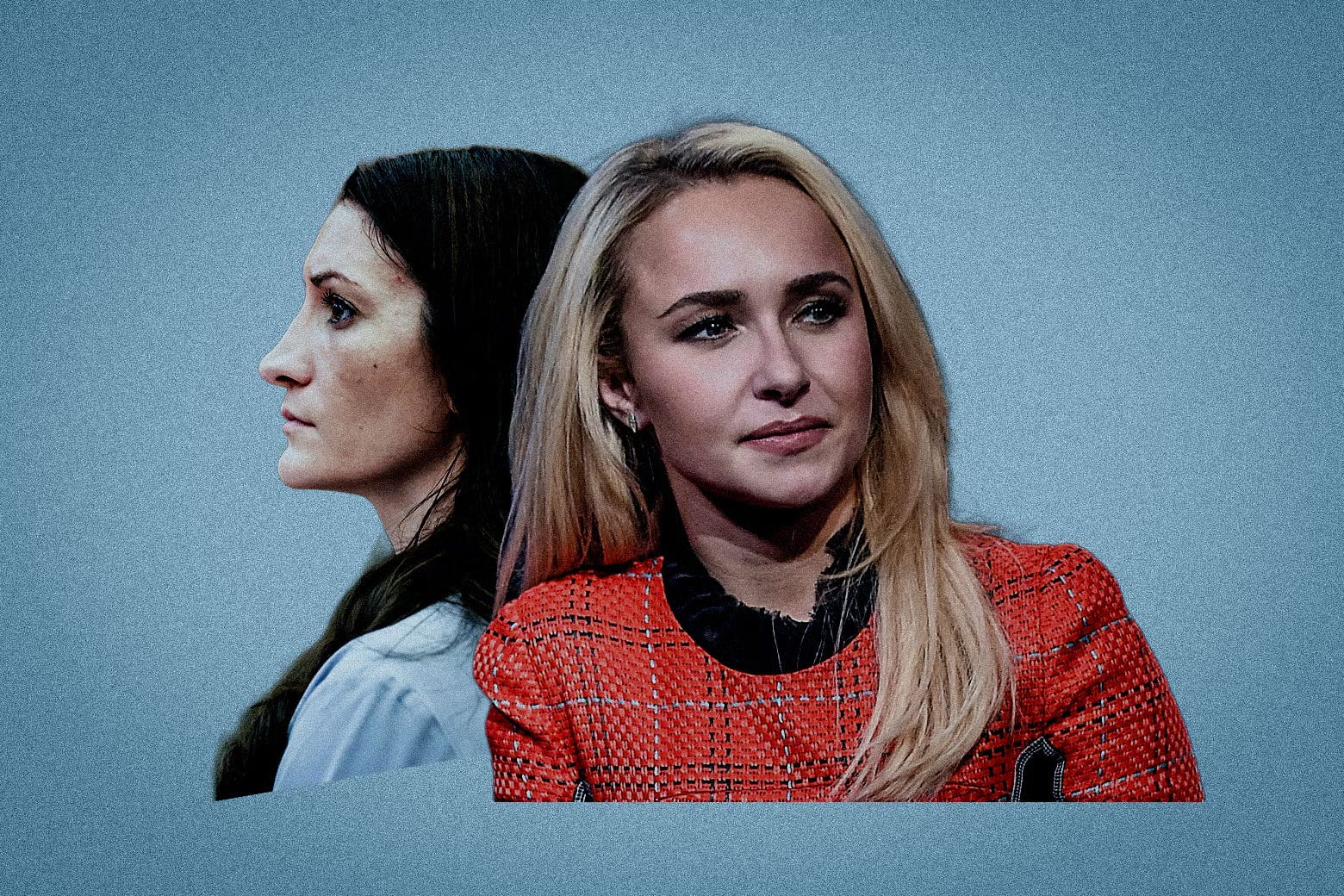
Women are carefully watching the Lindsay Clancy trial for reasons that have very little to do with true crime. They are watching because it has become a national conversation about the outer edge of postpartum mental illness, and because every new headline raises the same unsettling question: what happens when a mother says she’s not okay? Then, after Hayden Panettiere’s death, millions of people found themselves watching old interviews in which she described what happened after she publicly disclosed that she had postpartum depression, including her account that Neutrogena ended their relationship after she spoke openly about it. One story is about a woman accused of an unimaginable crime, and being failed by a medical system unequipped to handle maternal health. The other is about a woman who described a common medical condition and faced consequences for even mentioning it. They are radically different stories, but they arrive at the same cultural moment carrying an eerily similar message: motherhood remains one of the few experiences where telling the truth about your mental health is dangerous.
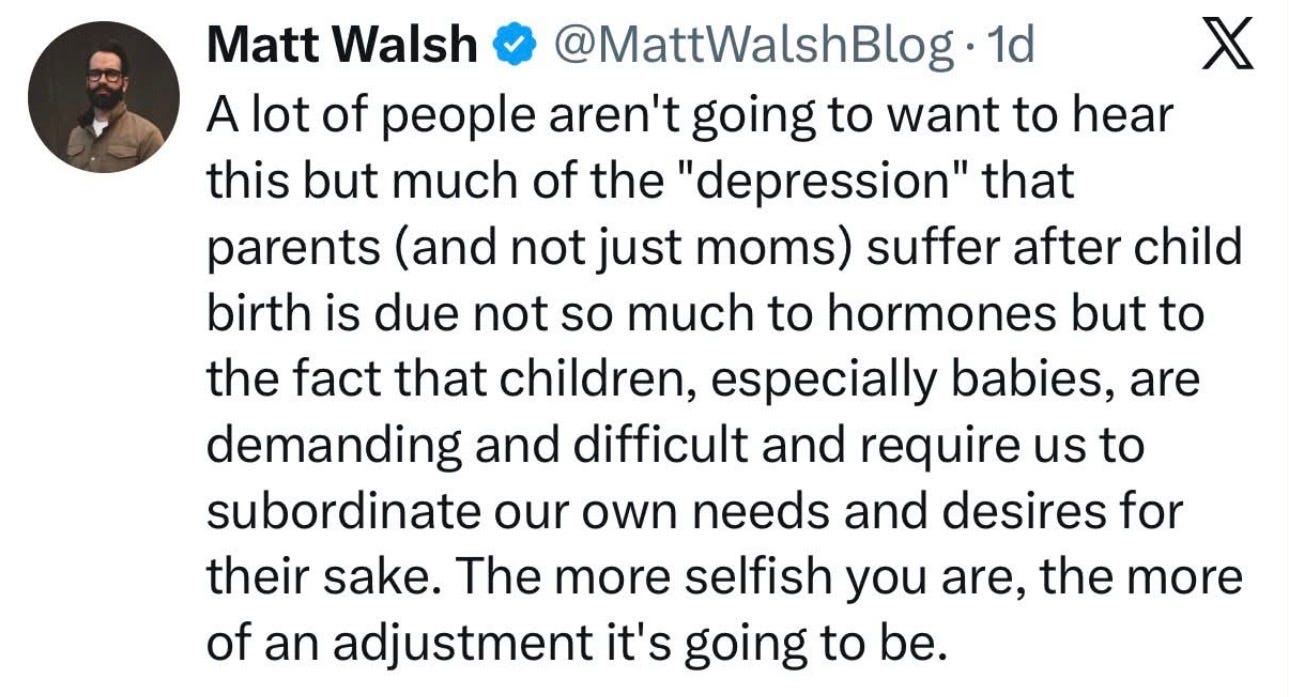
That is what made Matt Walsh's claim this week that post-partum depression doesn’t even exist feel less like a hot take than an act of calculated contempt. He argued that a "sizable portion" of postpartum depression isn't hormonal at all, but what happens when selfish women are forced to put someone else's needs before their own. It is a remarkable accusation to level at women whose bodies have spent nine months growing another human being, whose organs have rearranged themselves to sustain that life, who are surviving on fractured sleep while feeding another person with their own bodies, often with less support than mothers have had at any other point in human history. Faced with all of that, Walsh looked at their suffering and concluded the problem wasn't the conditions they were living under, it was their attitude.
Somewhere in the Paleolithic era, long before psychiatry, maternity leave or a man in a suit deciding when a mom should bounce back after growing a whole human, a woman gave birth surrounded by people who had already done it. Other women read her face before she said a word. Someone took the baby while she slept, someone shoved food into her hands before hunger became one more invisible job she had to manage, and someone noticed her hands shaking from exhaustion because there were enough people paying attention for someone to actually notice. She was not expected to recover alone because recovery was never imagined as a solitary thing. A new baby reorganized the entire community, not just one woman’s and her husband if he gets time off work.
Anthropologists call this alloparenting: the reality that human beings evolved to raise children collectively rather than inside isolated nuclear households. It’s easy to treat that as an interesting historical detail, but it’s our biological infrastructure. Human infants require extraordinary amounts of care, and human mothers have always depended on more than one pair of hands to provide it. For most of our history, the village wasn’t optional, it was primordial. It wasn’t just about emotional support, it was about physical safety.
Now imagine dropping that same woman into a third-floor apartment with a newborn, a partner who vanished back to work after a few measly days as though his job were the real emergency, grandparents scattered two time zones away, a few weeks of unpaid leave already bleeding out, and an endless chorus of people telling her to "enjoy every moment," ignoring her exhaustion entirely. She wouldn’t conclude that she had entered a more enlightened civilization. She would probably conclude that she had been abandoned. And yet, men like Matt Walsh argue the problem is the modern woman, even though she's raising children with less communal support than her ancestors ever had, and normalized fathers being optional instead of indispensable.
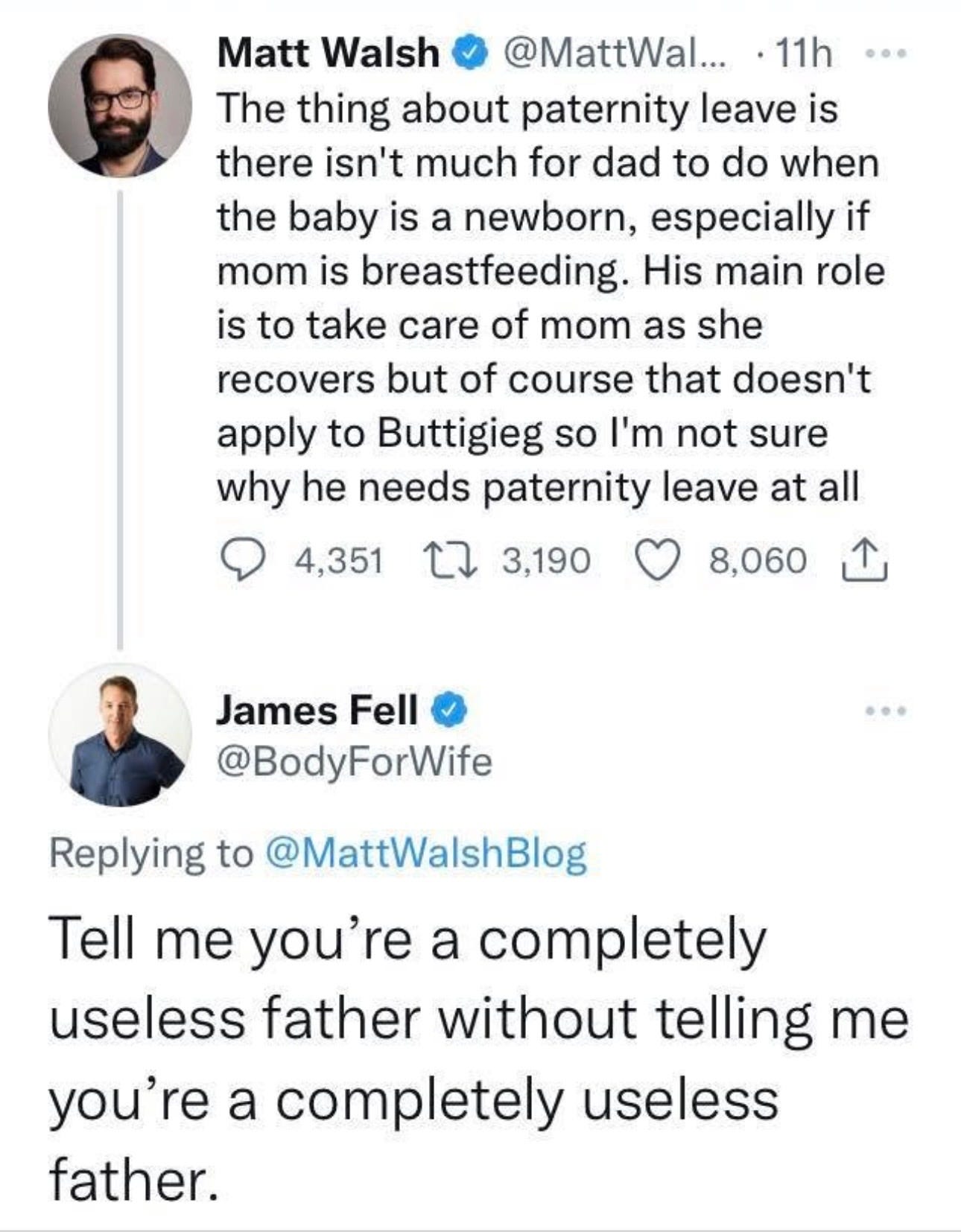
The abandonment of mothers has become so normalized we think it’s resilience. We celebrate women for doing it all. We applaud their strength. Then, when the predictable consequences of isolation begin to appear, we diagnose the mother instead of the conditions she’s been asked to survive. We assume something is wrong with her rather than asking what kind of society expects one person to do the work that entire communities once shared. And if we’re Matt Walsh we say that her diagnosis isn’t even real, it’s in her head.
While men like Matt Walsh beleive that postpartum depression isn’t real, it’s a serious medical condition, one that can require therapy, medication, hospitalization, or a combination of all three. It is also remarkably common, affecting one in seven mothers, with many more experiencing postpartum anxiety or other perinatal mood disorders. But what receives far less attention is the environment in which that illness unfolds. Sleep deprivation, chronic stress and social isolation isn't incidental. They are the conditions under which millions of women are expected to begin motherhood after we privatized what was once humanity's most collective job. We replaced the village with one exhausted mother, and then we blamed her for collapsing under a weight no human being evolved to carry alone. And this is even worse for non-white women. Black mothers experience postpartum depression at disproportionately high rates, with estimates ranging from 29% to 44%, and yet they are far less likely than white mothers to be diagnosed promptly or receive adequate treatment. And if you think white mothers are afraid to admit to wanting to harm them or their kids, for Black mothers, who risk having their children taken away far more than their white counterparts, asking for help is not even a possibility.
Modern parenting asks one or two adults to perform work that entire communities once shared. We have devalued and privatized care while leaving the expectations attached to care almost untouched. Mothers are still expected to be emotionally available, physically present, professionally ambitious, financially productive, and deeply grateful. This just isn’t sustainable at all. No wonder women are breaking.
The insults made by Walsh and other right-wing political hacks, which are arguments made by this very White House by the way, perform a real function. If postpartum depression can be explained as a character defect that millions of women who have never met each other, just happen to share, then nothing larger has to change. Employers don’t have to offer longer leave. Governments don’t have to use your taxes to make sure mothers have healthcare. Cities don’t have to become places where extended families can afford to live near each other. Fathers don’t have to rethink how care is divided. The problem can remain comfortably contained inside the individual woman. If she failed, then we don't have to admit we did. We have a long history of diagnosing women instead of indicting the world they've been asked to survive. The oldest trick in the book is to call a woman mad so no one has to answer for what was done to her.
And while Matt Walsh obsesses over mothers' character, researchers find that the one thing that predicts post-partum distress is not her personality, it’s whether she has people around her willing to help. Research has found that women with stronger practical and emotional support after birth are significantly less likely to develop postpartum depression, while declining support after childbirth predicts worsening mental health. A large California study found that mothers who consistently received emotional and practical support had about half the rate of postpartum anxiety and depression symptoms compared with mothers who lacked that support. In one prospective study, women with the lowest levels of postnatal social support were nearly ten times more likely to experience postpartum depression than women with the highest levels of support. The science has identified dozens of risk factors for postpartum depression, and shocker, shelfishness isn't one of them.
Postpartum depression isn’t happening to mothers, it’s being done to them.
The timing of the Clancy trial and the renewed attention to Panettiere’s story makes another reality difficult to ignore. Mothers are constantly absorbing lessons about what honesty costs. Clancy’s story raises agonizing questions about whether the health system can support mothers before tragedy occurs, while the other reminds women that publicly acknowledging postpartum depression can carry very serious professional consequences. It isn’t difficult to understand why so many mothers reserve their most frightening thoughts for whispered private conversations with friends rather than institutions, and people who could actually help.
So no this isn’t about women being selfish, it’s about women being burned out and scared to say it. The woman in the Paleolithic was not stronger than the woman standing in her kitchen today with throw-up on her shirt and three hours of sleep behind her. She was simply surrounded by more people. We like to imagine that modern mothers should be able to outperform their ancestors because medicine has advanced and technology has improved, when we’ve just made the job harder than it has ever been. We removed the people who used to share the work, then convinced ourselves that struggling under the weight says something about the woman instead of us.
This is why this week’s headlines weight so heavy on women, especially mothers or those who care about them. Mothers are trying to keep their heads above water, and Matt Walsh's contribution is another hand pushing them under. Mothers haven’t changed and become more self-centered, some men have just become increasingly comfortable asking them to do one of humanity’s oldest collective jobs almost entirely alone. When they falter, we reach for diagnoses, arguments, and moral judgments before we ask the simpler question our ancestors might have recognized immediately: why wasn’t someone there to help?
If this conversation resonated with you, I think you'll enjoy this week's episode of Boy Problems! I sat down with Julian Shapiro-Barnum, the host of Recess Therapy, to talk about what children can teach us about love, friendship, vulnerability, and the emotional honesty so many adults lose along the way. It's funny, unexpectedly moving, and one of my favorite conversations we've had. Listen wherever you get your podcasts.

Comments
Nothing yet. Say the first thing.
Sign in to join the conversation.