
Eschatology was never a concept I cared about in graduate school. It felt too churchy to me. The kind of thing biblical scholars got excited about, while those of us who study the religion of everyday life mostly ignored. If you studied eschatology I thought you probably spent a lot of time on the Book of Revelation, or the Rapture. And to me focusing-on-the-never-to-come-end-of-times seemed like a bit of distraction from the work of figuring out how to live…like right now.
But this is why writing this Substack is so great for me. I learn from you. You push me to consider new ways to reimagine religion. And the reason eschatology is suddenly on my radar is an example of how this can play out.
Let me back up a bit. A few months ago I wrote a piece about Zohran Mamdani, Trevor Noah, and David Tracy that went viral, or at least viral for me. Over 269,000 people have seen it, and over 1,000 people have commented on it. People are still sharing it every day. I’ve heard from academics, activists, and a surprising number of clergy that is was helpful to them.
I hadn’t really expected to reach clergy with this Substack, but that has been one of the delights of this platform for me. To be quoted in a Sunday sermon or a Dharma talk? I can’t think of a more meaningful result of this work. And another happy outcome of clergy reading me is that I’m learning a ton from how they build on my writing as well. Last month is a perfect example.
A United Methodist minister named Rev. Blair Trygstad Stowe tagged me in an Instagram reel for the Progressive Christians Podcast, where she is riffing on my Mamdani/Noah/Tracy piece and extending my argument with additional theological language. Her claim: your eschatology informs your ethics. And she thinks we’d lost our ability to see that.

I want to build on what she said. But first I need to explain what eschatology actually means. Not the doomsday version, but a more scholarly and pastoral one, because I think you’ll find it useful even if you have no religious affiliation whatsoever. This is a good example of what I’m always arguing: religion, approached as a conversation partner rather a repository of rigid dogma, can give us precision on things we’re already sensing but don’t have language for.
I’m not an expert in eschatology, I’ve already confessed that, so here goes my best shot at a brief introduction.
The word eschatology comes from the Greek eschaton, the last thing or the age to come. In religious studies, eschatology is the study of ultimate futures. What do you believe is possible? What is your vision of what humanity or the world would look like at its best? In religious traditions this gets expressed through ideas like heaven and the Kingdom of God. But the underlying question is simple: what are we working toward, and does it exist beyond our own lifetimes?
Here’s the key move that Rev. Blair made: everyone has an eschatology. You don’t have to be religious to have a vision of what the ultimate future holds. Political optimism is a form of eschatology. The belief that human beings can build a more just world even if you won’t live to see it is an eschatological commitment. And the belief that we can’t is one too. Your eschatology shapes your ethics because what you believe is possible determines what you’re willing to do today.
Now let me try to summarize some religious ways of thinking about eschatology because I see them as providing concepts and frameworks helpful as I work out my own eschatology, and you might as well. (This is by no means exhaustive, so if you have additional recommendations for how readers can go deeper on any of what follows, please share in the comments.)
Judaism has the concept of tikkun olam, or repairing the world. The concept appears in Kabbalistic mysticism and has evolved into a broad ethical framework for pursuing justice in the world. What I like about it is how it assumes incompleteness. You are not going to finish this work, but that’s not a reason not to do it. For a deeper dive, look at anything by Rabbi Abraham Joshua Heschel, who connects tikkun olam to ethics explicitly.
Buddhism has its own eschatology, though it looks very different because Buddhist cosmology is cyclical rather than directional, and I'll be honest, this is not intuitive territory for me, so I reached out to Eric Manigian, a Buddhist practitioner and scholar, for some help (any inaccuracies in what follows are my fault, not his). Eric described Buddhist cosmology as a spiraling corkscrew, with no fixed beginning or end to the universe. The Buddha himself stepped off that wheel by dissolving the delusions that generate negative karma. Within that framework, the Bodhisattva (a concept specific to Mahāyāna Buddhism) plays an important role: one who has attained the wisdom necessary for individual liberation but chooses to delay that liberation in order to help all sentient beings reach awakening. The Bodhisattva’s commitment is not contingent on seeing results, but this release from immediate outcomes shouldn’t be mistaken for passivity. Buddhist ethics (at least ethics associated with socially engaged forms of Buddhism that I find the most helpful) holds the Absolute and the Relative simultaneously: yes, we let go of the demand for results, but the Relative dimension means every encounter with suffering still calls for urgent engagement. I’ve had Jan Nattier's work recommended if you want to go deeper.
Many Indigenous traditions share an orientation toward intergenerational responsibility. For instance, the Iroquois have a seven generations principle: decisions should be made with the well-being of seven generations into the future in mind. I like that quite a bit, the idea that you are not just responsible to people alive today, or to your children, or even your grandchildren. You are responsible to people who do not yet exist because the choices you make will affect their lives. The Lakota concept of Mitákuye Oyás’iŋ (all my relations) extends that responsibility outward to include not just future humans but all living beings. This is an eschatology of radical relationality, and if you want to learn more check out my prior post about resources for reading about Indigenous worldviews.
Islam holds that human beings are khalifah (stewards) of the earth which means we are entrusted with its care on behalf of God and of those who come after. The concept of the akhirah, the hereafter, functions eschatologically not primarily as reward and punishment but as the ultimate accountability for how good of stewards we were. What did you do with what you were given? How did you treat those in your care? It assumes our actions always have consequences beyond what you can see. Seyyed Hossein Nasr’s work on Islamic environmental ethics is a good place to start.
Christianity at its best (I think) understands that the Kingdom of God is not simply a postmortem destination. It is something being built now, imperfectly and collectively, by people who will not see its completion. The Social Gospel movement of the early twentieth century understood this. Rev. Blair and her progressive Christian tradition seem to understand it. Walter Brueggemann’s The Prophetic Imagination is essential on this, and I’ll come back and do an entire post on that text when I can do it justice.
Now as a counterpoint, let’s look at the tech bros.
Elon Musk, Sam Altman, Peter Thiel and their Silicon Valley cohort are not operating without a vision of the future. They have a very specific one: AI will surpass human intelligence, humans will become obsolete as a species, and what matters now is making sure your version of AI is the one that wins.
We got an unusually clear window into exactly how this eschatology works in practice during the three-week federal trial in Oakland that ended last month, when a jury dismissed Musk’s lawsuit against Altman and OpenAI in less than two hours. The ongoing legal battle between Musk and Altman has produced language about AI’s rights as a species, about who gets to steward its development, about the inevitability of its dominance. This is an eschatology. A dark icky one, but an eschatology nonetheless. And like all eschatologies, it produces an ethics. Or in this case, an anti-ethics.
Because if you genuinely believe that human extinction is coming, why would you feel any obligation to the people around you right now? Why invest in public health, housing, schools, or anything that requires imagining a collective human future? The tech bros’ eschatology doesn’t just fail to motivate ethical behavior, it actively authorizes its absence. If the future belongs to AI, then caring about other people is just dumb.
Noah Hawley recently published a piece in The Atlantic, “What I Learned About Billionaires at Jeff Bezos’s Private Retreat,” describing his time at Bezos’s annual Campfire gathering and what it revealed about how the ultra-wealthy relate to the rest of humanity. His core observation: these men have left the world of consequences behind. Moral reasoning develops through consequences. But when you can buy your way out of any mistake and surround yourself entirely with people who need something from you, the basic mechanism by which humans learn that other people are real is missing. Hawley made this a psychological argument. I want to make a theological one with the same data: when your eschatology has already written other people out of the future, their reality in the present stops mattering. Like at all.
This is why Musk called empathy the fundamental weakness of Western civilization. That’s the logical consequence of an eschatology in which the human species is already obsolete. If we’re on our way out anyway, why feel anything about us?
Pope Leo XIV’s first encyclical is in part a direct theological response to the tech bro vision. Leo argues that the Silicon Valley eschatology, mainly that we will transcend human limitation through technology, is ethically dangerous. What he offers instead is closer to tikkun olam than to the Terminator scenario: a slow, relational, accountable vision of the ultimate future built piece by piece with everyone included.
Rev. Blair ends her reel with an observation that is similar to what I was trying to point out in my viral Noah/Mamdani/Tracy post: we’ve lost the ability to imagine together something that is bigger than ourselves. And I think this is a failure happening on multiple fronts simultaneously: in the tech world, in secular progressive politics, and inside religious communities that have let their vision shrink down to the size of individual spiritual comfort. What ideas like tikkun olam and the seven generations principle share is the insistence that the relevant unit of moral life is not the individual, not the immediate family, not even the generation. It is something larger and more communal than any of us can fully see.
We do not know what the future looks like. And yet, we have to act as if there is some version of us that endures, don’t we? As if what we do today will matter to people we will never meet? As if the world is worth repairing even though we won’t finish the job? Because if we don’t, the machines deserve to take over.
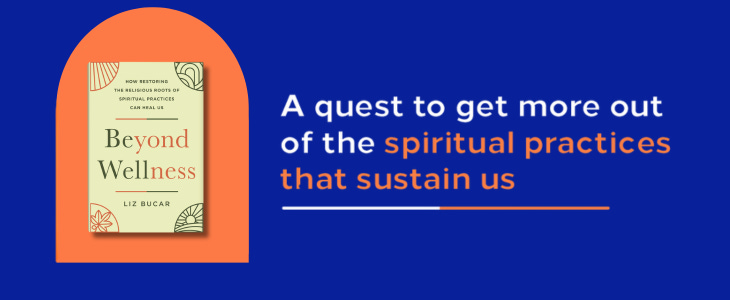
Speaking of imagining something bigger than ourselves…I wrote a whole book about this. Beyond Wellness came out in April and if you are enjoying my substack I think you’ll love my book. And if you have already read it, a review on Amazon or Goodreads would make a huge difference.
Comments
Nothing yet. Say the first thing.
Sign in to join the conversation.