
Dr. Thilde Ross and I have daughters who are super close. They met on our town swim team, from different K-8 schools, but now part of the same wonderful friend group that carried them through high school. They just graduated together this spring.
Thilde and I connected the way parents do: a parent potluck for our our kid’s sports team (this time crew). And eating salad and lasagna from a paper plates, we put it together that we had we’d overlapped at Harvard, she was a couple of years ahead of me, and we’d both rowed for Radcliffe Crew, though she was one of the cool varsity seniors by the time I showed up as a freshman novice. It made for a fun “wait, you’re that Thilde” moment.
So: two Brookline parents of teenagers, and now, this spring, authors of books that came out within weeks of each other. Thilde’s first book. My first trade book. We’ve spent the whole pre-launch/launch marketing gauntlet texting each other, which has been its own kind of support system.
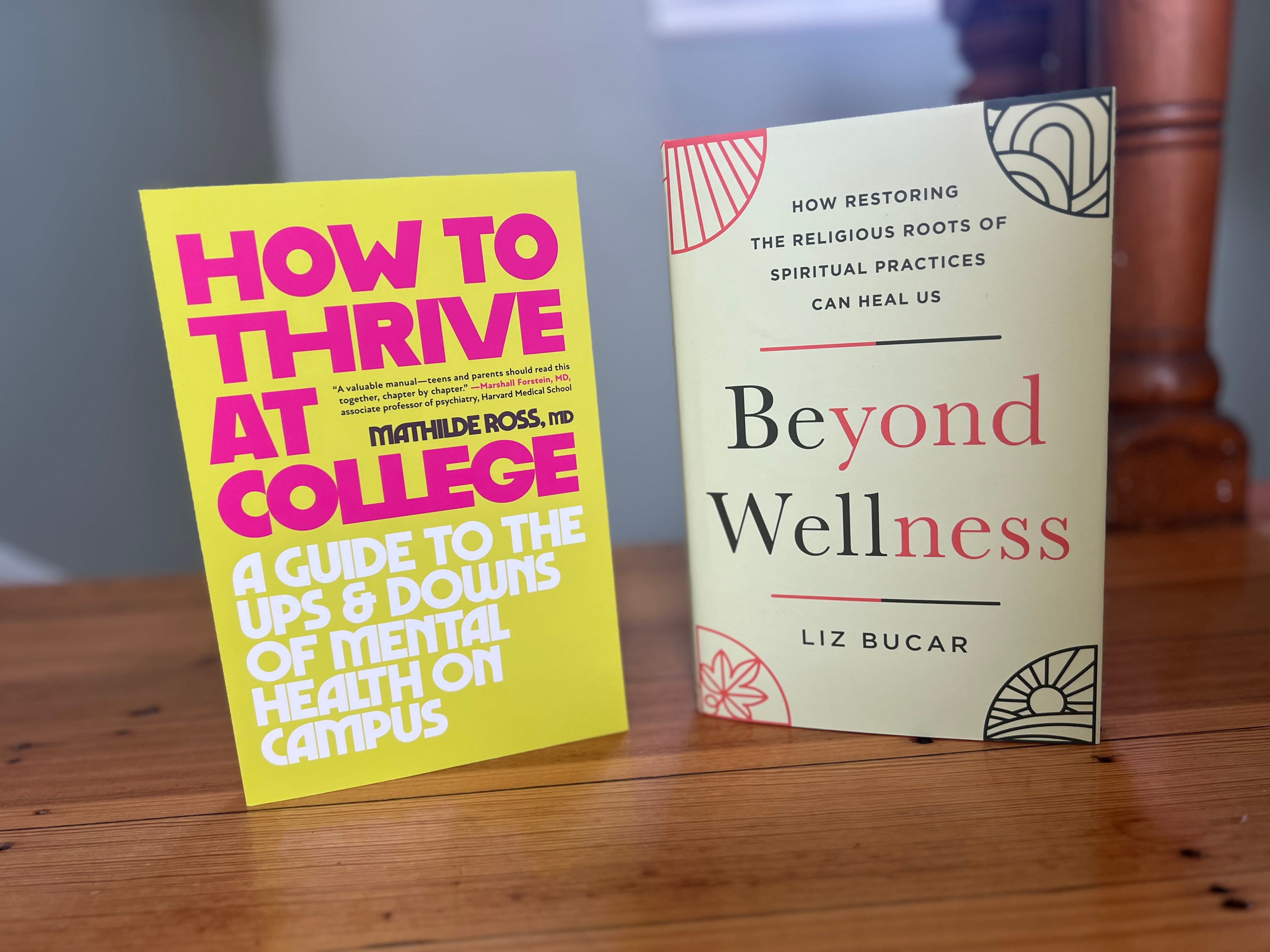
Early on I read a draft of Thilde’s book and blurbed it. And Thilde, because she’s a genuinely generous reader, bought several copies of mine, and has been working her way through it this summer. Every few chapters, she texts me some version of “wait, this is basically what I’m arguing too.” But you should also know that our books look, on paper, like they shouldn’t have much overlap: mine’s about religion and wellness culture, hers is about surviving college from her POV as a psychiatrist. But we landed in simliar places.
So today’s post is about that overlap, what a religion scholar and a college psychiatrist, working from completely different training and completely different case material, both concluded about what real well-being actually requires.
Liz: Your book and mine both push back on the idea that good mental health means maximizing positive feelings and minimizing bad ones. You’ve spent two decades watching what happens when students (and their parents) chase only the “ups.” What does it actually look like in your office when someone’s optimizing for feeling good, and it’s making things worse?
Thilde: An obvious example is grief, which everyone is familiar with. The death of a loved one doesn’t fit neatly into a college semester, so many students try to avoid feelings of grief and press on with their responsibilities. This can really backfire. Grief that isn’t processed in a culturally sanctioned way, with rituals and community (threw that in for you!), can fester and develop into depression or substance abuse.
Liz: Your book is built on stories from your practice of treating students. Is there a story that captures this pattern especially well, like a student who’d done “everything right” for happiness and still ended up in your office?
Thilde: I hate to rely on a stereotype, but sororities come to mind. They often have a culture of academic excellence, high standards for beauty and fitness, and a norm for social interaction that one of my colleagues calls “toxic positivity.” Sororities can be a great source of connection and motivation for some, but other students find the culture alienating and exhausting. It makes my job easy, though: I just tell girls like this to quit their sorority.
Liz: In my sound chapter, I describe going on a “gong crawl” expecting a relaxing, passive experience and instead getting overwhelmed, disoriented, uncomfortable, no real skill for processing what came up. Does that read as clinically familiar to you? Is there a psychiatric version of “not having the skill to sit with the hard feeling”?
Thilde: I loved this chapter! One thing a lot of people don’t understand is that therapy is difficult. It stirs up emotions that haven’t been dealt with and put away properly, like in my grief example. Early in therapy, part of the work is learning to tolerate and manage difficult feelings, so therapy itself doesn’t make the individual’s problems worse. You probably remember that in my book I return frequently to the theme that there is no improvement without doing hard things. This is true for every human pursuit I know of.
Liz: You cut through contradictory advice with common sense. So what’s the common-sense version of why chasing only positive emotion backfires? What do you say to a parent standing in your office?
Thilde: We have emotions for a reason. Say you’re walking alone at night on a dark street and start feeling uncomfortable: that discomfort prompts you to walk somewhere with better lighting, or just call an Uber. Ignoring emotions can lead to unsafe situations. More commonly, ignoring emotions means problems don’t get solved. In my book, I talk about a student who was running out of money at the end of the term and couldn’t afford art supplies for her final project. She was feeling increasingly anxious but didn’t take steps to solve the problem causing the anxiety. Eventually, she found her way to my office with a panic attack. I made a referral to the dean’s office for an emergency loan. She wouldn’t have had the panic attack if she’d responded appropriately to her anxiety in the first place.
Liz: I come at this through religious traditions that built ritual structures specifically for processing grief, anger, fear, with community built in. Is it fair to say psychiatry doesn’t usually think about the role “ritual” in that sense? Do you think something is lost without it or does clinical practice do that containing work differently, maybe better, for a college population?
Thilde: I work with students from all over the world, from all different religious traditions. I check my values at the door when I arrive at work in the morning. My role is to help students find a way forward from their suffering in a way that’s in line with their values, not mine. But usually, by the time someone winds up in my office, something in their life isn’t working for them—in which case it can be helpful to offer a different way of looking at things. I loved your section on Ramadan and eating disorders, by the way! It totally captured the way a set of beliefs or behaviors might have a different significance depending on the context.
Liz: Here’s a place I want you to push back on me if you think I’m being unfair to your field. To me it seems like psychiatry, like wellness culture, is built around the individual: the patient in the room who needs to get better. Religious traditions, at their best, orient people outward, toward obligation, community, collective ritual, and so on. Is the individual-patient model actually a limitation for college mental health? Is it a framing problem, the same blind spot I’d accuse wellness culture of having? Or is that a cheap shot, and psychiatry already does this collective work in ways I’m not seeing?
Thilde: I’m so glad you asked this question! You probably noticed in my book that I have some criticisms of my field, and this is a huge blind spot. There’s an old expression: psychiatrists are the handmaidens of the status quo. In other words, if you see mental health problems as based in individuals, you don’t need to do the more complicated work of improving society. If child abuse and child poverty didn’t exist, serious mental health problems would be quite rare in young people. The longer I do this work, and the longer I experience life as a human, the more obvious it becomes that individualism is a myth, and a pretty unhelpful one at that. Economic, cultural, social, and family factors are huge. And yet, it is individuals who become depressed, develop panic attacks, or stop eating. It is individuals who come into my office. And I am grateful that my field has tools that can really help them.
Liz: If a student or parent reading this asks “okay, so what do I actually do instead of chasing happiness,” what’s your real-world answer? What does making room for the full range look like during finals week?
Thilde: If you wouldn’t treat your dog that way, don’t treat yourself that way. (You saw that coming, right?) Seriously, we’re animals, biologic creatures with basic needs. Specifically, we’re mammals, a subset of animals with intense social needs. Just like dogs, we need food, water, companionship, exercise, play, and rest in appropriate proportions. If you’re not okay, ask yourself if you’re doing too much or too little of one of these essential activities. Feeling dysregulated on a Tuesday night during finals? Don’t reach for alcohol or an energy drink. Work out, play a game with a friend, eat good food, call your mom, or get some sleep. But there’s one thing we need that is uniquely human: meaningful work. If you hate your job (or major, if you’re a student), there’s a good chance you’re pretty unhappy, or will be eventually. A wellness guru isn’t going to solve that with mantras or poses or yogurt cleanses. (I think I made that one up, but it sounds like something that might exist on social media!)
Liz: Why do you think a religion scholar and a college psychiatrist landed in the same place on this? What does that convergence tell you?
Thilde: The convergence of our thinking on these topics is uncanny. I find it deeply reassuring that two people who have spent decades thinking about the human condition from completely different paradigms have come to many of the same conclusions. Maybe we’re on to something!
My new book, Beyond Wellness, is out now. You can order a copy at the link below (and if you have already read it I’d be SO grateful for an Amazon or Goodreads review!).
Thilde Ross’s book, How to Thrive at College: A Guide to the Ups and Downs of Mental Health on Campus, is out now as well. Link to order below.
Comments
Nothing yet. Say the first thing.
Sign in to join the conversation.