
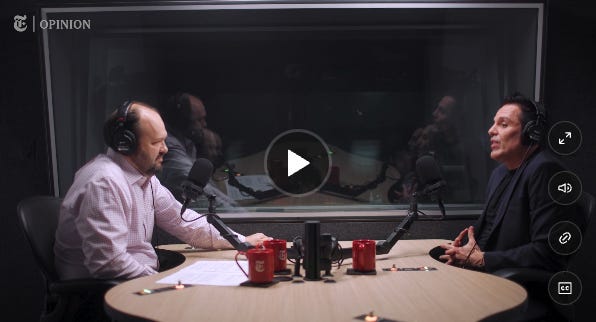
When I started listening to Ross Douthat’s June 11th podcast last week, which was an interview with a German biotech entrepreneur, I assumed it was going to be like every other tech bro conversation about optimization. Human flourishing reduced to performance metrics, the body as a project, suffering as a problem to be solved. An anemic view of well-being in my opinion.
And to be fair Christian Angermayer, the biotech billionaire in question, did talk about something he calls humanmaxxing (ick), and about the Enhanced Games, which are essentially the Olympics if you allowed athletes to take any FDA-approved performance-enhancing drug they wanted. So my instincts weren’t entirely wrong.
But I have to give Ross credit where credit is due. I don’t always agree with him (he’s a conservative thinker and I’m not) but he’s a good interviewer who often books great guests, and lately I’ve been finding his podcast really rich. And this conversation in particular went to places that biotech discussions rarely go in public: questions about God, about suffering, about what we’re actually for, in part because Angermayer is a biotech entrepreneur who also describes himself as religious, but religious in a different way than Ross.
And in my head, Ross was having a conversation that felt surprisingly close to what I read from a Franciscan sister named Ilia Delio (who I discovered here on Substack) responding to Pope Leo XIV’s new encyclical, and from my colleague Beatrice Marovich’s piece on the difference between transhumanism and posthumanism. A nun, a theologian, a biotech billionaire, and a conservative podcast host….an odd mashup, I know. But that is the conversation currently bouncing around in my head and it felt like it was worth sharing because it helps get some more precision about what the heck is at stake.
So here we go.
Let me start with a distinction Beatrice makes in her piece because I think it helps focus this whole conversation for me.
When most people, including Pope Leo, hear the word transhumanism, they picture something like Angermayer’s Enhanced Games: humans ramped up on testosterone and steroids, optimizing their bodies into peak performance machines. Leo defines it in his encyclical as an intellectual movement that envisions “the enhancement of human beings through technologies — such as biomedicine, body engineering, devices and algorithms — with the aim of increasing performance and capabilities.” That’s also Christian Angermayer’s entire project. He doesn’t like the term transhumanism and prefers to call it humanmaxxing, but the logic is identical. Take what’s already in us and turn up the volume.
Beatrice points out that posthumanism is something entirely different, and that Leo seems not to get the distinction. Here’s how she puts it:
What distinguishes posthumanism from humanism is not that it was simply an intellectual movement attempting to fuse humans with technology... but that it was a movement examining and exposing both the narrowness and the hubris of humanism. Posthumanism wanted to make explicit what humanism was designed to naturalize, or hide. It took on a view of the human from its own liminal edges.
Beatrice discusses Donna Haraway’s writing about the cyborg to show what a posthumanism project looks like. Many of us are already cyborgs Haraway would argue with our pacemakers, titanium joints, hearing aids. But the deeper point Haraway is not that our cyborg reality is good or bad, but that the IDEA of the human in our intellectual traditions had long been gendered as typologically male, and sustained itself by denying its own animality. Posthumanism isn’t about becoming something other than human. It is about seeing clearly what we already are.
And this means Leo, Beatrice argues, builds a scarecrow. He needs posthumanism to be the wrong kind of more-than-human so he can position Christian theology as the right kind. But the posthumanism he’s critiquing was never about upgrading the human into something limitless. It was about asking who the category “human” was always built to include, and who it was built to exclude. Collapsing these two things, which Leo does, makes it impossible to think clearly about any of it.
Back to that Angermayer conversation. He is absolutely a transhumanist, whatever he wants to call himself. His vision is maximization. And what makes me uncomfortable with this vision is that what are we maximizing towards is unclear.
And yet, I found Ross and Angermayer’s conversation about beauty standards really interesting. Ross raises the idea of convergence, i.e. won’t we all just end up looking like the Kardashians once the tech allows us to easily alter our physical appearance? But Angermayer doesn’t think this is actually a danger. He makes a historical argument: beauty standards have always been about what is hard to achieve. In medieval Europe, paleness was beautiful because only the wealthy could avoid working outdoors. Then tanning became beautiful because only the wealthy could afford beach vacations.
His argument is that if you make weight loss accessible to everyone through a GLP-1, and then muscle creation accessible through another drug (which he thinks we’re within a few years of having) then the standards of physical beauty (thin and toned) stop being hard to get. And if they stop being hard to get, diversity rather than sameness might become what’s actually desirable.

I read Scott Westerfeld’s Uglies YA series when it first came out fifteen years ago, and it’s really stuck with me. In those dystopian novels, everyone receives mandatory cosmetic surgery at sixteen and becomes uniformly pretty. The book is about the rebellion against that, the insistence that there’s something worth protecting in the weird, asymmetrical, unoptimized human face. My instinct is that Angermayer is too optimistic about how quickly we move through the homogenization phase. We’re in it right now. The Instagram face is real. The Ozempic body is becoming a new normal. But his longer view argument is worth considering….could bio tech open the door for human diversity in a new and helpful way?
But my overall concern with Angermayer isn’t that he’s wrong about the possibilities. It’s that possibility without direction doesn’t necessarily get us some place better.
This is where Ilia Delio comes in. Delio is a Franciscan Sister and Catholic theologian who specializes in science and religion. She currently holds an Endowed Chair in Theology at Villanova University but I found her here, on Substack (thank you Substack!). Her pushback against Leo’s critique of AI is one of the best I’ve read.
Leo’s problem, she argues, isn’t his anthropological concern, it’s his metaphysical constraint. And the most telling sign of that constraint is his use of the verb remain. Here is an bit of what Delio says:
Our duty in the age of AI, he writes, is to ‘remain profoundly human’... Yet an ontology of relationship, to which Laudato Si’ points, rests on the verb, become. I do not think the question the age of AI puts to theology is how to remain human. I think it is how personhood develops in a world where we are no longer the only minds, and where the human-machinic is not a horizon but a daily fact.
To understand why this matters, it helps to know the difference between the two theological traditions Delio is engaging. Thomistic theology (the tradition Leo is working in) gives us a fixed human essence. God is external and transcendent. The human person has a given dignity, conferred from above, to be protected. The job of ethics is essentially conservative: preserve what has been given.
Process theology (the tradition Delio is working in) sees things differently. God and the world are mutually becoming. Evolution is not just a biological fact but the medium through which consciousness and complexity unfold. The human person is not a finished essence to be protected but an unfinished process, always in relation, always becoming. The job of ethics here is not conservation but midwifery, helping bring forth what we are in the process of becoming.
Leo is trying to protect a fixed human that, as Delio points out, never quite existed. She writes:
“We are already posthuman, whether we want to be or not.”
She also makes a move I find helpful for understanding why people are turning to AI for companionship, advice, and even love. Leo notices this and worries about it. But Delio argues Leo shares the metaphysics that causes this. AI can only become a replacement for God when we were taught to look for God “out there.”
You should read her full essay to understand her solution to this, but in a nut shell she suggests instead of policing the boundary between human and machine, we should work towards unification: withdrawing the projection of God outside of us, recovering the interior ground, learning to inhabit the new relational fields as persons rather than standing outside them guarding a self that relations already exceed.
I think Delio’s right that Leo is protecting a romanticized version of the human that never existed and that human flourishing has never been about returning to some golden age. It’s always been a process, worked out in real time, in whatever context we are living in. She’s right that the ship has sailed: AI is here to stay. Or as Donna Haraway might say, we are already cyborgs and will be even more cyborg-ish in decades to come. And she gives me one of the most useful lines for my own work on wellness culture: that relations can be counterfeited, and counterfeit relations hollow us out. The wellness industry has been selling counterfeit meaning for years. AI is doing it at a scale the wellness industry can only dream of.
But I’m not ready to follow her all the way to the idea that AI is part of the teleological unfolding of the divine. I want to preserve space for critique. I want to be able to say: not everything that emerges from the process is good, and we retain the responsibility, and the capacity, to slow down, redirect, and even refuse. I bet Delio would say her framework allows for critique, but I’m not sure she has a way for refusal, for saying no, for slowing down rather than integrating forward.
Because this is my real concern: where are we headed? What is the future we are imagining and then creating (or co-creating with God if God is your jam). Angermayer never asks what we’re maximizing toward. Leo asks what we’re protecting, but his answer is a fixed idea of what the human is. Delio asks what we’re becoming, but I worry her answer risks making the becoming itself the good, regardless of direction.
What I want to know is toward what are we becoming, for whom, and at what cost? Not just are we flourishing, but who is included in that flourishing? Not just what can we optimize, but what is worth optimizing, and what gets lost in the optimizing?
In Westerfeld’s Uglies, the rebellion isn’t against beauty. It’s against the idea that beauty has one mandatory form that everyone must inhabit. The pretties aren’t villains, they’re people who were told this was flourishing, and believed it, because nothing else was on offer.
That’s the thing about optimization culture, whether it’s wellness or biotech or the Church’s mirror image of it. It tends to shrink the imagination. It gives you a fixed target and tells you to move toward it. What gets lost is the weirder, harder, more interesting question of what we might become if we let the target stay open.
And I didn’t expect a conversation between a biotech billionaire and conservative podcast host to make me think harder about that, but it sure did!
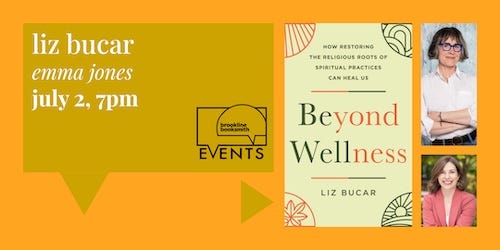
If these questions connect to your own thinking about wellness, flourishing, and what the good life actually looks like, my book Beyond Wellness is available now. I’d love for you to read it!
And if you are in the Boston area: please join me and Dr. Emma Jones at Brookline Booksmith this Thursday, July 2nd, at 7pm for a conversation about Beyond Wellness. I’m calling the talk “What a PhD, a Silent Retreat, and Three Days of Ayahuasca Taught Me About Real Well-Being.” Register for free at link below.
Comments
Nothing yet. Say the first thing.
Sign in to join the conversation.