
Dear Friends, this month’s conversation is with Julie Quiroz, a long-term organizer who recently moved to Minneapolis. She has played a key role in the collective creation of Central Minneapolis’ neighbor-to-neighbor rent assistance effort for families sheltering in place during the ICE siege, supporting over 220 families to stay in their homes during February. There’s a time-sensitive request for your donations for March rent via THIS LINK. Please share it. Thank you for your care and solidarity. The way through is together.
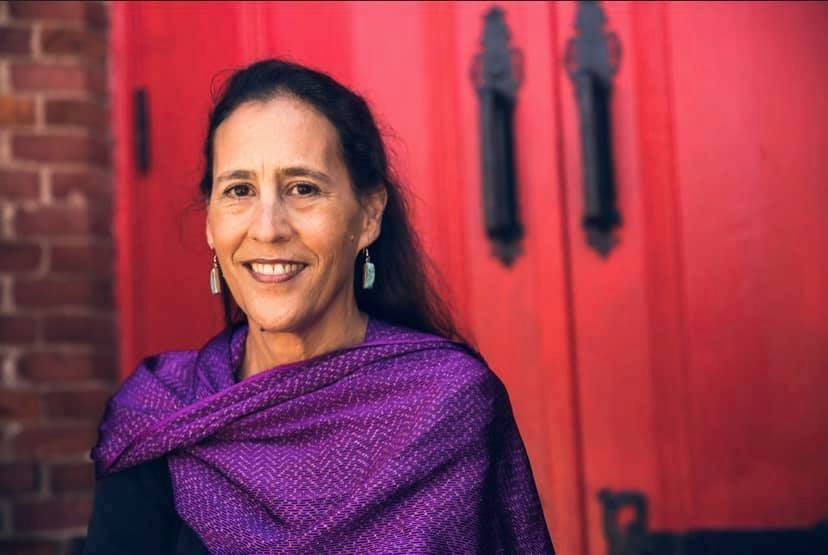
Julie Quiroz is a narrative strategist, a writer, a mama, and a longtime organizer for racial justice and immigrant rights. She grows community by nurturing culture and story to foster a world of loving joyful regeneration. Indeed, themes of love and liberation weave through all that she does.
I met Julie years ago when she was a senior fellow at Movement Strategy Center (MSC). She was part of the Transitions Initiative, which gathered movement leaders from across the country to explore how embodied wisdom generates untapped power and possibility in social, economic, and ecological justice. At MSC, Julie authored/co-authored publications including Love With Power: Practicing Transformation for Social Justice, ReGeneration: Young People Shaping Environmental Justice and Leading with 100 Year Vision: Transforming Ourselves; Transforming the Future.
Since that time, Julie led New Moon Collaborations, nurturing collaborative projects to grow a culture and economy grounded in love and care—including, for example, practices of ancestral agriculture and community birth. And in 2020 Julie helped spark the creation of Birth Center Equity, a network of Black, Indigenous, people of color-led community birth centers. She currently serves as director of BCE’s narrative strategy and communications.
Julie’s essays and poetry have appeared in such publications as Yes! Magazine, Colorlines, Nonprofit Quarterly, and The Nation. She co-founded a Michigan-based women of color poetry collective, and edited the anthology Love & Other Futures: Poetry of Untold Stories of Liberation & Love. Julie says, “poetry is the practice of seeing, naming, and valuing what oppression and violence has taught us to ignore—our tingles, intuition, dreams, magic, grief, and joy.”
Less than a year ago Julie moved to Minneapolis to join her sister, who has lived there for decades. Their neighborhood is among those most targeted by ICE and the Department of Homeland Security (DHS). As we talk together over zoom, she points out the window, “George Floyd, Mr. Floyd, was killed four blocks that way. Renee Good was killed a block-and-a-half that way. Alex Pretti was killed 10 blocks that way.”
She lets that sink in before continuing, “But I think because it was at the epicenter of the 2020 racial reckoning, and the uprising that came from that, this neighborhood has experience and depth with these situations. It laid the groundwork for so much. We’re a deeply diverse neighborhood—Latino, Black, and white—and the level of organizing and cohesion and care in the community is just extraordinary.”
She talks about how grateful she is for the anti-racist organizing done in white communities by groups like SURJ (Showing Up for Racial Justice), that created a foundation for people to show up more skillfully now. “Minneapolis is known for having a very white-dominant culture, and because the streets were not safe for people of color, a lot of the organizing during the siege has been white led. It’s an interesting moment, because a major part of this story has been that white people have stepped up and put their lives on the line in incredibly courageous and powerful ways. So there’s just incredible gratitude and respect for that. It’s inspiring . . . And it’s been interesting to be in white-dominant spaces and navigating the complexities of that.
“All of that navigating is on top of the daily violence. Feeling like a war zone . . . seeing your neighbors getting hurt, and just feeling on edge and on call all the time. It’s been so intense and so hard, right? And then when you’re doing the layers of dealing with white dominance—even the best of white dominance—it’s a lot.”
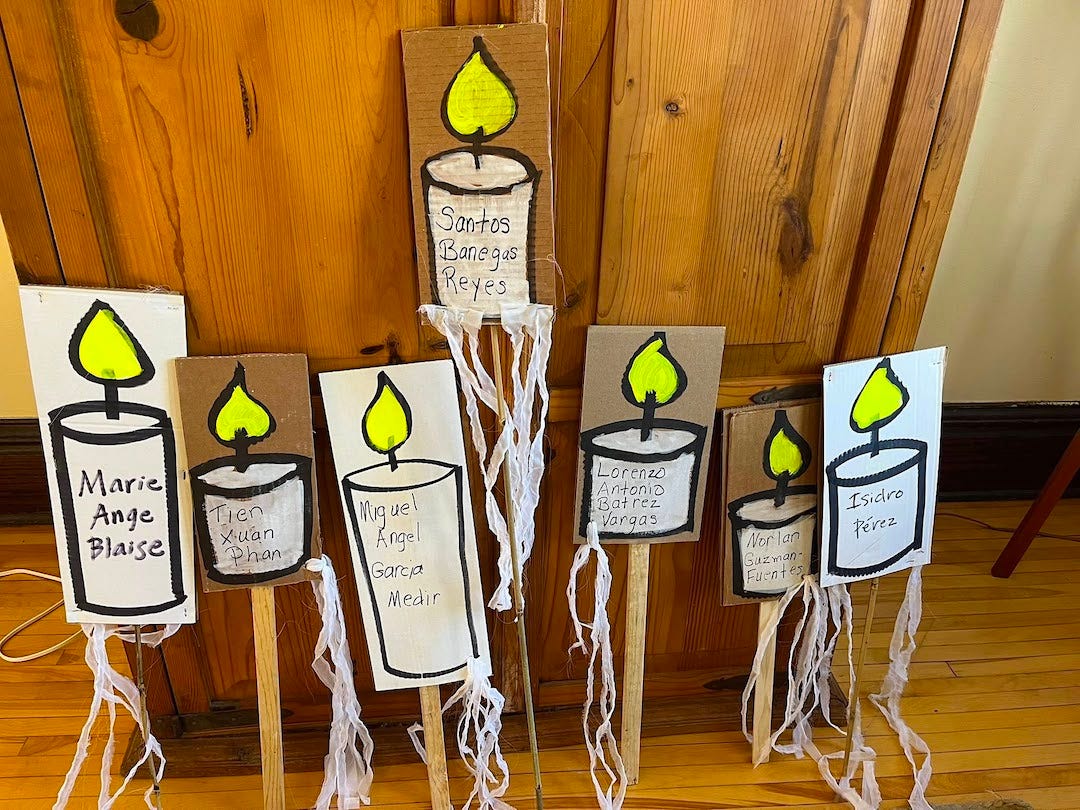
As a way to memorialize the many people who have died in ICE violence, Julie’s sister and a friend created signposts that could be carried or put in the ground, with paintings of candles and the names of those killed.
As we talk about the need for healing, Julie tells me that just last night she attended the first intentional healing space she’d been able to go to since the siege began—a space for people of color held at a local workers union.
“There’s been healing spaces,” she explains, “but it’s mostly been at sites of violence. Or it’s been in the context of doing things. Do you know what I’m saying? Publicly doing. The one I went to last night was not a public facing thing—like doors shut. They created an altar space in the middle and we were invited to bring something for the altar. They had tarot cards and blankets and pillows. It opened with some singing and inviting people in. There was all this beautiful music and it was like, you can let go, be cared for. People were humming and singing, and people were crying . . . And I just closed my eyes and felt the vibrations of all of that . . . of the grief, but just that safe space of those vibrations. I was floating. It was the first time that I really felt held since January, and that I could just let go.”
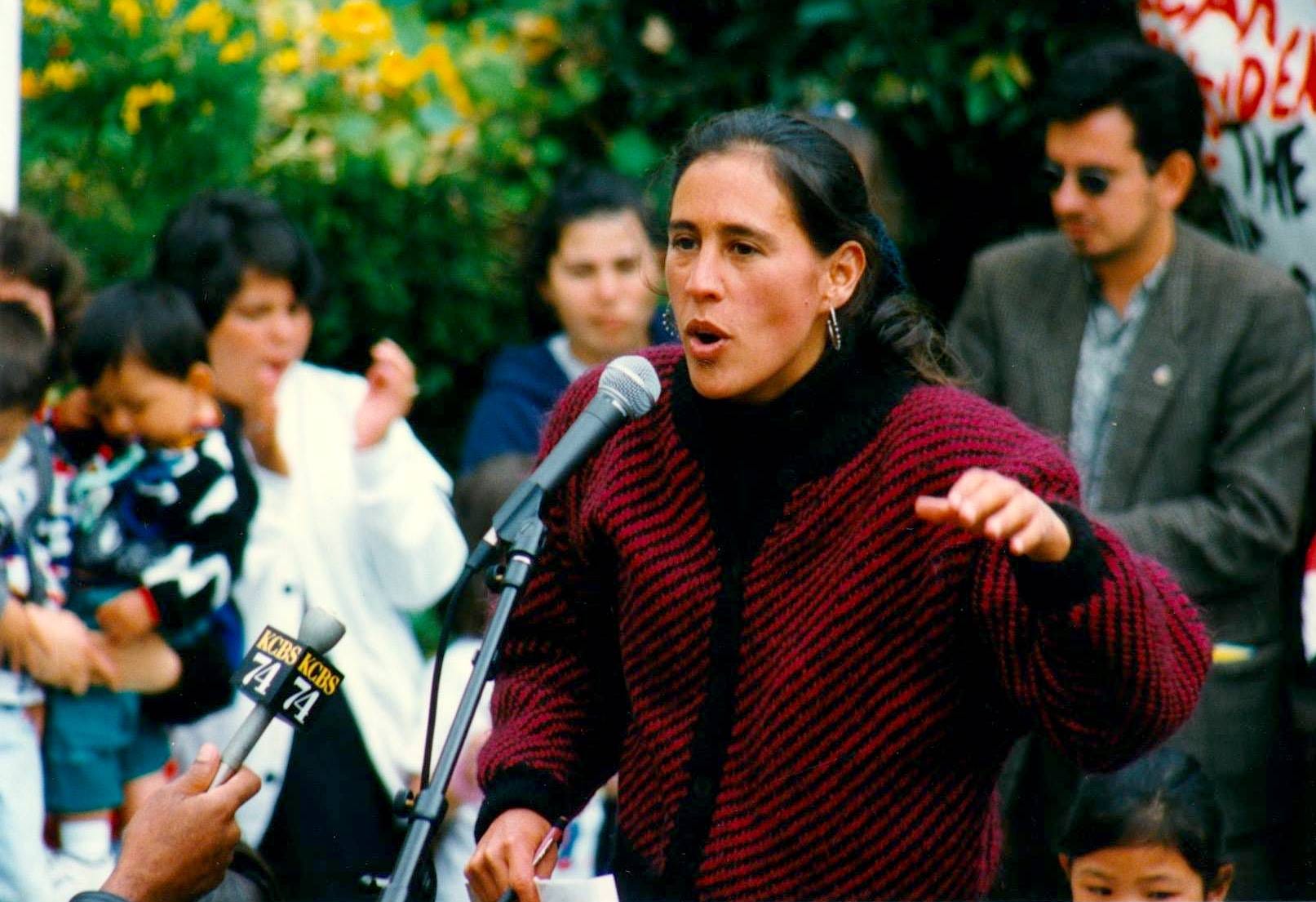
I ask Julie to tell me more about the organizing she’s part of to keep targeted families safe by paying their rent. “I came here in May,” she says. “I was brand new. So everyone who I work with on a constant basis now, is people I didn’t know. I knew people from salsa dancing, but I didn’t know my neighbors. And now I know everybody, literally everybody, which is one of the beauties of this.”
0:00
-2:04
Because of her many years of movement experience, Julie quickly found herself in the middle of things. She recalls, “Neighbors who had organized around Mr. Floyd’s death and the uprising there, neighbors who had organized through COVID, saw what was happening and the need for neighbor-to-neighbor support. So folks started block by block figuring out, okay, who needs help? What do they need? And it just started out with neighbors going to buy groceries for their neighbors.
“Starting in December, a lot of neighbors realized that it was not safe for them to leave their homes. And making that choice meant that people were unable to go to work. Or maybe the primary earner had been abducted. I mean, the situation was so bad that people were making a really hard choice to stay inside and not leave their homes.
“And then in January we started seeing that people who weren’t able to work were not going to be able to pay rent on February 1st. And that was the biggest concern.
“In order for our community to withstand this siege, we needed to make it possible for people to stay in their homes. To somehow support them with rent. We started going block by block to assess how many people it would be. Because all of this was relational—we knew who needed it and how much they needed. And I was the spreadsheet person. This is how I got so involved.”
She remembers feeling uncomfortable with the initial wording for the Go Fund Me campaign to raise rent that talked about people being “terrified to leave their houses.” She waited before saying anything to the other organizers, who were white, but when the conversation about the wording came up at a meeting, she said, “When I talk about our neighbors who are sheltering in place, I talk about them making a brave and wise choice to protect their family. So yes, it’s true that folks are afraid, but what I would describe is their agency and their power and their determination and their resilience. I would offer that maybe we’d move towards that wording.” The other organizers understood her point right away, she tells me, and everyone agreed to change the language. But it took her pointing it out.
The campaign was a huge success. Donations came in from around the country. “That was amazing to see,” Julie recalls. “Because we had no idea—we were just here in micro blocks. It seemed unimaginable. Our goal was $120,000 to cover 79 families. And by the end, the number of families grew, and we ended up raising $330,000 and serving, I think it was 223 families in a 40-block area.”
Although there has been some withdrawal of ICE and DHS troops, the siege is still ongoing in Minneapolis, and rent is due again for March. Some families owe two or three months back-rent. The team was exhausted, yet everyone recognized they had to do it again. The first round had relied heavily on the labor of Julie and one other person, in part to protect the names and addresses of community members at risk of seizure and deportation.
Julie tells me about the collective reflection process that ensued, looking at how the work could be shared among more people. A design team was formed and invited Julie’s expertise and guidance, but spreading out the heavy lifting. She smiles, “It was beautiful. People stepped up. And that was one of the most healing things, and one of the most ‘movement moments’ about regeneration and sharing roles in a mature way. Everybody brought the best of who they were. And the message was, ‘We are so grateful for what you did. We’re so energized to do this again, and we’re going to take the lead and we want your input.’ And it was like, wow. They created a space for the feedback and critique, and then stood up and led it. And I got to be part of that.
“And it is different. They have improved on it, and they’re gonna make their own mistakes. But I literally could not have done it a second time. So it’s those practices of regeneration, those practices of de-centering your ego where you’re like, I am offering these gifts and I am not the only person, and this is not the only way to do it. You have to be able to let go.”
Julie shares with me something she found particularly meaningful. “We were thinking about what we had accomplished in January. And what we needed to do next to continue to support our neighbors and stand up to state violence. And so I offered this quote from a novel by Palestinian author Susan Abulhawa, where a woman freedom fighter tells her comrades: Whatever we start should be with the goal of igniting the imaginations of people to act in their own ways and to trust that they will imagine what we have not.”
0:00
-0:57
We pause, just sitting with those words, and Julie says, “The moral of the story is not that Minneapolis is unique. It’s that we just got welcomed into the kinds of community that people have had to do for a long time in other places all over the world, in the face of state violence and other violence. And that, I think, is a really important message.”
She takes a breath, “We all need to practice who we want to be when the siege comes, when the violence comes. We need to have practiced our grounding, our vision, our sense of self, our ability to be agile. You really need to have practiced that before the crisis comes.”
0:00
-1:32
“You know, as someone who went through cancer, I’m not supposed to be here. I’m a miracle of medical science. And one of my main things I say is, don’t wait to start your spiritual practice when you hear you have leukemia. For me going into leukemia with a practice [made all the difference]. I don’t know what I would have done otherwise. And that was because I had spent time with Norma Wong, because all the Tai Ji, all the breathing, all of that stuff—that is what got me through. And allowed me to show up. Because I was just like, it’s my job to be grounded and well right now.
“So this is the same thing. It’s like all the stuff that SURJ did, and all the meditation, and all the emergent strategy—all of those things. All the fruits of the practice and the time put in. Everybody who meditated, everybody who journaled, everybody who took some healing time to know what it means to be in space with people where your energy is generative and positive. All of that mattered. In this time.”
Julie invites everyone to donate today to the Central Minneapolis Rent Fund to support families needing immediate rent support.
To learn more about Julie’s work visit:
In-depth interview with Julie: https://movementstrategy.org/blog_post/the-msc-storytelling-series-julie-quiroz/
What Is Cultural Strategy? (interview with audio): https://www.realfoodrealstories.org/journal/cultural-strategies-of-abundance
Some poems & blog posts: https://www.newmooncollab.org/blog
Links to some of Julie’s articles: https://muckrack.com/julie-quiroz/articles
Brief clip of Julie talking about Birth Center Equity:
Comments
Nothing yet. Say the first thing.
Sign in to join the conversation.