
Recently I entered a patient room and was surprised to find her alert and bright eyed. We chatted about faith and family and I truly enjoyed her company. At one point she glanced down at my name badge and said, “thank you, Liz from Spiritual Health.” And I replied lightly, “Thank you for sharing about your life and your story. You are spiritually healthy.” I meant the words. They were delivered with a sense of kinship. But I didn’t expect for my patient’s demeanor to unexpectedly shift. In less than a second, her eyes welled up with tears and she choked through whispered words “no one has ever said that about me before.”
Vocationally, I’m a hospital chaplain. I spend my time caring for my patients and their families. I respond to codes and crises. I handle the logistics of dying and death. My job in the broadest sense is to be a professional space maker. In moments of trauma, heightened emotion, and chaos, my job involves making space for spiritual healing and wholeness to exist mid-suffering. This work is an art, not a science. But by recognizing that all humans have a spiritual need for healing and wholeness, our work includes making space for folks to experience emotional safety, cultivate an environment that promotes spiritual health, and steward heavy moments with care. Our job is to respond to subtle shifts in the air, pay attention to nonverbal cues, and look for creative ways to provide care.
In an interfaith setting, this means that even though I am a Christian chaplain, I work from an ethical trauma-informed framework. As a professional space maker, my goal is to prioritize my patient’s agency over my own and put them before myself. In a sense, I control the parameters and the focus of our encounters so that we can make spiritual healing and wholeness a priority within that space. I do not ever seek to control the careseeker. I’m there to empower them to use their own agency in a safe space, even if our space is surrounded by chaos and uncertainty.
This is important because chaplains are faith leaders who are operating in an environment where the Christians aren’t in charge. Unlike church based ministry, seminary work, or parachurch ministry, Christian chaplains work with folks of other faith in good faith. We are not surrogate pastors— we are ambassadors of our traditions in our communities. We represent the faith. This means that our work isn’t only pastoral, its clinical too. Instead of only relying on a particular set of Christian interventions, we integrate evidence-based practices into our work to address the needs of all our patients without compromising their agency.
This is significant because evangelicalism has a particularly low view of agency, particularly as it relates to salvation. Agency is a person’s capacity to make meaningful, self‑directed choices and to act on them without coercion, within conditions that respect their dignity, autonomy, and moral worth. A hyper‑Calvinist might argue that human agency is ultimately illusory because God’s sovereign decree determines every choice and action.
Consequently, this framework would imply that patient autonomy carries little moral weight, since every decision is seen as predetermined rather than meaningfully chosen. Not only does this line of thinking diminish the patient’s own power, but it also makes space for abusers who feel entitled to override patient preferences under the guise of a predetermined moral order. Generally speaking, abusers seek to constrain, distort, or outright erasing a person’s ability to make meaningful choices, while the loss of agency in turn makes someone more vulnerable to further manipulation and control. This is antithetical to healing and wholeness.
Similarly, purity culture often collapses a woman’s agency into the authority of the men around her, using scripture out of context to justify control rather than mutuality. When the Bible is weaponized this way, it reinforces systems where women’s choices, bodies, and moral authority are treated as extensions of someone else rather than expressions of their own God‑given dignity. When one automatically assumes that a person’s agency is inherently bad or “less than” this dynamic creates an ethical hazard and causes harm. When people of faith encourage decision‑making that silences image bearers, justifies coercion, and erodes the trust that is essential for safe, respectful care, those faith practices create an environment for the patient that is ethically and spiritually unsafe.
To assert the idea that “my agency is better than yours” is to claim a moral authority that eclipses the other person’s humanity, reducing them from a participant in their own life to an object to be managed (rather than a person to commune with).
This is why chaplains working from an ethical framework prioritize the agency of others. When we participate in ethical consults on complicated cases our conceptualization of human dignity is directly connected to the agency of the patient— never severed. Human dignity is a really big deal. And as a Christian interfaith chaplain, unlearning thought patterns rooted in control and learning how to truly honor and trust the agency of others has been formative for me as a care provider. When I care for patients of other faiths I never stop being a Christian, but I root my clinical work in my faith, and I integrate faith-based interventions with science. As an interfaith chaplain, my work is interdisciplinary, integrating wisdom from psychology, neuroscience, philosophy, and ethics with my own tradition. Learning to honor agency in a hospital setting has left me wondering what it might look like to implement this framework in my writing, my teaching, and my advocacy work.
See, in this paradigm doctrinal agreement and dogmatic affirmation isn’t the standard. Disagreement can and does coexist. But I like to think of it this way: A family can gather for a potluck, and every plate will look a little different. The goal isn’t to get everyone to eat the same thing, it’s to ensure that everyone is fed and everyone has a seat.
Through asking “how do I learn to trust the agency of others,” even when we don’t share agreement, I’ve had to confront my own deeply ingrained distrust and my impulse to control so that I can truly love my patients and provide quality care. And in practice I’ve come to realize that those tensions often turn out to be more like discovering, “Oh, I didn’t know they’re vegetarian,” or “I didn’t realize they don’t like green bean casserole”—they’re small surprises that don’t threaten the shared meal itself but rather invite me to adjust how I show up at the table, and impact how I prepare a meal in the future.
In other words, discomfort/disagreement isn’t necessarily a crisis of truth; it’s an invitation to broaden my imagination about what spiritual care, respect, and shared space can look like. Some might liken my work to planting seeds, which is true in a sense. But I prefer to think of my work more like hosting a shared meal. Eat what you need to eat, come back for more if you’re hungry. There’s always a seat for you. There’s always space for you to receive nourishment. This table promotes healing and wholeness. Would you like more pie?
So, what does this look like outside of chaplaincy? How can space making influence our spiritual formation and translate to different contexts?
· Practice spacious presence in the Christian life. By slowing the pace of interactions, listening without rushing to interpret, and creating environments where people feel safe naming their own experiences before receiving guidance, we can make space for others to meaningfully pursue healing and wholeness.
· Embed agency‑honoring practices in pastoral care by framing conversations around the care seeker’s values, letting them set the direction, and resisting the impulse to resolve tension prematurely. I know this might feel prickly to some. It might even read like an abdication of Christian values. I promise it’s not. In western Christian culture we make a lot of space for arguing and defending. We make space for the authority of our viewpoint and our words. I suggest we lean into the fruit of the Holy Spirit while relying on the Holy Spirit to prioritize others. I suggest we make space for the Holy Spirit to work on the Spirit’s own terms. True healing requires honestly. If the other person feels like they need to parrot particular words or appease my spiritual authority, then I’m not making space for them to engage honestly (or safely). I’m prioritizing my own comfort and emotional safety at the expense of theirs.
· Cultivate collaborative leadership in community ministries. By sharing power, inviting diverse voices into decision‑making, and designing programs that empower participants rather than centering the minister’s authority, we create an environment that feels less suffocating, and more like a sanctuary.
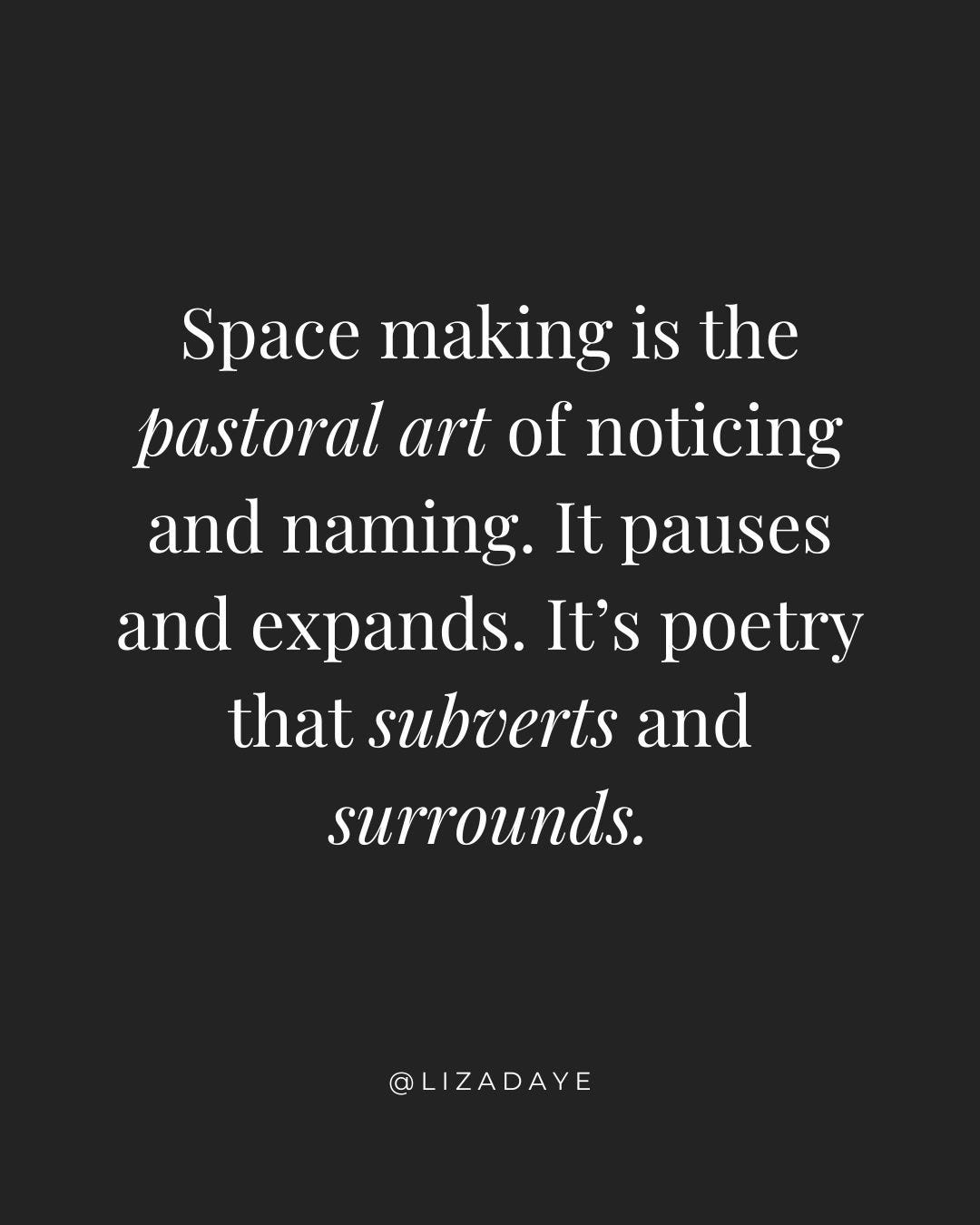
Space making is the pastoral art of noticing and naming. It pauses and expands. It’s poetry that subverts and surrounds. Honoring the inherent dignity of others begins with honoring the agency of others. This looks like making space for people to choose without coercion, respond without pressure, and participate fully in their own lives. We cannot love our neighbors without first honoring our neighbors. We also cannot love ourselves without honoring our own inner life. In the words of Paul, “love one another with mutual affection; outdo one another in showing honor.” (Romans 12:10)
This is my challenge to you: outdo one another in showing honor.
Be blessed, friends.
Thanks for reading For Flourishing! This post is public so feel free to share it.
Comments
Nothing yet. Say the first thing.
Sign in to join the conversation.